
FINANCE
Magic’s Marvel Set Breaks Revenue Records and Now Fuels Hasbro’s Profit
Magic: The Gathering’s Marvel Super Heroes set a $300 million revenue record, but Hasbro’s profit now rests almost entirely on one card game.

Magic: The Gathering’s Marvel Super Heroes set became the fastest expansion in the game’s 30-plus-year history to reach $300 million in revenue, Hasbro said this week, breaking records for both Day-1 and Month-1 sales. The card game topped $500 million in quarterly revenue for the first time ever, and Wizards of the Coast now generates almost the entirety of the toy giant’s profit.
Hasbro CEO Chris Cocks spent much of the Second Quarter 2026 earnings call redefining what Magic actually is, placing it beside Pokémon and Minecraft. He spent far less time on a detail from just over a year earlier: the very Marvel partnership now setting records had nearly gotten its own cards banned from Magic’s digital platform.
Marvel Super Heroes Turns Into Magic’s Fastest $300 Million Set
Hasbro’s total revenue rose 16% year over year to $1.14 billion in the quarter, beating Wall Street’s forecast of roughly $1.07 billion, according to a transcript reviewed by financial media. Adjusted earnings came in at $1.28 a share, above the $1.14 analysts had penciled in.
The real engine was Wizards of the Coast and Digital Gaming, up 27% to $663.8 million. Magic: The Gathering itself grew 32% to $545.3 million, the first time the game has ever cleared $500 million in a single quarter.
“Magic: The Gathering eclipsed $500 million in quarterly revenue for the first time in its 30-plus year history, led by the record-breaking debut of Marvel Super Heroes,” Cocks said in Hasbro’s earnings release. On the call itself, he went further, telling investors Marvel Super Heroes set a record for Day-1 and Month-1 revenue and became the fastest set ever to hit $300 million, backed by strong reorders and sell-through.
That number does not stand alone. It sits behind two other Universes Beyond launches that each redefined what a Magic set could earn on release day.
| Set | Release Year | Headline Milestone | Where It Stands Now |
|---|---|---|---|
| The Lord of the Rings: Tales of Middle-earth | 2023 | $200 million in six months | Held Magic’s all-time sales record until 2025 |
| Final Fantasy | 2025 | $200 million in a single day | Still Magic’s best-selling set of all time, per Cocks |
| Marvel Super Heroes | 2026 | Fastest set ever to $300 million; new Day-1 and Month-1 records | Bigger launch allocation and stronger sell-through than Final Fantasy, per Cocks |
Each launch outran the one before it. Six months collapsed into one day, and one day’s record has now been buried under a faster climb to a bigger number.
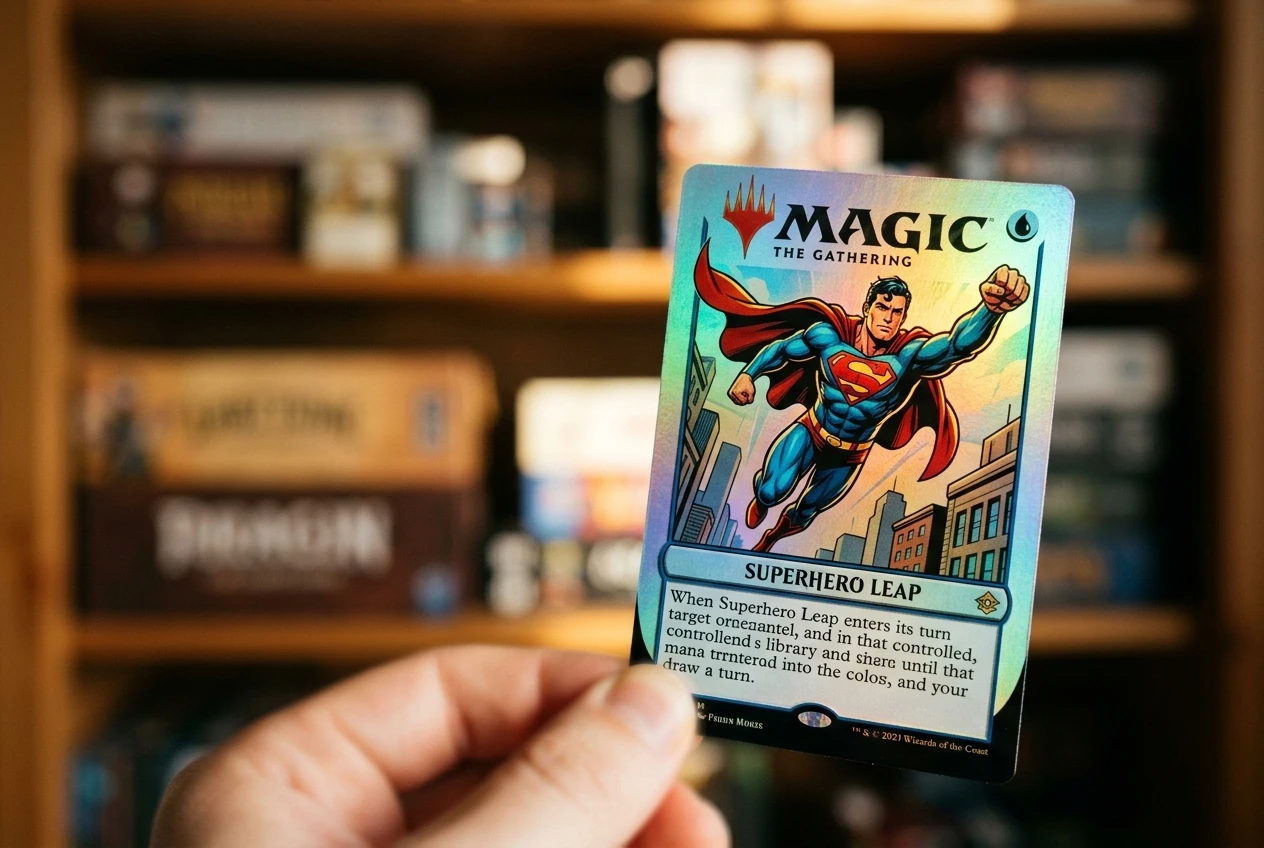
One Card Game Now Covers Nearly All of Hasbro’s Profit
Magic alone supplied $545.3 million of the Wizards segment’s $663.8 million in revenue, about 82% of it. That segment’s operating profit rose 12% to $270 million.
Set that beside the whole company. Hasbro’s adjusted operating profit for the quarter was $282 million, up 14%. Wizards of the Coast’s segment profit came within $12 million of covering the entire company’s adjusted operating profit by itself.
Everywhere else, the picture was flatter or worse. Consumer Products revenue rose 5% to $463.0 million but still posted an adjusted operating loss of $7.5 million, partly reflecting tariff costs and a cybersecurity breach the company disclosed in late March. Entertainment segment revenue fell 20% to $12.8 million.
Hasbro reported net profit of $160.9 million, or $1.12 a diluted share, reversing a net loss of $855.8 million a year earlier that included a $1.02 billion goodwill impairment charge. On the strength of the quarter, Hasbro raised its full-year revenue growth target to 5% to 7% in constant currency, up from 3% to 5%, and lifted its adjusted EBITDA guidance to a range of $1.45 billion to $1.50 billion. Shares gained roughly 1.73% in pre-market trading.
Chief Financial Officer Gina Goetter framed it as balance. “Moving forward we are leaning into our $1B share repurchase authorization as we continue to balance investment in the business with returning cash to shareholders,” she said. Right now, nearly all the cash generating that balance is coming from cardboard boxes of Magic cards.
Why Did These Same Marvel Cards Almost Get Left Off Arena?
Marvel Super Heroes plays fine on MTG Arena today, the same as any other set. That was not guaranteed. In April 2025, Wizards of the Coast announced that Marvel’s Spider-Man, the crossover set that came before Marvel Super Heroes, and any future Marvel-themed cards would not appear on Magic Online or Magic Arena at all.
Instead, digital players would get reskinned, mechanically identical stand-ins under a new line called Through the Omenpaths, a workaround Wizards of the Coast Communications Director Blake Rasmussen explained in an official update. Those digital cards would be mechanically identical to their Universes Beyond tabletop counterparts but carry different art and different names, stripped of any Marvel branding entirely.
The likely culprit was a licensing conflict tied to Marvel Snap, a rival digital card game built on the same Marvel roster. The reaction from Magic’s own community was immediate and unflattering.
It’s honestly kind of insane that WotC went with the decision to make UB sets standard legal without the ability to get the licenses to use those IPs in digital games.
That came from Brian Kibler, a longtime Magic pro player and content creator, posted to Bluesky the day the exclusion was announced. By May 2026, Wizards had reversed course, confirming Marvel Super Heroes and future Marvel crossover sets were greenlit for full representation on Arena, same art, same names, same rules text as the paper cards. Whatever the fix cost, it landed in time for the record-breaking quarter that followed.
Final Fantasy Still Wears Magic’s Crown
Asked directly to compare Marvel Super Heroes with 2025’s Final Fantasy set, Cocks gave credit in both directions without picking a winner. Marvel Super Heroes, he said, is off to a stronger start with a bigger launch allocation and better sell-through and reorders. Final Fantasy still holds the title of biggest Magic set ever, thanks to stronger follow-up and ancillary product sales after its initial release.
“We are pretty pleased with both,” Cocks said. “But you’re going to have a tough time getting us to compare third party IPs against each other. That’s something we are loathe to do.”
The refusal is itself a data point. Hasbro now runs its calendar year around licensed worlds it does not own, and ranking them against one another risks the relationships that supply them. This year’s release list shows both tracks running side by side.
- Secrets of Strixhaven, an original Magic setting, helped drive growth earlier in the year alongside Marvel Super Heroes.
- Marvel Super Heroes launched this quarter and set the new Day-1 and Month-1 records.
- Magic: The Gathering | The Hobbit is next on the schedule, previewed at MagicCon Amsterdam in mid-July.
- Reality Fracture closes out the year on October 2, 2026, as the capstone to a story arc that began with Wilds of Eldraine in 2023.
Two of those four are original Magic worlds. The other two are the ones setting revenue records.
Three New Worlds and Three Unnamed Partners Wait for 2027
MagicCon Amsterdam’s preview panels, held the weekend before the earnings call, doubled as a roadmap for next year. Cocks highlighted the announcement of three in-universe, first-party Magic sets for 2027 on the call, while also confirming three more Universes Beyond crossovers are coming that same year, still unnamed.
- What we know: Three original Magic worlds for 2027 were revealed at MagicCon Amsterdam, including a long-requested underwater setting. Reality Fracture wraps the current in-universe story arc on October 2, 2026, and The Hobbit is next on the release calendar.
- What’s unconfirmed: The three Universes Beyond partners lined up for 2027 have not been named. Cocks said only that they would be “a bit more fantasy adjacent” and confirmed none of them take place in New York City, a direct response to fan complaints about the setting’s overuse in recent crossovers.
Three more outside licenses means three more sets of digital rights to negotiate, three more contracts that could reproduce the same Arena standoff Marvel triggered in 2025, if not carefully worked out ahead of release this time.
Cocks Puts Magic Beside Pokémon and Minecraft
Pressed repeatedly on Magic during the call, Cocks used the moment to reposition the entire business. “Magic, while it’s by far our biggest brand, in many ways is also the least understood. Magic is not a niche hobby business, it’s a mega franchise,” he said. “Magic: The Gathering belongs in the same company as Pokémon, EA Sports, World of Warcraft, and Minecraft.”
He backed the claim with a growth history rather than a single quarter. Since 2009, tabletop and digital Magic revenue has compounded at over 17% a year, growing in 15 of the last 17 years, with the two down years each posting declines under 3%. Full-year 2025 revenue for Wizards of the Coast grew a record 45%, with Magic finishing its strongest year ever, up 59%, on the back of a Q4 Avatar: The Last Airbender set.
“And with Universes Beyond it is bigger than just a game, it is a platform with platform-level economics and potential,” Cocks said. He pointed to MTG Arena as proof, noting the digital client has generated almost $1 billion since its 2019 launch, with more upside still ahead. New digital initiatives meant to expand Magic beyond Arena are already funded. Cocks said those investments will not show results in 2027. He is aiming them at 2028 and beyond.
Frequently Asked Questions
What Is Magic’s Universes Beyond Program?
Universes Beyond is Wizards of the Coast’s line of Magic sets built around licensed outside properties rather than the game’s own original settings. It began in 2020 with a Walking Dead crossover and has since expanded to include Doctor Who, Fallout, Hatsune Miku, The Lord of the Rings, Final Fantasy, and now Marvel, alongside original Magic worlds released on a separate track.
What New Financial Guidance Did Hasbro Give for 2026?
Hasbro raised its full-year revenue growth target to a range of 5% to 7% in constant currency, up from 3% to 5% previously. It also lifted its adjusted EBITDA guidance to $1.45 billion to $1.50 billion, up from $1.40 billion to $1.45 billion, and raised total revenue guidance to a range of $4.936 billion to $5.03 billion.
How Did This Quarter’s Profit Compare With a Year Ago?
Hasbro posted net profit of $160.9 million this quarter, reversing a net loss of $855.8 million in the same period last year, which included a one-time $1.02 billion goodwill impairment charge. The quarter also absorbed roughly $25 million in lost revenue and $11 million in extra expenses tied to a cybersecurity breach the company identified in late March.


SharePoint’s Fifth Exploited Flaw of 2026 Echoes Last July’s Hack

Claude Code Skips the Screen Takeover to Test iPhone Apps Live

Caitlin Clark Skips the WNBA 3-Point Contest for a Third Straight Year

Light Phone’s New Flip Runs Into the Same Chip Shortage as the iPhone

Apple’s $634 Million Masimo Verdict Stands, but Danaher Gets the Money

Rainout Gives Red Sox Two Shots at a Franchise-Record Win Streak

Apple Needed Four Tries to Truly Fix Its Hide My Email Leak

Samsung’s Record Chip Profits Are Shrinking Galaxy Z Fold 8 Deals

Sony’s PlayStation Disc Exit Repeats the Fight Xbox Lost in 2013

Samsung’s Record Chip Profits Are Quietly Pricing Its New Z Fold 8

Halo Studios Reverses PS Plus for Halo: Campaign Evolved on PS5

Black Ops 1 and 2 PS5 Ports: $40 Price Tag Has Fans Uneasy

Matt Brown Dismisses Rousey and Paul’s MVP MMA Ratings Win Over UFC

Star Wars: Galactic Racer Is a Roguelite Racer With a Podracing Skin

Julius Randle Traded to Nets as Wolves Reclaim Cap Space for Dosunmu

Sega’s $49.99 Sonic Classic and Modern Bundles Hit Switch in October

Colombia Edge DR Congo as Muñoz Books World Cup Knockout Place

Warriors Take Yaxel Lendeborg, the Oldest Pick in the 2026 NBA Draft

Douze Dixièmes Closes Five Months After MIO: Memories in Orbit

Warhammer Horus Heresy Super-Heavy Tanks Share a Plastic Chassis
-

 TECHNOLOGY3 years ago
How to Adjust a Bulova Watch Band – An Easy Guide
-

 News3 years ago
Fred Pentland: Athletic Bilbao’s English mentor who changed the essence of Spanish football
-

 FINANCE3 years ago
Tax Planning for Every Season: Guide to Maximizing Your Tax Benefits
-

 Education3 years ago
African Ministers New Education Plan
-

 BUSINESS3 years ago
What is Entrepreneurial Operating System? A Comprehensive Guide to EOS
-

 Education3 years ago
Innovate Your Learning Journey with Technology and Enhance Education
-

 News3 years ago
Russians formally out of World Athletics Championships
-

 BUSINESS3 years ago
Top 9 Most Expensive American Cities to Rent an Apartment