
News
Light Phone’s New Flip Runs Into the Same Chip Shortage as the iPhone
Light Phone’s $299 flip phone fights smartphone culture, but a global memory chip shortage and a new subscription plan reveal real tradeoffs.

Light Phone unveiled a $299 flip phone this week with no touchscreen, no app store and no front display beyond a blinking notification light. It is the Brooklyn startup’s answer to Gen Z shoppers who told the company its metal-and-glass Light Phone III still felt too much like a smartphone.
But the same forces reshaping the smartphone market are reshaping Light Phone’s own math. A global memory chip shortage just pushed the Light Phone III’s price from $699 to $899, and to keep the new Light Flip cheap, the anti-subscription company built itself a subscription plan.
The Flip Copies a 2000s Motorola Look, Down to the D-Pad
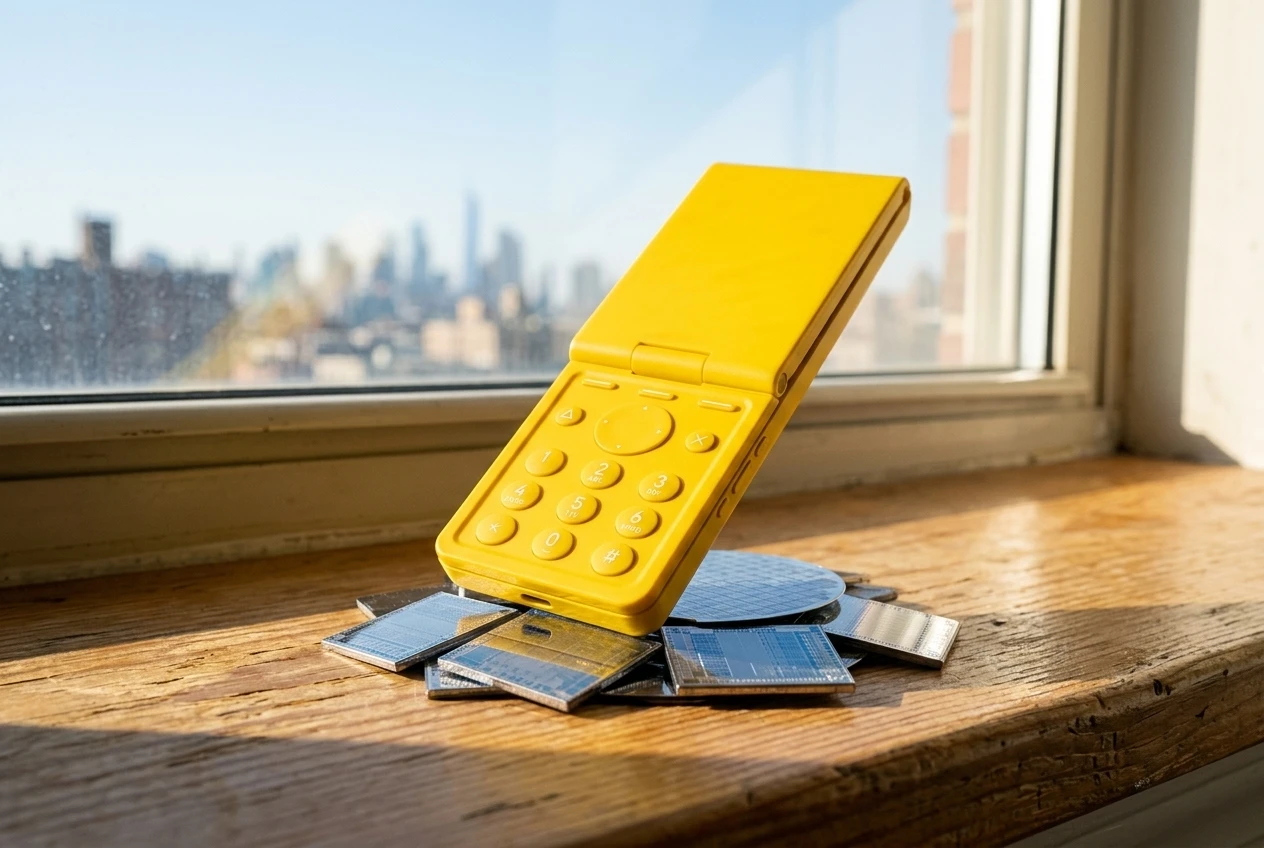
Closed, the Light Flip looks like a Motorola or Ericsson handset from two decades ago: a plastic clamshell with a single LED that flashes for new alerts and nothing else. Open it and there’s a 2.8-inch OLED screen, a D-pad, three programmable function keys, and buttons to confirm or cancel. Typing runs on T9 with predictive text, the same system flip-phone users tapped out on before smartphones existed.
Light cofounder Kaiwei Tang, the company’s chief executive, says the look is deliberate. The more than two dozen Gen Z consumers the company interviewed did not want a phone that could be mistaken for a smartphone, even a stripped-down one like the touchscreen Light Phone III.
“They don’t want to be seen as using a smartphone,” Tang says.
| Feature | Light Flip | Light Phone III |
|---|---|---|
| Starting Price | $299 | $899 (up from $699) |
| Body | Plastic | Aluminum |
| Display | 2.8-inch OLED, D-pad and T9 keys | 3.92-inch monochrome OLED touchscreen |
| Headphone Jack | Yes | No |
| Colors | Six: black, navy, red, pink, yellow, light gray | Black only |
| Ships | April 2027 | Currently shipping |
The tradeoffs run both ways. The Flip loses the aluminum build and the touchscreen, but it gains a headphone jack, something the pricier Phone III skips entirely.
Modern Guts, Retro Shell
The Light Flip isn’t actually a 2005 phone wearing a costume. Underneath the plastic, Light packed in modern radios and ports its pricier sibling either lacks or handles differently.
- 5G connectivity with support for both Nano SIM and eSIM, so the phone works on modern networks despite its old-school shape.
- Bluetooth and Wi-Fi for pairing headphones and connecting at home.
- A USB-C port for charging, replacing the micro-USB style still common on cheap flip phones.
- A 12-megapixel rear camera and a replaceable 1,800 mAh battery, a rarity on phones built around sealed-in cells.
- Stereo speakers and two microphones inside the clamshell once it’s opened.
- IP54 water and dust resistance, but no NFC chip, so there’s no tap-to-pay.
Every tool from LightOS, the company’s term for its limited set of apps, carries over: Phone, Alarm, Calculator, Calendar and Directions. In May, Light opened a software development kit letting outside developers build new tools, though the company says some may need tweaks to work well on the Flip’s smaller interface.
Gen Z Told Light Phone Its Metal Flagship Still Looked Too Smart
Light Phone spent the past year collecting complaints after launching the Light Phone III, according to Tang. Some of the Gen Z users the company spoke with had already cycled through cheap dumbphones from manufacturers like HMD or TCL and found them fragile.
Tang says users described those flip phones as “ugly, stupid,” abandoned by their makers and impossible to get repaired. Some who tried even older secondhand devices found they weren’t certified to run on major US networks at all.
“But they stick with it,” Tang says. Cofounder Joe Hollier, the company’s president, says these buyers know the choice is impractical. They are, in his words, “just so anti-Big Tech.”
Light Phone has spent a decade building toward this exact audience. Hollier and Tang founded the company in 2014, then raised just over $415,000 on Kickstarter the following year for the original Light Phone, a credit-card-sized device that could only make calls.
Why Did the Light Phone III’s Price Jump to $899?
Light Phone blames a global memory chip shortage, and the data backs that up. Chipmakers are steering wafer capacity away from ordinary phone memory and toward the high-bandwidth chips that feed AI data centers, and the crunch is hitting nearly every device that needs RAM.
Research firm Counterpoint expects global smartphone shipments to shrink 2.1% this year as memory costs eat into device budgets, with average selling prices rising 6.9% industry-wide. Cheap phones under $200 have seen production costs climb 20% to 30% since the start of the year, and memory prices could still climb another 40% by the middle of 2026.
IDC’s own research points to the same root cause: DRAM supply growth is falling well below historical norms in 2026, as chipmakers reallocate capacity toward AI inference hardware instead of consumer devices.
Light Phone isn’t alone in absorbing that hit, and it isn’t a one-time hit either. The company already raised the Light Phone III’s price once in 2025 because of tariffs. The jump to $899 is its second increase inside a year.
Light Phone Turns Itself Into a Wireless Carrier
To keep the Flip’s sticker price down, Light Phone is leaning on financing. Buyers can pay $299 outright for an unlocked phone, or sign a 24-month contract at $39 a month that bundles in wireless service: unlimited calls and texts plus 1 GB of data.
That service runs over AT&T and T-Mobile’s networks, which makes Light Phone a mobile virtual network operator (MVNO, a company that resells access to a larger carrier’s towers) in the US, Canada and the UK. A similar $59-a-month plan now covers the pricier Light Phone III too.
Over 24 months, the Flip’s contract adds up to $936 in payments, more than triple the outright price, though that total covers two years of network service along with the hardware. Hollier, who built his company’s brand on rejecting subscription culture, says the shift was hard to avoid.
“I think people are just so accustomed to the subscription model when it comes to cell phones,” Hollier says, adding that Light felt it had to offer one anyway.
Commodore’s Callback 8020 Hit the Same Memory Wall
Light isn’t the only company selling a break from smartphones, and it isn’t the only one getting squeezed. A month before the Flip’s debut, retro computing brand Commodore announced its own smart flip phone, the Callback 8020, which runs a modified operating system capable of downloading Android apps like Spotify, Uber and Google Maps while blocking social media apps and browsers entirely.
Commodore launched the Callback at $499, then cut it to $399 within a week after backlash over the price. To make that cut, the company now defaults new orders to recycled memory chips salvaged from older devices, charging extra for factory-fresh components. A launch-day discount code brought the price down further, to $349.
Commodore pointed to the same industry pressure Light Phone cited. Memory contract prices climbed roughly 90% to 95% in the first quarter of 2026 alone, squeezing every device that needs RAM, including dumbphones built to help people use less of it.
Commodore’s founder, Jack Tramiel, built our brand’s legacy on a singular promise: technology for the masses, not the classes.
said Peri Fractic, chief executive and president of Commodore International, in the company’s pricing announcement.
| Device | Starting Price | Response to the Memory Shortage |
|---|---|---|
| Light Flip | $299 or $39/month | Plastic body, added a 24-month financing and service plan |
| Light Phone III | $899 (from $699) | Absorbed the cost directly into a second price hike in a year |
| Commodore Callback 8020 | $399 (from $499) | Defaulted to recycled memory chips, sells new chips as a paid upgrade |
Tang and Hollier say they welcomed Commodore’s entry rather than treating it as competition. “They took a different approach to us by doubling down on the retro side, and I think that’s awesome,” Hollier says.
Gen Z Booed a Smartphone at the Summer of Ludd
Tang points to the recent Summer of Ludd festival in New York City, where Light Phone staff attended as participants. Attendees booed people who pulled out smartphones to record video.
“The sentiment of pushing back on smartphones is so strong; they don’t like AI,” Tang says. He describes users who want phones that make them feel “completely separated from smartphone app stores,” adding that the movement is “exactly what we’ve wanted to do for 10 years,” and that it keeps skewing younger.
There’s a personal irony in Tang leading this charge. Before cofounding Light Phone, he worked as a product lead designing handsets for Motorola, BlackBerry and Nokia, including work tied to Motorola’s Razr line, the same silhouette the Light Flip now borrows on purpose.
The Light Flip ships in April 2027. Samsung is expected to show off its next foldable phones one day later, at a Galaxy Unpacked event Light’s own announcement was timed to sit directly in front of.
Frequently Asked Questions
Is the Light Phone II still available?
No. Light Phone is discontinuing the Light Phone II now that the Flip exists, positioning the new $299 device as the entry point to its lineup while the Light Phone III stays on as the flagship.
Can I use my own SIM card instead of Light’s service plan?
Yes. The $299 unlocked price buys the hardware only, and the Light Flip supports both Nano SIM and eSIM, so it works with an existing carrier plan if you skip Light’s bundled 24-month contract.
Does the Light Flip work with mobile payment apps like Apple Pay?
No. The phone has no NFC chip, so tap-to-pay isn’t possible, one of the few features Light left out entirely rather than simplifying.
How much does the 24-month Light Flip contract cost in total?
At $39 a month, the plan adds up to $936 over two years, more than three times the $299 outright price, though that total includes ongoing network service, not just the hardware.
Which carriers actually power Light’s wireless plans?
Light Phone operates as a mobile virtual network operator riding on AT&T and T-Mobile’s networks in the US, and it also offers service in Canada and the UK.


Walmart’s $50 Million Opioid Settlement Closes Case Without Admission

California Sues Over $120 Million Morro Bay Wind Lease Buyout

Gilead Bixlenvo FDA Nod Opens Single Pill Path for Complex HIV Cases

Meta’s $18B Kids Deal Forever Shields Data Used to Spot Under-13s

Lettuce Outbreak Drove Record Cyclospora Spike Across 20 States

Amazon Shaves $20 Off M6 Mac Mini Before It Even Ships

SpaceX Louisiana Port Tests Debt Markets on Orbital AI Scale

Microsoft High Lifts Indexes as Small Caps Crack Support

Apple Replays 2015 Saturday Midnight Preorder for iPhone 18 Pro

Updated COVID Shots Clear FDA but Access Friction Hits High-Risk Groups

Take-Two CEO Pushes Netflix Subs for GTA 6 Extended Look

Wildlands Free Update Hands Players the Tools They Already Invented

Destiny 2 Fans Unlock Vaulted Maps After Live Service Ends

Quake Gets 19 Free Maps From MachineGames Quake Club

Quordle Monday Delivers Gavel Crush Speed Ethos Cleanly

Stripe Bid Shows PayPal Moat Cracked After Years of Slide

Tyson’s Five-Year Utah Plant Falls to Cattle Shortage Reckoning

Silver Lake Workday Talks Signal Private Floor for Software

Kennedy Lewis Takes Majority Control of The Greenbrier in $500M Deal

Best Buy Marks 60 Years With Sale That Echoes Its Audio Shop Roots
-

 TECHNOLOGY3 years ago
How to Adjust a Bulova Watch Band – An Easy Guide
-

 News3 years ago
Fred Pentland: Athletic Bilbao’s English mentor who changed the essence of Spanish football
-

 FINANCE3 years ago
Tax Planning for Every Season: Guide to Maximizing Your Tax Benefits
-

 Education3 years ago
African Ministers New Education Plan
-

 BUSINESS3 years ago
What is Entrepreneurial Operating System? A Comprehensive Guide to EOS
-

 Education3 years ago
Innovate Your Learning Journey with Technology and Enhance Education
-

 News3 years ago
Russians formally out of World Athletics Championships
-

 BUSINESS3 years ago
Top 9 Most Expensive American Cities to Rent an Apartment