
News
Musango Dinosaur Shows Zimbabwe Hosted Its Own Triassic World
New 210-million-year-old sauropodomorph from Lake Kariba reveals southern Africa’s Late Triassic as a mosaic of distinct ecosystems, not one uniform fauna.

Scientists have named Musango matusadonaensis, a lightly built sauropodomorph that lived about 210 million years ago on the shores of what is now Lake Kariba in northern Zimbabwe. The 4.5-metre animal weighed roughly 222 kilograms, about as much as a full-grown pig, and joins only four earlier dinosaurs formally described from the country.
The find, announced 29 July 2026, shows the Late Triassic of southern Africa was a patchwork of riverine habitats rather than one shared fauna. That shifts the search for dinosaur origins toward understudied African basins. Freshwater indicators preserved with the bones reinforce the picture of permanent water rather than seasonal drought.
Because named Zimbabwean dinosaurs were so few before this decade, each new skeleton carries outsized weight for regional biogeography. Musango supplies both a size benchmark and a phylogenetic anchor inside a formation that had yielded almost nothing formal until recently.
A Fifth Name for Zimbabwe
The holotype is a partial associated skeleton collected in 2018 from rocks of the Pebbly Arkose Formation on the southern margin of Lake Kariba. Bones include vertebrae, ribs, parts of the shoulder and hip girdles, and sections of the fore- and hind limbs. The skull is missing.
- Length: about 4.5 metres, roughly car-sized
- Mass: estimated 222 kg
- Age at death: at least eight years, nearly full grown
- Diet: probably herbivore or omnivore feeding on riverside plants
Lead author Paul Barrett of the Natural History Museum in London and an international team from South Africa and Zimbabwe described the animal as a plateosaurian sauropodomorph. It walked on two legs and sits close to the ancestry of the later giant long-necked forms. The specimen carries enough unique features to stand as a new genus and species.
Plateosaurian placement matters because it ties the Zimbabwe animal to a wider radiation of early bipedal herbivores rather than to the later heavy quadrupeds alone. Unique features in the limb and girdle bones separate it cleanly from the slightly larger form already named from the same shoreline.
The name draws from ChiShona. Musango means “living in the bush,” a nod to the remote find site. The species name honours nearby Matusadona National Park.
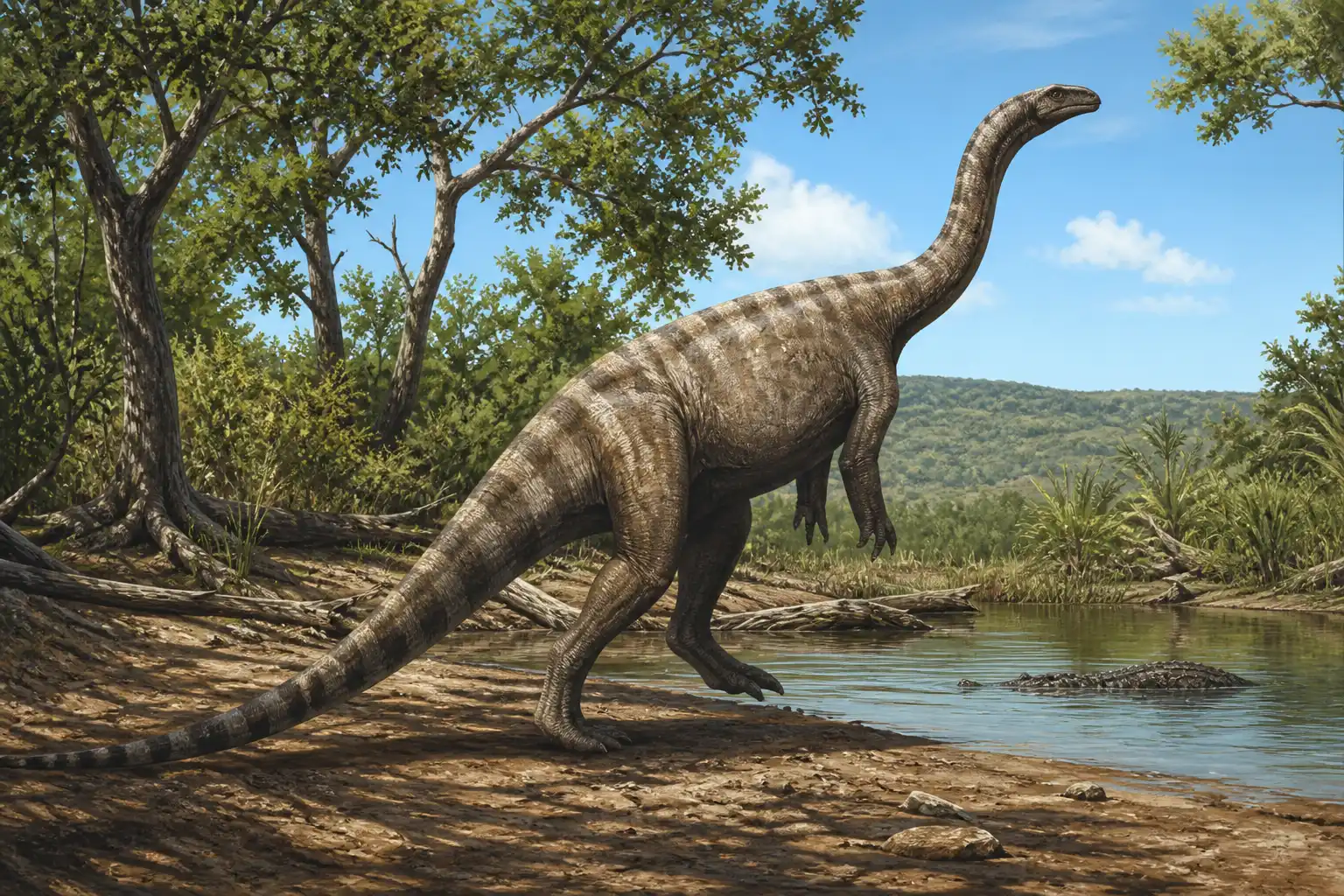
They Spotted Bones From a Boat
Most dinosaur digs happen in dry badlands. This one ran on water. Because the site lies inside a national park thick with elephants, hippos and crocodiles, the 2017-2018 expeditions stayed mobile by boat.
- 2017-2018: British, South African and Zimbabwean crew survey Lake Kariba shoreline from boats.
- March 2018: Bones spotted jutting from rock a few metres above the water line at the Musango Archosaur Site.
- Later 2018: Full excavation and preparation at Johannesburg’s Evolutionary Studies Institute; material returned to the Natural History Museum of Zimbabwe.
- 28 July 2026: Formal description appears online.
Barrett called it one of the most exciting digs of his career: purely exploratory work aimed at filling a blank spot on the southern African palaeontological map. The same rocks later yielded the larger Musankwa sanyatiensis, named by the same team in 2024. Boat travel kept the crew safe while they moved along the shore.
Working from the water also let the team reach exposures that stay hard to approach on foot once the park’s large mammals occupy the banks. Mobility turned a logistical obstacle into a survey advantage.
Jonah Choiniere of the Evolutionary Studies Institute, who led the fieldwork, noted the value of remote, scenic places and the strength of the UK-South Africa-Zimbabwe collaboration.
Light Build, Pig Weight, Eight Years Old
Osteohistology of a fibula showed the individual had reached at least eight years and was slowing its growth when it died. It had also healed from a serious injury or infection earlier in life. For a Late Triassic sauropodomorph the skeleton is relatively complete, giving a solid size estimate even without the head.
| Taxon | Length / Mass | Age / Notes |
|---|---|---|
| Musango matusadonaensis | 4.5 m / 222 kg | ~8 years, bipedal, Norian |
| Musankwa sanyatiensis | larger adult | same formation, closest relative |
| Mbiresaurus raathi | ~1 m tall / up to 30 kg | Carnian, Africa’s oldest named dino |
Both Musango and Musankwa belong to the small Unaysauridae group that once ranged across parts of Gondwana (Africa, India, South America). Phylogenetic analysis places them as sister taxa, though support is weak. They likely browsed at different heights as adults, allowing them to share the same river corridors.
Slowing growth at eight years implies the animal had nearly finished its main size increase. The healed damage shows it could survive a major setback and still reach near-adult mass in a riverside setting rich enough to support recovery.
Southern Africa Was a Mosaic Not a Uniform Block
Until recently many workers assumed Late Triassic dinosaurs across southern Africa were largely the same suite of animals. The Zimbabwe finds overturn that view.
Barrett said the discoveries show this part of Gondwana consisted of a series of smaller ecosystems each with different characters. Freshwater lungfish and crocodile-like phytosaurs turn up with the dinosaurs, pointing to more permanent water bodies than in the drier coeval deposits of South Africa and Lesotho.
- No dinosaur species are currently shared between Zimbabwe’s Triassic units and the main Karoo Basin of South Africa.
- The Pebbly Arkose Formation preserves a distinct riverine biome.
- Further undescribed specimens already sit in collections; more surface finds have been reported to the team.
Co-author Lara Sciscio put the point bluntly on X: Musango adds evidence that Zimbabwe preserves its own distinctive dinosaur fauna rather than a simple extension of the better-known South African record. That crowd observation matches the paper’s biogeographic conclusion exactly.
The pattern matters because the Late Triassic is when dinosaurs were still minor players but beginning to spread and diversify before they dominated Jurassic landscapes. Gaps in the African record have limited that story.
Permanent water changes the ecological baseline. Animals that needed reliable streams and associated plants could thrive along the Kariba margin even while drier Karoo settings supported a different cast.
The Short Roster Before Musango
Dinosaur bones have been known from Zimbabwe for nearly a century, yet named species stayed scarce. Early work in the 1950s-1970s produced the coelophysoid “Syntarsus” rhodesiensis and the early sauropod Vulcanodon karibaensis. Then came a long quiet period.
| Species | Year named | Age / Notes |
|---|---|---|
| “Syntarsus” rhodesiensis | 1969 | Early Jurassic theropod |
| Vulcanodon karibaensis | 1972 | Early Jurassic early sauropod |
| Mbiresaurus raathi | 2022 | Carnian, ~230 Ma, oldest African dino |
| Musankwa sanyatiensis | 2024 | Norian, Lake Kariba |
| Musango matusadonaensis | 2026 | Norian, fifth named |
Renewed expeditions since the 2010s, spurred by local knowledge and international partnerships, have doubled the count in four years. Barrett’s team already has one more undescribed species and tips on additional material. Early Jurassic rocks in Zimbabwe have not been studied in depth for roughly 50 years, so a fresh look could yield still more.
The gap between 1972 and 2022 left the country with only two formal names for decades. The recent cluster of three Norian and Carnian forms shows how quickly partnerships can rewrite a thin roster once fieldwork resumes.
Injury Scars and Missing Skull
The healed bone damage shows the animal survived a serious setback and kept growing. Without the skull, diet stays provisional: relatives point to plants or mixed feeding along streams. Scans and surface models of the bones supported the anatomical description and the body-mass estimate.
- Known from bone: age at death, healed injury, limb and girdle anatomy, mass estimate
- Still provisional: exact diet, full cranial characters, precise cause of the earlier damage
- Methods used: osteohistology of a fibula, surface models, comparative phylogeny
Until recently, it was assumed that the dinosaurs living across southern Africa were largely the same. However, these discoveries are showing that this part of the ancient supercontinent Gondwana was actually made of a series of smaller ecosystems, each with a different cast of characters. It suggests that what we’ve found so far is only the tip of the iceberg.
Paul Barrett said those words in the Natural History Museum release that accompanied the paper. The formal description of the partial associated skeleton from the Musango Archosaur Site appeared in the Journal of Systematic Palaeontology. The same team’s published findings in the Journal of Systematic Palaeontology underline that more fieldwork will almost certainly expand the roster.
The second-order effect is already visible: each new Zimbabwean skeleton makes the next expedition easier to justify and sharpens the contrast with the classic Karoo record. The blank map is filling, one boat-found bone at a time.
The expeditions conducted from a boat on Lake Kariba turned a scenic park into a productive fossil locality. That practical lesson may matter as much as any single species name.
Sister Taxa Browsed at Different Heights
Musango and Musankwa share the Pebbly Arkose Formation and fall inside the small Unaysauridae group. Phylogenetic analysis recovers them as sister taxa even though support stays weak. Their adult size difference supplies a simple ecological split.
A lightly built 222 kg biped and a larger adult from the same river system could feed at different levels along the same corridors. That arrangement reduces direct competition and helps explain how two close relatives coexisted without one excluding the other.
Unaysaurids once ranged across parts of Gondwana that now lie in Africa, India and South America. Finding two members on a single Zimbabwean shoreline tightens the African end of that distribution and shows the group held local diversity, not just wide geographic spread.
- Shared formation: both taxa come from Pebbly Arkose rocks along Lake Kariba.
- Shared clade: both sit inside Unaysauridae among early sauropodomorphs.
- Size split: Musango at 4.5 m and 222 kg; Musankwa recorded as the larger adult.
- Likely outcome: different browsing heights along the same riverside plants.
Weak nodal support leaves room for future specimens to revise the exact pairing. Even so, the present tree already frames the two Kariba forms as each other’s closest named relatives and as part of a broader Gondwanan pattern.
Understudied Basins Now Draw Fresh Attention
The Musango announcement reframes where teams should look next. Southern Africa’s Late Triassic record long leaned on the better-sampled Karoo basins. Zimbabwe’s riverine units now stand as a separate system with their own fauna, lungfish, phytosaurs and no shared dinosaur species with the main South African suites.
That contrast pushes exploratory effort toward other understudied African basins that may preserve equally distinct patches. The Late Triassic remains the interval when dinosaurs were still minor players beginning to spread. Filling African gaps therefore changes the map of early diversification, not only the local species list.
Practical gains follow the science. Boat-based survey inside a wildlife park proved workable. Collections already hold further undescribed material, and surface finds continue to reach the team. Early Jurassic rocks untouched in depth for roughly 50 years offer another open target once funding and permits align.
Each formal name strengthens the case for the next season. The tip-of-the-iceberg warning in the museum release is already operating as a fieldwork plan: more shoreline, more preparation tables, and a thicker Zimbabwean roster.
Frequently Asked Questions
What does the name Musango matusadonaensis mean?
Musango is a ChiShona word meaning “living in the bush,” chosen because the skeleton came from a remote lakeside site. The species name matusadonaensis refers to Matusadona National Park near the discovery locality.
How complete is the Musango skeleton?
It is one of the more complete Late Triassic dinosaur skeletons known from Zimbabwe, preserving vertebrae, ribs, girdle elements and portions of all four limbs, though the skull was never found. The material is catalogued as NHMZ 2583.
Is Musango related to the giant long-necked dinosaurs?
Yes. It is an early sauropodomorph, a bipedal relative of the later quadrupedal giants such as Diplodocus. It belongs to the Unaysauridae and is recovered as the closest relative of the slightly larger Musankwa from the same formation.
Why does this change ideas about southern African dinosaurs?
Previous assumptions treated the region’s Late Triassic dinosaurs as largely uniform. Musango and Musankwa, plus the absence of shared species with the main Karoo Basin, show Zimbabwe supported its own riverine ecosystems with a distinct cast of animals.
How many dinosaurs have been named from Zimbabwe?
Five. The earlier four are the theropod “Syntarsus” rhodesiensis, the early sauropod Vulcanodon karibaensis, the Carnian sauropodomorph Mbiresaurus raathi, and the 2024 Norian form Musankwa sanyatiensis. Musango is the fifth.


Boutte’s Quiet Camp Takeover Forces Patriots Receiver Choices

Red Sox Squander Hot Streak Chance in 4-3 Loss to Athletics

Moesch and Dressel Rewrite Night One at 2026 U.S. Nationals

Curtis Mead’s Red Sox Debut Ends With Fractured Wrist

Musango Dinosaur Shows Zimbabwe Hosted Its Own Triassic World

Red Cross Rations Type O as Second National Blood Crisis Hits

eBay Ex-CEO Funds Free Speech Charity After Steiner Settlement

Kospi Drops 6% as Chip Concentration and Leverage Amplify Miss

US Ban Locks Out New Chinese Humanoid Robots and Hands Home Makers the Field

Florida’s $800 Million Mega Millions Win Shrinks Fast After Tax

Pokémon GO Developer Niantic Rebrands as Scopely Explore

Persona 4 Revival Hands All Anime Cutscenes to Studio MAPPA

Jaylen Brown Traded to 76ers for Paul George and Four Draft Picks

Doom Studio id Software Cuts Half Its Staff in Xbox Layoffs

Nintendo Switch Online Adds Four Classics and One Japan-Only Title

Jordan Henderson Hospitalized After Wrist Injury at the Azteca

Mexico’s World Cup Run Ends at Azteca as England Hold On 3-2

Meta’s Muse Image Lets Anyone Use Your Instagram Photos in AI

Louis Vuitton Beats Molly Tea in China, Triggers Cultural Backlash

Pink Bearista Cup Returns July 13 as Starbucks Pink Vibes Drops
-

 TECHNOLOGY3 years ago
How to Adjust a Bulova Watch Band – An Easy Guide
-

 News3 years ago
Fred Pentland: Athletic Bilbao’s English mentor who changed the essence of Spanish football
-

 FINANCE3 years ago
Tax Planning for Every Season: Guide to Maximizing Your Tax Benefits
-

 Education3 years ago
African Ministers New Education Plan
-

 BUSINESS3 years ago
What is Entrepreneurial Operating System? A Comprehensive Guide to EOS
-

 Education3 years ago
Innovate Your Learning Journey with Technology and Enhance Education
-

 News3 years ago
Russians formally out of World Athletics Championships
-

 BUSINESS3 years ago
Top 9 Most Expensive American Cities to Rent an Apartment