
News
Microsoft Stock Surges 15% as AI Bet Finally Pays Off
Microsoft shares added roughly $480 billion in market value after Q4 results showed Azure growth at 43% and Copilot seats above 30 million.

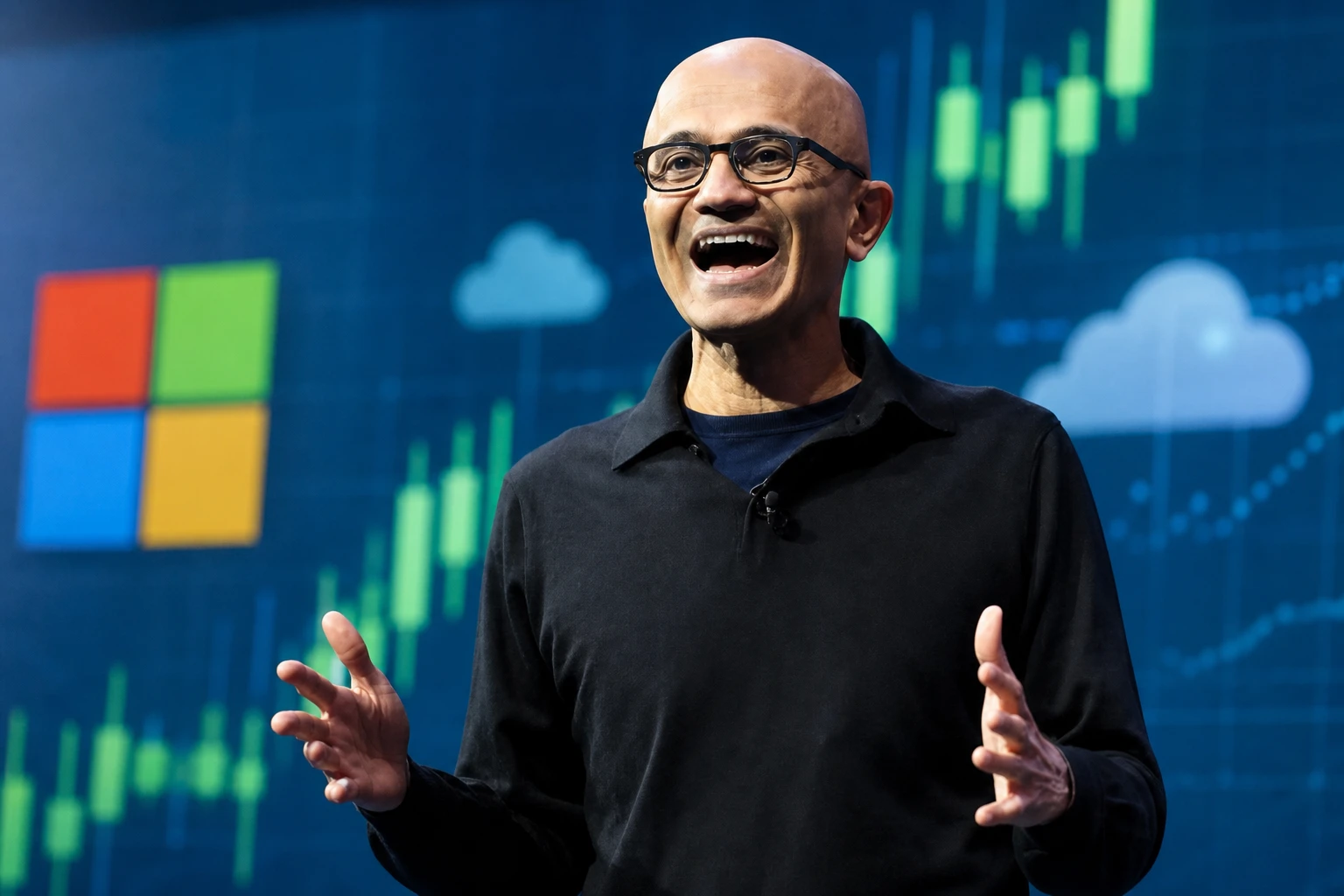
Microsoft shares closed up 15.5% on July 30, adding roughly $480 billion in market value, the largest single-day gain for any company on record, after fiscal fourth-quarter results showed Azure growth accelerating to 43% and Microsoft 365 Copilot paid seats clearing 30 million.
The jump, the stock’s biggest percentage advance since 2008, reversed months of underperformance driven by investor doubts over heavy AI capital spending. Revenue hit $90.0 billion and non-GAAP earnings per share reached $4.74, both well ahead of Wall Street targets.
The session did more than reward a beat. It reframed the entire AI spending debate around Microsoft: outlays that once looked open-ended now sat next to accelerating growth, a multi-year backlog, and free cash flow still large enough to fund returns to shareholders.
The Numbers That Cleared the Tape
Microsoft reported revenue of $90.0 billion for the quarter ended June 30, up 18% year over year. Operating income rose 18% to $40.6 billion. Non-GAAP diluted EPS came in at $4.74, versus the $4.25 consensus cited in early coverage and a $3.65 figure a year earlier on the comparable basis.
Intelligent Cloud revenue reached $39.3 billion, up 32%. Productivity and Business Processes delivered $37.8 billion, up 14%. More Personal Computing posted $12.9 billion, down 4%. Microsoft Cloud overall totaled $59.3 billion, up 27%.
| Metric | Reported | Estimate / Prior | Change |
|---|---|---|---|
| Revenue | $90.0B | ~$87.7B | +18% YoY |
| Non-GAAP EPS | $4.74 | ~$4.25 | +23% YoY |
| Azure & other cloud | +43% | 39-40% guide | Accelerated |
| Commercial RPO | $678B | ~$648B | +84% YoY |
| Capex (incl. leases) | $41B | ~$42B | Below anticip. |
Capital expenditures including finance leases landed at $41 billion, a shade under the $42 billion many had modeled. Full-year revenue reached $331.8 billion, up 18%. Operating income for the year was $155.2 billion, up 21%.
The segment split makes the growth engine plain. Cloud and productivity carried the print; the consumer-facing slice did not. That mix is why the Azure and Copilot figures dominated the market reaction even though overall revenue growth matched the full-year 18% pace.
| Segment | Revenue | YoY Change |
|---|---|---|
| Intelligent Cloud | $39.3B | +32% |
| Productivity and Business Processes | $37.8B | +14% |
| More Personal Computing | $12.9B | -4% |
| Microsoft Cloud (overall) | $59.3B | +27% |
Why the AI Spend Fog Lifted
For much of 2026 Microsoft stock lagged as the company poured capital into data centers and GPUs. Shares had fallen nearly 30% from an October 2025 high near $555. The worry was simple: massive outlays without visible returns.
- $41 billion quarterly capex still left free cash flow strong enough to return $10.2 billion to shareholders via dividends and buybacks.
- Azure guidance for the current quarter points to 45% growth, above the prior run-rate and street models around 41%.
- OpenAI contribution to Azure was disclosed at $24.1 billion for the full year, with concentration risk now better quantified.
CFO Amy Hood and CEO Satya Nadella framed the results as proof the build is converting. Investors agreed in real time. The session erased a large part of the year-to-date damage in one move.
Three signals mattered more than any single line item. Capex came in light of models rather than heavy. Azure growth accelerated and guided higher still. The OpenAI contribution was sized in dollars, which let investors measure concentration instead of guessing at it. Together those points turned a spending story into a returns story.
We are advancing the frontier on the cost-to-outcome curve, ensuring every customer can turn tokens into business results. This year, Azure revenue surpassed $100 billion for the first time, and Microsoft 365 Copilot reached over 30 million paid seats, reflecting the confidence customers are placing in us to power their AI transformation.
Satya Nadella said those words in the official release that accompanied the numbers.
Azure Crosses the Century Mark
For the first time Microsoft disclosed that full-year Azure revenue had Azure revenue surpassed $100 billion for the first time, up 41% for the year. The quarterly growth rate of 43% beat the company’s own prior guide of 39% to 40% and accelerated from 40% the previous quarter.
Intelligent Cloud as a whole grew 32% to $39.3 billion. Management pointed to broad demand across workloads, not only frontier model training. Capacity additions continued: 31 new data centers in the quarter and another gigawatt of capacity. Dock-to-live times for new GPUs fell nearly 50% in the largest regions over the fiscal year.
Efficiency gains also appeared. Throughput for Copilot workloads rose 4X since the start of the year. Custom silicon such as Maia 200 delivered better performance per dollar, and Cobalt CPUs expanded to more sites.
The operating picture is therefore two-sided. Microsoft is still adding capacity at scale, yet the time from delivery to revenue production is shrinking and the silicon mix is improving cost per unit of work. That combination helps explain why 43% growth arrived alongside capex that undershot the $42 billion many had modeled.
Thirty Million Copilot Seats Change the Conversation
Microsoft 365 Copilot paid seats passed 30 million. Net seat adds more than doubled quarter over quarter. Hundreds of enterprises bought millions of seats in the new high-end E7 bundles that package Copilot with security and agent tools. EY alone took 400,000 seats.
- NHS England is rolling Copilot out to 505,000 clinicians and staff after trials showed 43 minutes saved per day.
- KPMG is expanding across more than 276,000 professionals; HSBC committed to 200,000 seats.
- Customers with more than 50,000 seats jumped over 7X year over year.
- Conversations per user nearly doubled; time to high usage (above 80% monthly active) fell from months to days.
GitHub Copilot commercial users reached 50 million. The company is preparing a unified “super app” that folds chat, Cowork, Autopilots and coding into one experience for consumer and commercial users. Usage intensity, not just seat counts, is the metric management is watching.
These enterprise AI deployments sit alongside other Microsoft AI work already in the field, including Microsoft AI models already handling millions of patient visits in clinical settings at lower cost.
Seat scale and usage intensity now reinforce each other. Larger deployments such as EY, NHS England, KPMG and HSBC create reference cases; faster time to high monthly active use shortens the payback argument for the next buyer. That loop is what turned Copilot from a product launch story into a backlog and revenue story.
The Order Book That Locks Visibility
Commercial remaining performance obligations, the contracted backlog Microsoft still must deliver, hit $678 billion, up 84% year over year. That figure smashed the roughly $648 billion expectation. All sequential commercial RPO growth came from customers outside frontier model companies. Excluding OpenAI, RPO still rose 25%.
On the earnings call, management noted that commercial remaining performance obligation grew 84% to $678 billion. Roughly 30% is expected to convert to revenue in the next 12 months, up 37% year over year. The portion beyond 12 months jumped 112%. Weighted average duration sits at 2.3 years.
Bookings rose even after including Azure commitments from OpenAI. That visibility is what turned a strong beat into a historic re-rating. Investors had feared open-ended spending with uncertain demand. The backlog showed demand already under contract.
The duration detail matters as much as the headline total. A 2.3-year weighted average, with the long-dated slice up 112%, means the contracts stretch well past the next few quarterly prints. Near-term conversion still grows 37%, so the book feeds this year’s revenue without exhausting the later years.
How the Session Rewrote Peer Comparisons
The $480 billion one-day market-value increase topped prior records, including Nvidia’s previous high near $440 billion. Microsoft’s market capitalization moved back above $3.3 trillion. The percentage gain was the largest for the shares since a 19% rise in 2008, according to Jefferies data cited in coverage.
Other hyperscalers faced their own capital-intensity questions this earnings season. Microsoft’s combination of accelerating growth, contained quarterly capex versus models, and multi-year contracted revenue stood out. An accounting shift that extends data-center building useful lives to 25 years will further smooth future reported capex and free-cash-flow optics.
Product updates continue in parallel. Recent Windows changes, including recent Windows 11 search changes that cut ad clutter, show the company still polishing the consumer surface even as cloud and AI dominate the narrative.
Relative to peers, the print answered the three questions markets had been asking of every large cloud spender: is growth still accelerating, is capex still climbing faster than models, and is demand contracted or merely hoped for. Microsoft cleared all three in the same release.
How Capex and Cash Returns Fit Together
The same quarter that carried $41 billion of capital spending still returned $10.2 billion to shareholders through dividends and buybacks. That pairing is central to why the spending fog lifted. Investors were not asked to accept a pure reinvestment pause; they saw the build continue while cash generation funded both capacity and distributions.
Capex including finance leases also finished a shade under the $42 billion many had modeled. Coming in light of expectations, rather than above them, removed a common source of post-print selling in capital-intensive names. Guidance for Azure at roughly 45% then argued that the dollars already deployed are still producing faster top-line growth.
The 25-year useful-life shift for data-center buildings adds another smoothing layer on future reported figures. Extending those lives lowers the periodic depreciation hit and can improve the optics of free cash flow even when physical build activity remains high. Management is therefore attacking the spend debate on three fronts at once: absolute dollars versus models, growth conversion, and accounting presentation over time.
- Quarterly capex of $41 billion versus ~$42 billion modeled
- $10.2 billion returned via dividends and buybacks in the same period
- Azure growth guided to about 45% after a 43% print
- Data-center building lives extended to 25 years for reporting
What the Stock Path Shows About Sentiment
The equity story around these results is as much about the path into the print as the print itself. Mapping the sequence makes the size of the re-rating clearer.
- October 2025: Shares traded near a high around $555 before AI-spend doubts deepened.
- Through much of 2026: The stock lagged and ultimately sat nearly 30% below that peak as capital outlays rose without matching proof of returns.
- July 30 results: Azure at 43%, Copilot above 30 million paid seats, commercial RPO at $678 billion, and capex slightly under models.
- The session reaction: A 15.5% advance, roughly $480 billion in added market value, and a move back above $3.3 trillion in market capitalization.
That arc explains why a strong quarter became a record day. The market was not only pricing higher earnings; it was reversing a multi-month discount applied to the same AI platform thesis. Once growth, backlog, and cash returns arrived together, the prior underperformance had less fundamental cover.
Percentage terms underline the reset. A 15.5% single-day move is the largest for the shares since a 19% rise in 2008. Record dollar value creation followed naturally from the larger capital base, but the percentage comparison shows the sentiment swing was extreme even by Microsoft’s own history.
What the Record Session Leaves Behind
Microsoft entered the print as a 2026 laggard. It exited with the largest single-day market-value creation in stock-market history and fresh proof that its AI platform investments are translating into revenue acceleration and enterprise lock-in.
The numbers are now on the books: 43% Azure growth heading toward 45%, more than 30 million paid Copilot seats with rising intensity, and a $678 billion backlog that stretches years forward. The bet that once weighed on the stock just got cashed in public view.
What remains is execution against the order book and the guided growth rates. The contracts, seat base, and capacity additions are disclosed. The next tests are conversion of the 30% of RPO due in twelve months, delivery on the 45% Azure outlook, and proof that usage intensity inside the Copilot base keeps rising as the unified super app lands.
Frequently Asked Questions
What were Microsoft’s exact Q4 FY2026 revenue and earnings figures?
Revenue was $90.0 billion, up 18% year over year. Non-GAAP diluted earnings per share were $4.74, up 23%. GAAP EPS was $4.81. Operating income reached $40.6 billion, up 18%. Full-year revenue totaled $331.8 billion.
How large was the single-day market-value gain for Microsoft?
Shares added approximately $450 billion to $483 billion in market capitalization depending on the exact close and intraday peak used, setting a new record for any public company and surpassing Nvidia’s prior mark near $440 billion. The percentage gain was 15.5%.
What is commercial remaining performance obligation and why does it matter?
RPO measures contracted revenue Microsoft has not yet recognized. The $678 billion balance, up 84%, provides multi-year demand visibility. About 30% is set to convert within 12 months; the longer-dated portion more than doubled.
How many Microsoft 365 Copilot paid seats does the company now have?
More than 30 million paid seats at the end of the quarter. Net adds more than doubled sequentially, and large enterprise deployments of 50,000-plus seats rose more than sevenfold year over year.
Did Azure growth beat Microsoft’s own guidance?
Yes. Azure and other cloud services revenue grew 43%, ahead of the prior guide of 39% to 40%. Management guided the following quarter to approximately 45% growth.


Halo Campaign Evolved Skulls Meet Death Barriers That Kill the Hunt

Spotify Running Mode Returns After the 2015 Experiment Failed

Amazon AWS Hits Fastest Growth in Years as AI Spend Pays Off

Amazon Bets Platform Beats Models in the AI Race

Apple C2 Modem Edges Into iPhone 18 Pro After Qualcomm Drop

Google Earth Adds Nano Banana 2 to Reimagine Real Places

Apple Upgrade Turns Phones Into Monthly Utility Bills

Asha Sharma Bets Xbox Growth on Console and Four C’s

MacBook Ultra Design Follows Apple’s Familiar Cascade Path

TAG Heuer Carrera x Team Ikuzawa Revives 1970s Roadmaster Stopwatch DNA

Pokémon GO Developer Niantic Rebrands as Scopely Explore

Persona 4 Revival Hands All Anime Cutscenes to Studio MAPPA

Jaylen Brown Traded to 76ers for Paul George and Four Draft Picks

Doom Studio id Software Cuts Half Its Staff in Xbox Layoffs

Nintendo Switch Online Adds Four Classics and One Japan-Only Title

Jordan Henderson Hospitalized After Wrist Injury at the Azteca

Mexico’s World Cup Run Ends at Azteca as England Hold On 3-2

Meta’s Muse Image Lets Anyone Use Your Instagram Photos in AI

Louis Vuitton Beats Molly Tea in China, Triggers Cultural Backlash

Pink Bearista Cup Returns July 13 as Starbucks Pink Vibes Drops
-

 TECHNOLOGY3 years ago
How to Adjust a Bulova Watch Band – An Easy Guide
-

 News3 years ago
Fred Pentland: Athletic Bilbao’s English mentor who changed the essence of Spanish football
-

 FINANCE3 years ago
Tax Planning for Every Season: Guide to Maximizing Your Tax Benefits
-

 Education3 years ago
African Ministers New Education Plan
-

 BUSINESS3 years ago
What is Entrepreneurial Operating System? A Comprehensive Guide to EOS
-

 Education3 years ago
Innovate Your Learning Journey with Technology and Enhance Education
-

 News3 years ago
Russians formally out of World Athletics Championships
-

 BUSINESS3 years ago
Top 9 Most Expensive American Cities to Rent an Apartment