
News
Zoox Wins First Paid Robotaxi Exemption Without Human Controls
Amazon Zoox receives the first U.S. commercial exemption for purpose-built robotaxis without steering wheels.

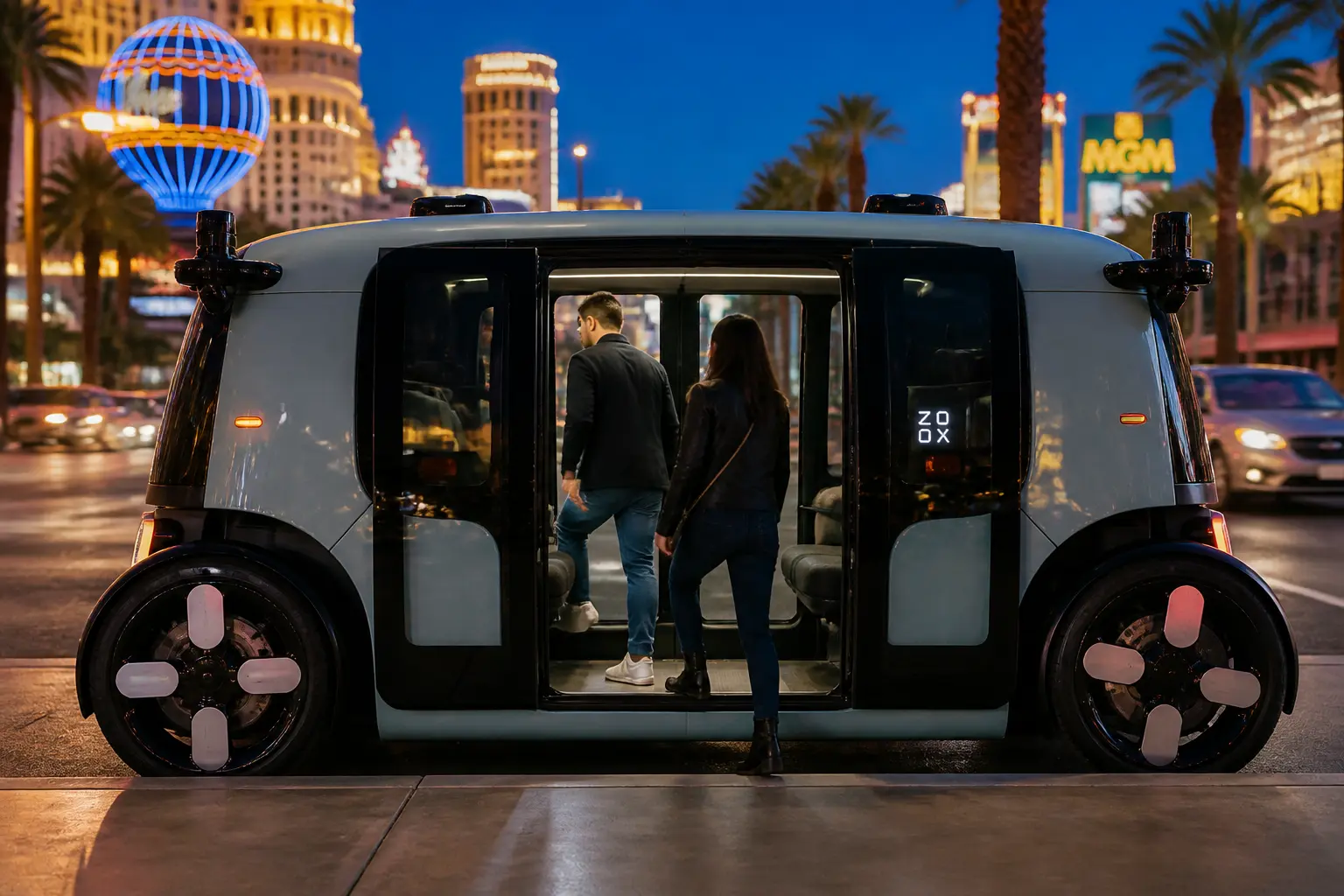
Amazon’s Zoox unit won the first U.S. commercial exemption for purpose-built robotaxis that lack steering wheels, pedals and human controls, the National Highway Traffic Safety Administration said Thursday. The Part 555 grant lets Zoox charge for rides and deploy up to 2,500 vehicles a year for two years, starting paid service next month in Las Vegas once state pieces finish.
The decision cracks open federal motor vehicle safety standards written for human drivers and installs a new oversight model that treats fleet operations as the core safety case.
What the Exemption Allows
NHTSA granted Zoox Temporary Exemption No. 2026-01 from portions of eight Federal Motor Vehicle Safety Standards. The list covers windshield defrosting and wiping, lamps and reflectors, rear visibility, light-vehicle brakes, interior impact protection, glazing materials and occupant crash protection. Those rules assume a human needs controls, mirrors and certain crash features that a fully driverless bidirectional vehicle does not use the same way.
The agency found the Zoox robotaxi delivers an overall safety level at least equal to a compliant vehicle. Administrator Jonathan Morrison told Reuters the systems “exceed the equivalent performance requirements of a compliant vehicle.” Zoox keeps ownership of every unit; none can be sold to the public.
| Limit or Condition | Detail |
|---|---|
| Annual vehicle cap | 2,500 exempted vehicles introduced into commerce per 12-month period |
| Duration | temporary exemption through July 2028 |
| FMVSS waived | Portions of Nos. 103, 104, 108, 111, 135, 201, 205, 208 |
| Oversight tool | Operational Authorizations that NHTSA can update or expand |
| Remote operators | Must be located in the United States |
Morrison said NHTSA can pull the exemption if major safety issues appear. The company must publish operating maps and file extra reports on crashes plus incidents such as stopping inappropriately in traffic.
The waived standards share a common thread. Each one was drafted around a human driver who needs to see, steer, brake and survive a crash in a fixed seating layout. A bidirectional pod with facing benches and no driver seat cannot meet those assumptions without fake hardware. NHTSA’s finding of equivalent overall safety therefore rests on system performance and fleet controls rather than on individual component checklists.
Purpose-Built Design Forced the Rule Change
Zoox vehicles are symmetrical carriages with two facing benches for four riders, no driver seat and a top speed of 75 mph. Battery packs support roughly 16 hours of use. Sensors cover 360 degrees. The design never planned for human controls, so full FMVSS compliance was impossible without adding useless hardware that would undermine the safety case Zoox built.
Earlier demonstration exemptions let Zoox run free rides in Las Vegas and San Francisco. Charging required the commercial grant. CEO Aicha Evans called it the first-ever commercial exemption for a purpose-built robotaxi.
We are honored to receive the first-ever commercial exemption for a purpose-built robotaxi from NHTSA, enabling us to begin charging for our service and take another step toward bringing autonomous ride-hailing to more communities.
Evans said the process showed shared commitment to innovation and safety. Zoox has been assembling vehicles in the United States and argued that outdated standards blocked a safer overall design.
Because the company retains every unit, the safety case travels with the fleet rather than ending at the point of sale. That ownership model is what makes the Operational Authorization structure workable: NHTSA can tighten conditions on a single operator without rewriting rules for an entire vehicle class already in private hands.
Guardrails Arrive After Smoke and First-Responder Friction
The exemption sits inside a broader NHTSA push that includes an enhanced adaptable oversight structure, a $5 million SAE partnership to write the first AV performance standards, and updates to FMVSS that still assume human drivers. Dynamic Operational Authorizations let the agency adjust conditions as the technology and real-road behavior evolve.
- Extra reporting on crashes and inappropriate roadway stops
- Public maps of operating areas
- All remote operators based in the United States
- Authority to revoke or tighten the grant based on performance
- No public sales of the vehicles
Just weeks earlier Morrison sent a letter ordering AV developers to fix a pattern of driverless AVs interfering with first responders. Zoox then recalled software on its fleet of 105 vehicles after one drove into heavy smoke at an active fire scene that lacked cones. The update targets detection of smoke near emergencies. No injuries were reported. Crowd discussion on X quickly noted that the new conditions measure fleet behavior in live traffic as closely as crash rates.
What We Know
- Federal commercial green light is final for the two-year window under the stated terms
- Paid rides begin in Las Vegas next month after remaining Nevada steps
- California still requires separate driverless deployment permits from the PUC and DMV
What’s Unconfirmed
- Exact fare structure and wait times once charging starts
- Precise schedule for Austin, Miami, Atlanta and Los Angeles commercial launches
- How quickly NHTSA will issue expanded Operational Authorizations if performance holds
The smoke recall and the first-responder letter show why the grant ties commercial rights to continuous reporting. A purpose-built vehicle can clear static design review and still fail in live emergency scenes. The extra incident categories, including inappropriate stops, give NHTSA visibility into those edge cases before the two-year window closes.
Half a Million Free Rides Built the Demand Case
Zoox says free service in Las Vegas and the Explorers program in San Francisco have already carried more than half a million riders, with another half million on the waitlist. The company launched free service last year and has expanded neighborhoods while adding Austin and Miami testing. A multi-year deal will put dedicated Zoox robotaxis available through Uber in Las Vegas and later Los Angeles.
Stats snapshot
- 2,500, maximum vehicles per year under the exemption
- 500,000+, free riders already carried
- 105, vehicles in the recent smoke-detection software recall
- 75 mph, stated top speed of the bidirectional pod
Riders who have posted detailed accounts praise the spacious facing-seat cabin and comfort suspension yet note occasional phantom braking and jerky inputs compared with smoother Waymo or Tesla software in limited zones. The vehicle feels premium; the software still draws mixed grades in dense traffic.
The waitlist size and the Uber partnership together argue that demand already exists once fares replace free demos. The annual vehicle cap still limits how fast that demand can be met in any single market, which keeps early service concentrated where state approvals land first.
Rivals Now Inherit the Same Template
Waymo already runs paid driverless service in multiple cities with modified Jaguar and Zeekr vehicles that retain conventional controls for regulatory ease. Tesla has begun Cybercab production and is pursuing self-certification to existing FMVSS plus state frameworks rather than a hard 2,500-unit annual ceiling. That path aims for higher volume if the software and modernization of the standards keep pace. Cruise remains sidelined after earlier safety setbacks.
| Operator | Vehicle approach | Federal path |
|---|---|---|
| Zoox | Purpose-built, no human controls | Part 555 exemption, 2,500-unit annual cap |
| Waymo | Modified Jaguar and Zeekr with controls retained | Paid driverless under existing frameworks |
| Tesla | Cybercab in production | Self-certification to FMVSS plus state rules |
| Cruise | Prior robotaxi fleet | Sidelined after safety setbacks |
Zoox’s grant is the first passenger-carrying ADS vehicle under the general exemption authority and the first under the updated AV Framework process improvements. NHTSA is also reviewing a low-speed delivery application from Robomart. The precedent tells every developer that purpose-built designs can clear federal review, but only with fleet caps, continuous reporting and the clear power to revoke.
On X, observers immediately framed the 2,500 ceiling as a measured gate rather than a blank check and highlighted the U.S.-only remote-operator rule as recognition that human remote assistance remains part of the safety case. That operational focus, not just the missing steering wheel, is the lasting shift.
Cities Still Hold the Final Key
Federal approval clears the vehicle. Paid commercial service still needs state and local sign-off. Las Vegas moves first. California requires additional PUC and DMV driverless permits. Zoox lists Austin, Miami, Atlanta and Los Angeles among future markets. Local rules on geofencing, data sharing, first-responder protocols and curb access will decide how fast the service feels useful rather than experimental.
NHTSA says it expects the first federal AV performance standards by the end of the current administration and is already proposing overhauls to rules written around brake pedals and rearview mirrors. Once those land, individual exemptions may become less necessary. Until then, every new purpose-built fleet will travel a version of the path Zoox just finished: prove equivalent safety, accept dynamic oversight, and keep remote humans in the loop on U.S. soil.
The human-controls moat has a hole in it. The next two years of Las Vegas fares and NHTSA Operational Authorizations will show whether the hole stays open for the rest of the industry.
The Exemption Clock Runs Through Mid-2028
The temporary grant opens a defined window rather than a permanent redesign of the standards. Paid Las Vegas service is slated to begin next month once remaining Nevada steps finish. The exemption itself runs through July 2028, giving NHTSA two full years of crash reports, stop-incident data and map updates before any renewal decision.
- Last year – Free service launched in Las Vegas; San Francisco Explorers program expanded the rider base.
- Recent weeks – Morrison letter on first-responder interference; Zoox software recall on 105 vehicles after the smoke incident.
- Thursday – Part 555 commercial exemption granted under Temporary Exemption No. 2026-01.
- Next month – Paid fares targeted to start in Las Vegas after state pieces close.
- Through July 2028 – Annual 2,500-vehicle cap and dynamic Operational Authorizations remain in force.
Each step tightens the link between commercial rights and observed fleet behavior. Free rides proved demand and basic reliability. The smoke recall tested emergency-scene detection. The commercial grant now ties revenue to the same reporting channels. If performance holds, NHTSA can expand Operational Authorizations; if it does not, the agency already holds the tools to tighten or pull the grant.
Fleet Caps Push Operators Toward Shared Platforms
The 2,500-vehicle annual ceiling and the ban on public sales shape how Zoox can grow inside the window. Ownership stays with the company, so capital and liability remain concentrated. The multi-year Uber arrangement in Las Vegas and later Los Angeles offers a distribution channel that does not require selling vehicles or exceeding the federal cap through a second branded fleet.
Rivals that keep conventional controls can still pursue higher volume through self-certification or existing state frameworks, as Tesla aims to do with Cybercab. Purpose-built designs that follow Zoox will inherit the same template: fleet caps, U.S.-based remote operators, public operating maps and continuous incident reporting. The Robomart low-speed delivery application now under review will show whether NHTSA applies a lighter version of that template to cargo vehicles or holds every ADS applicant to the same operational bar.
For cities deciding curb access and geofences, the federal structure supplies a ready checklist. Local officials can demand the same public maps and first-responder protocols already required at the national level, which may speed local sign-off in markets that want the service and slow it where trust remains thin.
Frequently Asked Questions
What specific vehicle features did NHTSA exempt Zoox from?
NHTSA waived portions of eight standards covering windshield defrost and wipe systems, lamps and reflectors, rear visibility requirements, brake-system details written for human drivers, interior impact protection, certain glazing rules and occupant crash-protection provisions that assume a traditional driver position and controls.
How many Zoox robotaxis can operate commercially under the grant?
Zoox may introduce no more than 2,500 exempted vehicles into interstate commerce for commercial deployment in any 12-month period during the two-year exemption window that runs through July 31, 2028.
Can Zoox sell its robotaxis to the public or other fleets?
No. Zoox must retain ownership and full responsibility for operations, maintenance, remote support and customer service; the exemption does not authorize sales of the vehicles.
When does paid service begin and in which cities?
Zoox plans to start charging fares in Las Vegas next month after finishing remaining Nevada requirements; additional markets follow only after each state completes its own commercial approvals, with California still needing separate driverless permits.
What happens if safety problems appear after launch?
NHTSA retains authority to modify Operational Authorizations or pull the entire exemption if it sees major safety issues, and Zoox faces heightened reporting duties on crashes and operational anomalies such as inappropriate stops.


Halo Campaign Evolved Skulls Meet Death Barriers That Kill the Hunt

Spotify Running Mode Returns After the 2015 Experiment Failed

Amazon AWS Hits Fastest Growth in Years as AI Spend Pays Off

Amazon Bets Platform Beats Models in the AI Race

Apple C2 Modem Edges Into iPhone 18 Pro After Qualcomm Drop

Google Earth Adds Nano Banana 2 to Reimagine Real Places

Apple Upgrade Turns Phones Into Monthly Utility Bills

Asha Sharma Bets Xbox Growth on Console and Four C’s

MacBook Ultra Design Follows Apple’s Familiar Cascade Path

TAG Heuer Carrera x Team Ikuzawa Revives 1970s Roadmaster Stopwatch DNA

Pokémon GO Developer Niantic Rebrands as Scopely Explore

Persona 4 Revival Hands All Anime Cutscenes to Studio MAPPA

Jaylen Brown Traded to 76ers for Paul George and Four Draft Picks

Doom Studio id Software Cuts Half Its Staff in Xbox Layoffs

Nintendo Switch Online Adds Four Classics and One Japan-Only Title

Jordan Henderson Hospitalized After Wrist Injury at the Azteca

Mexico’s World Cup Run Ends at Azteca as England Hold On 3-2

Meta’s Muse Image Lets Anyone Use Your Instagram Photos in AI

Louis Vuitton Beats Molly Tea in China, Triggers Cultural Backlash

Pink Bearista Cup Returns July 13 as Starbucks Pink Vibes Drops
-

 TECHNOLOGY3 years ago
How to Adjust a Bulova Watch Band – An Easy Guide
-

 News3 years ago
Fred Pentland: Athletic Bilbao’s English mentor who changed the essence of Spanish football
-

 FINANCE3 years ago
Tax Planning for Every Season: Guide to Maximizing Your Tax Benefits
-

 Education3 years ago
African Ministers New Education Plan
-

 BUSINESS3 years ago
What is Entrepreneurial Operating System? A Comprehensive Guide to EOS
-

 Education3 years ago
Innovate Your Learning Journey with Technology and Enhance Education
-

 News3 years ago
Russians formally out of World Athletics Championships
-

 BUSINESS3 years ago
Top 9 Most Expensive American Cities to Rent an Apartment