
News
MacBook Ultra Design Follows Apple’s Familiar Cascade Path
The thinner OLED chassis on Apple’s rumored MacBook Ultra is set to reach the cheaper 14-inch MacBook Pro within a year.

Apple’s rumored MacBook Ultra will debut a thinner chassis, hybrid OLED touch display and hole-punch camera late this year or early next, yet that same design is already scheduled to reach the entry-level 14-inch MacBook Pro in 2027. Bloomberg’s Mark Gurman mapped the full Mac refresh, and the pattern is clear: the exclusive look lasts roughly a year.
The cascade turns a halo machine into the new high-end baseline faster than the touchscreen or OLED headlines alone suggest.
The Cascade Hits the Entry Pro First
Gurman’s July roadmap lays out an end-to-end Mac overhaul across two years. The high-end machines, code-named K114 and K116, arrive first with the all-new design, M5 Pro and M5 Max options, tandem OLED touchscreens and Dynamic Island-style cutout. Then the volume model follows.
| Model | Codename | Chip | Design | Window |
|---|---|---|---|---|
| High-end 14/16-inch MacBook | K114 / K116 | M5 Pro / Max | All-new thinner OLED touch | Late 2026-early 2027 |
| 14-inch base MacBook Pro | K104 | Standard M7 | Resembles K114/K116 | 2027 |
| Follow-up high-end MacBook | – | M7 Pro / Max | Same chassis lineage | Late 2027-early 2028 |
| OLED MacBook Air | – | – | OLED (possible redesign) | 2028 earliest |
That sequence matches entry-level MacBook Pro plan details Gurman posted separately: current design with M6 this fall (J804), then the new design with M7 next year (K104). Once the base Pro adopts the chassis, the later high-end refresh with M7 Pro and Max chips almost certainly keeps it. All five of Apple’s most powerful laptops would then share the same overall look.
Mac sales have climbed for a third straight year on AI workloads, giving Apple room to refresh every machine it sells. The design migration is the quiet part of that plan.
Read as a single clock, the handoffs land in a tight order:
- This fall – current-design 14-inch base Pro with M6 (J804).
- Late 2026 to early 2027 – high-end K114 and K116 with M5 Pro and Max, thinner OLED touch chassis.
- 2027 – base 14-inch Pro K104 adopts the new shell with standard M7.
- Late 2027 to early 2028 – follow-up high-end units with M7 Pro and Max keep that same chassis lineage.
- 2028 at earliest – OLED reaches the MacBook Air, with a possible redesign of its own.
Each step shortens the window in which any single machine can claim a unique exterior. The halo look becomes the line-wide look on a schedule measured in months, not product generations.
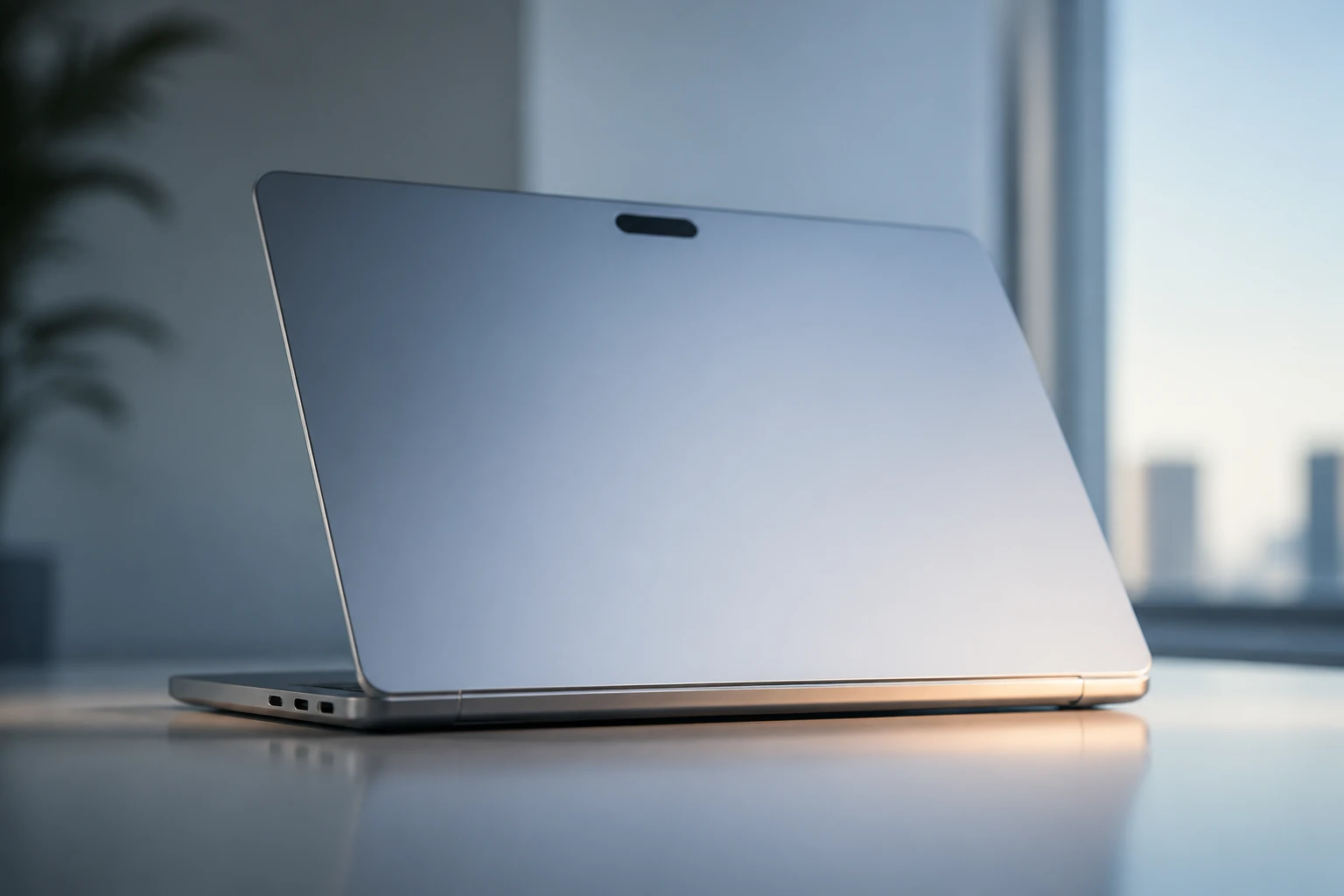
What Changes on the Outside
The 2021 MacBook Pro redesign went thicker and heavier to restore ports. This one runs the opposite direction. Swapping mini-LED for a hybrid OLED stack removes an entire backlight layer because the pixels emit their own light. The chassis is expected to end up noticeably thinner and lighter. Ports stay; there is no sign Apple will strip HDMI, SD or MagSafe again after the last backlash.
- Hole-punch camera replaces the notch; pill-shaped cutout enables an interactive Dynamic Island that expands like the iPhone version.
- Reinforced hinge keeps the display steady when tapped for touch input.
- Touch-friendly, not touch-first approach per Gurman; macOS adaptations without full iPad-style Pencil focus.
- Possible slight screen growth to 14.3 and 16.3 inches (Omdia) via slimmer bezels; earlier Bloomberg reporting held sizes steady.
Samsung Display is expected to supply the panels from its new 8.6-generation line. The hybrid stack (oxide TFT plus tandem OLED layers) already appears in iPad Pro models and brings higher brightness, better efficiency and longer life than single-stack OLED.
Those panel traits do more than improve the picture. Removing the backlight frees internal volume that can go to battery cells or thinner walls. The reinforced hinge is the mechanical answer to the same change: once the lid becomes a touch surface, it must stay put under finger pressure. The design therefore couples a thinner shell with a stiffer joint rather than trading one for the other.
Gurman’s touch-friendly framing keeps macOS in control of the interaction model. The machine gains a responsive panel without turning into a laptop that expects constant finger input or a stylus as primary tools.
The 2021 Playbook Ran Backward
Apple last overhauled the MacBook Pro in 2021 with the M1 Pro and M1 Max. That generation grew thicker, added weight and restored the ports the previous thin design had removed. Five years later the company is reversing the thickness again. The pattern is consistent even when the direction flips: a major chassis change arrives at the top of the range, then migrates downward once yields, cost and software settle.
Forum discussion around the latest reports treats the Ultra moniker the same way. Many readers see it as temporary labeling for the next Pro redesign rather than a permanent new tier. The cascade to the base model next year, then OLED to the Air by 2028, matches how Apple moved Retina, then the current Pro shape, and how OLED migrated across iPhones and iPads. Start high and low-volume, then fill the middle.
Side by side, the two chassis eras show the same migration logic pointed in opposite directions:
- 2021 move: thicker and heavier shell, ports restored, mini-LED retained at the high end first.
- Next move: thinner and lighter shell, ports kept, hybrid OLED and hole-punch introduced at the high end first.
- Shared rule: top-of-range debut, then base Pro, then the rest of the powerful stack, with Air trailing on its own clock.
The direction of the thickness change is new. The order of who receives it is not. That order is what keeps the exclusivity window short by design.
Branding Stays Loose While the Chassis Spreads
Gurman’s list describes high-end 14-inch and 16-inch “MacBook” machines without the Pro suffix and does not place a separate high-end Pro beside them. That phrasing is hard to lean on; marketing names stay internal until the final stretch. The new machines could replace the current M5 Pro and Max models at a higher price or sit above them as a true Ultra tier while the older designs linger briefly.
Either way the design does not stay exclusive. Once K104 ships in the new shell, the follow-on high-end units with M7 Pro and Max chips will share it. The entire powerful laptop stack converges on one look. That leaves the MacBook Air and Neo on older industrial design longer, though an OLED Air is already on the far side of the roadmap.
Memory supply constraints have already pushed some Studio and mini updates and made the later 2026-early 2027 window for the OLED machines more likely. Chip and panel readiness still drive the exact week more than branding debates.
Name plates can shift in the final months. Chassis tooling cannot. By the time the M7 Pro and Max machines arrive, the thinner shell will already be the default shape for every high-power MacBook Apple sells, whatever badge sits above the keyboard.
How Panel and Chip Readiness Set the Pace
The roadmap’s windows are not branding exercises. They track when hybrid OLED panels and the matching silicon are ready in volume. Samsung Display’s 8.6-generation line is the supply side of that equation. The M5 Pro and Max generation is the demand side for the first wave; the standard M7 and then M7 Pro and Max fill the next two.
Memory constraints already delayed some Studio and mini refreshes. That same pressure makes the later edge of the late-2026 to early-2027 window the more probable landing zone for the first OLED machines. Panel yields and chip availability still decide the week more than any internal debate over Ultra versus Pro naming.
Once those pieces lock, the cascade itself is mechanical. K114 and K116 prove the chassis and the tandem stack. K104 reuses both at the volume price with a standard M7. The later high-end refresh keeps the proven shell and simply drops in faster silicon. Nothing in that sequence requires a second industrial-design cycle.
The OLED Shift Reaches Farther Than Apple
Omdia’s June research pegs notebook OLED revenue at $4 billion in 2026 and $11.5 billion by 2033. Hybrid panels start at 12.6 percent of OLED notebook shipments this year and are forecast to hit hybrid OLED share rising to 89.5% by 2033. Jerry Kang, practice leader at Omdia, said leading brands are adopting the oxide TFT, LTPO and RGB tandem combination for the first time in this form factor because it cuts power use and enables thinner, lighter designs by freeing space for batteries and circuits.
| Metric | Near term | Longer horizon |
|---|---|---|
| Notebook OLED revenue | $4 billion in 2026 | $11.5 billion by 2033 |
| Hybrid share of OLED notebooks | 12.6% this year | 89.5% by 2033 |
Apple’s volume is expected to pull the rest of the industry along. Samsung and BOE are ramping Gen 8.6 capacity. The same thinner chassis logic that lets Apple reverse 2021’s bulk also becomes the economic argument for every other premium laptop maker.
Rival high-end machines face their own trade-offs. The Surface Laptop Ultra memory trade-offs show how AI-focused specs can hide base-configuration limits; Apple’s cascade keeps the visual and structural upgrade moving even as silicon and memory costs fluctuate.
The industry numbers and Apple’s internal sequence reinforce each other. Hybrid OLED is the panel technology that makes a thinner premium notebook practical at scale. Apple’s decision to start at the top and then flood the middle simply accelerates how fast that panel type leaves the specialty tier.
Buyers Face a Clearer Calendar
Anyone shopping the current 14-inch or 16-inch Pro now knows the next major redesign is already scheduled for the volume model a year after the halo launch. Waiting for K104 means the thinner shell and hole-punch arrive with a standard M7 at a lower price point. Buying the first Ultra machines means paying the early premium for M5 Pro/Max performance plus the new display and chassis while the design is still exclusive.
Power users running AI agents already drive Mac mini and Studio demand high enough that some configurations face multi-month waits. Those buyers may prioritize silicon and memory over the lid design. For everyone else the chassis migration itself becomes the deciding fact: the look that debuts as Ultra becomes ordinary Pro hardware on a predictable clock.
The practical choice therefore splits along workload lines rather than along brand loyalty:
- Silicon-first buyers can take the current Pro or the first M5 Pro and Max machines and treat the lid as secondary.
- Design-first buyers who want the thinner shell without the halo premium can target K104 in 2027.
- Holdouts for Air thinness plus OLED are looking at 2028 at the earliest, and possibly a separate redesign.
Apple has run this cycle before. The only difference this time is the direction of the thickness and the addition of touch and OLED. The exclusivity window remains short by design.
The thinner MacBook is coming to more desks sooner than the Ultra badge alone implies.


Halo Campaign Evolved Skulls Meet Death Barriers That Kill the Hunt

Spotify Running Mode Returns After the 2015 Experiment Failed

Amazon AWS Hits Fastest Growth in Years as AI Spend Pays Off

Amazon Bets Platform Beats Models in the AI Race

Apple C2 Modem Edges Into iPhone 18 Pro After Qualcomm Drop

Google Earth Adds Nano Banana 2 to Reimagine Real Places

Apple Upgrade Turns Phones Into Monthly Utility Bills

Asha Sharma Bets Xbox Growth on Console and Four C’s

MacBook Ultra Design Follows Apple’s Familiar Cascade Path

TAG Heuer Carrera x Team Ikuzawa Revives 1970s Roadmaster Stopwatch DNA

Pokémon GO Developer Niantic Rebrands as Scopely Explore

Persona 4 Revival Hands All Anime Cutscenes to Studio MAPPA

Jaylen Brown Traded to 76ers for Paul George and Four Draft Picks

Doom Studio id Software Cuts Half Its Staff in Xbox Layoffs

Nintendo Switch Online Adds Four Classics and One Japan-Only Title

Jordan Henderson Hospitalized After Wrist Injury at the Azteca

Mexico’s World Cup Run Ends at Azteca as England Hold On 3-2

Meta’s Muse Image Lets Anyone Use Your Instagram Photos in AI

Louis Vuitton Beats Molly Tea in China, Triggers Cultural Backlash

Pink Bearista Cup Returns July 13 as Starbucks Pink Vibes Drops
-

 TECHNOLOGY3 years ago
How to Adjust a Bulova Watch Band – An Easy Guide
-

 News3 years ago
Fred Pentland: Athletic Bilbao’s English mentor who changed the essence of Spanish football
-

 FINANCE3 years ago
Tax Planning for Every Season: Guide to Maximizing Your Tax Benefits
-

 Education3 years ago
African Ministers New Education Plan
-

 BUSINESS3 years ago
What is Entrepreneurial Operating System? A Comprehensive Guide to EOS
-

 Education3 years ago
Innovate Your Learning Journey with Technology and Enhance Education
-

 News3 years ago
Russians formally out of World Athletics Championships
-

 BUSINESS3 years ago
Top 9 Most Expensive American Cities to Rent an Apartment