
News
Surface Laptop Ultra’s 128GB AI Promise Hides a 16GB Catch
Microsoft’s Surface Laptop Ultra debuts with Nvidia’s RTX Spark chip and up to 128GB memory, but base models start at 16GB and pricing is unconfirmed.

The Surface Laptop Ultra is Microsoft’s first laptop built on Nvidia’s RTX Spark platform, shown at Computex 2026 in Taipei with a 20-core CPU, an RTX 5070-class GPU, up to 128GB of unified memory and a claimed 1 petaflop of AI compute. It ships this fall; base configurations start at 16GB, and pricing is unconfirmed.
Most of the early coverage led with that petaflop figure. The number worth watching is 16GB, the floor configuration Microsoft showed on the show floor, and it falls well short of running the giant offline models Nvidia keeps demoing. Buyers who want the headline AI experience will have to pay for the top memory tier, and Microsoft hasn’t said what that costs.
On the Computex Floor
Nvidia and Microsoft used Computex to unveil the platform, but only Microsoft’s machine got into reporters’ hands. The hands-on came from PCMag’s PC Labs, which spent a short session with a non-powered unit, enough to judge the build if not the benchmarks. Nobody was allowed to switch an RTX Spark laptop on for the press, which tells you how early this still is. It fits a wider Microsoft bet on Arm and Nvidia silicon that the company has now made twice.
A Familiar Shell With a Floating Deck
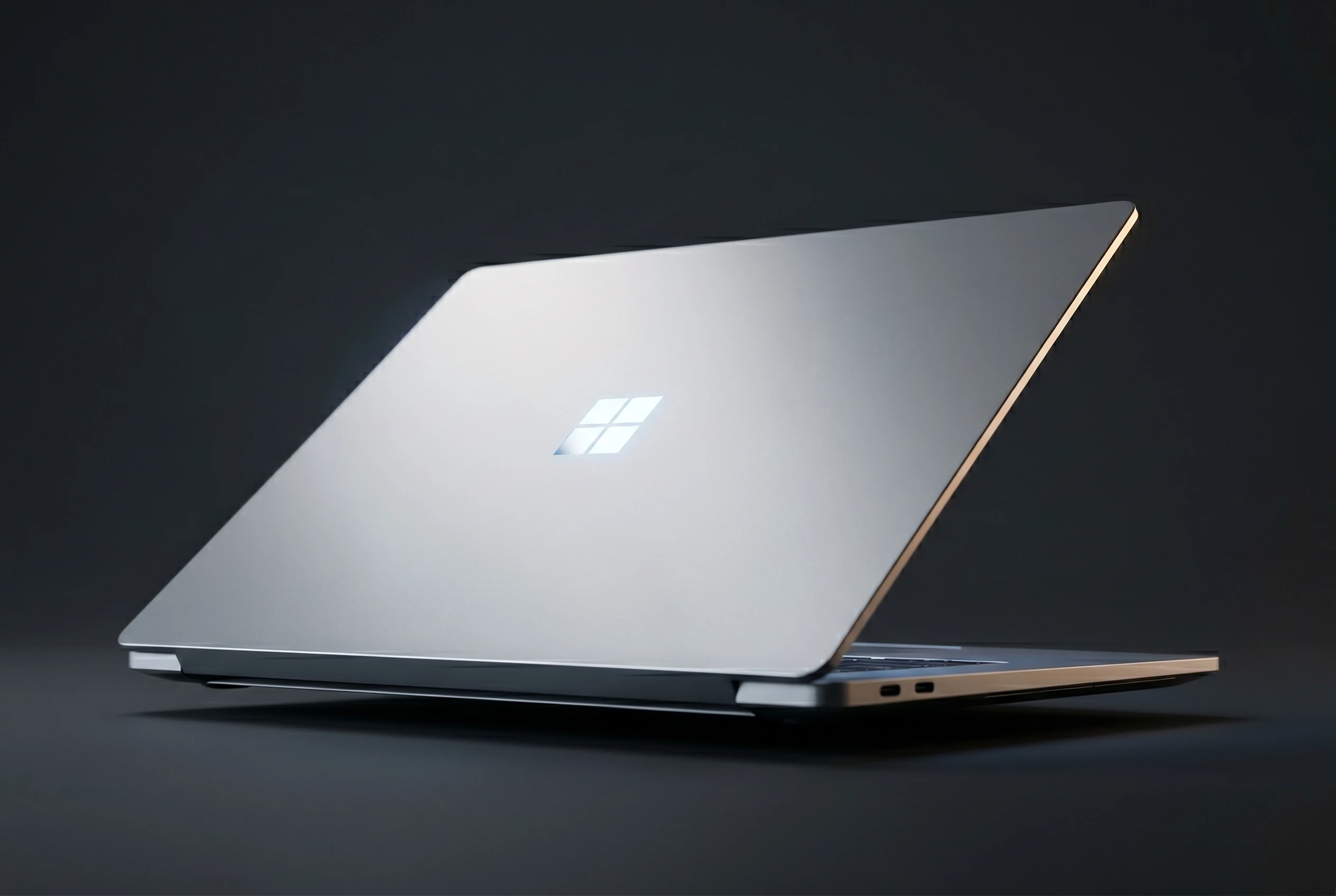
At a glance the Ultra looks like the 15-inch Surface Laptops Microsoft has sold for years. Same all-metal chassis, same polished Windows logo on the lid, the same Platinum finish, with a darker Nightfall option alongside it. Look closer and the base is raised, so the body appears to hover a few millimetres off the desk. Microsoft quotes a thickness under 18mm and a weight under 4.5 pounds, which keeps it in thin-and-light territory despite the workstation-class silicon inside.
The Brightest Display Microsoft Has Shipped
Open the lid and the panel is the headline. It’s a 15-inch mini-LED PixelSense Ultra touchscreen in Microsoft’s squarish 3:2 shape, rated for up to 2,000 nits of peak HDR brightness, which Microsoft calls the brightest screen it has ever put in a laptop. Pixel density runs to 262 per inch, and the team confirmed variable refresh and a 120Hz peak. Mini-LED draws a little more power than the older panels, but Microsoft insists all-day battery holds.
Ports, Camera, and a Touchpad You Can Replace
Connectivity is generous for a machine this thin: full-size HDMI, USB-C, USB-A, an SD card reader and a 3.5mm headphone jack. The haptic touchpad is the largest Microsoft has ever fitted to a Surface, and a rep said it can be swapped out if it fails. A webcam with Windows Hello face sign-in sits in a thin bezel, though Microsoft wouldn’t give its resolution.
The N1X Superchip Under the Lid
The chassis is familiar; the silicon is not. Microsoft built the Ultra around Nvidia’s N1X, the first chip in the RTX Spark line and a close relative of the Grace Blackwell GB10 part inside Nvidia’s DGX Spark developer box. The build-up ran for weeks, with coordinated teasers pointing to the June 1 Taipei keynote.
One System-on-Chip, Two Processors
The N1X fuses a 20-core Arm CPU with a Blackwell GPU carrying 6,144 CUDA cores, linked by Nvidia’s NVLink-C2C interconnect and sharing a single pool of unified memory that either side can claim on demand. Nvidia rates the package at up to 1 petaflop of AI compute using FP4 precision, and says that’s enough to render 90GB-plus 3D scenes, edit 12K video and run 120-billion-parameter models offline, per its RTX Spark platform announcement. Microsoft says that makes the Ultra its most capable AI PC by a wide margin.
| Spec | Surface Laptop Ultra (N1X) | DGX Spark (GB10) |
|---|---|---|
| CPU | 20-core Arm | 20-core Arm |
| GPU | Blackwell, 6,144 CUDA cores | Blackwell |
| Unified memory | Up to 128GB | 128GB |
| AI compute | Up to 1 petaflop (FP4) | Up to 1 petaflop (FP4) |
| Form factor | Sub-18mm laptop | Small desktop box |
| Operating system | Windows on Arm | Linux-based DGX OS |
The DGX Spark is a desktop tool aimed at AI developers; the Ultra takes broadly the same chip recipe and stuffs it into a notebook running Windows. You can see the lineage Nvidia is drawing on in its own Grace Blackwell DGX Spark listing.
Cooling a Workstation in a Notebook
Driving that many cores in an 18mm body is a thermal problem, and Microsoft’s booth made a show of the answer. A dual-fan, dual heat-pipe system pulls air from the sides and vents out the back, with thinner fans and tighter fin spacing than before. Microsoft claims more than twice the thermal headroom of its 2024 Surface Laptop 7th Edition. A smoke demo traced the airflow for the cameras.
The Memory Gap Between the Pitch and the Base Model
Here is the part the launch slides skipped. Nvidia’s demos lean on the full 128GB configuration, but Microsoft confirmed the Ultra will sell in trims with far less, some as low as 16GB of unified memory. On a chip that shares one memory pool between CPU and GPU, that 16GB has to cover the operating system, your apps and any AI model you want to keep resident. A 120-billion-parameter model, even heavily compressed, won’t fit.
That gap matters because the AI horsepower is the whole sales pitch. A few practical limits stack up fast:
- Large local language models, the class Nvidia keeps demoing, need tens of gigabytes just for the weights, before any conversation context is added.
- The unified design means GPU rendering and resident AI models compete for the same memory your regular apps are already using.
- The memory is soldered down; the show unit had no SO-DIMM slots, so you pick a tier at purchase and live with it for the life of the machine.
- DRAM prices are climbing, the same squeeze that left the cheap MacBook Neo stuck at 8GB, so jumping to the top tier will carry a real premium.
The swappable parts are real but limited. The SSD is a standard M.2 2280, the battery is replaceable, and QR codes inside the body point to service guides, Framework-style. Memory isn’t on that list.
Windows on Arm Brings Back an Old Compatibility Problem
Every RTX Spark laptop runs Windows on Arm, and that carries baggage. Arm chips can’t run x86 software directly; they push it through Windows on Arm’s x86 translation layer, which has a long history of uneven results. Native Arm apps fly. Older x86 programs, much of the PC game back catalogue and enterprise tools like legacy macros run through emulation that can cost speed and battery.
Microsoft and Nvidia have worked on GPU-accelerated translation, and Nvidia claims 100 fps at 1440p in AAA titles with DLSS upscaling. That’s a number delivered on a stage, not a benchmark anyone outside the two companies has run. Battery is the other open question: a mini-LED panel at 2,000 nits and a Blackwell GPU are both thirsty, and Microsoft’s “all-day” assurance is, for now, just a word. The company has conceded that driver problems quietly drained Windows laptops for years, so independent battery testing will matter here.
Microsoft Shares the RTX Spark Stage With Five Rivals
The Ultra is the flagship, but it isn’t the only one. Nvidia lined up the top tier of the PC industry behind RTX Spark, part of its plan to put Grace Blackwell on every developer’s desk. The first wave of partners reads like a who’s who of premium Windows hardware:
- Asus, with ProArt-class creator models
- Dell, including a new XPS built on the N1X
- HP
- Lenovo, under its Yoga Pro line
- MSI, with the Prestige range
- Acer and Gigabyte, set to follow later
All of them chase the buyer Microsoft is chasing: creators and developers who want local AI muscle and will pay “Ultra” or “Pro” money for it. Nvidia says the first machines roll out this fall, which means the Surface won’t have the segment to itself for long.
Price and the “This Fall” Question
Microsoft pointed the Ultra at a specific user rather than the mass market.
Surface has always exemplified the best of what a Windows PC can be.
That line came from Brett Ostrum, Microsoft’s corporate vice president for Surface, who framed the machine around creators, developers and engineers. What it doesn’t answer is cost. Microsoft wouldn’t name a price, and on timing it would only say this fall, leaving open whether the Ultra lands for back-to-school or the holiday rush. These are premium, AI-first machines built for early adopters, so the sticker is unlikely to be gentle, and the 128GB trim that delivers the headline feats will sit at the top of the range.
Microsoft hasn’t set a price or a firm ship date. Until it does, the Ultra stays a Computex demo with very large numbers and no number that counts.






Iowa Farmer Built Resilience for 16 Years Then Tariffs Hit Hard

HHS Adds FDA Tech and Drugs Deputies to Lock In AI and Review Power

Nvidia Earnings Carry a Built-In Sell-the-News Trap

HP Licenses Huawei Wi-Fi Patents Despite the Entity List

Poland Named in $131B F-15 Deal Echoes Apache Path

Sewer Scavengers Near Penn Station Repeat a Decades-Old NYC Pattern

Second Muni Fatigue Crash Exposes Surface Line Gaps

Chick-fil-A Chicken and Waffles Closes Its 80-Year Loop

Musk Data Centers Leave a Mississippi Family’s Historic Land Empty

OpenAI Data Center Chief Exits as Stargate Strategy Shifts

Double Fine Cuts 23 Jobs Weeks After Xbox Independence

Day-One Big Walk Lifts PS Plus August Beyond Recycled AAA

Curtis Mead’s Red Sox Debut Ends With Fractured Wrist

John Hight Exits Wizards After Digital Reckoning Hits

Moesch and Dressel Rewrite Night One at 2026 U.S. Nationals

Red Sox Squander Hot Streak Chance in 4-3 Loss to Athletics

Boutte’s Quiet Camp Takeover Forces Patriots Receiver Choices

Take-Two CEO Pushes Netflix Subs for GTA 6 Extended Look

Halo Campaign Evolved Skulls Meet Death Barriers That Kill the Hunt

Wildlands Free Update Hands Players the Tools They Already Invented
-

 TECHNOLOGY3 years ago
How to Adjust a Bulova Watch Band – An Easy Guide
-

 News3 years ago
Fred Pentland: Athletic Bilbao’s English mentor who changed the essence of Spanish football
-

 FINANCE3 years ago
Tax Planning for Every Season: Guide to Maximizing Your Tax Benefits
-

 Education3 years ago
African Ministers New Education Plan
-

 BUSINESS3 years ago
What is Entrepreneurial Operating System? A Comprehensive Guide to EOS
-

 Education3 years ago
Innovate Your Learning Journey with Technology and Enhance Education
-

 News3 years ago
Russians formally out of World Athletics Championships
-

 BUSINESS3 years ago
Top 9 Most Expensive American Cities to Rent an Apartment