
News
Googlebook’s NYC Date Continues Google’s Long Laptop Restart Cycle
Google locks September 15 for its NYC Googlebook media showcase, pairing a native Android platform and Gemini tools with Lenovo.

Google has locked Tuesday, September 15, 2026, for an in-person media preview of its Googlebook platform in New York City. The day will feature a leadership keynote on the software architecture, Gemini features and native Android codebase, plus hands-on stations with hardware from Lenovo, ASUS, HP and other partners.
Chrome Unboxed received the official invite and itinerary, confirming the long-teased fall showcase is now less than a month away. The move puts concrete dates on a project first sketched at The Android Show in May.
What the September 15 itinerary actually includes
According to the invite shared with Chrome Unboxed, the New York event is built as a full hardware showcase rather than a pure software briefing. Attendees can expect three core blocks.
- Keynote from Google leadership introducing the computing platform, software architecture and the vision that unites ChromeOS-style web productivity with a native Android codebase.
- OEM partner demo stations giving hands-on time with launch hardware and platform features from each participating manufacturer.
- Media sandbox access for photography, video and benchmarking of the first wave of devices.
Google stayed quiet on Googlebook during the recent Pixel 11 launch, only promising more details this fall alongside those partners. The September date closes that gap.
The May sneak peek that started the clock
On May 12 Google published its first official look at the platform. Alex Kuscher, senior director of laptops and tablets, framed it as a rethink of the laptop after more than 15 years of Chromebooks.
We’re bringing together the best of Android, which comes with powerful apps on Google Play and a modern OS that’s designed for Intelligence, and ChromeOS, which comes with the world’s most popular browser. The result is Googlebook: a new category of laptops built with Gemini’s helpfulness at its core.
Kuscher wrote that Googlebooks are the first laptops designed from the ground up for Gemini Intelligence. Two features stood out then and will likely dominate the September keynote.
Magic Pointer turns the cursor into a Gemini interface. Wiggle it and the system offers contextual actions: point at a date in email to schedule a meeting, or select two images to composite them. Google built the feature with its DeepMind team.
Create your Widget lets users prompt Gemini to build custom desktop widgets that pull from the web or Google apps such as Gmail and Calendar. A family trip can become a single dashboard of flights, hotels and countdowns.
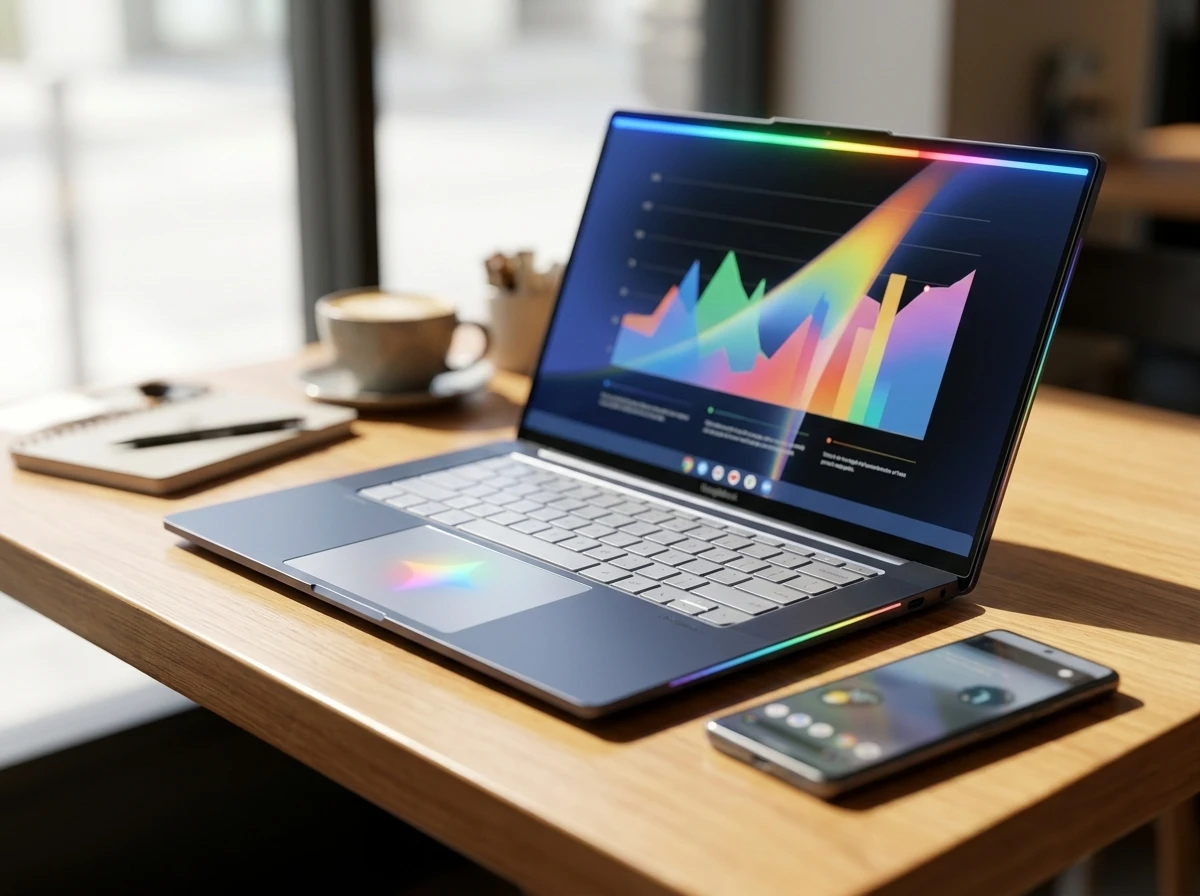
The same post confirmed deeper phone continuity: Quick Access to phone files inside the laptop browser, and the ability to run or jump into phone apps without leaving the laptop screen. Devices would ship this fall from Acer, ASUS, Dell, HP and Lenovo, each carrying a distinctive glowbar as a visual signature.
That May post remains the clearest primary description of the new category of laptops designed for Gemini.
Partner hardware already leaking into view
Leaks have filled in the blanks Google left. Press images of a Lenovo Googlebook 15 show a dedicated Google key for Gemini, multiple ports including HDMI, USB-C, USB-A and a headphone jack, Dolby Atmos audio and narrow bezels. No official specs or prices have attached to the images, but the chassis looks aimed at the premium tier.
Development boards tracked in Chromium Gerrit carry codenames such as Sapphire, Quartz and Mica. One widely discussed path points to a Snapdragon X series chip powering at least some models, the first time that silicon would ship outside Windows. A Dell XPS 13 Googlebook chassis leak under the Mica codename has drawn particular attention from buyers who wanted a flagship Windows chassis on Google’s stack.
Qualcomm’s own confirmation that Snapdragon silicon is heading to Googlebook added weight. The Snapdragon-powered Googlebook fall confirmation aligns with the September event timing and the broader OEM pipeline that also includes Intel and MediaTek options for different segments.
| Partner / Codename | Noted form factor | Chip signals |
|---|---|---|
| Lenovo Googlebook 15 | 15-inch clamshell | Unspecified; premium ports and Google key |
| Dell Mica | XPS 13-class | Snapdragon X Elite path |
| HP Quartz / 14c | 14-inch | Snapdragon-linked leaks |
| Lenovo Sapphire | 13-inch tablet / Duet style | MediaTek thin-and-light tier |
| Multiple Bluey boards | Shared base for several OEMs | Snapdragon X Plus |
All first-wave devices are expected to carry the Glow Bar. Retail availability is still listed simply as fall 2026.
The Glow Bar ties phones and laptops together
Google is treating the light strip as more than decoration. On Pixel 11 devices the related HiLight LED handles notifications and Gemini activity. On Googlebooks the Glow Bar (also called the lightbar in earlier materials) is being engineered to reflect operating-system activity.
Google VP John Maletis has described a vision of cafe tables dotted with the glowing bars, each one offering functional light effects that mimic active workflows. The Glow Bar functional light effect details make clear Google wants the hardware marker to double as status and brand signal across the entire lineup.
That consistency is new. Earlier premium Chromebooks and the Pixelbook line used light elements sporadically. This time the bar is a required signature for every Googlebook.
Fifteen years of laptop restarts, one more try
Google introduced the Chromebook more than 15 years ago as a cloud-first machine. It found durable success in education and low-cost markets but struggled to hold premium buyers who wanted full local apps and creative tools. The Pixelbook and Pixelbook Go arrived later as Google’s own high-end attempts. They earned praise for build quality and then faded as software support and app gaps limited their appeal.
For a decade, rumors of an Android-ChromeOS merger circulated without landing. In 2025 Google executives began confirming work on a single platform. The May 2026 reveal and the locked September 15 event finally put hardware and a native Android base on a public calendar. Aluminium OS remains the development codename; a consumer name is still expected later.
The pattern is familiar: announce ambition, recruit OEMs, ship a first wave, then watch whether software and ecosystem keep buyers after the launch glow fades. What changes this cycle is the Gemini layer baked into the OS itself and the decision to run Android natively rather than through a compatibility container. That removes a performance ceiling that limited earlier Android-on-Chrome experiments.
Readers tracking the longer arc can see the same cycle laid out in coverage of Google’s decade-long laptop restart pattern.
- 2011 onward, Chromebook launches and grows in schools and budget segments.
- 2017-2019, Pixelbook and Pixelbook Go attempt a premium Google-branded laptop line.
- 2025, Executives confirm work combining ChromeOS and Android into one platform.
- May 12, 2026, Googlebook category and Gemini features introduced at The Android Show.
- September 15, 2026, NYC media event with keynote, partner hands-on and first public hardware.
- Fall 2026, Planned retail availability of first devices.
Who benefits when the devices finally ship
OEM partners gain a fresh product line that can sit beside Windows machines without competing solely on price. Lenovo, ASUS, HP, Dell and Acer already have manufacturing scale and retail channels. A successful Googlebook tier gives them another way to sell premium metal and high-refresh screens.
Google gains a desktop surface for Gemini that is not limited by browser constraints or ARC runtime overhead. Phone-to-laptop continuity becomes a selling point against both Windows and macOS, especially for users already inside the Pixel and Android ecosystem.
Education buyers who standardized on Chromebooks face a longer transition. Aluminium OS is expected to reach some existing Chromebooks later, but the first Googlebooks are positioned as premium. Schools may wait for lower-cost waves or dual-boot paths before committing budgets.
Microsoft and Apple watch a new competitor that can undercut on price while matching AI features on Snapdragon NPUs. Whether Googlebook carves meaningful share depends on app quality, long-term update policy and whether the Magic Pointer and widget tools feel essential after the demo novelty wears off.
On X, partner accounts such as ASUS posted early enthusiasm about building high-performance Gemini machines. Enthusiasts who once hoped for an XPS-class Chromebook now see a realistic path. Others still point to Fuchsia as Google’s quieter long-term OS bet and wonder whether Aluminium is the final architecture or another intermediate step. The September event will not settle that debate, but it will put real devices under real hands.
Fall rollout now has a hard start date
The New York media day on September 15 turns months of code commits, board codenames and teaser posts into a public schedule. Leadership will walk through the software stack. Partner stations will show what the Glow Bar, Google key and Mag ic Pointer feel like on metal. Benchmarks and first photos will leave the room the same day Google allows them.
Devices remain on track for fall availability. Pricing, exact SKUs and the consumer name for Aluminium OS are still unannounced. Those details will almost certainly land either at the event or in the weeks immediately after. For now the only locked facts are the date, the city, the keynote topics and the list of OEMs ready to put hardware on tables.
Google has restarted its laptop story before. This time the company arrives with a native Android base, a mandatory design signature and five major PC makers already building. The next thirty days will show whether the hardware matches the May ambition.


Spotify Running Mode hits Android and revives its old tempo experiment

Galaxy Tab S12 Ultra Renders Keep the Notch Fans Hate

Novato Spinning Round House Sells With Six Neighbors for $3.3 Million

Crop Tour Finds Indiana and Nebraska Corn Yields Lagging 2025

Best Buy 60th sale brings Android deals back to its roots

American Airlines reverses seatback screen bet years too late

Iran Hormuz Strikes Force Gulf Oil Onto Costlier Paths

Plague Tale Prequel Day One Joins Game Pass Wave 2 as Witcher Exits

NBA 2K27 opens The City to everyone and rewrites career eras

iOS 26.6.1 Patches 29 Flaws as AI Forces Faster Apple Updates

Caitlin Clark Skips the WNBA 3-Point Contest for a Third Straight Year

Rainout Gives Red Sox Two Shots at a Franchise-Record Win Streak

Double Fine Cuts 23 Jobs Weeks After Xbox Independence

Day-One Big Walk Lifts PS Plus August Beyond Recycled AAA

John Hight Exits Wizards After Digital Reckoning Hits

Curtis Mead’s Red Sox Debut Ends With Fractured Wrist

Moesch and Dressel Rewrite Night One at 2026 U.S. Nationals

Red Sox Squander Hot Streak Chance in 4-3 Loss to Athletics

Boutte’s Quiet Camp Takeover Forces Patriots Receiver Choices

Take-Two CEO Pushes Netflix Subs for GTA 6 Extended Look
-

 TECHNOLOGY3 years ago
How to Adjust a Bulova Watch Band – An Easy Guide
-

 News3 years ago
Fred Pentland: Athletic Bilbao’s English mentor who changed the essence of Spanish football
-

 FINANCE3 years ago
Tax Planning for Every Season: Guide to Maximizing Your Tax Benefits
-

 Education3 years ago
African Ministers New Education Plan
-

 BUSINESS3 years ago
What is Entrepreneurial Operating System? A Comprehensive Guide to EOS
-

 Education3 years ago
Innovate Your Learning Journey with Technology and Enhance Education
-

 News3 years ago
Russians formally out of World Athletics Championships
-

 BUSINESS3 years ago
Top 9 Most Expensive American Cities to Rent an Apartment