
Health
Amazon CVS Walmart Turn $50 Medicare GLP-1 Bridge Into Scale
Amazon, CVS and Walmart automate fulfillment of Wegovy, Zepbound and Foundayo for eligible Medicare patients at $50 a month under the Bridge program through 2027.

Amazon Pharmacy now fills Wegovy, Zepbound KwikPen and Foundayo for eligible Medicare Part D patients at a flat $50 a month under the federal Bridge program, with automated eligibility checks, prior authorization support and free home delivery. CVS Health and Walmart moved in parallel, turning a temporary cost cut into a three-way race for high-volume specialty fulfillment.
The shift drops list prices that once ran $1,200 to $1,500 a month by as much as 97 percent for those who qualify. More than 66 million Americans carry Medicare coverage. About 72 percent of adults 20 and older are overweight or obese per CDC figures.
What the Bridge Covers and What It Leaves Out
The Medicare GLP-1 Bridge launched July 1, 2026, and runs through December 31, 2027. It sits outside regular Part D benefit flow. CMS absorbs the financial risk for the demonstration rather than private insurers. Eligible patients pay $50 for a 28- or 30-day supply. That payment does not count toward the Part D deductible or the annual out-of-pocket maximum, and low-income subsidy help does not apply.
Covered drugs are limited to weight-loss indications only.
| Medication | Form | Notes |
|---|---|---|
| Wegovy | Injection or oral tablet | Full Bridge coverage |
| Zepbound | KwikPen only | Single-dose pens and vials excluded |
| Foundayo (orforglipron) | Daily oral pill | Eli Lilly’s new small-molecule GLP-1 |
Ozempic and Mounjaro stay out. Ninety-day supplies and pen needles are not covered. A first fill requires prior authorization from the prescribing clinician, usually decided within 72 hours. Dose changes on the same drug do not need a new PA; switching drugs does.
Full Medicare GLP-1 Bridge program details live on the CMS site, including provider and pharmacy guidance.
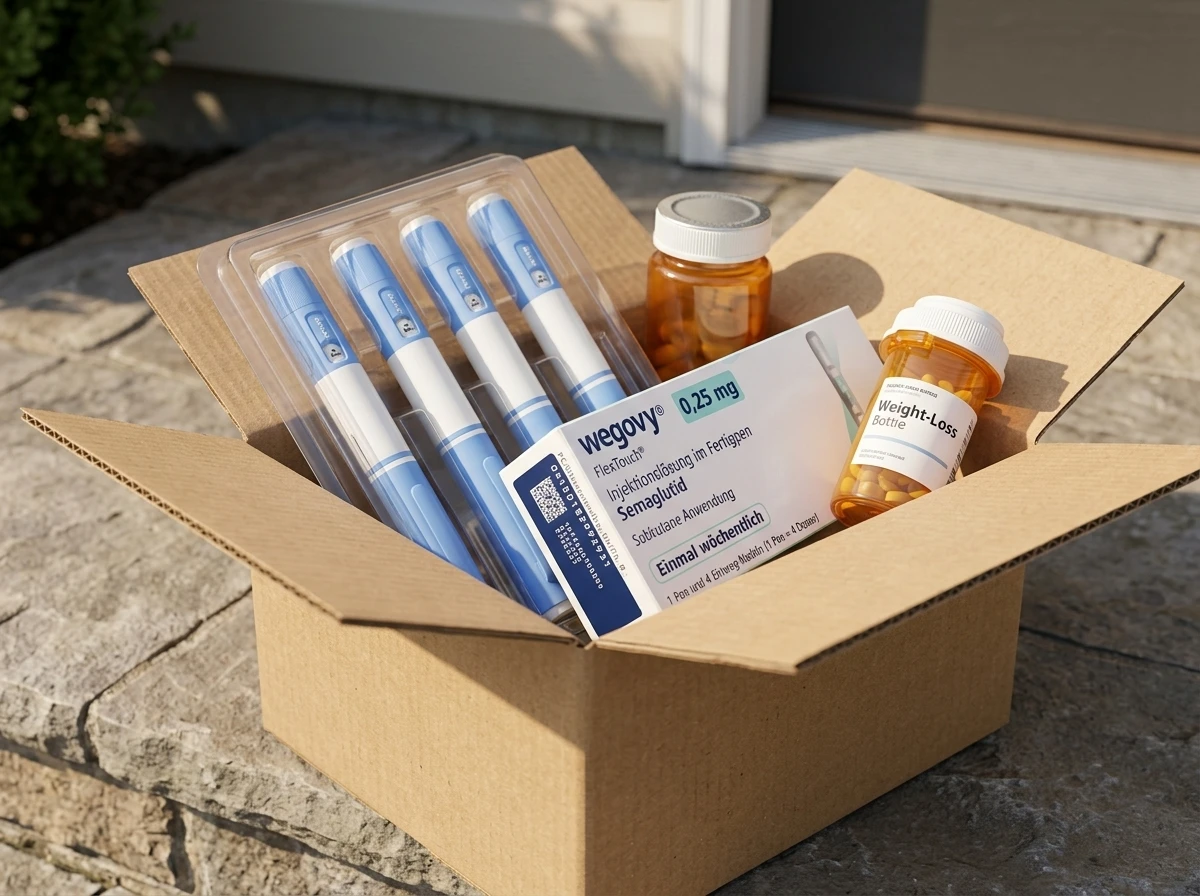
Amazon Automates the Paperwork Path
Amazon Pharmacy’s August 6 announcement focused on removing friction after the clinician sends an electronic prescription. Patients add the Bridge plan to their insurance profile with BIN 028918, PCN MEDDGLP1BR and their Medicare number. Amazon then handles eligibility verification, prior authorization support and billing.
Tanvi Patel, vice president and general manager of Amazon Pharmacy, said the goal is “no confusing paperwork, no prior authorization delays, no waiting at a pharmacy counter.” Free home delivery runs nationwide. Same-day delivery in more than 3,100 cities needs no Prime membership and is set to reach nearly 4,500 by year-end. Pickup at select One Medical kiosks is also available. Twenty-four-hour pharmacist access and caregiver account tools round out the offer.
Amazon has already processed claims into complete orders. The company frames broader coupon and pricing tools as having saved customers more than $300 million to date across medications including GLP-1s and insulin.
CVS Cuts the Visit Price and Links Lilly Pricing
CVS Health overhauled its direct-to-consumer weight-management stack on August 5. MinuteClinic digital weight-loss visits dropped to $29 MinuteClinic digital weight loss visits with no membership or recurring fee, available 24/7 in nearly every state for self-pay adults 18 to 64. A licensed clinician reviews history and goals, then can prescribe when clinically appropriate. Follow-ups cover dose changes and side effects.
CVS Pharmacy stocks all FDA-approved GLP-1s for insurance or cash-pay paths. A new collaboration with Eli Lilly lets eligible Zepbound and Foundayo patients see transparent pricing, including cash-pay options, inside the CVS Health app for same-day pickup at roughly 9,000 locations by early fourth quarter. Cash-pay with manufacturer vouchers can reach $149; commercially insured patients with coupons can hit $25. Pharmacists at those stores provide free start-and-stay support. CVS also participates in the Bridge program for qualifying Medicare patients.
Sid Tenneti, senior vice president and interim president of Pharmacy and Consumer Wellness, called weight management “a deeply personal health journey” and said the connected model removes fragmented handoffs.
Walmart Puts Pharmacists on Navigation Duty
Walmart and Sam’s Club launched a nationwide Medicare navigation push in June as the Bridge opened. The effort centers on education and one-on-one help rather than pure mail-order volume.
- Easy-to-read materials on coverage pathways
- One-on-one pharmacist consultations for Medicare beneficiaries
- Help navigating government and plan resources
- In-store support across nearly 5,000 locations, including rural markets
- Digital tools plus links to nutrition, wellness products and same-day pharmacy delivery
Kevin Host, senior vice president of Walmart Health & Wellness, said the aim is to help customers “access trusted information, understand their options, and feel confident navigating the healthcare system.” Roughly 90 percent of the U.S. population lives within 10 miles of a Walmart. The company operates about 4,600 pharmacies and already expanded its Better Care Services platform in April with virtual care, nutrition and GLP-1 support. It stocks FDA-approved options only, including Foundayo, and rejects compounded versions.
Who Qualifies Among the 3.8 Million
Eligibility is narrower than broad obesity prevalence. Patients must be 18 or older, enrolled in Part D, and prescribed a covered drug strictly for weight reduction and maintenance with lifestyle changes. They cannot have a diagnosis (type 2 diabetes, obstructive sleep apnea or MASH) that would make a GLP-1 coverable under ordinary Part D, even if the plan previously denied it. Prior 2026 Part D GLP-1 fills also block Bridge use.
Clinical thresholds at initiation:
- BMI of 35 or higher, or
- BMI of 30 or higher plus heart failure with preserved ejection fraction, uncontrolled hypertension, or chronic kidney disease stage 3a or above, or
- BMI of 27 or higher plus prediabetes, prior heart attack, prior stroke, or symptomatic peripheral artery disease
A KFF analysis of 2023 data found 3.8 million Part D enrollees potentially eligible after applying the clinical rules and exclusion diagnoses. That is about 8 percent of Part D enrollees. Another 5.9 million met BMI-related criteria but carried disqualifying diagnoses or prior fills. Overall, 13.3 million Medicare beneficiaries had BMI of 27 or higher recorded. CMS has spoken of “single-digit millions” at launch. Take-up rates will drive federal cost, which KFF modeled from roughly $1.3 billion to $10 billion depending on participation and adherence over 18 months.
How Far Prices Have Fallen Outside the Bridge
List prices for injectables once sat between $1,200 and $1,500 monthly. Cash-pay and coupon paths have already compressed for commercial and uninsured patients. Foundayo, approved in April 2026 as the first small-molecule oral GLP-1 without food or water restrictions, starts at $149 self-pay through LillyDirect for the lowest dose and can reach $25 with commercial coverage plus savings card. Higher doses climb toward $349 without programs. Zepbound and Wegovy commercial cash or coupon floors often land near $25 to $149 depending on the path.
The Bridge’s $50 floor for Medicare weight-loss use is lower still, but only for the narrow eligible pool and only until the end of 2027. Outside that window the statutory ban on Medicare weight-loss coverage remains unless a permanent model replaces it. For context on alternative interventions, an NYU study examined bariatric surgery compared with GLP-1 drugs and found substantially larger average weight loss with surgery.
These treatments are a major medical advancement, but too many seniors are currently unable to access them due to high cost. The Medicare GLP-1 Bridge changes that by making these medications more affordable and accessible.
CMS Administrator Dr. Mehmet Oz said that when the agency announced the demonstration. Chris Klomp, then director of Medicare, added that the design aims for simpler, more predictable access across the program.
The Temporary Window Is Building Permanent Pipes
The Bridge is explicitly a data-gathering and access demonstration under Section 402 authority. It was extended through 2027 after a related BALANCE model timeline shifted. CMS wants utilization and outcomes information to share with Part D sponsors before any broader coverage decision. In the meantime the three large retailers are installing automated PA handling, transparent pricing apps, same-day logistics and pharmacist navigation at national scale.
That infrastructure does not vanish when the demonstration ends. Amazon’s claim-to-door automation, CVS’s $29 clinician-plus-pickup loop, and Walmart’s rural pharmacist network create durable capacity for specialty volume. On X, the announcement drew immediate volume and stock-reaction posts focused on access and upside for Lilly and Novo Nordisk, while supply and sustained adherence remain the quieter variables. Patients still need lifestyle changes alongside the drugs; the medications lower appetite and “food noise” but rebound risk stays real without protein, movement and habit work.
For the next 16 months the practical effect is clear. Eligible seniors who clear the BMI and comorbidity gates can get authentic Wegovy, Zepbound KwikPen or Foundayo for $50 with far less paperwork friction than before, delivered or picked up through the chains that already sit closest to most American households.
Frequently Asked Questions
What is the Medicare GLP-1 Bridge program?
It is a short-term CMS demonstration running from July 1, 2026, through December 31, 2027, that lets eligible Part D members obtain certain weight-loss GLP-1 drugs for a flat $50 monthly copay outside the normal Part D payment system so plans carry no risk.
Which weight-loss drugs does the Bridge cover?
Only Wegovy (injection or oral), Zepbound KwikPen, and Foundayo for weight-loss use; Ozempic, Mounjaro, single-dose Zepbound pens or vials, 90-day supplies and pen needles are excluded.
Who is eligible for the $50 monthly copay?
Part D enrollees 18 or older who meet specific BMI thresholds (35+, or 30+ with listed heart/kidney/hypertension conditions, or 27+ with prediabetes or prior cardiovascular events) and who lack a diagnosis that would make the drug coverable under ordinary Part D, such as type 2 diabetes, OSA or MASH.
Does the $50 Bridge payment count toward my Part D deductible or out-of-pocket maximum?
No. The $50 sits completely outside Part D benefit calculations, so it does not apply to the deductible, TrOOP or low-income subsidy cost-sharing.
How long will the $50 Medicare price last?
The demonstration is scheduled to end December 31, 2027; after that date coverage reverts to existing statutory rules unless CMS implements a successor model with different terms.
Disclaimer: This article is for informational purposes only and does not constitute medical or insurance advice. Eligibility, coverage and clinical suitability must be confirmed with a licensed clinician and the official Medicare or plan resources.


NFL Three-Strike Safety Fouls Now Pull Coaches and Clubs In

Browns Fans Tape Protest Signs to Jim Brown Statue Over Watson

Amazon Pixel 11 Deal Erases the $100 Hike for One More Day

Elden Ring on Switch 2 Turns Its Own Worst Label Into a Portable Win

Ternus Takes the Stage With Apple’s Foldable Debut

Ikea Xbox Yxstaby Turns Controller Thumbstick Into Home Furniture

Pokémon Center Turns Past Worlds Wins Into Bundles and a Pikachu Coin

NFL Scraps Pro Bowl Game to Restore Pure Player Honor

New Twitter.now Bets the Brand Musk Left Behind

Bella Mir’s Famous First Loss Meets the Accountant Who Won

Double Fine Cuts 23 Jobs Weeks After Xbox Independence

Day-One Big Walk Lifts PS Plus August Beyond Recycled AAA

John Hight Exits Wizards After Digital Reckoning Hits

Curtis Mead’s Red Sox Debut Ends With Fractured Wrist

Moesch and Dressel Rewrite Night One at 2026 U.S. Nationals

Red Sox Squander Hot Streak Chance in 4-3 Loss to Athletics

Boutte’s Quiet Camp Takeover Forces Patriots Receiver Choices

Take-Two CEO Pushes Netflix Subs for GTA 6 Extended Look

Halo Campaign Evolved Skulls Meet Death Barriers That Kill the Hunt

Wildlands Free Update Hands Players the Tools They Already Invented
-

 TECHNOLOGY3 years ago
How to Adjust a Bulova Watch Band – An Easy Guide
-

 News3 years ago
Fred Pentland: Athletic Bilbao’s English mentor who changed the essence of Spanish football
-

 FINANCE3 years ago
Tax Planning for Every Season: Guide to Maximizing Your Tax Benefits
-

 Education3 years ago
African Ministers New Education Plan
-

 BUSINESS3 years ago
What is Entrepreneurial Operating System? A Comprehensive Guide to EOS
-

 Education3 years ago
Innovate Your Learning Journey with Technology and Enhance Education
-

 News3 years ago
Russians formally out of World Athletics Championships
-

 BUSINESS3 years ago
Top 9 Most Expensive American Cities to Rent an Apartment