
News
Anker’s sub-$25 kit fixes the portless laptop problem
Five Anker gadgets under $25 restore Ethernet, USB-A, HDMI and surge protection on thin laptops without buying expensive docks or Prime gear.

Five Anker accessories priced between roughly $13 and $23 restore Gigabit Ethernet, USB-A ports, 4K HDMI output and basic surge protection on thin USB-C-only laptops. BGR highlighted the set as overlooked kit builders that skip the $150-plus Prime chargers and wireless stations most people already know.
The second-order payoff is simple usability. Modern ultrabooks deleted the ports people still need every day; these small pieces put them back without a full dock.
Thin laptops created a daily port drought
MacBook Pros, Surface Pros and many Windows ultrabooks ship with only USB-C or Thunderbolt ports. Ethernet jacks vanished years ago. Full-size USB-A ports followed. HDMI often requires a dongle or cable that itself needs power.
Wi-Fi 6 and Wi-Fi 7 can top 1 Gbps in ideal conditions, yet competitive gaming, large downloads and 4K or 8K streams still suffer when apartments or offices pack devices onto the same band. A physical Ethernet link removes that variable. Legacy flash drives, older keyboards, gamepads and external hard drives still use USB-A. A single USB-C port on a laptop cannot feed a monitor, a drive and a charger at once without a hub.
High-end Anker Prime gear solves power density. It does little for the person who just needs a reliable link and three extra ports for under $25. That is the gap these five products fill.
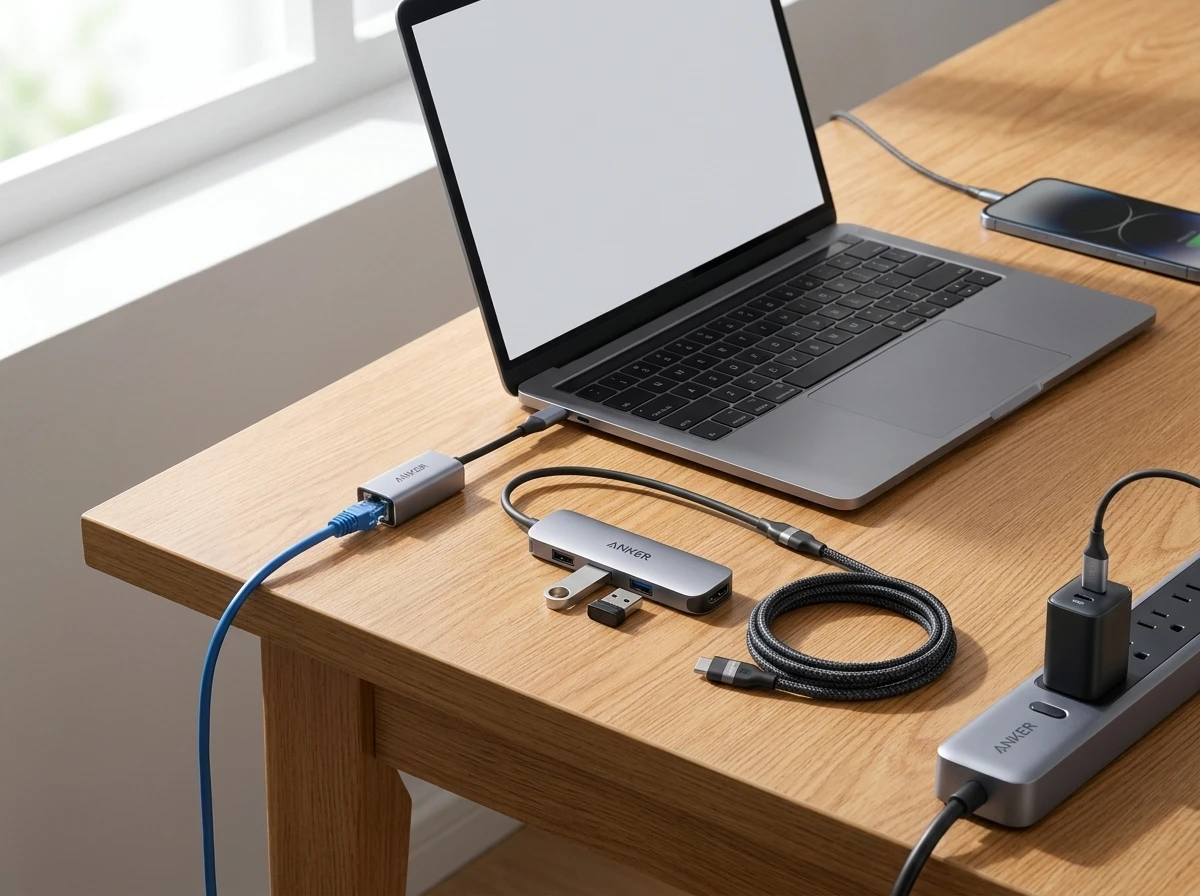
Ethernet that actually sticks on a MacBook
The USB-C to Gigabit Ethernet Adapter lists around $16.99 on Anker’s site and has recently sold near $15.50 on Amazon. It carries a single RJ45 port rated for 1 Gbps and uses a Realtek chipset common in this class. Aluminum housing keeps it small enough for a laptop sleeve.
BGR notes it works with modern MacBook Pros, iPhone 15 and newer, and recent Samsung Galaxy phones that support USB-C networking. Verified Amazon tallies in recent storefront snippets show roughly 4.8 stars across more than 6,400 ratings and thousands of monthly purchases. That volume matters more than any single lab test for a $16 part.
You lose mobility while tethered. You gain a stable pipe that does not drop when the microwave runs or the neighbor’s mesh network congests. For anyone who still edits video over a local drive or queues ranked matches, the adapter is the cheapest reliability upgrade available.
Legacy USB-A and a five-port desk fix
The Anker USB-C to USB 3.0 Adapter two-pack often sits near $9.99-$12.99. Each dongle turns a USB-C port into a full-size USB-A port so older flash drives, mice, keyboards and receivers still work on portless machines. They are tiny and easy to lose; BGR’s advice to keep a dedicated pouch is sound.
The larger step is the 5-in-1 USB-C Hub. Official specs list a 90W pass-through charging port (100W input with 10W reserved for the hub itself), one USB-A 3.0 port at 5 Gbps, two USB-A 2.0 ports at 480 Mbps, and an HDMI port that drives 4K at 30 Hz in mirror or extend mode. It is compatible with recent macOS, Windows 10/11 and ChromeOS machines that support DisplayPort Alt Mode and Power Delivery. Linux is explicitly unsupported.
| Product | Key ports / rating | Typical street price | Standout limit |
|---|---|---|---|
| USB-C to Ethernet | 1× Gigabit RJ45 | ~$15-17 | No extra data ports |
| USB-C to USB-A 2-pack | USB 3.0 data | ~$10-13 | Easy to misplace |
| 5-in-1 USB-C Hub | 90W PD in, 3× USB-A, 4K30 HDMI | ~$20 | HDMI capped at 30 Hz; PD port charges laptop only |
| 240W USB-C cable 6 ft | 240W PD, braided | ~$20-23 | Data limited to 480 Mbps |
| 10-in-1 power strip | 6 AC + 2C + 2A, 300J | ~$20 | Shared USB power drops when all ports used |
Gizmodo has tracked the hub near $20, down from a $25 list. That price puts a second display and three USB devices on one laptop port while the machine still charges. The HDMI ceiling at 30 Hz is fine for spreadsheets, browsing and most video; it is not a gaming external display. The pass-through port cannot feed peripherals or phones. Know those limits and the hub still earns its slot in a bag.
The cable that matches the charger you already own
A 30W or 40W wall charger is useless if the cable cannot carry the current. Anker’s 240W upcycled-braided USB-C cable is rated for the full 240W and sells for $19.99 on the official store in 3 ft, 6 ft and 10 ft lengths. BGR cited the 6-foot version near $22.99.
Official claims include over 30,000 bend cycles, USB-IF certification, soft PCR (post-consumer recycled) nylon braid, plastic-free packaging and 480 Mbps data. Compatibility covers recent iPhones, MacBook Air and Pro models, iPads, and many Windows and Android machines. BGR repeats Anker’s marketing that a 30W charger can push an iPhone 16 to 50 percent in about 30 minutes and that higher-wattage bricks can hit similar marks faster on newer phones, provided the phone and charger both support USB Power Delivery.
Crowd notes on X occasionally report braided Anker cables fraying inside a year of heavy pocket or bag use, faster than some older OEM cords. The braid still beats smooth PVC for abrasion resistance, and the 30,000-cycle lab figure is far above typical unbranded cables. Treat it as a high-duty daily cable rather than an heirloom and the math stays favorable.
One strip that feeds the whole desk and covers surges
The Anker 10-in-1 power strip with surge protection gives six AC outlets plus two USB-C and two USB-A ports. Street price has hovered near $20 against a higher list, according to deal coverage. The first USB-C port delivers up to 20W PD; the second is rated 15W. Together the USB ports share lower totals when several devices draw at once. USB-A ports top out at 12W shared.
Anker’s own user guide lists the 300J surge energy rating along with over-voltage, over-current, over-temperature and short-circuit protection, grounded outlets and fire-resistant construction. The company also advertises a $200,000 connected-equipment guarantee if the strip fails and damages attached gear.
- Six spaced AC outlets for a desktop, monitor, lamp and audio gear without blocking neighboring plugs.
- 20W USB-C PD that can charge a recent iPhone to roughly half in half an hour when used alone.
- 300J surge absorption plus multi-layer electrical protections and the equipment guarantee.
- Compact footprint with a cord long enough for most desks or dorm walls.
Three hundred joules is modest compared with 1,000J-plus whole-home or premium strips. It is still more protection than a bare wall outlet or an uncertified $8 no-name bar, and it is enough for ordinary brownouts and small spikes in apartments and offices. Anyone in lightning-prone areas or with five-figure audio or workstation gear should look higher; for phones, laptops and monitors the Anker unit covers the common case.
Why Anker owns the under-$25 shelf
Anker markets itself as the world’s No. 1 mobile charging brand by retail sales value for six straight years from 2020 through 2025, citing Euromonitor data completed in April 2026. The company claims more than 200 million global customers and presence in 146 markets. That scale funds the quality control, warranty support and Amazon review volume that no-name adapter brands rarely match.
BGR’s selection filter was deliberate: skip the obvious high-watt chargers and power banks most buyers already consider, require four-star-plus Amazon ratings with thousands of verified reviews, and stay under $25. The resulting list is not glamorous. It is the set of parts that turn a port-starved laptop into a usable daily machine.
Related coverage on this site has tracked both recent Anker back-to-school deals and 14-port Prime dock leftover pricing. Those higher-ticket items solve different problems. The sub-$25 layer solves the ones most people hit first.
Building the kit without overspending
A realistic starter set looks like this: Ethernet adapter for stable networking, two-pack USB-A dongles for legacy gear, the 5-in-1 hub for desk days, one 6-foot 240W cable, and the 10-in-1 strip for the wall. Street totals often land between $80 and $100 before tax if everything is bought at recent deal prices. That is less than many single premium docks.
Who benefits most are students, remote workers and anyone still carrying older drives or controllers alongside a new thin laptop. Who can skip pieces are pure wireless households with no Ethernet need, or users already invested in a full Thunderbolt dock. The power strip’s modest joule rating and the hub’s 30 Hz HDMI limit are real; they do not erase the value for ordinary desks.
Anker’s low end keeps the brand in bags and drawers long before anyone considers a $230 Prime power bank. That is how a charging specialist stays the default name when the next cable or adapter fails. The five pieces BGR flagged simply make the everyday machine work again.


Spotify Running Mode hits Android and revives its old tempo experiment

Galaxy Tab S12 Ultra Renders Keep the Notch Fans Hate

Novato Spinning Round House Sells With Six Neighbors for $3.3 Million

Crop Tour Finds Indiana and Nebraska Corn Yields Lagging 2025

Best Buy 60th sale brings Android deals back to its roots

American Airlines reverses seatback screen bet years too late

Iran Hormuz Strikes Force Gulf Oil Onto Costlier Paths

Plague Tale Prequel Day One Joins Game Pass Wave 2 as Witcher Exits

NBA 2K27 opens The City to everyone and rewrites career eras

iOS 26.6.1 Patches 29 Flaws as AI Forces Faster Apple Updates

Caitlin Clark Skips the WNBA 3-Point Contest for a Third Straight Year

Rainout Gives Red Sox Two Shots at a Franchise-Record Win Streak

Double Fine Cuts 23 Jobs Weeks After Xbox Independence

Day-One Big Walk Lifts PS Plus August Beyond Recycled AAA

John Hight Exits Wizards After Digital Reckoning Hits

Curtis Mead’s Red Sox Debut Ends With Fractured Wrist

Moesch and Dressel Rewrite Night One at 2026 U.S. Nationals

Red Sox Squander Hot Streak Chance in 4-3 Loss to Athletics

Boutte’s Quiet Camp Takeover Forces Patriots Receiver Choices

Take-Two CEO Pushes Netflix Subs for GTA 6 Extended Look
-

 TECHNOLOGY3 years ago
How to Adjust a Bulova Watch Band – An Easy Guide
-

 News3 years ago
Fred Pentland: Athletic Bilbao’s English mentor who changed the essence of Spanish football
-

 FINANCE3 years ago
Tax Planning for Every Season: Guide to Maximizing Your Tax Benefits
-

 Education3 years ago
African Ministers New Education Plan
-

 BUSINESS3 years ago
What is Entrepreneurial Operating System? A Comprehensive Guide to EOS
-

 Education3 years ago
Innovate Your Learning Journey with Technology and Enhance Education
-

 News3 years ago
Russians formally out of World Athletics Championships
-

 BUSINESS3 years ago
Top 9 Most Expensive American Cities to Rent an Apartment