
News
Claude Shared Chats Hit Google Again After the Same Old Gap
Hundreds of Claude share links briefly appeared in Google after users posted them, repeating OpenAI and Anthropic’s earlier robots.txt versus noindex miss.

Hundreds of Claude conversations created with Anthropic’s optional share feature briefly appeared in Google search after a Reddit user typed site:claude.ai/share and found public links sitting in the index. The results later vanished. The technical pattern did not.
PCMag, TechCrunch and others confirmed the weekend discovery, the sensitive material mixed into those pages, and Anthropic’s stance that users who post share URLs make the content public web pages. That framing matches earlier ChatGPT, Grok and Claude episodes. The durable lesson sits in how “anyone with the link” pages interact with crawlers when noindex is missing.
Hundreds of Share Links Hit Google Over a Weekend
On Saturday, July 25, 2026, a post in r/ClaudeAI showed that a simple site operator returned a long list of claude.ai/share URLs. Each page carried a conversation someone had chosen to make link-accessible, often with a first name or handle attached.
By Monday, 404 Media and TechCrunch had reported the find. TechCrunch’s test that afternoon already returned no Google hits for the same query, and PCMag later wrote that search engines appeared to have stopped surfacing the shared chats. Residual copies and third-party archives are a different problem.
- Initial public recovery: a GitHub archiver first mirrored on the order of 519 conversations while the window was open.
- Later archive growth: the same public archive of exported share links listed 755 Claude transcripts among a multi-model collection of 1,528 conversations.
- Prior Claude scale (2025): Google estimated just under 600 indexed Claude pages in the September 2025 episode reported by Forbes.
Artifacts, Claude’s shareable mini-apps and documents, also showed up under related public paths. Some of those were built to be public. Many of the plain chat shares looked like material meant for a colleague, a friend, or a small group.
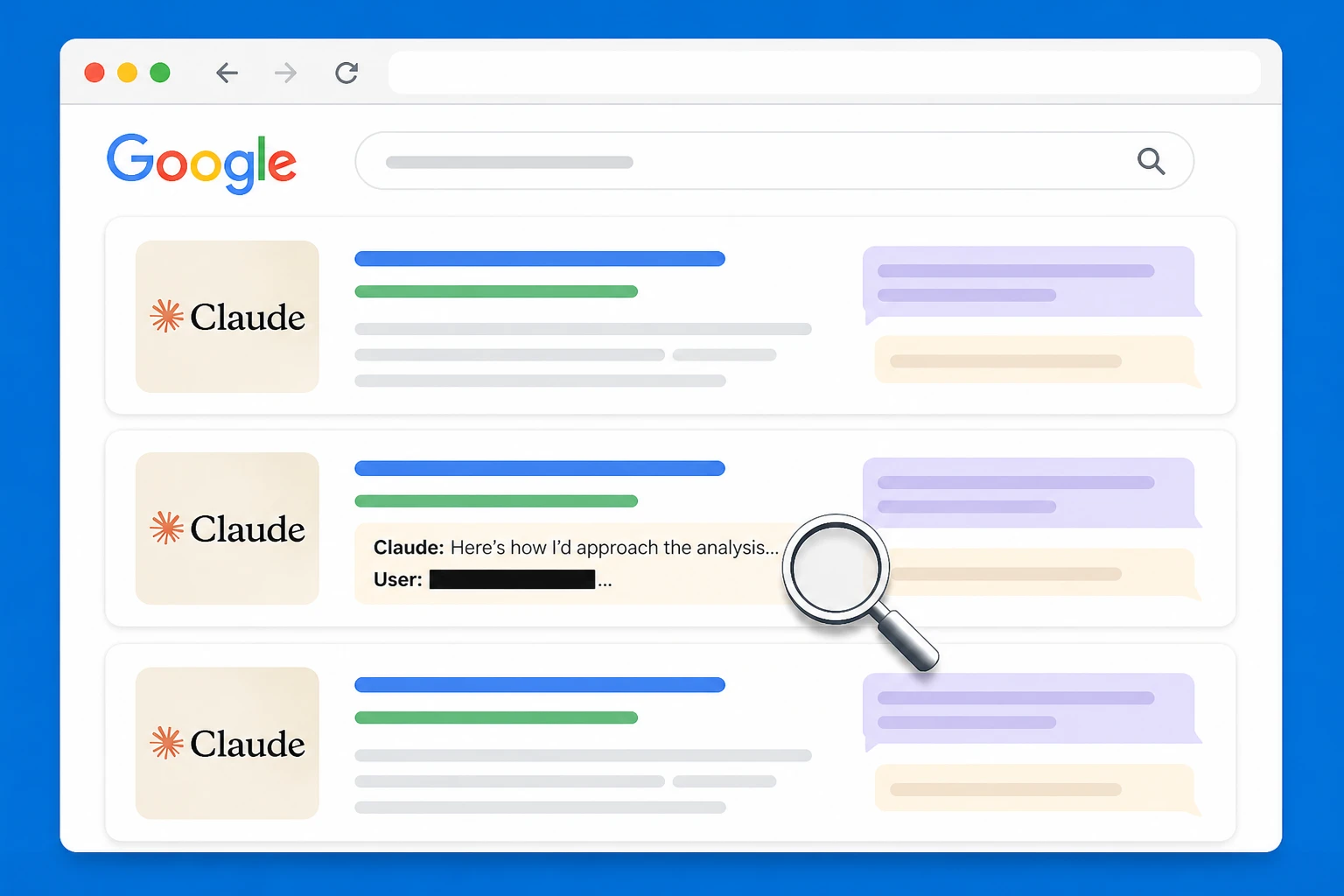
The Robots.txt Gap Google Already Documented
Anthropic blocks crawlers from claude.ai/share in robots.txt and says it does not hand search engines directories or sitemaps of shared chats. That is real. It is also incomplete as a privacy control.
Google’s own documentation states that robots.txt will not keep a page out of Google. A disallowed URL can still be discovered and indexed when it is linked from elsewhere on the open web. The result often shows as a URL with little or no snippet, the familiar “No page information” line, because the crawler never fetched the body.
| Control | What it does | What it fails to do |
|---|---|---|
| robots.txt Disallow | Asks polite crawlers not to fetch the URL | Stops the URL from entering the index if other pages link to it |
| noindex (meta or header) | Tells Google not to show the page in results once crawled | Works only if the crawler can reach the page to see the tag |
| Password or auth wall | Keeps content off the public web | Breaks casual “send this link” sharing |
| User never posts the link | Leaves the URL undiscovered in practice | Depends on every recipient and every paste staying private |
Google tells site owners it provides clear controls for crawl and index decisions and that it respects those directives. Spokesperson Ned Adriance told outlets that neither Google nor other engines control which pages people make public, and that the Claude share pages were indexed across many search engines. The missing piece on the share pages, according to multiple technical write-ups and user analysis, was a reliable noindex signal that crawlers could see.
Same Movie for ChatGPT, Grok and Claude Before
This was not Anthropic’s first pass at the problem, and not the industry’s.
- July 2025, OpenAI / ChatGPT: Shared conversations set as discoverable appeared in Google at large scale. 404 Media later described a researcher scrape on the order of 100,000 public ChatGPT conversations. OpenAI removed the option that made chats appear in search and worked to clear results. CISO Dane Stuckey called the experiment short-lived because it created too many chances to share things people never intended to broadcast.
- August 2025, xAI / Grok: Forbes reported hundreds of thousands of Grok share transcripts indexed and searchable, including extreme content, with weak user warning that search engines might list them.
- September 2025, Anthropic / Claude: Forbes found hundreds of Claude share pages in Google and Bing. Google put the count just under 600 before they disappeared. Anthropic used the same core message it used in 2026: users who post links make public pages; the company blocks crawlers and does not publish share sitemaps. Forbes also spoke with one identifiable user who said they had not posted their work chat online.
- July 2026, Anthropic / Claude again: Reddit’s site: operator revived the same class of URLs. Results were scrubbed from Google within days of the public notice.
Each vendor’s share product creates a real, unauthenticated webpage. Each time, some users treat that page like a private dropbox link. Each time, a paste on Reddit, X, Discord or a blog is enough for discovery. OpenAI eventually changed the product. Anthropic kept the share model and the robots.txt posture, then met the same indexing path twice.
Medical Files, Wallet Keys and Kids’ Numbers
Not every indexed page was explosive. Plenty were coding help, hobby prompts or conspiracy rants. The ones that drove the reaction were different.
Futurism reported reviewing, via Google, material that included a detailed medical report that appeared to belong to a real patient, clinical trial results with patient names, documents listing names and phone numbers of primary-school-aged children, internal-only company files, and employee reviews with personal worker details. TechCrunch summarized the same categories as health records, private company documents, and children’s names and numbers. Other roundups and the viral X thread described crypto seed phrases, API keys, resumes with addresses and phones, and chats that looked like social-security-number fragments.
- Health and clinical material tied to real identities
- School-age children’s contact details in shared documents
- Internal corporate files and staff performance notes
- Credentials, wallet seeds and API keys pasted into prompts
- Legal and ethics brainstorming a lawyer would not want public
- Erotica and jailbreak-style prompts that clashed with Claude’s stated usage rules
On X, builder Om Patel’s post explaining the indexing window drew millions of views. He wrote that Anthropic never added a noindex tag to those shared pages and that one line of code would have prevented the whole episode, then pointed people to Settings to revoke shares. Replies split hard. Some users insisted “share means share” and that the UI already says anyone with the link can view. Others treated the expectation gap as the product bug: people use share to send a transcript to one coworker, not to publish a searchable diary.
That crowd split is the practical risk surface for companies. Employees paste client data, strategy notes and credentials into assistants, then hit share for convenience. Once the URL exists on a crawlable page somewhere, the chat is ordinary public web content.
Anthropic Pins the Outcome on Posted Links
Anthropic’s response stayed consistent with 2025. Spokeswoman Amie Rotherham told TechCrunch the company gives people control over sharing, does not send chat directories or sitemaps to Google, and does not make share links guessable. When someone shares a conversation, she said, they make that content publicly accessible, and like other public web content it may be archived by third parties.
We give people control over sharing their Claude conversations publicly, and in keeping with our privacy principles, we do not share chat directories or sitemaps with search engines like Google. These shareable links are not guessable or discoverable unless people choose to share them themselves. When someone shares a conversation, they are making that content publicly accessible, and like other public web content, it may be archived by third-party services.
That is the company’s position, restated across PCMag, TechCrunch and Futurism. Futurism also noted that Artifacts carry a clearer warning that publishing can make content visible in search results, while the chat share flow stresses that anyone with the link can view without spelling out search-engine indexing in the same breath.
Google’s line matched the documentation: publishers control whether pages are indexed; engines respect the controls they are given. Neither side called the episode a breach of private accounts. The contested point is product design after two years of identical incidents across labs: whether a share page that is meant for narrow forwarding should ship without noindex by default, and whether “public link” copy is enough when users still dump medical and corporate text into the box.
How to Kill a Shared Claude Link
If you ever used Claude’s share control, the cleanup path is concrete. Anthropic exposes shared chats and artifacts under account privacy settings. PCMag and TechCrunch both directed users to Settings > Privacy (Your Data / Shared Chats, depending on the UI label) to list active shares and rescind access.
Revoking the share stops new viewers on that URL. It does not erase copies already scraped into archives, screenshots or other search engines’ residual caches. A link sent only inside a private messaging app is far less likely to be crawled than a link posted on a public forum. The safe habit for sensitive work is still copy-paste into a document you control, not a permanent public Claude URL.
Artifacts deserve a second look. Some were intentionally published as demos or personal sites. Others carried the same internal documents and notes that turned up in the chat share pile. The privacy settings surface covers both.
Frequently Asked Questions
Why did robots.txt fail to hide Claude share pages from Google?
Robots.txt only asks crawlers not to fetch a URL. Google can still learn the URL exists from inbound links and may list it with little or no snippet. Preventing appearance in results requires noindex (which the crawler must be allowed to see), authentication, or removing the public page. Anthropic’s Disallow rule matched crawler etiquette, not a hard privacy wall.
How do I remove a Claude conversation I already shared?
Open Claude, go to Settings, then Privacy (Your Data), and open the list of shared chats and artifacts. Rescind or delete each share you no longer want reachable. After revocation, new visitors should be blocked on that link, though third-party archives that already copied the text are outside Anthropic’s control.
Did OpenAI change ChatGPT sharing after its Google indexing episode?
Yes. After shared ChatGPT conversations became widely searchable in 2025, OpenAI removed the discoverability path that let chats appear in Google Search and said the feature created too many accidental-share risks. That product change is the clearest vendor fork from the “blame the pasted link” posture other labs kept.
Can a Claude share sent only in a private message still show up in Google?
Google’s crawlers need a publicly reachable link path. A URL that never leaves an encrypted private chat and is never posted on the open web is unlikely to be discovered. The moment that same URL is pasted into a public Reddit thread, a blog, an unauthenticated Discord, or an indexed GitHub issue, it becomes ordinary link bait for search engines.
Do Claude Artifacts carry a stronger search warning than chat shares?
Futurism reported that publishing an Artifact warns that the item will be accessible to anyone on the internet and potentially visible in search engine results. The standard chat share flow emphasizes that anyone with the link can view. Both create public pages; the Artifact copy is more explicit about search visibility.
The Google results for site:claude.ai/share went quiet again. The share button did not. Until AI labs treat every public transcript URL as a search document by default, the next archive will look a lot like this one.


Spotify Running Mode hits Android and revives its old tempo experiment

Galaxy Tab S12 Ultra Renders Keep the Notch Fans Hate

Novato Spinning Round House Sells With Six Neighbors for $3.3 Million

Crop Tour Finds Indiana and Nebraska Corn Yields Lagging 2025

Best Buy 60th sale brings Android deals back to its roots

American Airlines reverses seatback screen bet years too late

Iran Hormuz Strikes Force Gulf Oil Onto Costlier Paths

Plague Tale Prequel Day One Joins Game Pass Wave 2 as Witcher Exits

NBA 2K27 opens The City to everyone and rewrites career eras

iOS 26.6.1 Patches 29 Flaws as AI Forces Faster Apple Updates

Guardians Rout Twins With Seven Homers, Leave Joe Ryan One Shy of Record

Caitlin Clark Skips the WNBA 3-Point Contest for a Third Straight Year

Rainout Gives Red Sox Two Shots at a Franchise-Record Win Streak

Double Fine Cuts 23 Jobs Weeks After Xbox Independence

John Hight Exits Wizards After Digital Reckoning Hits

Day-One Big Walk Lifts PS Plus August Beyond Recycled AAA

Curtis Mead’s Red Sox Debut Ends With Fractured Wrist

Moesch and Dressel Rewrite Night One at 2026 U.S. Nationals

Red Sox Squander Hot Streak Chance in 4-3 Loss to Athletics

Boutte’s Quiet Camp Takeover Forces Patriots Receiver Choices
-

 TECHNOLOGY3 years ago
How to Adjust a Bulova Watch Band – An Easy Guide
-

 News3 years ago
Fred Pentland: Athletic Bilbao’s English mentor who changed the essence of Spanish football
-

 FINANCE3 years ago
Tax Planning for Every Season: Guide to Maximizing Your Tax Benefits
-

 Education3 years ago
African Ministers New Education Plan
-

 BUSINESS3 years ago
What is Entrepreneurial Operating System? A Comprehensive Guide to EOS
-

 Education3 years ago
Innovate Your Learning Journey with Technology and Enhance Education
-

 BUSINESS3 years ago
Top 9 Most Expensive American Cities to Rent an Apartment
-

 News3 years ago
Russians formally out of World Athletics Championships