
BUSINESS
Meta’s Louisiana Data Center Leaves Ratepayers Part of the Bill
Louisiana fast-tracked new gas plants for Meta’s $50 billion data center, and regulatory filings show ratepayers covering a share of the build-out costs.

Louisiana ratepayers will help cover the natural gas plants built to power Meta’s data center in Richland Parish, and their share starts at $470 million. Regulators approved the buildout in months rather than years, part of a $50 billion project state officials are calling a model for how America should build artificial intelligence infrastructure.
The New York Times’ account of the nine months of secrecy behind the deal cast that speed as an achievement. Utility filings, regulatory dockets and consumer watchdog groups tell a less flattering side: ratepayers who had no seat at the table are covering costs that Meta’s own contract does not.
Nine Months of Silence Built a $50 Billion Bet
The Times interviewed more than 40 people across Richland Parish, Baton Rouge, New Orleans, New York and Silicon Valley for its reporting, and reviewed corporate filings, tax records, property records and meeting transcripts. What they found was a deal built almost entirely out of public view.
Energy executives, Gov. Jeff Landry’s administration, and Meta representatives negotiated for nine months before anything became public. Phillip May, Entergy Louisiana’s chief executive, drove the process from the start. He invited Meta executives to the utility’s New Orleans headquarters in January 2024, where he pitched the state’s business-friendly government and its native oil and gas industry.
May stayed involved at every stage, from securing a tax rebate on data center equipment to buying nearby land and drafting nondisclosure agreements for government officials. Real estate outlet The Real Deal has reported that landowners near the site profited handsomely as land values in Richland Parish climbed alongside the project. Meta refers to the campus internally as Hyperion. It covers roughly six square miles of the Mississippi Delta.
Entergy Promised Power for Seven New Orleans
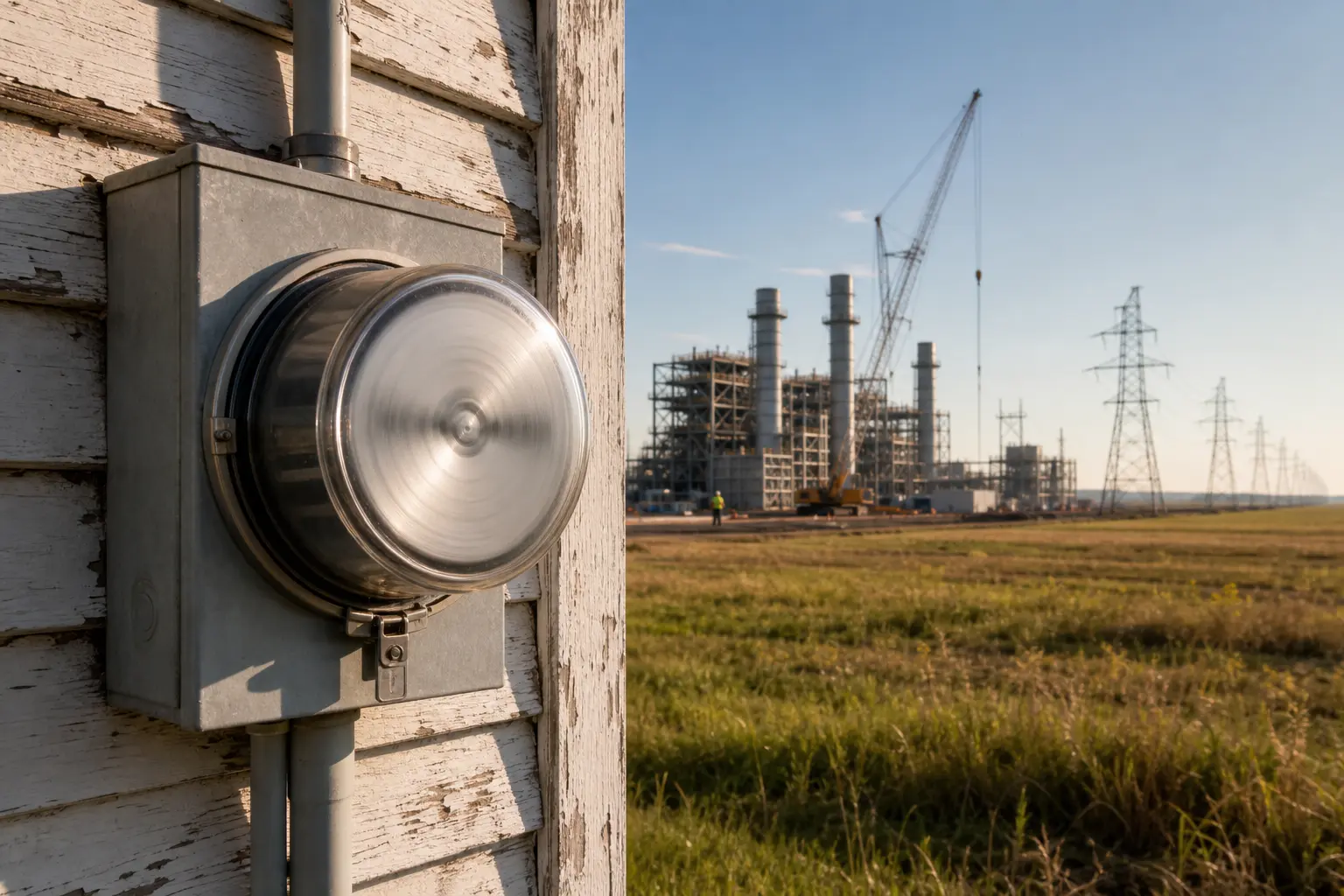
What separated Louisiana’s pitch from rival states was not tax breaks. It was electricity. Entergy promised to build dedicated gas turbines carrying enough capacity to power the city of New Orleans seven times over, a commitment no competing state could match on the same timeline.
The Louisiana Public Service Commission (LPSC, the state’s utility regulator) voted 4 to 1 in April to fast-track the turbine buildout under the state’s Lightning Initiative, part of Landry’s broader push to speed up approvals for major employers. Two of the three combined-cycle gas turbines are being built in Richland Parish and are due online in late 2028; a third, at Entergy’s existing Waterford site in St. Charles Parish, is expected by the end of 2029. Combined, the three carry a rated capacity of 2.26 gigawatts. Entergy has already broken ground on the plants, according to Louisiana news outlet NOLA.com.
That is only the first phase. Entergy’s full agreement with Meta calls for:
- Seven new gas-fired generating plants in total, of which three have cleared regulatory approval so far
- Up to 1,500 megawatts of solar power, authorized through an expedited certification process
- Three grid-scale batteries
- A potential uprate of Entergy’s existing Waterford 3 nuclear plant
Executives have said the campus could eventually scale to 5 gigawatts of capacity, well beyond the roughly 2 gigawatts the first wave of turbines was sized to support.
Who Pays for Meta’s Power
Entergy structured Meta’s contract so the company pays what the utility calls its “full cost of service” for dedicated power over 15 years. The physical plants and transmission lines built to deliver that power carry a different lifespan and a different bill.
Consumer advocates who reviewed the filings found the gap. The gas turbines are engineered to run for up to 40 years, a quarter-century longer than Meta’s contract guarantees. If Meta’s demand ever falls short of projections, other Entergy Louisiana customers could be left covering plants built primarily for one company.
| Party | Financial Stake | What It Means |
|---|---|---|
| Meta | 15-year dedicated power contract, plus $120 million for low-income bill assistance and $140 million for efficiency upgrades | Structured to cover its own “full cost of service,” per Entergy |
| Louisiana ratepayers | At least $470 million of gas-plant costs beyond Meta’s payments, plus a $550 million transmission line | Spread across every Entergy Louisiana customer, whether or not they live near the site |
| State of Louisiana | Roughly $3.3 billion in state and local tax breaks for Meta | Enacted in 2024 without an official cost estimate |
| Entergy Louisiana | Claims $2.65 billion in combined customer savings over 20 years | Figure spans two separate agreements with Meta |
Entergy Louisiana customer bills were already running 11% higher in July than a year earlier, according to an analysis from the Alliance for Affordable Energy, a Louisiana consumer advocacy group. The $550 million transmission line tied to the Meta buildout gets billed to all customers regardless of how much power the data center ultimately draws, the Union of Concerned Scientists found in its review of the regulatory dockets.
Where Regulators and Watchdogs Split
Not everyone reading the same filings reaches the same conclusion. The disagreement breaks down roughly along these lines:
- Consumer and watchdog groups, including the Union of Concerned Scientists and the Alliance for Affordable Energy, say regulators moved too fast and left ratepayers exposed to decades of cost if Meta’s power demand ever falls short of projections.
- Entergy Louisiana says Meta is paying its own way and that the combined agreements net out to billions in customer savings, including dedicated funding for low-income households.
- Governor Landry and state economic development officials frame the fast-tracked approvals as proof Louisiana can close deals other states move too slowly to land.
The commission’s own vote reflected some of that tension. One of five commissioners voted against the fast-tracked plan even as the other four approved it.
The Savings Pitch Comes With Fine Print
Entergy’s newest agreement with Meta, layered on top of $650 million the utility had already pledged, is projected to deliver $2 billion in customer savings over 20 years. Combined, the two deals add up to the $2.65 billion figure Entergy now cites publicly.
Some of Meta’s payments are earmarked for specific programs. Entergy says $120 million, with matching contributions, will fund its low-income bill assistance program, and another $140 million will go toward efficiency upgrades for customers with limited means.
Those savings figures do not offset the $470 million ratepayers separately owe toward the three new gas turbines, or the $550 million transmission line, which sit in a different accounting bucket in the same filings. The two sets of numbers describe different parts of the same deal.
The Tax Side of the Deal
Energy costs are only part of what Louisiana put on the table. Landry signed a law making data centers built before 2029 exempt from state and local sales taxes for 20 years, covering everything from servers to chillers to construction materials.
Meta’s agreement with Louisiana Economic Development and Richland Parish officials also ties its property tax bill to investment and hiring. Local station KTVE has reported that Meta’s rate drops to 40% of the standard property tax once its investment reaches $5 billion and 300 permanent jobs are created, and to 20% once investment hits $10 billion.
Fortune’s review of state filings put Meta’s combined state and local tax breaks at roughly $3.3 billion. Louisiana passed its data center sales tax exemption in 2024 without producing an official cost estimate, according to the Institute on Taxation and Economic Policy, a nonpartisan tax research group. Louisiana is not alone in the rush. Applied Digital has separately broken ground on a $3.6 billion Louisiana AI campus under similar state incentives, a sign the Meta deal is a template rather than a one-off.
Why Did Officials Who Approved the Deal Sign NDAs Too
Some Louisiana officials who voted for legislation supporting the project did not know its full details when they cast their votes. Nondisclosure agreements covered state and local officials throughout the nine-month courtship, and some remained bound even after the project became public.
Public radio station WWNO has reported that NDAs have cloaked many of Louisiana’s biggest business developments in recent years, limiting what elected officials can say about deals even after they take effect. The Meta project followed that same pattern, using confidentiality agreements to keep tax rebate negotiations, land purchases and turbine contracts out of public view until the state and the company were ready to announce a finished deal.
The first real test of the arrangement lands in late 2028, when the initial Richland Parish turbines are due online. The Waterford unit follows about a year later. That is when the promises on both sides of the ledger, Entergy’s customer savings and the watchdogs’ cost warnings, start showing up in actual electricity bills.
Frequently Asked Questions
How Many Jobs Will Meta’s Louisiana Data Center Create?
Entergy’s agreement materials point to thousands of construction jobs between 2026 and 2031, plus permanent roles in engineering, maintenance and support once the campus is operating. Meta’s incentive deal with Richland Parish requires at least 300 permanent jobs to unlock the deepest property tax discount.
Will Any of the New Power Come From Solar or Nuclear Instead of Gas?
Yes. Alongside the gas turbines, Louisiana regulators authorized Entergy to procure up to 1,500 megawatts of solar power through an expedited process, and the companies’ broader agreement includes three grid-scale batteries and a possible uprate of the Waterford 3 nuclear plant.
Does Louisiana Know How Much the Tax Breaks Will Cost the State?
Not precisely. Louisiana created its data center sales tax exemption in 2024 without producing an official price tag, and state officials have not published an updated estimate since Meta’s investment grew to $50 billion.
Has Construction Started on the Louisiana Site?
Yes. Entergy has broken ground on the new generating plants tied to the project, and site work is underway at the Richland Parish campus, though the first turbines are not due online until late 2028.
What Does Meta Call the Louisiana Data Center Internally?
Meta refers to the project as Hyperion. It is described as the most expansive data center campus the company has ever built, with the potential to reach five gigawatts of capacity across its full build-out.


Spotify Running Mode hits Android and revives its old tempo experiment

Galaxy Tab S12 Ultra Renders Keep the Notch Fans Hate

Novato Spinning Round House Sells With Six Neighbors for $3.3 Million

Crop Tour Finds Indiana and Nebraska Corn Yields Lagging 2025

Best Buy 60th sale brings Android deals back to its roots

American Airlines reverses seatback screen bet years too late

Iran Hormuz Strikes Force Gulf Oil Onto Costlier Paths

Plague Tale Prequel Day One Joins Game Pass Wave 2 as Witcher Exits

NBA 2K27 opens The City to everyone and rewrites career eras

iOS 26.6.1 Patches 29 Flaws as AI Forces Faster Apple Updates

Double Fine Cuts 23 Jobs Weeks After Xbox Independence

Day-One Big Walk Lifts PS Plus August Beyond Recycled AAA

John Hight Exits Wizards After Digital Reckoning Hits

Curtis Mead’s Red Sox Debut Ends With Fractured Wrist

Moesch and Dressel Rewrite Night One at 2026 U.S. Nationals

Red Sox Squander Hot Streak Chance in 4-3 Loss to Athletics

Boutte’s Quiet Camp Takeover Forces Patriots Receiver Choices

Take-Two CEO Pushes Netflix Subs for GTA 6 Extended Look

Halo Campaign Evolved Skulls Meet Death Barriers That Kill the Hunt

Wildlands Free Update Hands Players the Tools They Already Invented
-

 TECHNOLOGY3 years ago
How to Adjust a Bulova Watch Band – An Easy Guide
-

 News3 years ago
Fred Pentland: Athletic Bilbao’s English mentor who changed the essence of Spanish football
-

 FINANCE3 years ago
Tax Planning for Every Season: Guide to Maximizing Your Tax Benefits
-

 Education3 years ago
African Ministers New Education Plan
-

 BUSINESS3 years ago
What is Entrepreneurial Operating System? A Comprehensive Guide to EOS
-

 Education3 years ago
Innovate Your Learning Journey with Technology and Enhance Education
-

 News3 years ago
Russians formally out of World Athletics Championships
-

 BUSINESS3 years ago
Top 9 Most Expensive American Cities to Rent an Apartment