
News
Hyena Matriarchs Turn Privilege Into Clan-Wide Dynasties
A 29-year pedigree of 2,700 hyenas shows maternal rank inheritance reverses sex differences in reproductive success across generations, explaining female dominance.

A 29-year pedigree of more than 2,700 spotted hyenas across eight generations in Tanzania shows that reproductive inequality among females overtakes males once grandchildren enter the count, driven by maternal rank that high-status daughters never lose.
The finding, published in Science Advances by the Ngorongoro Hyena Project, supplies the missing mechanism for why females fight harder for status in this species and identifies a third evolutionary route to female-biased competition.
What the Pedigree Measured
Researchers from the Leibniz Institute for Zoo and Wildlife Research and the Institut des Sciences de l’Évolution de Montpellier tracked eight clans inside the Ngorongoro Crater. They identified 2,743 individuals and calculated reproductive success four ways: annual offspring, lifetime offspring, grandoffspring and great-grandoffspring.
On an annual basis the pattern looked ordinary. The multinomial M-index of inequality stood at 0.18 for females and 0.40 for males. Lifetime offspring numbers stayed roughly even. Then the curve bent.
For grandoffspring the female M-index jumped to 3.53 while the male index reached only 1.91. For great-grandoffspring the gap widened further to 7.50 versus 4.41. Lorenz curves told the same story: the top 4 percent of females produced half of all great-grandoffspring.
| Measure | Female M-index | Male M-index |
|---|---|---|
| Annual offspring | 0.18 | 0.40 |
| Lifetime offspring | 0.76 | 0.78 |
| Grandoffspring | 3.53 | 1.91 |
| Great-grandoffspring | 7.50 | 4.41 |
The same figures, read as a sequence, show where the sexes diverge. Annual and lifetime tallies keep males level with females or ahead. The first multi-generation step reverses that order, and the second step widens it.
- Annual offspring: males lead (0.40 against 0.18)
- Lifetime offspring: nearly tied (0.78 against 0.76)
- Grandoffspring: females pull ahead (3.53 against 1.91)
- Great-grandoffspring: the female lead grows again (7.50 against 4.41)
Lead author Marta Mosna of the Leibniz-IZW noted that short windows hide the real skew. The full study in Science Advances and the accompanying Leibniz-IZW summary of the findings make the numbers plain.
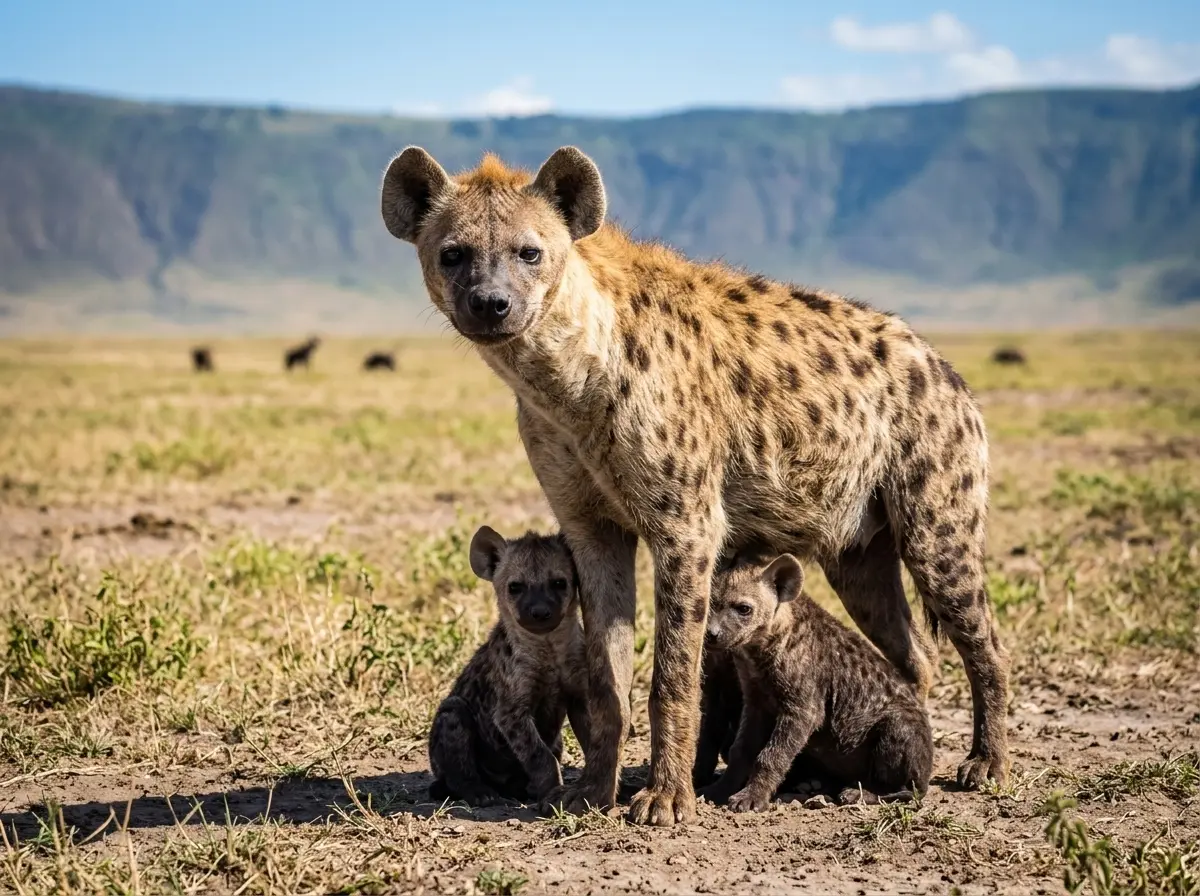
How Rank Becomes a Dynasty
Spotted hyena clans run on linear dominance hierarchies topped by an alpha female. Offspring inherit their mother’s rank. High rank brings immediate payoffs that compound only for daughters.
- Priority access to carcasses and kills
- Faster growth and higher cub survival
- Earlier first reproduction and shorter intervals between litters
- Longer adult lifespan
Females stay in their natal clan for life and keep the rank their mother handed them. Sons receive the same early boost, then leave. When a young male disperses to a new clan he drops to the bottom of the hierarchy and starts over with no inherited status to pass on.
Philemon Naman, a field assistant on the project, put it simply: offspring inherit rank from the mother, and that rank decides who eats first. High-ranking females convert the advantage into more surviving descendants every generation. Alpha females account for roughly 10 percent of a clan’s offspring in one generation and 20 percent of the next generation’s grand-offspring. After six generations virtually every living hyena traces back to the original matriarch lines.
Those successive shares matter because each step multiplies the last. A matriarch line that claims one tenth of a generation’s births already claims one fifth of the births two steps down. Lower-ranking female lineages shrink and often vanish. The monopoly is quiet and cumulative rather than a single violent takeover.
The Male Dispersal Reset
Male spotted hyenas almost always leave home at maturity. The move erases maternal privilege. Immigrant males sit below every female and every natal male still in the clan. They must climb the ladder through aggression, coalitions and time, none of which they can bequeath automatically to their own sons.
Dr. Oliver Höner, co-director of the Ngorongoro Hyena Project field site, explained the consequence: males cannot turn a privileged start into multi-generation dynasties the way high-ranking females can. The sex difference in dispersal therefore becomes the engine of the inequality reversal.
Short-term tallies still show males with higher variance in mates and annual offspring, exactly as the Darwin-Bateman paradigm expects. Only the multi-generation lens reveals that female competition is the stronger long-term filter.
If you only measure offspring, you might conclude that there is little inequality among females and therefore weaker competition among them, and that males are the more competitive sex. However, if you measure across generations, you see the opposite, finally explaining why females are the more competitive sex among hyenas!
Mosna said that in the institute release. The observation matches earlier work from the same long-term study showing that social support, not raw body size, underpins female dominance over males.
The reset is structural, not accidental. Every son who leaves home breaks the chain that every daughter preserves. That single demographic rule turns a shared early advantage into a female-only dynasty engine.
A Third Path Beyond Seahorses and Meerkats
Female-biased reproductive inequality already appears in two familiar cases. Male seahorses carry the pregnancy, flipping parental investment. Meerkat alpha females suppress breeding by subordinates through aggression and eviction. The hyena system supplies a third route: pure social inheritance of privilege along the maternal line, without male pregnancy or active reproductive suppression of all other females.
| Route | Core mechanism | Requires active suppression? |
|---|---|---|
| Seahorses | Male pregnancy reverses investment | No |
| Meerkats | Alpha female aggression and eviction | Yes |
| Spotted hyenas | Stable maternal transmission of rank | No |
Co-author Dr. Alexandre Courtiol of the Leibniz-IZW called it exactly that, a third route to the same outcome. Maternal inheritance of status also occurs in other mammals and in humans. Whether those systems produce similar multi-generation reversals remains open, but the hyena data now give a clear quantitative template.
The project itself has run continuous long-term monitoring since 1996, producing an almost complete genetic pedigree across nine generations and more than 2,500 individuals. That depth is what made the generational flip visible.
What Extreme Female Inequality Changes
When a handful of matrilines monopolize descendants, genetic diversity inside the clan narrows faster than short-term models predict. Natural selection on female traits linked to rank and coalition-building intensifies. Male traits still face sexual selection, yet the long-term reproductive filter sits heavier on the female side.
Crowd discussion of the paper on X quickly latched onto the dynastic angle: alpha lines do not merely stay successful, they expand until the rest of the female population’s genetic contribution shrinks toward zero. That pressure explains the high aggression and status striving already documented among female hyenas. It also explains why low-ranking females face steeper fitness cliffs than low-ranking males once the clock runs past one generation.
Dr. Eve Davidian, co-director at ISEM, summarized the key insight: privileged lineages did not just remain successful, they grew ever larger. The preprint with full methods and M-index data lays out the statistical path from annual counts to great-grandoffspring skew.
The top 4 percent of females producing half of all great-grandoffspring is the arithmetic endpoint of that expansion. Selection has fewer independent female lines left to work on, and more of the clan’s future funnels through the same high-rank coalitions.
Life Inside the Matriarchal Clan
Clans can hold 80 to 130 members. Females are larger and more aggressive than males on average. They form coalitions that decide daily contests over food and space. Cub mortality is high for everyone, yet the rank gap in survival and growth appears early and never closes for daughters who stay home.
Males who remain natal for a time keep some maternal rank benefits, but most eventually disperse. The demographic result is a society in which immigrant males form a permanent lower tier while female lines accumulate power across decades. Earlier papers from the same project showed that social support networks, not individual fighting ability alone, let females dominate adult males.
The new work does not overturn those mechanisms. It shows their multi-generation arithmetic. High-ranking mothers produce more daughters who themselves become high-ranking mothers. The feedback loop is simple and relentless.
The Feedback Loop Runs Through Daughters
Each payoff listed for high rank feeds the next generation only when the beneficiary stays and breeds in place. Daughters do both. They keep priority at carcasses, keep the growth and survival edge, keep earlier and more frequent litters, and keep the longer adult lifespan that multiplies those litters.
Sons receive the same list for a season or two, then forfeit it at dispersal. Their later success depends on climbing a foreign hierarchy from the bottom, a climb their own sons will not inherit. The maternal line therefore retains every compounding step the paternal line discards.
That asymmetry is why the M-index stays ordinary on annual and lifetime offspring counts and then bends once grandoffspring enter the ledger. The first generation still looks balanced. The second generation already carries the doubled share that alpha lines claim. By the sixth generation the original matriarch lines have absorbed virtually the whole living clan.
- Birth: cub takes rank just below its mother
- Early life: high rank raises survival, growth and speed to first litter
- Adulthood: daughters keep the rank; sons leave and restart at the bottom
- Next generation: high-ranking daughters hand the same rank to their own young
- Six generations on: nearly every living hyena traces to the founding matriarch lines
The loop needs no active eviction of every rival female and no reversal of pregnancy. Stable transmission of rank, plus female philopatry, is enough to turn a modest annual edge into extreme multi-generation inequality.
Why Low Ranking Females Fall Faster
Low-ranking males still face harsh short-term odds, yet the dispersal reset gives their sons a fresh start in a new clan. Low-ranking females hand their disadvantage straight to daughters who remain at home. The fitness cliff therefore steepens with each generation on the female side alone.
That pattern matches the aggression and status striving already recorded among females. When the long-term filter weighs heavier on one sex, contest behavior tracks that filter. Social support networks become decisive because they defend the rank that daughters will inherit, not merely the meal in front of the group.
The same arithmetic narrows the set of female lines that contribute to future clans. Genetic diversity contracts faster than single-generation models expect, and selection on coalition-building and rank-related traits intensifies among the females who remain in the pedigree.
Male sexual selection continues. Immigrant males still compete for mates through aggression, coalitions and time. Their victories, however, do not found dynasties. The multi-generation ledger keeps scoring the larger inequality on the maternal side.
Frequently Asked Questions
What is the Darwin-Bateman paradigm and how do hyenas challenge it?
The paradigm holds that anisogamy and higher female parental investment produce greater reproductive variance and stronger sexual selection in males. Spotted hyenas match it on annual and lifetime offspring counts, yet reverse it once grandoffspring and great-grandoffspring are counted, because maternal rank inheritance compounds only on the female side.
How exactly do spotted hyena cubs inherit social rank?
Offspring take a rank just below their mother and above her younger sisters. The rule is social, not genetic. Daughters keep that position for life inside the natal clan; sons lose it upon dispersal to a new group where they enter at the bottom.
Why do male hyenas leave their birth clan?
Male natal dispersal is the norm in spotted hyenas. It reduces inbreeding and is reinforced by female mate choice for immigrant males. The move strips males of maternal privilege, preventing the formation of multi-generation paternal dynasties.
What makes this a third evolutionary route to female competition?
Seahorses reverse investment via male pregnancy. Meerkats use active suppression by a single breeding female. Hyenas achieve female-biased long-term inequality solely through stable maternal transmission of rank and privilege without either of those mechanisms.
How large was the dataset behind the inequality reversal?
The analysis used 2,743 individually known hyenas from eight clans, spanning 29 years and eight generations, with nearly complete genetic pedigree information collected since continuous monitoring began in 1996.


Spotify Running Mode hits Android and revives its old tempo experiment

Galaxy Tab S12 Ultra Renders Keep the Notch Fans Hate

Novato Spinning Round House Sells With Six Neighbors for $3.3 Million

Crop Tour Finds Indiana and Nebraska Corn Yields Lagging 2025

Best Buy 60th sale brings Android deals back to its roots

American Airlines reverses seatback screen bet years too late

Iran Hormuz Strikes Force Gulf Oil Onto Costlier Paths

Plague Tale Prequel Day One Joins Game Pass Wave 2 as Witcher Exits

NBA 2K27 opens The City to everyone and rewrites career eras

iOS 26.6.1 Patches 29 Flaws as AI Forces Faster Apple Updates

Caitlin Clark Skips the WNBA 3-Point Contest for a Third Straight Year

Rainout Gives Red Sox Two Shots at a Franchise-Record Win Streak

Double Fine Cuts 23 Jobs Weeks After Xbox Independence

Day-One Big Walk Lifts PS Plus August Beyond Recycled AAA

John Hight Exits Wizards After Digital Reckoning Hits

Curtis Mead’s Red Sox Debut Ends With Fractured Wrist

Moesch and Dressel Rewrite Night One at 2026 U.S. Nationals

Red Sox Squander Hot Streak Chance in 4-3 Loss to Athletics

Boutte’s Quiet Camp Takeover Forces Patriots Receiver Choices

Take-Two CEO Pushes Netflix Subs for GTA 6 Extended Look
-

 TECHNOLOGY3 years ago
How to Adjust a Bulova Watch Band – An Easy Guide
-

 News3 years ago
Fred Pentland: Athletic Bilbao’s English mentor who changed the essence of Spanish football
-

 FINANCE3 years ago
Tax Planning for Every Season: Guide to Maximizing Your Tax Benefits
-

 Education3 years ago
African Ministers New Education Plan
-

 BUSINESS3 years ago
What is Entrepreneurial Operating System? A Comprehensive Guide to EOS
-

 Education3 years ago
Innovate Your Learning Journey with Technology and Enhance Education
-

 BUSINESS3 years ago
Top 9 Most Expensive American Cities to Rent an Apartment
-

 News3 years ago
Russians formally out of World Athletics Championships