
BUSINESS
Taco Bell $1 Deals Speed Recovery After Cyclospora Hit
Taco Bell’s dollar Mexican Pizzas and Enchiritos reverse traffic drops after 1,947 cyclospora cases linked to Taylor Farms lettuce, but discounting deepens.

Taco Bell is flooding the app and counters with $1 Mexican Pizzas and lettuce-free Enchiritos after a cyclospora outbreak tied to its supplier’s iceberg lettuce drove double-digit traffic drops. Parent Yum Brands says the sales hit already looks temporary.
The chain removed the implicated produce on July 17 and is now pairing deep discounts with limited-time items to pull customers back before the summer sales window closes.
Nearly Two Thousand Cases Tied to One Supplier
Federal investigators linked the illnesses to shredded iceberg lettuce from Taylor Farms de Mexico that reached certain Taco Bell restaurants. The 1,947 confirmed cases linked to Taco Bell span nine states: Illinois, Indiana, Kansas, Kentucky, Michigan, Ohio, Oklahoma, Pennsylvania and West Virginia.
Illness onsets ran from June 22 through July 20. At least 98 people were hospitalized. No deaths were reported. Michigan and Ohio recorded the heaviest loads. CDC notes the true toll is higher because many people never get tested.
- 1,947 laboratory-confirmed cases with Taco Bell exposure
- 98 hospitalizations, zero deaths
- 9 states in the official cluster
- Onset window June 22 to July 20
Ingredient interviews showed roughly 90 percent of a Michigan sample of sick diners had eaten iceberg lettuce. FDA traceback converged on the same central Mexico source. That concentration of exposure in a single sample gave investigators a clear signal even before the full multi-state picture locked in.
- July 14, 2026: Early multi-state investigation notes more than 400 cases in four states.
- July 16-17: Link to Taco Bell shredded iceberg and Taylor Farms de Mexico publicly established; Taco Bell begins full removal.
- July 17: Taylor Farms issues voluntary recall of central Mexico iceberg and suspends production from the region.
- July 24: Case count reaches 1,947 confirmed with four added states.
A later FDA sample initially flagged positive was ruled a false positive and removed from the public record. Epidemiologic and traceback evidence still points to the same lettuce. The false positive did not slow the removal timeline. By the time the lab correction landed, the product was already out of restaurants and the recall was already public.
The roughly four-week onset window, from late June into mid-July, left little room for a quiet fix. Once public health agencies named the chain and the supplier, the story moved from investigation to consumer reaction in a matter of days.
Traffic Fell Hard Then Began to Stabilize
Placer.ai foot-traffic data showed sharp daily drops once the FDA and CDC public links landed. Visits fell roughly 18 percent on July 15, nearly 31 percent on July 17, and 20.8 percent on July 23 versus the day-of-week average from January through early July.
| Date | Reported Traffic Change | Source Context |
|---|---|---|
| July 15 | Down ~18% | Early public reports |
| July 17 | Down nearly 31% | Day of strong linkage and removal |
| July 18 | Down 29.8% | Saturday comparison |
| July 23 | Down 20.8% | Thursday vs Jan-July average |
The worst single day lined up with the strongest public linkage and the start of the full lettuce removal. That pattern suggests diners reacted to the news itself as much as to any change inside the restaurants. Softening from nearly 31 percent down to 20.8 percent within a week pointed to an early floor forming even before the heaviest promotions hit.
Other chains that use similar produce also saw softer traffic as diners grew wary of lettuce in general. Yum Brands reported on its July 30 earnings call that Taco Bell same-store sales ran about 2 percent lower from the end of June through July 27. CEO Chris Turner called it a “meaningful sales hit in the short term” that the company expects to prove temporary.
“Over the last ten days, we have seen sales trends steadily improving,” Turner said. CFO comments added that declines had “moderated materially.” Shares rose after the update. The second-quarter numbers themselves, which largely pre-dated the outbreak, remained strong: Taco Bell same-store sales grew 7 percent and system sales rose 9 percent.
That gap between a 2 percent same-store sales dip and the steeper daily traffic drops reflects how the outbreak compressed into the final stretch of the quarter. Momentum from earlier weeks still carried the printed results. The live traffic data told the sharper story of what happened once headlines landed.
Two Dollar Deals in One Week
Taco Bell’s counter-attack arrived as one-day or short-window $1 offers on items that skip lettuce or already sit high on the popularity chart.
- $1 Enchirito (flour tortilla, ground beef, beans, onions, cheddar, red sauce) on July 22, lettuce-free, limit five per purchase at participating locations.
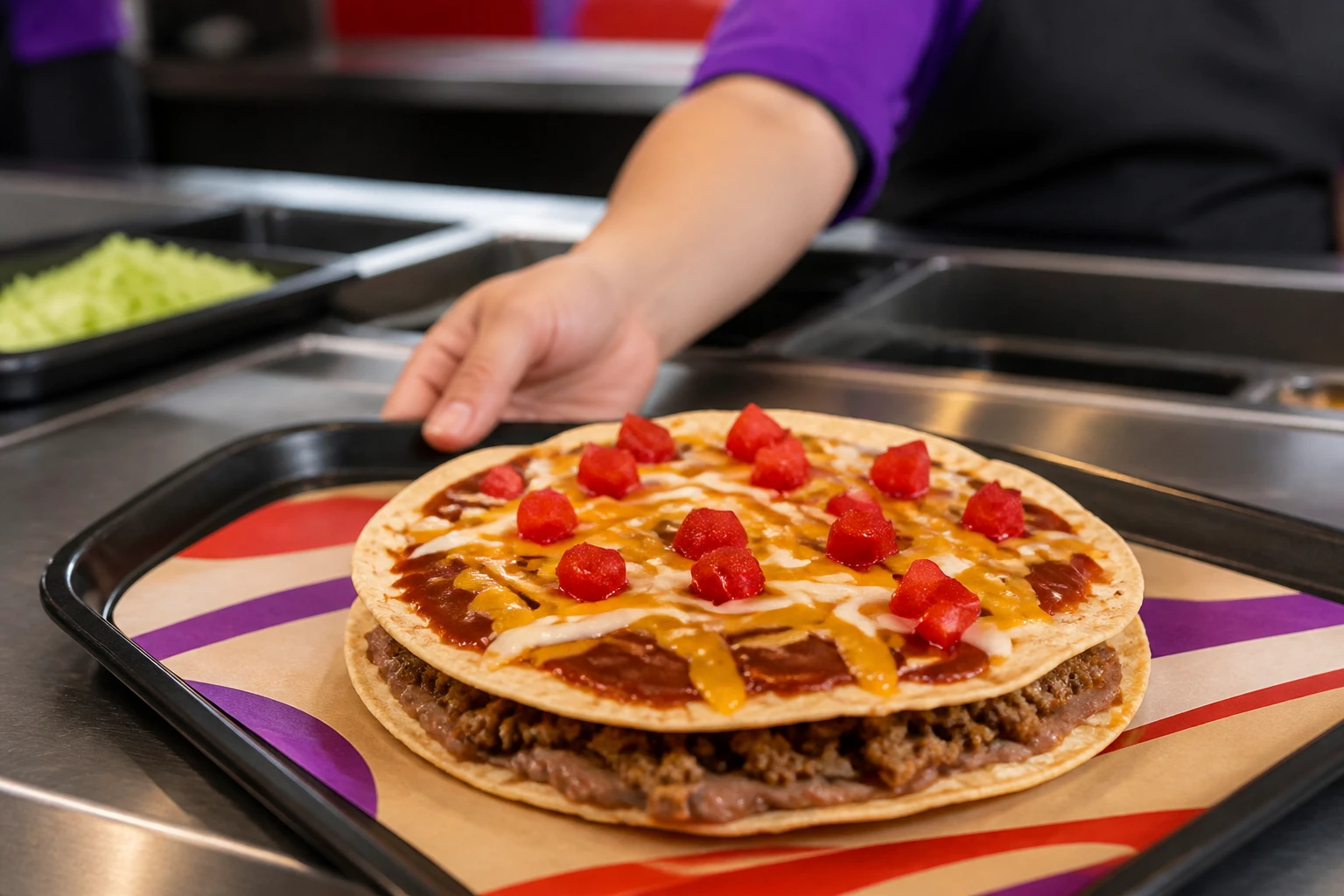
- $1 Mexican Pizza on July 28 only, beef and beans between tortillas with sauce, cheese and tomatoes, usual price $5.39-$6.99, limit one per order, available in-store, app and delivery.
- Rewards members also saw $1 medium drink add-ons on the pizza day.
| Item | Promo Price | Usual Range | Lettuce |
|---|---|---|---|
| Enchirito | $1 | Standard menu | None |
| Mexican Pizza | $1 | $5.39-$6.99 | None on this build |
The Mexican Pizza is a long-time top seller. The Enchirito gave the brand a clean, lettuce-free vehicle while the recall was still fresh. Social posts from the chain itself never named the parasite, but the timing was obvious to anyone watching the news.
Crowd reaction on X mixed hunger for the deals with lingering distrust. Some users noted that other chains never dropped prices this hard. Others treated the $1 icons as a short-term sugar high that would fade once the headlines cooled.
The five-per-purchase cap on the Enchirito and the one-per-order limit on the pizza kept the offers from turning into wholesale giveaways. Limits also nudged customers into the app and rewards flow, where the drink add-on waited on pizza day. The mechanics served traffic recovery and digital engagement at the same time.
Butter Chicken and the Lettuce-Free Menu Shift
Beyond the dollar blasts, Taco Bell is leaning on limited-time offers already in the pipeline. Rewards members voted the Butter Chicken Taco from India the winner of the brand’s first Global Taco Vote earlier this year. The item features shredded chicken in a tomato-cream sauce with spices, onion, cilantro, lettuce and cheddar inside a fried chalupa shell. It is scheduled for a U.S. limited-time run later in 2026.
The outbreak simply raised the stakes for every non-lettuce or low-risk item on the board. Locations in the hardest-hit states had already pulled fresh toppings as a precaution. The company statement confirmed the completed removal of affected lettuce from all restaurants as of July 17 “out of an abundance of caution” and said the ingredient was out of the national supply chain.
That speed mattered. Yum executives later credited transparency around the pull for helping rebuild trust faster than a slower, quieter response would have allowed. A full national clear-out on the same day as the supplier recall left little ambiguity about whether any affected stock remained in stores.
The Butter Chicken Taco still carries lettuce in its planned build. Its value in the recovery window is less about being produce-free and more about giving the calendar a high-interest item that was already voted in by rewards members. Pipeline LTOs become more useful when the brand needs reasons to visit that do not depend on the disputed ingredient.
Taylor Farms Suspends Central Mexico Lines
The supplier moved in parallel. Taylor Farms de Mexico recalled all iceberg lettuce from central Mexico and suspended all central Mexico iceberg production. The company also paused broader production at the facility for a top-to-bottom independent review and said it invests more than $200 million a year in food-safety systems.
When questions were raised about the source of the recent Cyclospora outbreak, we immediately removed all potentially implicated product from the marketplace, and out of an abundance of caution we issued an even broader recall of all iceberg lettuce sourced from the region.
Taylor Farms noted that FDA had no confirmed positive product tests as of July 24 and emphasized its own protocols, traceability and industry leadership roles. Recalled product also reached retail under Marketside branding at some Walmarts and food-service customers beyond Taco Bell, including other major chains. Distribution lists covered more than two dozen states.
The broader industry felt the chill. Reuters reported double-digit sales pressure on lettuce growers as diners simply avoided the ingredient. That spillover is the second-order layer: one supplier’s problem became a category problem overnight.
Suspension of an entire regional production line, plus a facility-wide pause for independent review, goes beyond pulling one lot. It signals that the company chose capacity loss over any residual doubt about the central Mexico source. Retail and food-service customers outside Taco Bell inherited the same disruption through shared distribution.
How the Outbreak Rewired Short-Term Demand
The traffic crash and the promotional response formed a single loop. Public linkage drove diners away from lettuce-heavy menus. Taco Bell answered with items that either never used the ingredient or could be built without it, priced low enough to restart trial.
Several forces moved at once:
- Removal of affected lettuce from all restaurants on July 17 cut the exposure path.
- Dollar Enchiritos and Mexican Pizzas gave customers a reason to return without ordering the disputed topping.
- Yum’s public read on improving trends over ten days before the July 30 call gave franchisees and investors a recovery signal.
- Category-wide lettuce avoidance meant competitors could not simply harvest the lost visits.
The same-store sales decline of about 2 percent from late June through July 27 looks modest next to daily traffic drops above 20 percent. Promotions and a short damage window help explain the difference. So does the strength of the quarter that came before the outbreak dominated the news.
Trust repair and price memory now run on different clocks. Clearing the supply chain and speaking publicly addressed the health scare. Teaching customers that a top seller can cost a dollar addresses a different habit, one that lasts after the case counts stop rising.
Why Franchisees and Growers Share the Bill
Margin pressure does not land only at corporate. Franchisees fund the discount on every promotional Enchirito and Mexican Pizza that crosses the counter. Limits per order blunt the worst of the giveaway risk, yet volume at a dollar still compresses the contribution on high-awareness items.
Growers face a separate version of the same problem. Double-digit sales pressure on lettuce, as diners avoided the ingredient across brands, turns one traceback into a category event. Taylor Farms suspended central Mexico iceberg production and paused broader output at the facility. Capacity that sits idle does not earn, even when annual food-safety investment exceeds $200 million.
Other major chains that shared the distribution network inherited recall logistics and traffic noise without controlling Taco Bell’s menu or messaging. Marketside product at some Walmarts extended the story into retail coolers. More than two dozen states appeared on distribution lists, so the operational footprint outran the nine-state illness cluster.
Yum’s cushion was the pre-outbreak quarter: 7 percent same-store sales growth and 9 percent system sales growth at Taco Bell. That buffer does not erase franchisee-level promo costs or grower-level idle lines. It only buys time for traffic to stabilize while those bills come due.
The Recovery Path Carries Its Own Costs
Yum’s early read is that traffic is healing. The $1 promotions generate app downloads, trial and social chatter. Quick removal of the ingredient plus public statements limited the damage window. Core Q2 momentum gave the brand a cushion.
What We Know
- Confirmed cases and hospitalizations remain as reported by CDC and FDA through late July.
- Taco Bell and Taylor Farms both acted on July 17 to clear the supply chain.
- Yum reported improving sales trends over the ten days before its July 30 call.
What’s Unconfirmed
- Final total case count once lagging reports finish arriving.
- Exact contribution of the $1 deals versus natural recovery from the news cycle.
- Whether lettuce fear lingers into fall menus across the QSR sector.
The open question is whether the discounting habit sticks. Once customers relearn that a Mexican Pizza can cost a dollar, ordinary pricing feels expensive again. Franchisees absorb the margin hit on every promotional unit. Taylor Farms faces ongoing scrutiny and suspended capacity. Other brands that rely on the same produce network quietly watch their own traffic data.
Taco Bell has used value plays before and usually climbs out. This time the climb started from a public-health crater rather than a quiet sales soft patch. The deals are working. The deeper bet is that trust and traffic can return without permanently resetting what a taco is worth.


Spotify Running Mode hits Android and revives its old tempo experiment

Galaxy Tab S12 Ultra Renders Keep the Notch Fans Hate

Novato Spinning Round House Sells With Six Neighbors for $3.3 Million

Crop Tour Finds Indiana and Nebraska Corn Yields Lagging 2025

Best Buy 60th sale brings Android deals back to its roots

American Airlines reverses seatback screen bet years too late

Iran Hormuz Strikes Force Gulf Oil Onto Costlier Paths

Plague Tale Prequel Day One Joins Game Pass Wave 2 as Witcher Exits

NBA 2K27 opens The City to everyone and rewrites career eras

iOS 26.6.1 Patches 29 Flaws as AI Forces Faster Apple Updates

Double Fine Cuts 23 Jobs Weeks After Xbox Independence

Day-One Big Walk Lifts PS Plus August Beyond Recycled AAA

John Hight Exits Wizards After Digital Reckoning Hits

Curtis Mead’s Red Sox Debut Ends With Fractured Wrist

Moesch and Dressel Rewrite Night One at 2026 U.S. Nationals

Red Sox Squander Hot Streak Chance in 4-3 Loss to Athletics

Boutte’s Quiet Camp Takeover Forces Patriots Receiver Choices

Take-Two CEO Pushes Netflix Subs for GTA 6 Extended Look

Halo Campaign Evolved Skulls Meet Death Barriers That Kill the Hunt

Wildlands Free Update Hands Players the Tools They Already Invented
-

 TECHNOLOGY3 years ago
How to Adjust a Bulova Watch Band – An Easy Guide
-

 News3 years ago
Fred Pentland: Athletic Bilbao’s English mentor who changed the essence of Spanish football
-

 FINANCE3 years ago
Tax Planning for Every Season: Guide to Maximizing Your Tax Benefits
-

 Education3 years ago
African Ministers New Education Plan
-

 BUSINESS3 years ago
What is Entrepreneurial Operating System? A Comprehensive Guide to EOS
-

 Education3 years ago
Innovate Your Learning Journey with Technology and Enhance Education
-

 News3 years ago
Russians formally out of World Athletics Championships
-

 BUSINESS3 years ago
Top 9 Most Expensive American Cities to Rent an Apartment