
Education
How a Housekeeper’s Diary Solved the River Wear Hoard

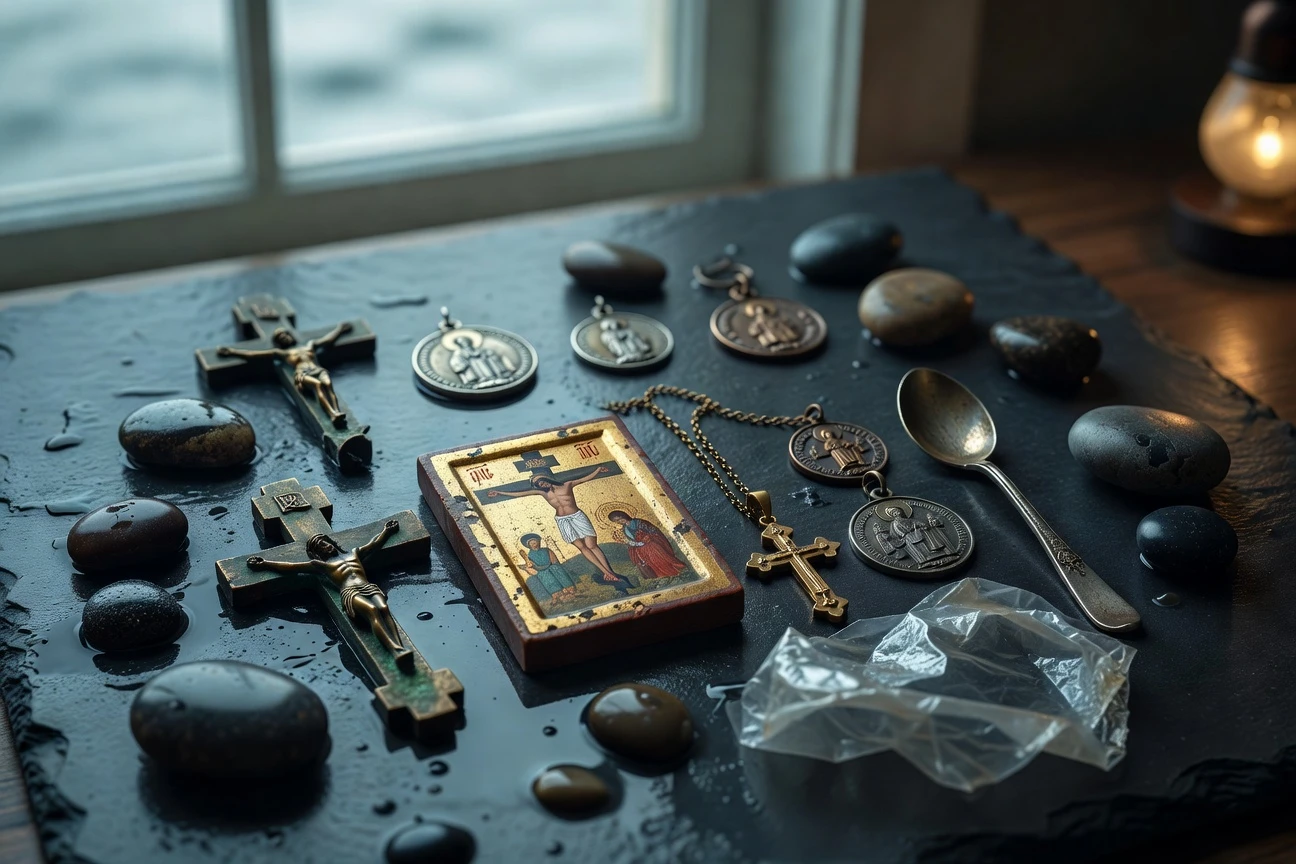
For nearly two decades, the strangest hoard pulled from an English river had no story attached to it. Between 2007 and 2009, brothers Gary and Trevor Bankhead dived a short stretch of the River Wear in Durham and kept surfacing with clusters of religious medals, a Russian icon of the crucifixion, a Greek Orthodox cross pendant, a bronze crucifix, and gold and silver pieces struck for the Second Vatican Council. None of it was ancient. All of it had a single owner. The owner was dead.
The owner was Michael Ramsey, Archbishop of Canterbury from 1961 to 1974. The puzzle was how dozens of his ceremonial gifts ended up at the bottom of a river running past his retirement home. The answer, published this spring, sat in a housekeeper’s diary the entire time.
Where the Hoard Was Found
Gary Bankhead, an honorary fellow in the Department of Archaeology at Durham University, has logged roughly 14,500 small finds from the same river over 16 years of diving. Most are coins, dress pins, lead cloth seals, and pilgrim souvenirs going back seven centuries. The Ramsey material was different. It was clustered, recent, and arranged by tradition.
The objects sat in distinct piles beneath four bridge abutments near Prebends Bridge, one of Durham’s best-known footbridges. Greek Orthodox pieces were in one cluster. Vatican-associated medals were in another. A 19th-century Russian icon depicting Jesus on the cross was found with material of similar provenance. Bankhead said the layout looked, in his own words, as though someone had stood above the bridge and dropped the items deliberately.
The recovered objects span three loose categories.
| Category | Representative Pieces | Approximate Period |
|---|---|---|
| Orthodox devotional | Gold Greek Orthodox cross pendant; Russian icon of the crucifixion | 19th to mid 20th century |
| Roman Catholic ceremonial | Gold, silver and bronze medals from the Second Vatican Council; bronze crucifix | 1962 to 1965 |
| Anglican and civic | Elizabeth II coronation medal; silver trowel; christening spoon; silver key | 1953 to 1970s |
Theories That Did Not Hold
When the discoveries first reached the press, two theories competed. The first was a burglary at the Ramsey home, with a thief panicking at the bridge. The second was that the archbishop himself had quietly emptied his cabinets into the water before he died in 1988. Neither could be proved, and both had problems.
A burglar would not have sorted the loot by religious tradition before dumping it. Nor would a thief have bothered to weight individual plastic bags with river stones. The deliberate clustering pointed to someone with intimate knowledge of the collection and a reason to keep similar objects together. That ruled out a smash-and-grab and pointed inside the household.
The Very Reverend Victor Stock, Dean of Guildford and a friend of the Ramseys, told the Guardian at the time that the archbishop had already faced a public-relations problem after selling some donated gifts and giving the proceeds to Christian Aid. Donors were upset. Ramsey was embarrassed. Stock thought it plausible the archbishop walked to the river himself, made up a packet, and dropped it. Plausible, yes. Provable, no.
The Diary That Cracked the Case
The breakthrough came when Bankhead tracked down the niece of Audrey Heaton, the Ramseys’ housekeeper. The niece had kept Heaton’s diaries and a clear set of family memories. According to Fox News reporting on the find, those documents reframed the entire mystery.
The objects were not randomly dispersed. Items relating to Greek Orthodoxy were found together in one location, Vatican-associated objects in another, with the remaining material arranged in distinct clusters beneath the four different bridge abutments.
That observation, from the archaeologist who recovered the material, only matched the housekeeper’s account. According to Bankhead’s reconstruction, Joan Ramsey, the archbishop’s wife, packaged the items into plastic bags by tradition, weighted each bag with stones, and asked Heaton to do the dropping. The dean’s theory had been close. The hands belonged to the housekeeper.
How Joan Ramsey Staged the Disposal
The mechanics, once explained, are almost forensic. Joan Ramsey did the curation. Heaton did the carrying. The clustering on the riverbed mirrors the way the items left the house.
- Sorting by tradition. Bags were filled with objects of a shared origin so that they would sink together, not scatter.
- Stones for ballast. Each bag was weighted to ensure it dropped straight down rather than drifting with the current.
- Walks at the edges of the day. Heaton was instructed to do the disposal early in the morning and late at night while walking the family’s dogs.
- Discretion above all. She was told to make sure nobody saw what she was doing.
- One bridge, four abutments. Each cluster was released from a slightly different point above the same span, producing the patterned scatter Bankhead recovered.
This was not a panic. It was a logistics plan, carried out across multiple visits, by a woman walking dogs.
The Housekeeper Who Carried the Weight
Heaton’s niece told Bankhead that her aunt was distressed by the assignment. The pieces were not anonymous trinkets to her. She knew where they had come from and what they were worth, both as memorabilia and on the open market. Refusing the instruction was not really an option in the household she worked for.
“She recognized that they had real historical and monetary value,” the niece said, in remarks Bankhead has repeatedly cited, “and struggled with the idea of throwing them away.” The phrase used most often, in conversations with the family and in the diary entries, was that Heaton was “extremely upset.”
The Ramseys, by every account, were not acting out of malice. Joan Ramsey was elderly, ill, and packing up a house with no children to inherit it. Selling the gifts had already produced a small scandal. Giving them away risked more of the same. The river, in that calculation, offered something none of the other options did. It made the objects disappear without explanation. The cost of that solution sat with the person doing the walking.
That cost is the part of this story that survived only because a niece kept a relative’s diary and a diver kept asking questions. Without either, the hoard would have remained a curiosity with a hole at the center.
Where the Objects Live Now
Some of the recovered material is now held in a cathedral safe in Durham. Other pieces are catalogued in the collection of Durham University’s Museum of Archaeology on Palace Green, where Bankhead’s wider river inventory is housed. The full catalogue, including the Ramsey-linked finds, runs through his book Pilgrim Souvenirs, Devotional and Other Objects of Faith, published with the Architectural and Archaeological Society of Durham and Northumberland alongside the university museum.
That book sits inside a much larger inventory. Bankhead’s finds also include 3,653 coins and tokens, 3,052 dress pins and accessories, 364 lead cloth seals, pilgrim ampullae, First World War medals, and trade tools, most of them recovered from around the 12th-century Elvet Bridge. The Ramsey cluster is a small fraction of the count and the most narratively dense single group in it.
Readers drawn to deliberately deposited hoards of this kind may find a useful parallel in coverage of the pre-Roman necropolis recently unearthed in northern Italy, where grave goods were also arranged with care rather than discarded. A nearer geographic comparison is the medieval material recovered from Galway’s Rathgurreen Ringfort, which similarly mixes high-status devotional objects with the everyday detritus of a household.
Frequently Asked Questions
Who Was Michael Ramsey?
Michael Ramsey was the 100th Archbishop of Canterbury, serving from 1961 to 1974. He retired to Durham and died in 1988. During his tenure he gathered many ceremonial and devotional gifts from churches and dignitaries around the world.
Where Exactly Were the Artifacts Found?
They were recovered from the bed of the River Wear in Durham, England, near Prebends Bridge. Bankhead’s wider inventory has come from a stretch that also includes the 12th-century Elvet Bridge.
How Many Items Were Linked to the Archbishop?
Dozens of religious medals, crosses, icons and ceremonial objects were tied to the Ramsey household across the cluster sites. They are a small subset of the roughly 14,500 small finds Bankhead has logged from the river overall.
Why Did Joan Ramsey Choose the River?
According to friends and to Bankhead’s reconstruction, the Ramseys had already faced criticism for selling some donated gifts. Giving the remaining items away risked further awkwardness, and the couple had no heirs. The river was a way to make the objects vanish without a transaction.
Did the Housekeeper Know What She Was Carrying?
Yes. Her niece’s account, supported by diary entries, makes clear that Heaton understood the pieces had both historical and monetary value. She found the task distressing and was told to be discreet about it.
Can the Public See the Recovered Objects?
Many of the items are now held in a cathedral safe, while others are catalogued at Durham University’s Museum of Archaeology on Palace Green. The Ramsey-linked pieces feature in Bankhead’s published catalogue.






Redmi Battery Monsters Win the Week as Samsung Trims S27 Cameras

Moto G Max India Bet Puts 7000mAh Battery Ahead of Specs

Take-Two CEO Pushes Netflix Subs for GTA 6 Extended Look

Google Bets Tensor G6 Efficiency Fixes Pixel’s Old Flaws

Grok Image 2.0 Adds Pro Edits While Scandals Linger

Caviar Leather iPhone 18 Pro Editions Kill Wireless Charging for Status

Quordle Monday Delivers Gavel Crush Speed Ethos Cleanly

Goldmund Telos 9800 Mono Amp Costs More Than Most Ferraris

Gemini Plan Dropped the Race and Made Running Stick

Cloudflare Kitesurf Cracks Chromium Moat for AI Agents

ZA/UM Lays Off 32 Staff as Zero Parades Wins Reviews, Not Players

EA’s New In-Game Ad Platform Skips the Games That Need It Most

Mortgage Rates Climb to 6.55%, the Highest Level in Nearly a Year

Colby Covington Stuns Tsarukyan as Askren Retires in Tears at RAF 11

Netflix Heads Into Earnings With Its 2022 Playbook Already Spent

Spain’s Diaspora-Rooted Squad Wins Over New York Ahead of the Final

NHL’s Monday Matinee Push Puts Capitals Fans on the Clock

DeChambeau’s Two-Shot Penalty Rewrites the Open’s Weekend Draw

Guardians Rout Twins With Seven Homers, Leave Joe Ryan One Shy of Record

England Beats France 6-4 to Claim World Cup Bronze Medal
-

 TECHNOLOGY3 years ago
How to Adjust a Bulova Watch Band – An Easy Guide
-

 News3 years ago
Fred Pentland: Athletic Bilbao’s English mentor who changed the essence of Spanish football
-

 FINANCE3 years ago
Tax Planning for Every Season: Guide to Maximizing Your Tax Benefits
-

 Education3 years ago
African Ministers New Education Plan
-

 BUSINESS3 years ago
What is Entrepreneurial Operating System? A Comprehensive Guide to EOS
-

 Education3 years ago
Innovate Your Learning Journey with Technology and Enhance Education
-

 News3 years ago
Russians formally out of World Athletics Championships
-

 BUSINESS3 years ago
Top 9 Most Expensive American Cities to Rent an Apartment