
ENTERTAINMENT
EA’s New In-Game Ad Platform Skips the Games That Need It Most
EA has built its EA Advertising platform into Frostbite, selling in-game ad space to Visa, Red Bull and Mountain Dew across its sports games.

Electronic Arts has wired a working ad exchange into Frostbite, the engine behind Madden NFL, EA Sports FC and Battlefield, and started selling that space to advertisers. The platform, called EA Advertising, went live June 15 with dynamic pricing that runs $1 to $10 per thousand impressions depending on the game.
EA is testing the model hardest inside the sports and live-service franchises that already print money, not the pricier single-player games pushing industry budgets higher. The company is also racing toward a change in ownership that adds its own pressure to find new revenue before that deal closes.
EA Wires Ads Straight Into Frostbite
EA Advertising launched as a system built directly into Frostbite, letting brands buy dynamic, real-time placements instead of the one-off logos EA used to hand-build into individual games. EA says its games and services reached more than 120 million monthly players across console, mobile and PC during fiscal year 2026.
“Players come to EA’s games and live experiences every day to play, watch, create and connect,” said David Tinson, EA’s chief experiences officer. “That gives brands a meaningful opportunity to show up in ways that add value and respect the player experience, while maintaining authenticity in the worlds our teams are building.”
Alexander Dao, EA’s vice president of advertising and sponsorships, has pushed studios to plan for ads from the start rather than bolt them on later. He told The Game Business Show, a trade podcast hosted by Chris Dring, that building ads into a game from day one feels more native than retrofitting them in afterward. It also gives EA more flexibility in which brands rotate in and out.
The Formats Now on the Table
The system covers a wider range of placements than EA has sold before. Advertisers can now buy into:
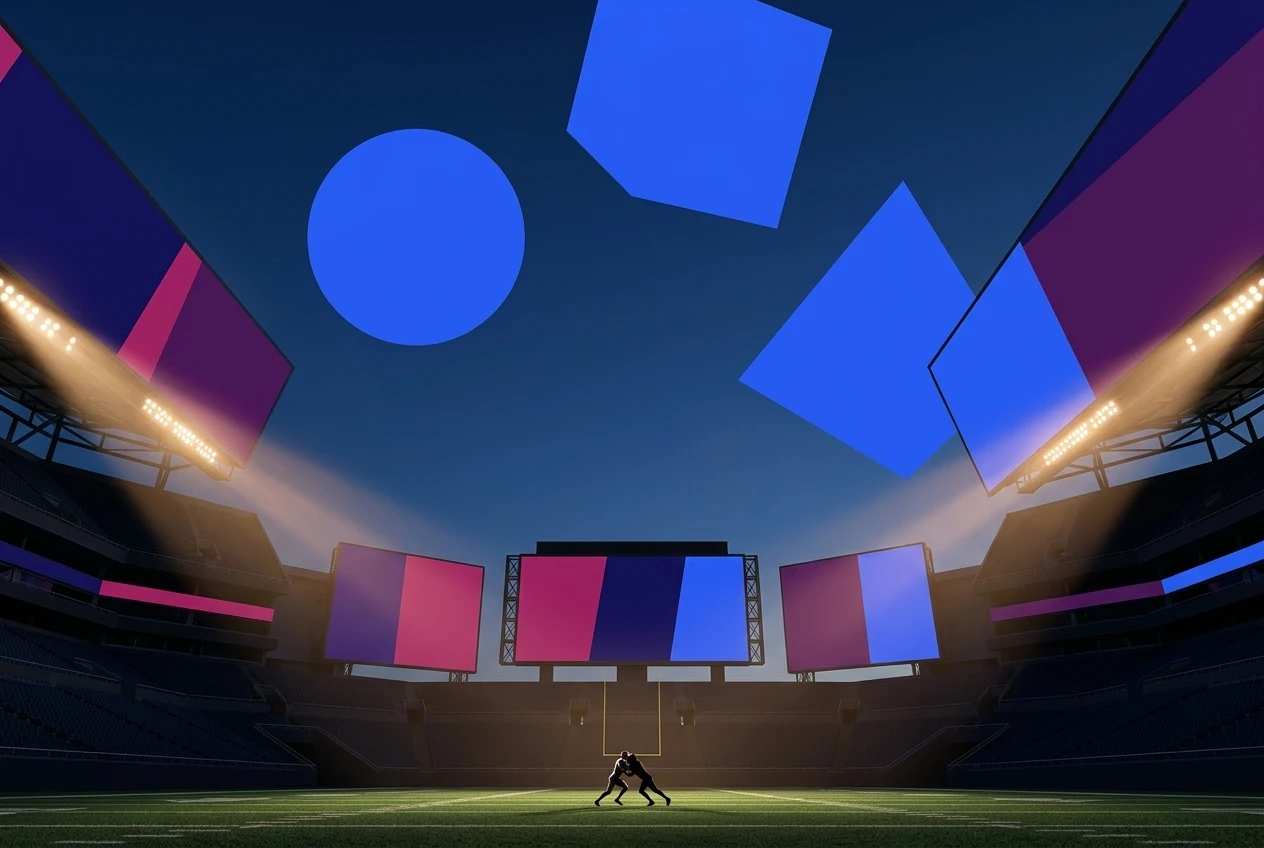
- Stadium signage and broadcast overlays – digital ad boards, scoreboards and jumbotrons built to mimic real match-day television coverage
- Branded cosmetics and vanity items – kits, outfits and Ultimate Team packs players can equip inside the game
- Sponsored challenges and objectives – reward-based tasks tied to a specific product or brand
- Fully playable brand experiences – custom stadiums, mascots and teams built around one sponsor
Some of these already have real campaigns attached, and the table below shows how a few of EA’s earliest partners are using them.
Who Signed On First
EA lined up a roster of national brands for the launch, spanning three of its sports franchises plus one detour into life-simulation territory.
| Brand | Game | Integration | Reported Result |
|---|---|---|---|
| Red Bull | EA Sports FC | Branded objectives, team kits, athlete tie-ins | 128 million+ matches played, 1.2 million objectives completed |
| Lowe’s | EA Sports College Football | Sponsored “Stadium Pulse” feature | Over 1 billion impressions, per Dao |
| Mountain Dew | EA Sports College Football 26 | “DEW University” playable team, custom stadium | Headline launch partner |
| Xfinity and Peacock | EA Sports FC 26 | Broadcast overlays, vanity kits, Ultimate Team Packs | Headline launch partner |
| Domino’s | EA Sports FC | Branded jersey tied to pizza redemption codes | Recurring Friday promotion |
| Coach | The Sims 4 | Branded collaboration shaped by player surveys | First major non-sports tie-in |
Visa and State Farm also signed on at launch, mostly through stadium and broadcast-style branding similar to what fans already see during real match broadcasts.
Why Is EA Pushing Ads Into Games Right Now?
EA is moving now because game budgets and prices keep rising while the company heads toward a change in ownership that will load on new debt. A big-budget console game costs $70 today, up from $60 a few years ago, and the upcoming Grand Theft Auto VI is set to launch at $80. Advertising gives EA a lever besides raising the sticker price again.
That ownership shift adds its own urgency. EA is on track to go private in a $55 billion buyout led by a Saudi Arabia-backed group of investors, and a new, scalable ad business gives the incoming owners another revenue source to point to.
Media analyst Matthew Ball raised a version of this argument back in February, before he joined Xbox. Mobile in-game advertising alone generated roughly $55 billion in revenue in 2025 outside China, while PC and console titles captured almost none of that money. “The money needs to come in one way or another,” Ball said.
The wider in-game advertising market is expanding regardless of what EA does. Mordor Intelligence estimates the category will grow from $131 billion to $217 billion by 2031, helped along by cloud gaming and privacy rules pushing advertisers toward formats that do not rely on tracking individual users. Dentsu puts the addressable audience at 3.5 billion gamers worldwide, yet says gaming still draws only 5% of global ad spending, a gap EA is racing to close.
Sports Games Get the Ads. Blockbusters Don’t.
The franchises EA is testing hardest, Madden NFL, EA Sports FC and College Football, are already its biggest earners. Players complete the equivalent of 23,000 NFL seasons a day in Madden and more than 1 billion matches a month in EA Sports FC, by the company’s own count.
Those aren’t the games driving up development costs. A single-player blockbuster typically needs to sell more than 5 million copies just to break even, and most players spend their time in live-service hits, not narrative single-player releases. Take-Two Interactive chief executive Strauss Zelnick has made a similar point. He has said in-game ads fit a game like NBA 2K but would not suit a premium release like Grand Theft Auto VI.
Dao himself has drawn a line around where he thinks ads do not belong.
It’s difficult for me to believe that we would want to have interstitial advertising in a game that someone paid $70 or $80 for. It would seem unfair.
Dao said that on the same Game Business Show appearance. EA’s own launch partners so far back up the pattern: nearly every deal sits inside a sports title, and The Sims 4 tie-up with Coach remains the lone exception.
Gamer Tolerance, By the Numbers
Player reaction to in-game ads depends heavily on execution, and the numbers shift a lot depending on which question researchers ask.
- 66% of gamers feel positively about in-game brands, according to Dentsu research, though most say the integration needs to fit the game
- 20.3% of US gamers say they generally dislike ads in games, per Attest data cited by EMarketer
- 34% of console gamers have searched for more information about a product after seeing it in a game, up from 23% a year earlier, according to Comscore
- 27% of gamers say they have clicked on an in-game ad, Dentsu found
“The benefit for gamers, in a sports simulator, is authenticity,” said Brent Koning, global head of gaming at the ad agency Dentsu and a former EA executive. “But when advertising adds friction for gamers, that’s when the yellow flags start getting raised.”
EMarketer projects US game ad revenue will cross $10 billion in ad revenue by 2029, even though gaming still draws only 2.3% of overall digital ad spending this year. Developers using less intrusive formats are already seeing an upside. Technavio found publishers running non-intrusive in-game ads have seen partner revenue climb by as much as 30%.
EA Already Tried This, and Players Revolted
This isn’t EA’s first run at ads inside gameplay. In 2020, the company placed ads into EA Sports UFC 4 during replay moments, the pause where a knockout gets shown again from multiple angles.
The backlash was immediate. EA apologized and disabled the ads within days.
Reaction to the new platform has followed a similar pattern in some corners. “I pay for the console, I pay for the game, and I pay for online services,” one gamer told the outlet Inven Global, adding that he now feels forced to watch ads on top of everything else.
EA’s newer pitch draws a sharper line between stadium-style sponsorship, the kind fans already see during real broadcasts, and the pop-up interstitials that triggered the 2020 backlash.
Who Else Might Follow EA Into Ads?
Brent Koning, the former EA executive who now leads gaming at Dentsu, thinks EA’s approach could work for any publisher with a sports catalog deep enough to sell believable sponsorships, and he names 2K Games, the studio behind NBA 2K, as the clearest candidate to try something similar next.
EA has paired the platform with outside measurement partners so brands can verify what they are buying. The company works with Integral Ad Science to confirm ads are viewable and reach real audiences, and it built its ad server and software development kit, or SDK, to align with standards set by the Interactive Advertising Bureau. EA has also linked the system to LiveRamp, letting advertisers match their own customer data against EA’s first-party player identity, which stays consistent across a person’s consoles.
“If they build an ad network, they could be successful in selling inventory,” Koning said. “The few that can do it will be successful.”
Dao joined EA a little over a year ago from Snap, where he had risen to managing director of global agencies and sales partnerships. He compares the opportunity to connected TV, describing advertising’s path as one that always follows where the audience and the attention are, pointing to social media, retail media and streaming as earlier stops on that same road.
Streaming has already run a version of this play. Netflix’s push to grow ad-supported subscribers and ad revenue shows how much engagement is worth once a brand can buy directly into it, and EA is chasing the same math with a controller instead of a remote.
Once the buyout closes, how much money the ad business actually brings in may never show up in a public filing again.


Iowa Farmer Built Resilience for 16 Years Then Tariffs Hit Hard

HHS Adds FDA Tech and Drugs Deputies to Lock In AI and Review Power

Nvidia Earnings Carry a Built-In Sell-the-News Trap

HP Licenses Huawei Wi-Fi Patents Despite the Entity List

Poland Named in $131B F-15 Deal Echoes Apache Path

Sewer Scavengers Near Penn Station Repeat a Decades-Old NYC Pattern

Second Muni Fatigue Crash Exposes Surface Line Gaps

Chick-fil-A Chicken and Waffles Closes Its 80-Year Loop

Musk Data Centers Leave a Mississippi Family’s Historic Land Empty

OpenAI Data Center Chief Exits as Stargate Strategy Shifts

Double Fine Cuts 23 Jobs Weeks After Xbox Independence

Day-One Big Walk Lifts PS Plus August Beyond Recycled AAA

Curtis Mead’s Red Sox Debut Ends With Fractured Wrist

John Hight Exits Wizards After Digital Reckoning Hits

Red Sox Squander Hot Streak Chance in 4-3 Loss to Athletics

Moesch and Dressel Rewrite Night One at 2026 U.S. Nationals

Boutte’s Quiet Camp Takeover Forces Patriots Receiver Choices

Take-Two CEO Pushes Netflix Subs for GTA 6 Extended Look

Halo Campaign Evolved Skulls Meet Death Barriers That Kill the Hunt

Wildlands Free Update Hands Players the Tools They Already Invented
-

 TECHNOLOGY3 years ago
How to Adjust a Bulova Watch Band – An Easy Guide
-

 News3 years ago
Fred Pentland: Athletic Bilbao’s English mentor who changed the essence of Spanish football
-

 FINANCE3 years ago
Tax Planning for Every Season: Guide to Maximizing Your Tax Benefits
-

 Education3 years ago
African Ministers New Education Plan
-
 BUSINESS3 years ago
What is Entrepreneurial Operating System? A Comprehensive Guide to EOS
-

 Education3 years ago
Innovate Your Learning Journey with Technology and Enhance Education
-

 News3 years ago
Russians formally out of World Athletics Championships
-

 BUSINESS3 years ago
Top 9 Most Expensive American Cities to Rent an Apartment