
News
Spain’s Diaspora-Rooted Squad Wins Over New York Ahead of the Final
Argentina’s referee controversies and a Falklands banner dispute are pushing New York’s neutral fans toward Spain’s Moroccan and Ghanaian rooted World Cup squad.

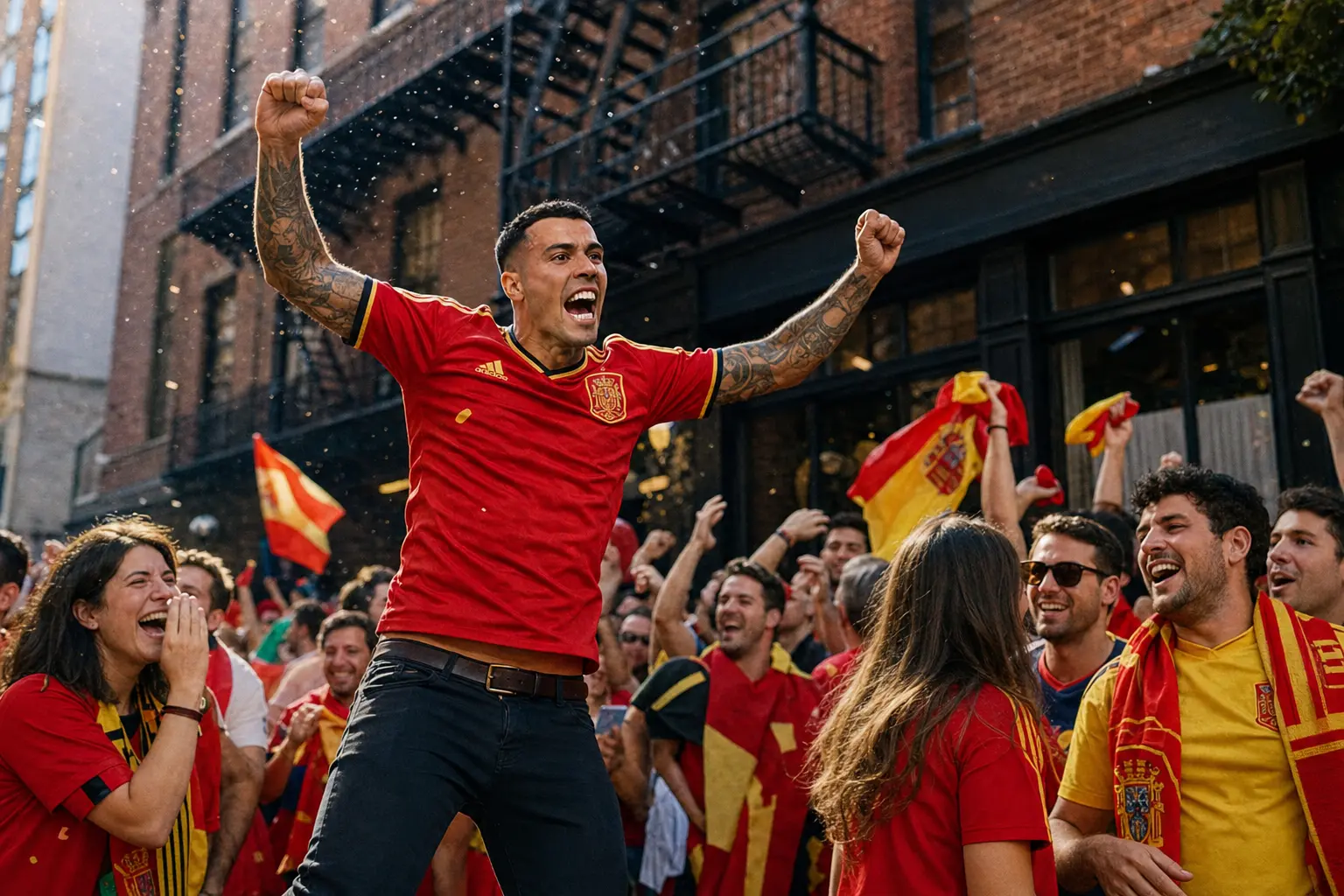
Spain kicks off against Argentina at 3 p.m. Sunday at MetLife Stadium, and Robert Sanfiz has already stopped taking reservations. The 57-year-old, who runs the Spanish Benevolent Society’s La Nacional clubhouse in Manhattan’s Chelsea neighborhood, is booked solid for the World Cup final and still fielding VIP requests he cannot fill.
The waiting list reflects something bigger than one nonprofit’s watch party. Six weeks of refereeing controversies have turned much of New York’s neutral fan base against Argentina, and Spain, fronted by a 19-year-old winger with roots in Morocco and Equatorial Guinea, has become the city’s adopted second team.
A Waiting List Forms at Chelsea’s Spanish Clubhouse
Sanfiz credits Spain’s 2010 championship, still its only World Cup title, with helping revive La Nacional, a nonprofit that launched 150 years ago to help newly arrived Spanish immigrants settle in the city. The neighborhood’s old Spanish enclave has mostly disappeared, but Sanfiz says the clubhouse remains a touchstone for homesick expatriates.
He remembers the tension before the 2010 final against the Netherlands, when fans crowded the sidewalk to watch through the window as Spain won its first title. This run has felt calmer, he says, thanks to the composed play of teenager Lamine Yamal and the team-first system built by manager Luis de la Fuente. Spain reached Sunday’s final by beating France 2-0 in Tuesday’s semifinal, a game in which Mikel Oyarzabal converted a penalty and Pedro Porro added a second-half goal, extending Spain’s run to just one goal conceded across the entire tournament.
Still, Sanfiz plans to dodge the tension on Sunday the way he always does.
You know what I do during the game? I just sit out and direct traffic and make sure nobody gets hit. I subconsciously do that because my greater stress is the game itself.
Sanfiz told Al Jazeera, describing the ritual he repeats every time Spain plays a final.
A day before the match, red was not as visible across the city as Argentina’s blue and white, but the diehards insisted their devotion ran deeper. At Midtown’s Mercado Little Spain, a cluster of restaurants opened by chef Jose Andres, 38-year-old Javier Vriz had flown in from Chicago to watch in person, calling decades of Spain fandom a lesson in disappointment before this run of consistency finally paid off.
Why Is Argentina Losing New York’s Neutral Fans?
Argentina enters Sunday defending the title it won in Qatar, but a run of disputed calls, from a contested Round of 16 win over Egypt to an overturned card against Switzerland, has fed a global perception of favoritism toward Lionel Messi’s team. In New York, that backlash has helped push fans whose own countries were eliminated toward Spain instead.
Rolando Sanchez, 26, a Bronx resident who mainly followed Mexico until England eliminated the co-hosts at Azteca Stadium, said Mexican fans have turned sharply on Argentina this tournament. For him, the shift comes down to personnel rather than politics.
“I wouldn’t mind seeing Messi finish on top, but Spain’s players are the future,” Sanchez said.
The list of flashpoints is long enough that FIFA officials have had to respond publicly to accusations they deny. Here is how the pattern unfolded.
- June 16: Referee Szymon Marciniak books Messi rather than sending him off for a challenge on Algeria defender Aissa Mandi, an early spark for what fans online started calling Argentina against the world.
- July 7: Argentina beats Egypt 3-2 in the Round of 16 after officials disallow an Egyptian goal and decline to review a possible foul on Mohamed Salah. Egypt coach Hossam Hassan calls it unfair, saying his team suffered injustice.
- July 11: A VAR review in the quarterfinal against Switzerland overturns a caution on Breel Embolo into a second yellow and a red card, and Argentina needs extra time and a Julian Alvarez strike to advance.
- July 15: Argentina beats England 2-1 in the semifinal in Atlanta, then players unfurl a banner reading Falklands are Argentine, drawing calls for a FIFA investigation.
- July 19: Hours before kickoff, FIFA is still reviewing the banner incident, with the White House publicly defending Argentina.
FIFA has repeatedly rejected any suggestion of bias. Forbes reported that Messi, worth an estimated $1.1 billion, is tied with France’s Kylian Mbappe for the tournament’s scoring lead with eight goals, a detail critics have folded into the favoritism narrative regardless. Former FIFA president Sepp Blatter added fuel in February, calling the organization a “dictatorship.” Messi has pushed back publicly on the claims, saying nothing was handed to his team this tournament.
Yamal, Williams and a Squad Built From the Diaspora
Spain’s own roster complicates any simple reading of the tournament’s politics. Lamine Yamal, born in Esplugues de Llobregat to a father from Morocco and a mother from Equatorial Guinea, will take the field Sunday as, history shows, the third-youngest player ever to appear in a World Cup final, behind only Pele and Italy’s Giuseppe Bergomi. He turns 19 years and six days old on final day.
His own family history echoes the migration story now playing out across Spain. His paternal grandmother left Morocco without papers and worked several shifts a day in Catalonia to bring over her son, who later met Yamal’s mother after she had arrived from Equatorial Guinea. Yamal, a practicing Muslim who has voiced solidarity with Palestinians, opened Spain’s scoring account this tournament against Saudi Arabia at 18 years and 343 days old, making him Spain’s second-youngest World Cup scorer ever, behind only teammate Gavi.
He is not the only player carrying that story into MetLife Stadium.
| Player | Age | Family Roots | World Cup Note |
|---|---|---|---|
| Lamine Yamal | 19 | Father from Morocco, mother from Equatorial Guinea | Third-youngest World Cup finalist in history |
| Nico Williams | 24 | Parents from Ghana | Starting winger, Euro 2024 champion |
| Gavi | 21 | Born in Spain to Spanish parents | Spain’s youngest-ever World Cup scorer, set in 2022 |
| Pau Cubarsi | 19 | Born in Catalonia | Among the five youngest World Cup finalists ever |
For fans without a Spanish or Latin American background, that roster has become its own draw.
Bronx Coaches Find Their Own Story in La Roja
Support for Spain has run especially deep among New York’s West African community, boosted by the heritage of its stars and the size of the city’s African population. Ousman Saho, 34, who coaches the Bronx-based Huntaz FC through the BAMBA Sports nonprofit, would have liked to see his native Gambia go further, but says Spain’s young core has earned his backing.
“I want them to win this one because it’s gonna motivate them,” Saho said. “Messi has already won every tournament. He has shown he’s the greatest.”
Mamadou Diabate, 36, who coaches the Bronx-based Los Espanoles FC, said he was proud of his native Ivory Coast’s group-stage run, including a win over Ecuador, but Spain has always held a special place for him.
“Spain is one of those teams that lets you look at how beautiful soccer is, how teamwork works,” Diabate said.
Across the boroughs, a loose network of clubs and venues has turned into an informal Spain fan network this tournament:
- La Nacional – the Spanish Benevolent Society’s Chelsea clubhouse, run by Robert Sanfiz, booked to capacity for Sunday’s final.
- Huntaz FC – a Bronx youth club backed by the BAMBA Sports nonprofit and coached by Gambia-born Ousman Saho.
- Los Espanoles FC – a Bronx club coached by Ivory Coast native Mamadou Diabate.
- Mercado Little Spain – Jose Andres’s Midtown restaurant collection, where fans gathered in red the day before the final.
Yamal’s Moroccan heritage and Spain’s recognition of Palestinian statehood have also drawn support from Arab enclaves in the city, including Brooklyn’s Little Palestine, adding another layer to a coalition that crosses several of New York’s immigrant communities at once.
Madrid’s Migration Bet Plays Out on New York’s Streets
The goodwill toward Spain among African and Arab New Yorkers is not just about players born to immigrant parents. It is also about policy. Where the United States and much of Europe have tightened enforcement against undocumented migrants, Spain has moved in the opposite direction.
In January 2026, Spain’s government approved a Royal Decree opening legal residency to undocumented migrants already in the country, a plan expected to grant legal status to more than 500,000 people who can prove they lived in Spain for at least five months before the end of 2025. Applicants without criminal records get a renewable one-year permit, with a path to citizenship after a decade. Prime Minister Pedro Sanchez has framed the policy as a moral obligation, pointing to the more than two million Spaniards who emigrated between 1960 and 1973.
By late May, more than 550,000 applications had already been submitted, according to InfoMigrants, which has covered the rollout on the ground in Madrid and Barcelona. Edith Espinola, director of a Madrid workers’ advocacy group and a founder of the Regularizacion Ya movement, described the goal in blunt terms.
“People understand that the undocumented migrant person living next to their house is a neighbor not an invader,” Espinola said.
The nuance New York’s West African fans may not know is that most of the people benefiting are not African. Research group Funcas estimated Spain had roughly 840,000 people in irregular status at the start of 2025, and the largest share, some 760,000, came from the Americas, led by Colombians, Peruvians and Hondurans. Africans made up an estimated 50,000 of that total. The policy is real, but its biggest beneficiaries are Latin American, not West African, a detail that complicates without undercutting the goodwill it has generated among Spain’s newest New York fans.
Kickoff at MetLife
Spain has not lost a competitive match since a Euro qualifier defeat in Scotland in March 2023, and Argentina is chasing a feat no team has managed since Brazil won consecutive titles in 1958 and 1962. Resale prices for Sunday’s match climbed so high that New York and New Jersey prosecutors issued subpoenas to FIFA over its ticket pricing, adding one more grievance to a tournament that has generated plenty.
None of that will be on Sanfiz’s mind at kickoff. By his own admission, he will spend Sunday’s final the way he spent the last one, outside on the sidewalk in Chelsea, waving cars past a clubhouse packed with people watching the game he says he cannot bear to watch himself.


Walmart’s $50 Million Opioid Settlement Closes Case Without Admission

California Sues Over $120 Million Morro Bay Wind Lease Buyout

Gilead Bixlenvo FDA Nod Opens Single Pill Path for Complex HIV Cases

Meta’s $18B Kids Deal Forever Shields Data Used to Spot Under-13s

Lettuce Outbreak Drove Record Cyclospora Spike Across 20 States

Amazon Shaves $20 Off M6 Mac Mini Before It Even Ships

SpaceX Louisiana Port Tests Debt Markets on Orbital AI Scale

Microsoft High Lifts Indexes as Small Caps Crack Support

Apple Replays 2015 Saturday Midnight Preorder for iPhone 18 Pro

Updated COVID Shots Clear FDA but Access Friction Hits High-Risk Groups

Take-Two CEO Pushes Netflix Subs for GTA 6 Extended Look

Wildlands Free Update Hands Players the Tools They Already Invented

Destiny 2 Fans Unlock Vaulted Maps After Live Service Ends

Quake Gets 19 Free Maps From MachineGames Quake Club

Quordle Monday Delivers Gavel Crush Speed Ethos Cleanly

Stripe Bid Shows PayPal Moat Cracked After Years of Slide

Tyson’s Five-Year Utah Plant Falls to Cattle Shortage Reckoning

Silver Lake Workday Talks Signal Private Floor for Software

Kennedy Lewis Takes Majority Control of The Greenbrier in $500M Deal

Best Buy Marks 60 Years With Sale That Echoes Its Audio Shop Roots
-

 TECHNOLOGY3 years ago
How to Adjust a Bulova Watch Band – An Easy Guide
-

 News3 years ago
Fred Pentland: Athletic Bilbao’s English mentor who changed the essence of Spanish football
-

 FINANCE3 years ago
Tax Planning for Every Season: Guide to Maximizing Your Tax Benefits
-

 Education3 years ago
African Ministers New Education Plan
-

 BUSINESS3 years ago
What is Entrepreneurial Operating System? A Comprehensive Guide to EOS
-

 Education3 years ago
Innovate Your Learning Journey with Technology and Enhance Education
-

 News3 years ago
Russians formally out of World Athletics Championships
-

 BUSINESS3 years ago
Top 9 Most Expensive American Cities to Rent an Apartment