
News
Sinkhole Swallows LaGuardia Runway Built on 1930s Landfill

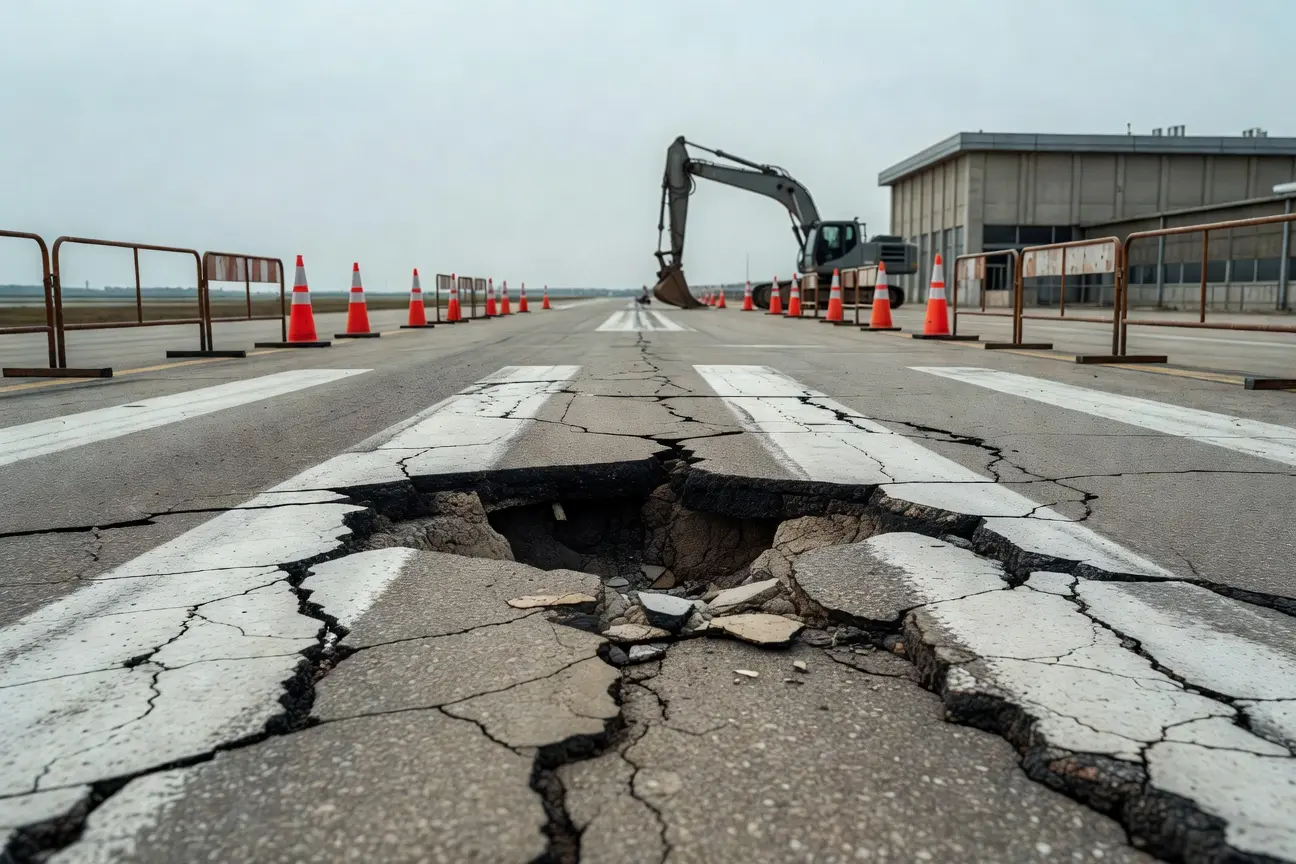
At 11 a.m. on Wednesday, during its routine morning inspection of the airfield, a Port Authority of New York and New Jersey crew identified a sinkhole near Runway 4/22 at LaGuardia Airport and immediately shut the runway down. By mid-afternoon, the Federal Aviation Administration (FAA), the agency that manages national air traffic flow, was reporting average arrival delays of 97 minutes. FlightAware, the aviation tracking service, counted 197 cancellations and 168 delays. Memorial Day weekend was three days out.
LaGuardia has only two runways. One of them was just swallowed by the ground it was built on. That ground, assembled starting in 1937, consists of more than 17 million cubic yards of cinders, ashes and garbage, some of it hauled from Rikers Island, New York City’s main detention facility. By 1942, three years after the airport opened, runways were already sinking into it.
Runway 4/22 Goes Dark
The Port Authority’s inspection crew spotted the depression at roughly 11 a.m. The 7,000-foot strip was taken out of service within minutes. An excavator and a dump truck arrived within hours, and aerial footage captured the scale of the damage: large enough to need heavy machinery, not a patching crew. Air traffic control audio caught the moment pilots learned what had happened. “Ground, uh, what happened to the uh, Runway 4/22?” one pilot asked. “There’s a sinkhole,” the controller replied.
Investigators from the agency named a fuel-line tunneling project running beneath the runway surface as one possible cause, though nothing was confirmed by Wednesday afternoon. No public repair timeline appeared until the FAA published a NOTAM (Notice to Air Missions) setting closure through 6 a.m. Thursday, subject to the severe thunderstorm watch covering the New York metropolitan area Wednesday night.
Within hours of the closure, FlightAware’s real-time tracking and the FAA’s ground delay program illustrated what losing one of LaGuardia’s two runways means in practice: no buffer, no rerouting option, and no quick fix on the busiest travel threshold of spring.
- 197 cancellations into and out of LaGuardia counted by mid-afternoon Wednesday
- 168 delays recorded at the same checkpoint, many stacked on top of flights already rescheduled from the morning closure
- 97 minutes: average arrival delay reported by the FAA’s ground delay program for LaGuardia-bound traffic as of 3 p.m. EST
- 1 of 2 runways in operation at an airport where, unlike JFK or Newark Liberty International, there is no third or fourth strip to absorb the overflow
Built on 17 Million Cubic Yards of Landfill
The land now occupied by LaGuardia Airport was, before 1929, the Gala Amusement Park, a waterfront attraction on Flushing Bay once owned by the Steinway piano family. A roller coaster stood where runways now run. The park declined, the site became a private airfield, and then Mayor Fiorello La Guardia, the combative New York City mayor who in 1934 refused to deplane from his TWA flight at Newark because his ticket read “New York,” campaigned for construction of a new municipal airport on the spot.
Ground was broken September 9, 1937, funded by a $45 million Works Progress Administration (WPA) grant. New York City Parks’ historical account of the construction records that more than half of the 558 acres carved out for the facility was manufactured land, “filled in with more than 17 million cubic yards of cinders, ashes and trash.” The landfill came from Rikers Island and a nearby garbage dump, then was laid over a metal frame extended out into Flushing Bay.
The airport opened December 2, 1939, and official publicity called the result “unsurpassed and unrivaled in utility, capacity, safety, convenience and beauty.” Thousands of New Yorkers paid a dime in the opening weeks to watch planes land and take off. The compressed ash, cinder and municipal waste beneath them compacted quietly beneath each landing.
Mayor La Guardia died in 1947, the same year the agency assumed operations under a lease with New York City. Runways were extended to 7,000 feet in subsequent decades. The main terminal was rebuilt in a widely praised renovation completed in recent years. The foundation layer of 1930s-era refuse has not been replaced.
The Runways Started Sinking in 1942
Three years after the airport opened, three of its runways began sinking into the landfill beneath them. New York City Parks’ own historical record documents this without elaboration: the fill settled, and the pavement settled with it. The airport continued to function. Subsequent decades brought runway extensions, terminal overhauls and, most recently, a multibillion-dollar reconstruction of the main terminal building. None of those renovations addressed the foundational layer of ash, cinder and garbage placed in the late 1930s, which remains the base on which the runways sit today.
Sinkholes on airport runways are uncommon events. CBS News senior transportation correspondent Kris Van Cleave noted Wednesday that “potholes on runways and the taxiways at an airport are fairly unusual, but like any roadway, something can undermine that surface and cause it to collapse.” What makes LaGuardia’s situation specific is not just the isolated incident but the foundation type: not engineered bedrock, not uniform modern fill, but 17 million cubic yards of 1930s-era compacted refuse that has been settling unevenly under the weight of aircraft operations for the better part of nine decades.
Ground Subsidence Data Shows 3.9 Percent at Risk
In July 2025, researchers from Virginia Tech published findings in the peer-reviewed journal Earth and Space Science measuring ground subsidence at 15 major U.S. coastal airports. The study used InSAR (Interferometric Synthetic Aperture Radar), a satellite-based technology that detects millimeter-scale ground movement with high precision. Virginia Tech’s summary of the findings reported that 3.5 million square meters of runway surface across the surveyed airports are experiencing significant subsidence, and nearly 14,000 square meters are at high to very-high risk of structural damage. Overall, 3.9 percent of the surveyed runway area falls into medium-to-very-high damage risk categories.
Even small, uneven changes in runway elevation can compromise aircraft performance and safety. Our research highlights the importance of continuous monitoring so that maintenance can be targeted before problems escalate.
Oluwaseyi Dasho, lead author and graduate researcher in the Department of Geosciences at Virginia Tech, from the July 2025 university research release.
The 2025 study focused on coastal airports and did not include LaGuardia in its surveyed set. But the geological mechanism it documents applies directly: compressible sediment and landfill beneath heavily used pavement, settling unevenly over decades of aircraft loads. The airports with the largest proportion of runway area at risk included Miami International and Philadelphia International. San Francisco International Airport logged the fastest raw sinking rate of any airport in the data.
| Airport | Annual Sinking Rate | Risk Profile |
|---|---|---|
| San Francisco International (SFO) | 9.2 mm per year | Fastest nationally; all four runways affected |
| Miami International (MIA) | Moderate | Largest share of total runway area at risk |
| Philadelphia International (PHL) | Moderate | Largest share of total runway area at risk |
| Los Angeles International (LAX) | 2.0 mm per year | Lowest subsidence rate in the study |
No crashes have been directly linked to subsidence at any airport in the study. The paper notes that the primary visible consequence so far has been rising maintenance costs. Proactive real-time subsidence monitoring is not yet standard practice at U.S. airport facilities.
The Worst Spring for One Runway
Wednesday’s sinkhole is not this runway’s first crisis of 2026. On the night of March 22, Air Canada Express Flight 8646, a Bombardier CRJ900 regional jet operated by Jazz Aviation and inbound from Montreal with 72 passengers and four crew members, struck a Port Authority fire truck that had been cleared to cross the runway. The collision killed both pilots: Captain Antoine Forest, 30, of Coteau-du-Lac, Quebec, and First Officer Mackenzie Gunther, 24, of Ottawa, Ontario. It was the first fatal accident at the airport in 34 years.
The National Transportation Safety Board (NTSB), the federal agency that investigates U.S. transportation accidents, is still working through the case. Preliminary findings from the NTSB’s active aviation investigations revealed that the fire truck carried no transponder, the device that allows controllers to track vehicles across the airfield, and that the airport’s surface detection system failed to generate a collision alert before impact. NTSB Chair Jennifer Homendy presented those details at an early press briefing. The runway was closed for investigation and reopened March 26 after the debris field was documented.
Separate in cause, the two incidents share a single strip of pavement at an airport with no capacity to lose either runway. The March crash traced to a coordination breakdown between ground control and a moving vehicle. The May sinkhole traces to conditions beneath the surface. Both happened at a facility whose scheduling model assumes constant availability of both its runways, and both sent cascades of delays and cancellations through the New York metropolitan air network.
The bodies of Forest and Gunther were repatriated to Canada on March 26. The NTSB investigation may take a year or more to conclude. Air traffic control audio recorded a controller saying, roughly 18 minutes after the impact, “I messed up.” Who gave which clearance, and how the surface detection failure compounded the sequence, remains under active review.
Two Runways, One Holiday Weekend
LaGuardia’s operational fragility is not a secret to anyone who writes airline schedules. The airport sits on a 680-acre footprint in Queens, bounded by Flushing Bay to the north and the Grand Central Parkway to the south, with no physical room to expand. It handles primarily domestic routes and ranked 19th nationally by passenger volume as of 2023. JFK operates four runways. Newark operates three. LaGuardia operates two, and the scheduling model that makes it one of the most efficiently used airports in the country depends on both strips being available at all times.
Several converging factors made Wednesday’s disruption worse than a single runway closure would normally produce on its own.
- A severe thunderstorm watch blanketed the New York metropolitan region from late afternoon through Wednesday night, adding weather-driven delays on top of the already reduced runway capacity
- Memorial Day weekend travel ranks among the highest-demand periods in domestic aviation, with seats booked weeks in advance and limited rebooking inventory across all three major New York-area airports
- The NTSB’s ongoing investigation into the March collision has placed sustained scrutiny on Port Authority operations at the airport, creating pressure to resolve the sinkhole quickly and with full public transparency
- The cause of the sinkhole remained unconfirmed Wednesday evening; the suspected fuel-line tunnel mechanism, if verified, could require subsurface repairs far more extensive than surface patching alone
If crews clear the runway by the Thursday morning reopening target, the holiday crunch may prove manageable. If investigators find that a tunnel void beneath the landfill drove the collapse, and that the damage extends beyond the visible surface break, then an airport that first began sinking into its own foundation in 1942 may be facing a repair window measured in days it does not have.






Geekbench 7 Launches and Erases Three Years of Scores

Google’s Selfie Video Sign-In Arrives as Deepfake Fraud Surges

Samsung’s New Galaxy Z Fold 8 Undercuts Its Own Ultra

Kroger and Brookshire’s Recall Over 19 Million Eggs for Salmonella

Mortgage Rates Hit an 11-Month High as Oil Fears Bite

Oil’s Price Shock Collides With Wall Street’s AI Spending Boom

Parsley and Cilantro Emerge as Cyclospora Suspects in North Carolina

Walmart Dresser Recall Reveals a Wider Furniture Safety Sweep

Apple’s iOS 27 Speed Fixes Echo Its 2018 Playbook

Cheshire Medical Center Cyclospora Cluster Exposes a Wider Outbreak

Pokémon GO Developer Niantic Rebrands as Scopely Explore

Persona 4 Revival Hands All Anime Cutscenes to Studio MAPPA

Doom Studio id Software Cuts Half Its Staff in Xbox Layoffs

Jaylen Brown Traded to 76ers for Paul George and Four Draft Picks

Nintendo Switch Online Adds Four Classics and One Japan-Only Title

Jordan Henderson Hospitalized After Wrist Injury at the Azteca

Mexico’s World Cup Run Ends at Azteca as England Hold On 3-2

Meta’s Muse Image Lets Anyone Use Your Instagram Photos in AI

Louis Vuitton Beats Molly Tea in China, Triggers Cultural Backlash

Marine Cloud Brightening Could Weaken Super El Niños, Study Says
-

 TECHNOLOGY3 years ago
How to Adjust a Bulova Watch Band – An Easy Guide
-

 News3 years ago
Fred Pentland: Athletic Bilbao’s English mentor who changed the essence of Spanish football
-

 FINANCE3 years ago
Tax Planning for Every Season: Guide to Maximizing Your Tax Benefits
-

 Education3 years ago
African Ministers New Education Plan
-

 BUSINESS3 years ago
What is Entrepreneurial Operating System? A Comprehensive Guide to EOS
-

 Education3 years ago
Innovate Your Learning Journey with Technology and Enhance Education
-

 News3 years ago
Russians formally out of World Athletics Championships
-

 BUSINESS3 years ago
Top 9 Most Expensive American Cities to Rent an Apartment