
News
Amazon Leo Adds 29 Satellites as Its FCC Deadline Slips Away

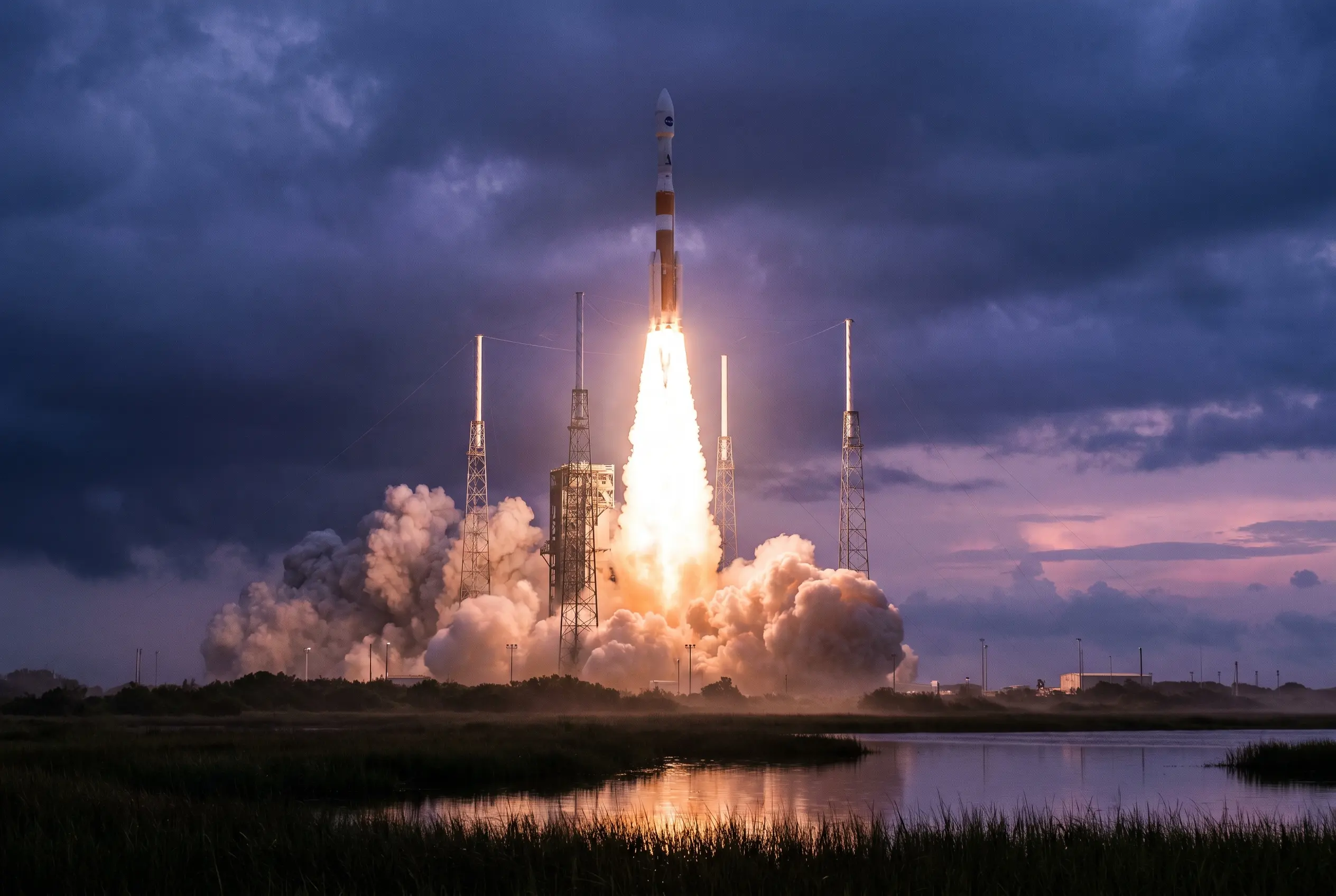
United Launch Alliance pushed 29 Amazon Leo broadband satellites into low Earth orbit on Friday evening, lifting off from Cape Canaveral Space Force Station at 7:53 p.m. EDT after weather officers had given the flight only a 30 percent shot at acceptable conditions. The launch brought Amazon’s first-generation constellation to 331 satellites across 12 missions. The company’s federal license says it needs 1,618 of them operating by July 30.
That gap would be steep on its own. It turned close to impossible 24 hours before liftoff, when Blue Origin’s New Glenn rocket, the vehicle Amazon was counting on to carry most of the load, exploded on its only launch pad during a ground test.
A Launch That Barely Moves the Math
Friday’s flight, dubbed Amazon Leo 7 by United Launch Alliance (ULA, the Boeing and Lockheed Martin launch venture) and Leo Atlas 07 by Amazon, used an Atlas 5 in its most powerful 551 configuration, with five solid rocket boosters strapped to the core. The rocket, tail number AV-113, was the 109th Atlas 5 ever flown and the 22nd in that five-booster setup. It cleared Space Launch Complex 41 on a north-easterly track shortly after sunset.
The hardware performed. The arithmetic did not improve much. Adding 29 satellites to a deployment that began in April 2025 leaves Amazon Leo, the broadband network formerly branded Project Kuiper, sitting at roughly a fifth of what regulators expect within two months. For perspective, here is where the numbers stand.
- 331 satellites in orbit after Friday’s flight
- 1,618 required to be operating by July 30 under the original license terms
- 7th production batch ULA has flown for Amazon on an Atlas 5
- 12 launches completed in the program’s first year, roughly one a month
At that cadence, reaching 1,618 by the end of July is not a stretch. It is off the table. The question is no longer whether Amazon hits the deadline, but what happens when it does not.
Why July 30 Is the Date That Matters
The deadline traces back to July 2020, when the Federal Communications Commission (FCC, the US regulator that licenses satellite spectrum) authorized Amazon to build a 3,236-satellite network. The approval came with a condition the agency attaches to large constellations to stop companies from warehousing valuable orbital slots: deploy and operate half the fleet within six years, and the entire fleet within nine.
Counting from the 2020 authorization, that put the 50 percent milestone at July 30, 2026, and full deployment at July 30, 2029. At the time, six years looked generous. Amazon had bought launch capacity from three different rocket builders and planned to start flying production satellites years before the deadline.
Then the schedule slipped. The first production batch did not reach orbit until April 2025, leaving barely 15 months to close a gap of more than 1,500 satellites. The condition that once read as routine is now the single number that defines the program’s near-term story, and missing it forces the company back in front of the same regulator that set the terms.
Falling short does not automatically cost Amazon its license. The FCC can grant relief, and it has done so for other operators that showed good-faith progress. But relief is discretionary, and the agency weighs it against the interests of rivals who want the same spectrum and orbital shells.
Two Rockets Down at the Worst Possible Moment
Amazon’s deployment plan rested on two heavy rockets doing the bulk of the work, with the aging Atlas 5 serving only as a bridge. Both of those workhorses are now sidelined, and the timing could hardly be worse.
| Rocket | Status (late May) | Role in Amazon’s plan |
|---|---|---|
| Atlas 5 551 | Flying, one launch left | Bridge vehicle, small batches of around 29 |
| New Glenn | Grounded, only pad destroyed | Heavy lifter, 24 missions contracted |
| Vulcan Centaur | Grounded since February | Primary workhorse, 38 missions contracted |
The New Glenn Pad Is Gone
On May 28, around 9 p.m. EDT, Blue Origin was counting down to a brief test firing of New Glenn’s seven methane-fueled BE-4 first-stage engines when the vehicle erupted in a fireball at Cape Canaveral. The 188-foot first stage caught fire, the upper stage tilted and collapsed, and the rocket was lost. All personnel were accounted for and unharmed.
The destroyed rocket had been slated to carry 48 Amazon Leo satellites, with the first New Glenn deployment flight expected as soon as June 4. Blue Origin, the space company founded by Jeff Bezos, operates just one New Glenn pad, and it took serious damage. That single event froze all 24 New Glenn missions Amazon had on the manifest.
It’s too early to know the root cause but we’re already working to find it.
So wrote Jeff Bezos, Blue Origin’s founder, in a post after the loss. Amazon Leo confirmed that its satellites sat untouched at the company’s payload processing facility at NASA’s Kennedy Space Center during the blast, and ULA said its own infrastructure at United Launch Alliance’s Atlas 5 launch complex was unaffected.
Vulcan Has Been Grounded Since February
The other workhorse was already down. On February 12, a Vulcan Centaur flying the USSF-87 mission for the US Space Force suffered a burn-through at the throat of one solid rocket booster nozzle. The mission still reached orbit, but it was the second identical anomaly on the booster, the first having struck a Vulcan flight in October 2024. ULA and booster maker Northrop Grumman opened a full root-cause investigation, and ULA has said Vulcan will not fly again until the cause is found and fixed. Officials have warned that work could run for months.
Amazon’s Plea to the FCC
Anticipating the squeeze, Amazon went to regulators in January and asked for breathing room. The filing requests a 24-month extension, pushing the 50 percent milestone from July 30, 2026, to July 30, 2028, while citing a shortage of available rockets rather than any problem with its own satellites.
The company also moved to widen its launch options. Even before the New Glenn loss, Amazon had taken several steps to add capacity.
- Bought 10 additional Falcon 9 launches from SpaceX
- Booked 12 more New Glenn flights on top of its existing manifest
- Shifted small batches onto the remaining Atlas 5 hardware to keep a steady drumbeat
Amazon has told the agency it expects to reach roughly 700 satellites by the end of July, enough to rank as the world’s second-largest constellation behind SpaceX’s Starlink, but still less than half of the 1,618 its license demands. The petition remains under review, and the calculus the agency uses is laid out in the FCC’s satellite licensing rules. Approval is plausible. It is not guaranteed.
The SpaceX Lifeline and Its Limits
With both heavy rockets parked, the most reliable path to orbit runs through a competitor. SpaceX has already flown three Amazon Leo missions on Falcon 9, each carrying 24 satellites, and the additional 10 flights give Amazon a vehicle with a launch record nobody else can match right now.
The irony is hard to miss. Amazon is paying SpaceX, operator of the Starlink network with more than 10,000 active satellites, to help stand up a rival broadband service. SpaceX has its own demanding calendar, including the heavy-lift Starship test campaign at its Starbase site in Texas, which competes for engineering attention and range time.
Falcon 9 also carries fewer Amazon satellites per flight than New Glenn was designed to loft. Leaning on it closes part of the gap, but ten extra launches at 24 satellites apiece adds 240 spacecraft, a fraction of what the company is missing. The backstop helps. It does not rebuild the deployment plan.
One Atlas 5 Still in the Hangar
Friday’s flight was the penultimate Atlas 5 mission for Amazon. After Leo Atlas 07, a single Atlas 5 551 remains, and ULA has said it will fly the final one in July, closing out the rocket’s service to the constellation just as the original deadline arrives. From there, Amazon’s plan always called for transitioning the bulk of launches to Vulcan, the vehicle now under investigation.
Amazon bought 47 launches from ULA in total, 38 on Vulcan and nine on Atlas 5, part of a broader package of more than 100 rockets secured across providers for the first-generation network. That hardware exists. The constraint is whether it can fly. Vulcan’s grounding and New Glenn’s wrecked pad mean a launch backlog is building faster than orbit-ready rockets can clear it.
You can track the running tally on Amazon Leo’s official deployment page, which logged the jump to 331 within hours of Friday’s deployment. The next entry, in July, will likely be the last Atlas 5 line on it.
If Vulcan returns to flight this summer and Blue Origin rebuilds its pad before year’s end, Amazon’s extension request becomes a formality and the constellation grows fast in 2027. If either slips further, the company will be making its case to regulators with a few hundred satellites in orbit and a deadline already in the rear-view mirror.


SpaceX IPO Hands Retail 30%, But Day-One Odds Are Grim

Penn Station Fire Injures 5 and Halts Rail Service Again

Oil’s Worst Month Since 2020 Powers Dow Past 51,000

Ferrari Luce Backlash Is Running BMW’s China Playbook

Tomato Prices Jump 40% as Grower Tariff Win Hits Shoppers

Universal Music Rejects Ackman’s $64 Billion Takeover Bid

Anthropic Hits $965B Valuation, Tops OpenAI as Mythos Looms

Amazon Leo Adds 29 Satellites as Its FCC Deadline Slips Away

SEC Moves to Rescind Climate Rule as States Keep the Mandate

Moringa Superfood Supplements Recalled Over Salmonella Risk

Subnautica 2 Studio Apologises, Holds Line on No-Kill Combat

Mitchell Matches Kobe in Game 7 Rout, Cavaliers Reach East Finals

Xperia 1 VIII Holds Price, Xiaomi 17 Max Loads Up: Week 20 Phone News

Shai Gilgeous-Alexander Wins Second Straight MVP With 83 of 100 First-Place Votes

Brent at $111 Hides the Hormuz Damage Hitting Fed and Asia

Colt Emerson Debuts, Mariners Get Swept by Padres in Vedder Cup

Rousey Finishes Carano in 17 Seconds and Hands Netflix Its MMA Opening

Samsung Strike Looms May 21 as Union Eyes SK Hynix Bonus Formula

LIRR Strike Hits Third Day as 250,000 Commuters Face a Tougher Manhattan Run

Jaylen Brown Calls Stephen A. Smith the Face of Clickbait Media
-

 TECHNOLOGY3 years ago
How to Adjust a Bulova Watch Band – An Easy Guide
-

 FINANCE3 years ago
Tax Planning for Every Season: Guide to Maximizing Your Tax Benefits
-

 Education3 years ago
African Ministers New Education Plan
-

 News3 years ago
Fred Pentland: Athletic Bilbao’s English mentor who changed the essence of Spanish football
-

 BUSINESS3 years ago
What is Entrepreneurial Operating System? A Comprehensive Guide to EOS
-

 Education3 years ago
Innovate Your Learning Journey with Technology and Enhance Education
-

 News3 years ago
Russians formally out of World Athletics Championships
-

 BUSINESS3 years ago
Top 9 Most Expensive American Cities to Rent an Apartment