
News
Penn Station Fire Injures 5 and Halts Rail Service Again

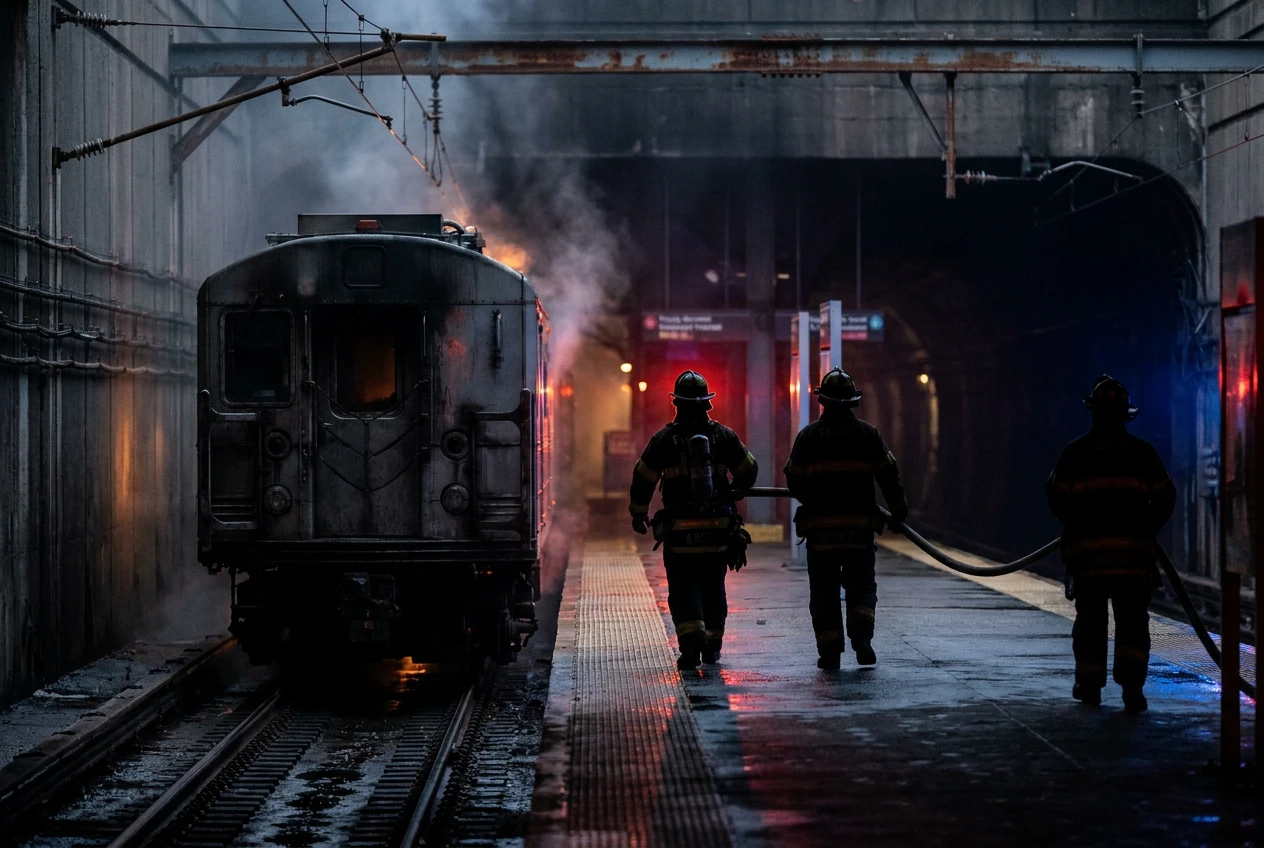
A Penn Station fire on an Amtrak maintenance train injured five rail workers early Friday and shredded the morning commute for hundreds of thousands of passengers across three railroads. The blaze, reported around 1:25 a.m. on May 29, started on a contractor’s maintenance vehicle just outside the Hudson River tunnels, west of the Manhattan hub, and was not brought under control until close to 4 a.m.
It was the third time this month that trouble on Amtrak-owned infrastructure has knocked out the busiest rail station in the Western Hemisphere, and the permanent fix is still nearly a decade from opening.
A 1:25 A.M. Fire That Took Out the Friday Commute
Firefighters got the emergency call shortly after 1:25 a.m., according to the New York City Fire Department, which described a fire on a train car at the western edge of the station. The response was heavy for a maintenance vehicle: dozens of trucks and well over a hundred personnel worked the scene before the fire was knocked down and later extinguished.
Five rail workers were hurt. Two were taken to a hospital with serious injuries, officials said, while others were treated for smoke inhalation at the scene. The cause was still under investigation Friday, though Amtrak, the national passenger railroad that owns Penn Station and much of the surrounding track, accepted responsibility and said the fire began on an Amtrak contractor’s maintenance vehicle.
- 46 fire trucks and 141 Fire Department personnel deployed to the scene overnight.
- Five rail workers injured, two of them with serious injuries.
- 4 a.m. approximate time the blaze was brought under control, roughly two and a half hours after the first call.
Some Amtrak service resumed around 12:30 p.m. Friday. Gery Williams, an executive vice president at Amtrak, called the disruption “unacceptable” at an afternoon news conference and said full normal service would not return until Monday morning.
The Third Penn Station Breakdown in Three Weeks
Friday’s fire did not land in a vacuum. It capped a stretch of May in which the region’s core rail network failed riders three separate times, twice because of fire on the tracks and once because of a labor walkout. Each event hit the same chokepoint, and each one rippled outward across commuter lines that have nowhere else to terminate in Manhattan.
- May 14: an electrical fire in a tunnel under the East River snarled train traffic for hours during peak service.
- Days later: a Long Island Rail Road strike shut the nation’s busiest commuter railroad for three days, stranding roughly a quarter-million daily riders.
- May 29: the maintenance train fire on track 11, near the North River Tunnel entrance, suspended Amtrak and NJ Transit service into the afternoon.
Who Got Stranded, and What Each Railroad Did
Penn Station serves more than 600,000 passengers on a typical weekday, split across three operators that share the platforms but run their own trains, crews and management. When the tracks west of the station go down, all three feel it at once, which is exactly what happened Friday.
NJ Transit riders took the heaviest hit. With service between Newark and New York suspended, Midtown Direct trains were diverted to Hoboken, leaving passengers to finish the trip by bus or on the PATH train into Manhattan. Long Island commuters fared better by midmorning, after the Long Island Rail Road restored full service out of the station.
| Railroad | Status Friday morning | Return to service |
|---|---|---|
| Amtrak | NY to NJ and points south suspended; north and east reduced | Partial by 12:30 p.m.; normal Monday |
| NJ Transit | Penn to Newark suspended; Midtown Direct diverted to Hoboken | Afternoon, with delays; normal Monday |
| Long Island Rail Road | Suspended both directions early; some branch cancellations | Full service by about 8:30 a.m. |
The disruption echoed the same network the LIRR walkout had paralyzed days earlier, a reminder that the region’s three railroads keep failing through the one door they all share. Jenna Houston, a 28-year-old traveler from Pennsylvania, found her train canceled and joined an Amtrak refund line that snaked around the main hall. “It’s so frustrating,” she said. The company apologized and said it was processing rebookings and refunds for affected passengers. For the labor side of this month’s chaos, see our earlier coverage of the three-day Long Island Rail Road strike that preceded the fires.
Tunnels Built in 1910 Are Doing 2026 Work
Strip away the daily blame and the underlying problem is concrete and steel that predates the Model T. The fire ignited near the North River Tunnel, the pair of single-track tubes under the Hudson that carry every Amtrak and NJ Transit train between New Jersey and Manhattan.
Why the North River Tunnel Keeps Failing
The North River Tunnel went into service in 1910 and is now more than 115 years old. Superstorm Sandy flooded both tubes in 2012, and the chlorides left behind after the saltwater receded continue to corrode the tunnel walls, signals and electrical equipment, according to the Gateway Program, the agency overseeing the replacement. With only two tubes and no spare capacity, a single failure forces trains onto one track, which collapses throughput for the entire corridor.
What the Gateway Program Fixes, and When
The repair is already designed and partly funded. A new pair of tubes, the Hudson River rail tunnel replacement project, broke ground in 2023 and is scheduled to open in 2035, after which crews can finally take the century-old tubes out of service one at a time for a full rehabilitation expected to run into 2038. The federal piece of the work is tracked through the Federal Transit Administration’s Hudson Tunnel Project page. Until those new tubes open, riders are betting their morning on infrastructure that turns 116 this year. New York’s own plan to rebuild Penn Station sits on top of that same aging track network.
Amtrak Owns the Tracks, the MTA Owns the Anger
The structural problem has a governance problem stacked on top of it. Amtrak owns Penn Station and the tracks around it, but the Metropolitan Transportation Authority (MTA, the state agency that runs the Long Island Rail Road and Metro-North) carries much of the rider pain when those tracks fail. That split has curdled into open conflict.
Amtrak has to do better. When you see impacts like we are seeing in New York right now, you say, what is going on in Amtrak? We need some assurance that this is not going to keep happening again and again and again.
That was Janno Lieber, the MTA’s chief executive, who said his understanding was that Friday’s fire stemmed from a collision of two work trains that damaged the electrical system. Amtrak’s Williams pushed back on the idea of a pattern, casting the incidents as “anomalies” and “completely separate.” The authority has spent months frustrated by Amtrak track fires and equipment failures, and in October it blamed Amtrak for delays on new Metro-North stations in the Bronx, a claim Amtrak denied. If full service returns Monday as promised, the immediate crisis ends; if a fourth failure hits the same tunnels before the new ones open, the feud stops being about apologies and starts being about who pays for the next decade of risk.
Frequently Asked Questions
When will normal service return to Penn Station?
Amtrak said full normal service between New York and New Jersey is expected to resume by the Monday morning commute. Limited Amtrak service began returning around 12:30 p.m. Friday, and the Long Island Rail Road was running full service out of the station by about 8:30 a.m.
What caused the Penn Station fire on May 29?
The cause was still under investigation Friday. Amtrak said the fire started on a contractor’s maintenance vehicle just outside the Hudson River tunnels. MTA chief executive Janno Lieber said his understanding was that two work trains collided, damaging the electrical system and igniting the blaze.
How many people were injured?
Five rail workers were hurt. Two were taken to a hospital with serious injuries, and others were treated for smoke inhalation. No passengers were reported among the injured.
How can NJ Transit riders get into Manhattan?
During the suspension, NJ Transit’s Midtown Direct trains were diverted to Hoboken, where riders could complete trips using buses or the PATH train. Check NJ Transit’s site for the current status before traveling, as service was still recovering with delays.
Can affected passengers get refunds?
Yes. Amtrak apologized for the disruption and said it was working on rebookings and refunds for affected passengers. Riders reported long customer service lines at the station, so handling requests through Amtrak’s app or website may be faster.





Spotify Running Mode hits Android and revives its old tempo experiment

Galaxy Tab S12 Ultra Renders Keep the Notch Fans Hate

Novato Spinning Round House Sells With Six Neighbors for $3.3 Million

Crop Tour Finds Indiana and Nebraska Corn Yields Lagging 2025

Best Buy 60th sale brings Android deals back to its roots

American Airlines reverses seatback screen bet years too late

Iran Hormuz Strikes Force Gulf Oil Onto Costlier Paths

Plague Tale Prequel Day One Joins Game Pass Wave 2 as Witcher Exits

NBA 2K27 opens The City to everyone and rewrites career eras

iOS 26.6.1 Patches 29 Flaws as AI Forces Faster Apple Updates

Double Fine Cuts 23 Jobs Weeks After Xbox Independence

Day-One Big Walk Lifts PS Plus August Beyond Recycled AAA

John Hight Exits Wizards After Digital Reckoning Hits

Curtis Mead’s Red Sox Debut Ends With Fractured Wrist

Red Sox Squander Hot Streak Chance in 4-3 Loss to Athletics

Moesch and Dressel Rewrite Night One at 2026 U.S. Nationals

Boutte’s Quiet Camp Takeover Forces Patriots Receiver Choices

Take-Two CEO Pushes Netflix Subs for GTA 6 Extended Look

Halo Campaign Evolved Skulls Meet Death Barriers That Kill the Hunt

Wildlands Free Update Hands Players the Tools They Already Invented
-

 TECHNOLOGY3 years ago
How to Adjust a Bulova Watch Band – An Easy Guide
-

 News3 years ago
Fred Pentland: Athletic Bilbao’s English mentor who changed the essence of Spanish football
-

 FINANCE3 years ago
Tax Planning for Every Season: Guide to Maximizing Your Tax Benefits
-

 Education3 years ago
African Ministers New Education Plan
-

 BUSINESS3 years ago
What is Entrepreneurial Operating System? A Comprehensive Guide to EOS
-

 Education3 years ago
Innovate Your Learning Journey with Technology and Enhance Education
-

 News3 years ago
Russians formally out of World Athletics Championships
-

 BUSINESS3 years ago
Top 9 Most Expensive American Cities to Rent an Apartment