
FINANCE
Polymarket’s $1.9M Fake Bet Scandal Hits a Prediction Market’s Promise
WSJ says Polymarket paid creators to film $1.9M in fake bets across 1,105 videos, then told them not to disclose the deal. Polymarket promises a comprehensive audit.

Polymarket paid online creators to film roughly $1.9 million in bets that never happened on its prediction market, then told them not to disclose the arrangement, according to a Wall Street Journal investigation published over the weekend. The Journal reviewed 1,105 videos from 10 sponsored creators and found that the wagers shown across them were not real, with the campaign racking up more than 140 million views on TikTok, YouTube, and Instagram.
The campaign, which targeted U.S. users, lands as Polymarket pushes for broader U.S. re-entry under a CFTC-licensed exchange and counts the owner of the New York Stock Exchange among its largest backers. The platform has told reporters it is “committed to maintaining accurate, fair, and transparent markets” and plans a comprehensive audit of its promotional content.
The 1,105 Videos and the $1.9 Million That Wasn’t Real
A college student named George Makihara posted a video in January showing him winning $100,000 on a Polymarket bet that President Trump would publicly say the word “McDonald’s” that month. The Wall Street Journal reported that the bet was one of 145 Makihara appeared to place on the platform between January and mid-May, totaling almost $410,000. None of those bets were real.
Across the 1,105 creator videos the Journal reviewed, posted since December by 10 sponsored creators, a wager appeared in roughly 70% of them and none were genuine. Together, the fake bets on screen added up to roughly $1.9 million, the Journal reported, citing its analysis and instructional materials the company provided to creators. The campaign generated more than 140 million views on TikTok, YouTube, and Instagram, according to analytics provider Tubular, cited by the Journal. The Verge reported that many creators have since scrubbed the videos from their accounts after the Journal began asking questions.
The campaign’s full footprint, by the Journal’s count:
- 1,105 creator videos reviewed
- 10 sponsored creators behind the campaign
- ~$1.9 million in bets shown on screen, none of which were real
- 140 million+ combined views on TikTok, YouTube, and Instagram
Polymarket has since taken down the look-alike sites used in the videos, including a password-protected page at the misspelled URL “poiymarket.com.” The platform did not respond to a request for comment from the Journal about the marketing operation.
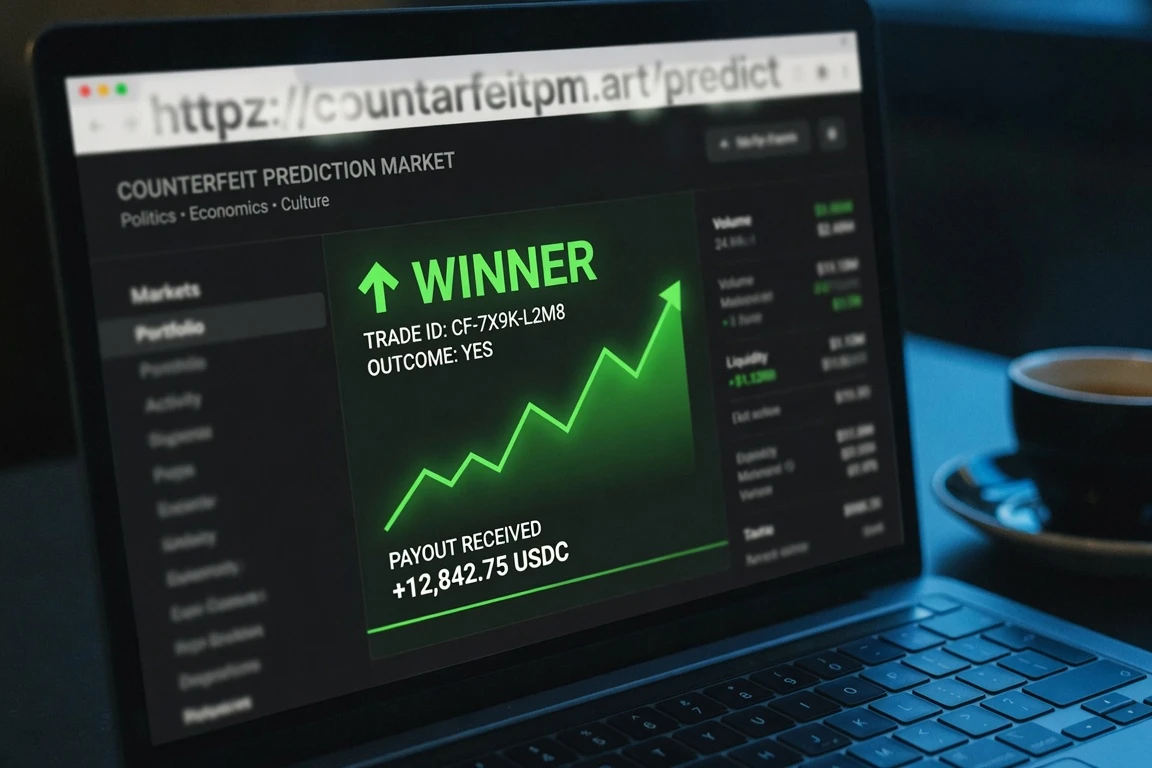
How a Misspelled URL Sold the Illusion
The fake videos were filmed on near-perfect copies of the Polymarket website, with creators placing trades and watching notifications pop on dummy interfaces that mirrored the real platform. The Journal said it identified several discrepancies between the real Polymarket site and the look-alikes, including a password-protected page at “poiymarket.com” that, with the “i” capitalized, reads as “polymarket.com.” A source familiar with the matter told the Journal that the dummy site was built by Polymarket itself; other videos suggested the sites were test environments for the company’s engineers. Creators were given instructional documents, prepared videos, and access to a chat group with nearly 20,000 messages, the Journal reported, citing materials it reviewed.
Creators were also given a short list of instructions that read more like a covert-ops checklist than a marketing brief:
- Make posts “personal and organic,” with no reference to “Polymarket” in account names.
- Do not disclose that Polymarket paid for the videos; one creator added a “$20 bonus code” to his bio instead.
- Film the trades on the dummy sites, including “poiymarket.com,” then react as if the winnings were real.
The creators only added “@polymarket partner” to their bios after the Journal began asking the company about the marketing operation, the Journal and TechCrunch both reported.
Who Filmed the Videos and Who Paid Them?
Polymarket hired and worked closely with a marketing firm called Virality, which managed a network of “clippers,” mostly college-age influencers, who produced the videos and reposted them across social platforms, The Wall Street Journal reported. Creators were paid $2,000 to $3,000 a month, and they were paid only when at least 60% of their audience was based in the United States, the Journal said. The U.S.-only payment threshold is a notable detail: Polymarket’s main site remains geoblocked for American users, and CBS News reported that the campaign was pitched as luring U.S. users to that offshore, unregulated platform.
Razeen Khan, a California-based college student, worked as a Polymarket creator for several months until March, the Journal reported. He compared the practice to fast food commercials that show burgers looking better than they look in real life. Khan’s framing of the arrangement captures how at least one creator defended it:
We’re depicting what actually happens.
Razeen Khan, a college student in California who worked as a Polymarket creator until March, in remarks to The Wall Street Journal.
The defense sits in tension with the company’s own marketing pitch. Polymarket’s public homepage describes itself as “the world’s largest prediction market,” a place where users bet on real-world events and the prices reflect real money at stake. The promotional videos depicted wins on trades that, on the real order book, never settled. Polymarket did not respond when the Journal asked for comment on the marketing operation.
The 118 Videos Where Every Bet Would Have Lost
The Journal’s review identified a smaller, sharper subset inside the 1,105-video set: 118 clips, roughly 10% of the total, in which creators celebrated wins that real Polymarket users could never have collected. Together, those 118 videos depicted creators pocketing nearly $900,000 in fabricated winnings. On the actual platform, identical bets would have lost more than $166,000, the Journal reported. CBS News reported the same figures on Monday.
The gap between the wins shown on screen and the outcome on the real order book is the part of the campaign most likely to draw regulatory attention. Trump never said “McDonald’s” publicly in January, and more than 50 real accounts that placed the same bet all lost, the Journal found. The 118-video subset also lines up awkwardly with a separate federal insider-trading case filed in May against a Google engineer who used an internal marketing dashboard to win about $1.2 million on Polymarket. Both cases test the same promise: that the prices on the platform are real.
Polymarket’s Reply and the Rulebook It Already Has
Polymarket has issued two written responses to reporters since the Journal’s findings were published. To the Journal, the company said it is “committed to maintaining accurate, fair, and transparent markets” and plans a promotional-content audit. To CBS News on Monday, a spokesperson added that the audit will be “comprehensive” and will ensure content “complies with our standards, as well as applicable regulatory and legal disclosure requirements.”
The company’s own public rules already prohibit what the videos depicted. Polymarket US’s market-integrity page, hosted at integrity.polymarket.us, lists “fictitious transactions” alongside spoofing, wash trading, and front-running as conduct the platform prohibits on its CFTC-regulated exchange. The page describes that exchange as built to “keep markets fair and orderly,” with trade-surveillance partners and a real-time control desk monitoring for unusual activity. Polymarket US is the CFTC-licensed entity that operates separately from Polymarket’s main offshore site, where the 1,105 videos were filmed.
Here is where the platform’s stated position and its published rules sit next to each other:
| Polymarket’s stated position | Polymarket US’s own published rules |
|---|---|
| “Committed to maintaining accurate, fair, and transparent markets.” | Rules prohibit fictitious transactions and market manipulation. |
| Conducting a “comprehensive audit of active promotional content.” | Account-conduct rules forbid “all types of fraud and market manipulation.” |
| Billed publicly as “the world’s largest prediction market.” | Polymarket US markets itself as built to “keep markets fair and orderly.” |
Why the Timing Matters for U.S. Regulators
The investigation lands as Polymarket is pushing hardest to consolidate a U.S. foothold. NYSE owner Intercontinental Exchange has poured roughly $2 billion into the platform across successive funding rounds, The Defiant reported, citing the Journal’s coverage. Monthly event-contract volume across prediction markets passed $20 billion in 2026, and institutional market makers including Wintermute have begun quoting the contracts. The platform’s main site remains geoblocked for U.S. users after a 2022 CFTC settlement, but a separate CFTC-regulated U.S. exchange called Polymarket US operates through a mobile app that CBS News reported is currently invite-only.
Regulators are already circling. The CFTC did not respond to CBS News’ request for comment on whether it plans to examine the Journal’s findings. The FTC declined to comment on whether it plans to investigate, citing federal truth-in-advertising law. The campaign’s mechanics land squarely in the FTC’s frame: “Federal law says that ad[s] must be truthful, not misleading, and, when appropriate, backed by scientific evidence,” the agency told CBS News.
At the state level, Kentucky has sued Polymarket and rival Kalshi over alleged unlicensed sports wagering, echoing earlier actions by Nevada and Arizona, The Defiant reported. The CFTC, under Chair Mike Selig, has pushed back on state jurisdiction and warned that forcing prediction markets offshore risks an FTX-style implosion. The American Gaming Association and tribal coalitions have pressed Congress to carve sports prediction markets out of the CLARITY Act, the crypto market-structure bill moving through the Senate. Donald Trump Jr. is an investor in Polymarket and an adviser to both Polymarket and Kalshi. The House Oversight Committee sent Polymarket its own letter in May as part of a broader review of online prediction market platforms.
The whole point of an exchange is that the order book is real and anyone can audit it.
Jason Trost, CEO of Smarkets, a U.K. prediction market that has filed for a CFTC license to operate in the U.S., in an email to CBS News.
For now, the platform has said it will publish the audit’s findings without committing to a timeline. CBS News reported on Monday that no standalone blog post or public statement on X had appeared from Polymarket as of that afternoon. The two written responses to reporters are the company’s public posture, and the rest of the picture will depend on what the audit turns up and which agency moves first. Kalshi, Polymarket’s main U.S. competitor, has separately been adding risk scoring and employment verification tools under federal pressure, and Smarkets has filed its own U.S. application, leaving Polymarket to argue that its promotional operation is an outlier inside an industry that is otherwise tightening its controls.
Frequently Asked Questions
What did the Wall Street Journal investigation find?
The Journal reported that Polymarket paid 10 sponsored creators to film roughly 1,105 videos showing fake bets on the platform since December. Across those videos, the displayed bets added up to about $1.9 million, none of which were real trades. Creators were paid $2,000 to $3,000 a month, told not to disclose the arrangement, and only paid when at least 60% of their audience was based in the United States. The campaign generated more than 140 million views on TikTok, YouTube, and Instagram, according to analytics provider Tubular.
Are Polymarket’s actual prediction markets real?
The Journal’s findings concern Polymarket’s marketing videos, not the trading on its order books. Polymarket operates two related entities: an offshore main site that remains geoblocked for U.S. users after a January 2022 CFTC settlement, and a CFTC-regulated U.S. exchange called Polymarket US, operated by QCX LLC, which runs a mobile app that is currently invite-only. CFTC oversight applies to the U.S. exchange, not to the promotional operation that produced the 1,105 videos. Polymarket’s own public integrity rules forbid “fictitious transactions” and “market manipulation” by users.
What has Polymarket said in response?
Polymarket told the Journal it is “committed to maintaining accurate, fair, and transparent markets” and will conduct an audit of its promotional content. To CBS News on Monday, a spokesperson added that the audit will be “comprehensive” and will ensure content complies with the company’s standards as well as “applicable regulatory and legal disclosure requirements.” Polymarket has not posted a standalone blog post or public statement on X as of Monday afternoon, and the company did not respond to the Journal’s request for comment on the marketing operation when it was first asked.
What is Polymarket’s regulatory situation in the U.S.?
Polymarket’s main site has been geoblocked for U.S. users since the platform settled CFTC charges in January 2022 for $1.4 million over unregistered event-based binary options. A separate U.S.-regulated exchange, Polymarket US, operates under CFTC oversight through QCX LLC, the company acquired last year, and runs a mobile app that is currently invite-only. NYSE owner Intercontinental Exchange has invested roughly $2 billion across successive Polymarket funding rounds, and the platform is pursuing a broader U.S. re-entry as monthly event-contract volume across prediction markets passed $20 billion in 2026. Kentucky, Nevada, and Arizona have sued the company and its rival Kalshi over alleged unlicensed sports wagering, and the House Oversight Committee opened its own review in May.





Iowa Farmer Built Resilience for 16 Years Then Tariffs Hit Hard

HHS Adds FDA Tech and Drugs Deputies to Lock In AI and Review Power

Nvidia Earnings Carry a Built-In Sell-the-News Trap

HP Licenses Huawei Wi-Fi Patents Despite the Entity List

Poland Named in $131B F-15 Deal Echoes Apache Path

Sewer Scavengers Near Penn Station Repeat a Decades-Old NYC Pattern

Second Muni Fatigue Crash Exposes Surface Line Gaps

Chick-fil-A Chicken and Waffles Closes Its 80-Year Loop

Musk Data Centers Leave a Mississippi Family’s Historic Land Empty

OpenAI Data Center Chief Exits as Stargate Strategy Shifts

Double Fine Cuts 23 Jobs Weeks After Xbox Independence

Day-One Big Walk Lifts PS Plus August Beyond Recycled AAA

Curtis Mead’s Red Sox Debut Ends With Fractured Wrist

John Hight Exits Wizards After Digital Reckoning Hits

Red Sox Squander Hot Streak Chance in 4-3 Loss to Athletics

Moesch and Dressel Rewrite Night One at 2026 U.S. Nationals

Boutte’s Quiet Camp Takeover Forces Patriots Receiver Choices

Take-Two CEO Pushes Netflix Subs for GTA 6 Extended Look

Halo Campaign Evolved Skulls Meet Death Barriers That Kill the Hunt

Wildlands Free Update Hands Players the Tools They Already Invented
-

 TECHNOLOGY3 years ago
How to Adjust a Bulova Watch Band – An Easy Guide
-

 News3 years ago
Fred Pentland: Athletic Bilbao’s English mentor who changed the essence of Spanish football
-

 FINANCE3 years ago
Tax Planning for Every Season: Guide to Maximizing Your Tax Benefits
-

 Education3 years ago
African Ministers New Education Plan
-

 BUSINESS3 years ago
What is Entrepreneurial Operating System? A Comprehensive Guide to EOS
-

 Education3 years ago
Innovate Your Learning Journey with Technology and Enhance Education
-

 News3 years ago
Russians formally out of World Athletics Championships
-

 BUSINESS3 years ago
Top 9 Most Expensive American Cities to Rent an Apartment