
FINANCE
China’s Economy Grows Just 4.3% as Exports Boom and Households Retreat
China’s economy grew 4.3% in the second quarter, its slowest pace since 2022, as exports boomed but consumers and property investment stayed weak.

China’s economy expanded 4.3% in the second quarter, the government said Wednesday, its weakest pace in more than three years. The reading missed forecasts of 4.5% and slowed sharply from 5% growth in the first quarter, even as factories filling semiconductor and electric vehicle orders kept exports at near record levels.
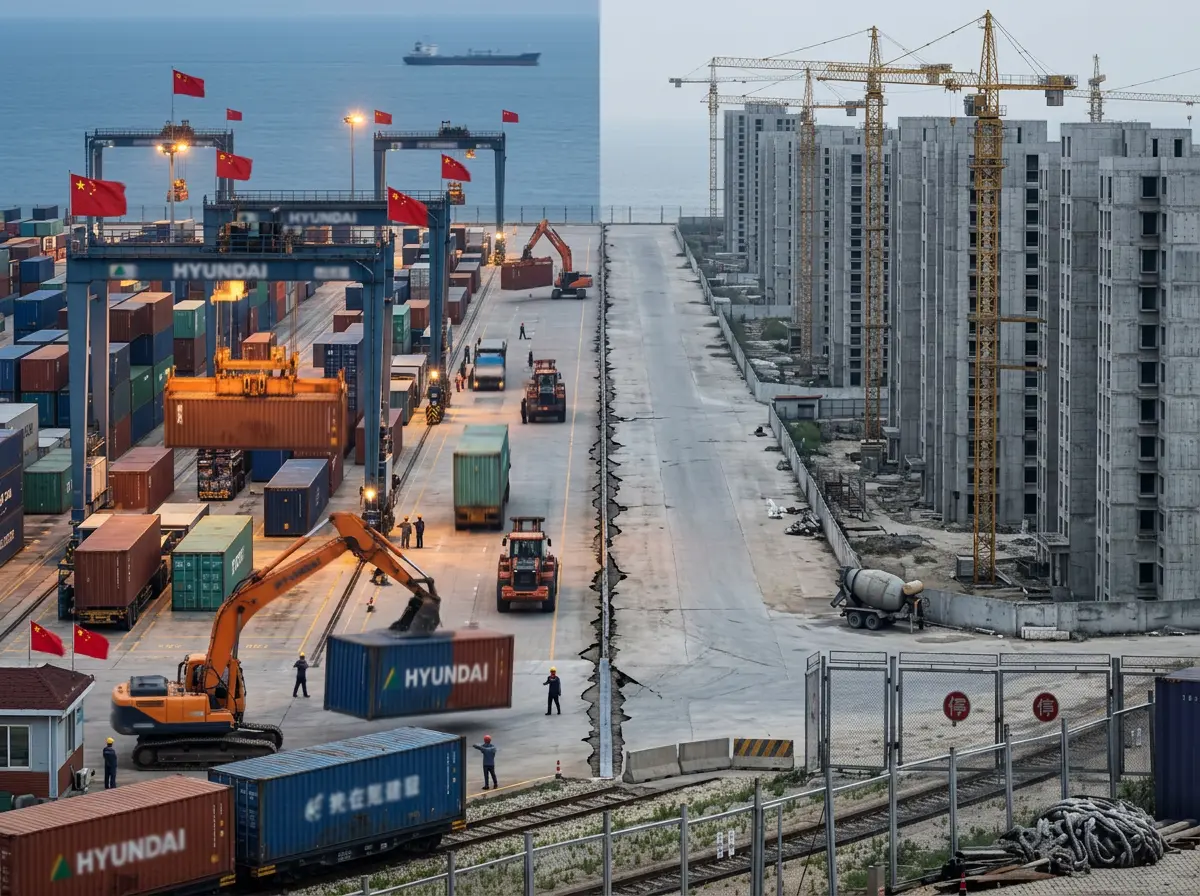
Behind the miss sits a split that is getting harder to paper over. State backed chipmakers and automakers are having a banner year while property developers sit idle and shoppers keep their wallets shut, and the same export machine lifting headline growth is also stoking the trade friction now testing Beijing’s ties with Washington and Brussels.
Growth Falls Below Beijing’s Own Target
China’s National Bureau of Statistics (NBS) said gross domestic product grew 4.3% in the April to June quarter compared with a year earlier. That missed the 4.5% median forecast in a Reuters poll of economists and cooled from 5% growth in the first quarter.
“This was the slowest growth in any quarter since the lockdown-impacted fourth quarter of 2022,” said Lynn Song, chief economist for Greater China at ING Bank, in a note.
For the first half of 2026, the economy grew 4.7% and generated about 69.57 trillion yuan (roughly $10.25 trillion) in output. Quarter on quarter growth cooled to 0.9%, down from 1.3% in the first three months of the year. The 4.3% print also landed below Beijing’s own annual target of 4.5% to 5%, the lowest goal China has set since it began publishing growth targets in 1991.
The bureau struck a cautious tone, saying the economy “operated within a reasonable range” overall while acknowledging that external instability was significant and that the domestic mismatch between “strong supply and weak demand” remained prominent. Global oil prices spiked as high as $114 a barrel in May after the Iran war disrupted shipments through the Strait of Hormuz, one more source of instability the bureau pointed to. A separate detail buried in the release: the GDP deflator, a broad gauge of prices across the economy, turned positive for the first time since early 2023, a tentative sign of China’s long deflationary stretch finally easing.
The authorities appear willing to curb overreporting and allow published growth to come in near the bottom of their target range.
That is how Julian Evans-Pritchard, head of China economics at Capital Economics, read the miss in a research note. He added that the shift could give Beijing more room going forward to publish slower growth figures that better match conditions on the ground.
Factories Outrun the Shoppers
The headline number hides two economies moving at very different speeds. Semiconductor exports roughly doubled in the first half from a year earlier, electric vehicle shipments jumped about 70%, and China’s monthly car exports topped 1 million units for the first time in June. Industrial output rose 5.4% over the same six months and picked up further in June.
Consumers barely moved. Retail sales climbed just 1.3% over the first half, and fixed asset investment, the money businesses and governments plow into factories, roads and buildings, fell 5.7%. Real estate investment collapsed 18%.
| Indicator, First Half of 2026 | Year on Year Change |
|---|---|
| Exports (overall) | +17.6% |
| Semiconductor exports | Roughly doubled |
| Electric vehicle exports | +70% |
| Industrial output | +5.4% |
| Retail sales | +1.3% |
| Fixed asset investment | -5.7% |
| Real estate investment | -18% |
| Infrastructure investment | -2.4% |
Macquarie analysts called external demand “the bright spot of China’s economy so far in 2026,” adding that its strength will shape how much support Beijing needs to deploy at home. Fabien Yip, a market analyst at IG, put it more bluntly: growth remains “very much powered by manufacturing” rather than the consumption led rebalancing officials promised when they set this year’s target.
The pattern predates this quarter. Beijing has funneled state money into chips, batteries and electric vehicles for years, chasing headline wins like the world’s fastest supercomputer title and a plan to lift R&D spending past 3.2% of GDP by 2030. Vanguard’s economists flagged the same split in a recent client note, pointing out that growth imbalances have widened even as the AI boom and green transition prop up the export side of the ledger.
Why Won’t Chinese Households Spend?
Chinese consumers are holding back because a prolonged property slump has erased paper wealth, wages have stalled in many sectors, and the real jobless rate runs far hotter than the official 5% urban figure suggests. New home prices fell again in June, and a broader gauge of unemployment sat above 10% during the quarter.
Eswar Prasad, a professor of economics and trade policy at Cornell University, said China’s reliance on exports to sustain growth means “China’s growth model has become increasingly imbalanced.” He added that lifting domestic demand will be tough while consumer confidence stays weak.
The numbers back him up:
- New home prices fell 0.1% in June, a smaller drop than May but still part of a downturn that has yet to bottom out.
- The official urban unemployment rate held at 5% in June, but a separate survey tracking people jobless for two years or more put the real figure at 10.2%, covering roughly 24 million people.
- More than half of those long term unemployed are between 16 and 24 years old, and the youth jobless rate, recalculated under a new methodology after Beijing suspended the old measure in 2023, stood at 15.6% in May.
- Fixed asset investment dropped 5.7% in the first half, meaning even the businesses still standing are spending less to expand.
The divide shows up in how workers feel about their own prospects, too. Employees at companies with overseas revenue felt more upbeat about their job outlook than those at domestically focused firms, according to Morgan Stanley research into the labor market’s two speed split.
An Export Boom That Doubles as a Trade Problem
China’s trade surplus widened to $125.62 billion in June alone, building on a record $1.2 trillion global surplus last year. That kind of imbalance is exactly what is drawing complaints from trading partners who say Beijing’s subsidies are flooding world markets with cheap manufactured goods.
The European Union has been the loudest. China’s trade surplus with the bloc widened 24% in the first half, driven by machinery and vehicle shipments, according to Larry Hu, chief China economist at Macquarie. “Despite a three-month trade truce, the growing surplus keeps the risk of a China-EU trade conflict elevated,” Hu said.
The imbalance runs deepest in the “new three” export categories Beijing has championed: electric vehicles, batteries and solar panels. Chinese EV production capacity now runs roughly triple domestic sales, and the country controls 90% of global solar capacity, churning out 588 gigawatts of panels last year against global demand of just 451 gigawatts. Thailand has logged more than 2,000 factory closures this year, and Indonesia’s textile sector has shed tens of thousands of jobs, tied to the flood of cheap Chinese goods moving through Southeast Asia.
Washington’s posture has softened since President Trump’s visit to Beijing in May eased tensions, and outbound shipments to the United States rose 26% in June. The underlying supply and demand math has not changed, which is why economists keep calling China’s export strength both its best asset and its biggest liability.
Who Else Pays for the Slowdown?
China generates more than 30% of global economic growth, so a wobble at home rarely stays home. Falling Chinese demand is already pressuring prices for steel, copper and iron ore, squeezing commodity exporting economies while easing input costs for manufacturers elsewhere.
The IMF has trimmed its global growth forecast for 2026 too, citing weaker momentum across major economies tied partly to China’s uneven recovery. Multinational companies are responding by speeding up the so called “China Plus One” strategy, shifting supply chains toward alternative manufacturing hubs even as cheaper Chinese exports intensify competition for industries such as steel and chemicals in the countries absorbing that diversification.
Beijing’s Cautious Next Move
All eyes now turn to the Communist Party’s Politburo, which typically meets in the final week of July to set the economic agenda for the rest of the year. Premier Li Qiang has already called for stronger counter cyclical measures, and the People’s Bank of China moved first, running a 900 billion yuan reverse repo operation over two days at the end of June.
Few economists expect a bazooka. “The economic growth slowed in Q2, but I am not sure it would push the government to change policy stance significantly in the coming months,” said Zhiwei Zhang, chief economist at Pinpoint Asset Management in Hong Kong. He noted the first quarter’s strong 5% print still leaves China on track for its target, and that the export boom keeps beating expectations.
Mao Shengyong, deputy head of the NBS, told reporters the imbalance between strong supply and weak demand at home “remains acute,” even as the bureau leans on high tech manufacturing and steady services growth to keep employment stable. Wei Li, head of multi asset investments at BNP Paribas Securities (China), described the moment more plainly, calling it a “significant transition” for the world’s second largest economy.
The forecasts agree on direction if not exact magnitude. The IMF raised its 2026 China growth forecast by 0.2 percentage point to 4.6% but still expects the economy to expand just 4.1% in 2027. The OECD sees growth slowing to 4.3% in 2027, pointing to a property sector still contracting and an anti-involution campaign that will weigh on business investment even as infrastructure spending picks up.
Every major forecaster now expects that slide to continue, with growth cooling toward just 4.1% by 2027 on the IMF’s own numbers.


Mortgage Rates Climb to an 11-Month High, and Buyers Retreat Fast

FCC Sets August 6 Vote to Erase the 39% TV Ownership Cap

Netflix Heads Into Earnings With Its 2022 Playbook Already Spent

China’s Economy Grows Just 4.3% as Exports Boom and Households Retreat

United Airlines Beats Earnings Estimates Despite $6 Billion Fuel Hit

California’s Plastic Packaging Law Draws Fire From Every Side

xAI Sues a Grok User for CSAM Deepfakes It Struggled to Stop

US Stocks Edge Within 0.5% of a Record as Oil Climbs on War

BlackRock’s Private Markets Bet Pays Off With a Record $15 Trillion in Assets

Kalshi Traders See 93% Odds Gas Tops $4 as Iran Strikes Return

Halo Studios Reverses PS Plus for Halo: Campaign Evolved on PS5

Black Ops 1 and 2 PS5 Ports: $40 Price Tag Has Fans Uneasy

Matt Brown Dismisses Rousey and Paul’s MVP MMA Ratings Win Over UFC

Star Wars: Galactic Racer Is a Roguelite Racer With a Podracing Skin

Julius Randle Traded to Nets as Wolves Reclaim Cap Space for Dosunmu

Sega’s $49.99 Sonic Classic and Modern Bundles Hit Switch in October

Colombia Edge DR Congo as Muñoz Books World Cup Knockout Place

Douze Dixièmes Closes Five Months After MIO: Memories in Orbit

Warriors Take Yaxel Lendeborg, the Oldest Pick in the 2026 NBA Draft

Meta’s Muse Image Lets Anyone Use Your Instagram Photos in AI
-

 TECHNOLOGY3 years ago
How to Adjust a Bulova Watch Band – An Easy Guide
-

 News3 years ago
Fred Pentland: Athletic Bilbao’s English mentor who changed the essence of Spanish football
-

 FINANCE3 years ago
Tax Planning for Every Season: Guide to Maximizing Your Tax Benefits
-

 Education3 years ago
African Ministers New Education Plan
-

 BUSINESS3 years ago
What is Entrepreneurial Operating System? A Comprehensive Guide to EOS
-

 Education3 years ago
Innovate Your Learning Journey with Technology and Enhance Education
-

 News3 years ago
Russians formally out of World Athletics Championships
-

 BUSINESS3 years ago
Top 9 Most Expensive American Cities to Rent an Apartment