
FINANCE
United Airlines Beats Earnings Estimates Despite $6 Billion Fuel Hit
United Airlines beat second quarter estimates and raised its 2026 outlook, even as Iran war driven jet fuel costs add nearly $6 billion in expenses.

United Airlines posted second quarter profit that beat Wall Street’s targets on Wednesday, then told investors the win arrived bundled with a nearly $6 billion fuel bill. Adjusted earnings hit $1.99 a share against the $1.88 analysts expected, on revenue of $17.67 billion. The stock fell anyway.
It was the third straight quarter United beat estimates and watched shares drop regardless. Jet fuel, still swinging with every twist in the war between the United States and Iran, is consuming the profit gains almost as fast as the airline can book them.
The Numbers Behind the Beat
For the quarter ended June 30, United reported net income of $805 million, or $2.46 a diluted share, a decline of more than 17% from a year earlier.
Stripped of one time items, adjusted net income came to $649 million, or $1.99 a share, above the $1.88 Wall Street expected. The estimates were compiled by LSEG, the data and analytics arm of the London Stock Exchange Group.
Total operating revenue climbed 16% year over year to $17.67 billion, edging past the $17.61 billion analysts had modeled. Revenue per available seat mile, a measure of pricing power, rose 12.1%, the fastest pace since early 2023, according to FactSet.
Premium ticket revenue rose 16% from a year earlier. Basic economy climbed 11%, loyalty revenue grew 11% and cargo jumped 23%. Contracted corporate travel revenue rose 27%. The airline also generated $1.6 billion in operating cash flow during the quarter and $322 million in free cash flow.
United expanded flying 3.5% during the quarter. Newark, a hub that has struggled with delays for years, logged its best ever second quarter on time performance, while the airline’s systemwide on time departure rate was its best for any second quarter since 2021.
Full year guidance moved higher too, to a range of $9 to $11 a share, up from the $7 to $11 range set in April. For the third quarter, United forecast adjusted earnings of $2.50 to $3.50 a share, below the $3.60 analysts had penciled in.
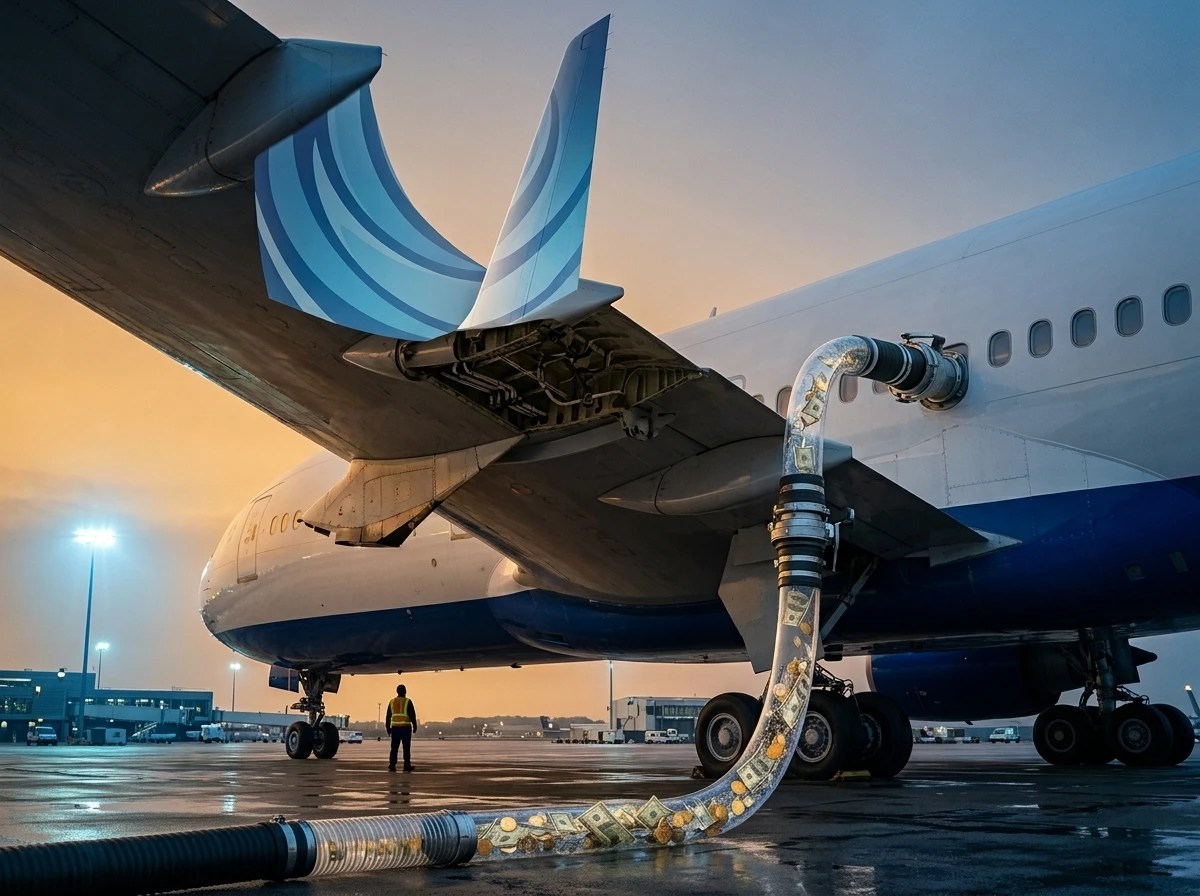
The Iran War’s Fuel Math
Jet fuel is the largest cost for airlines after labor, and this year it has moved almost entirely on geopolitics. Argus data tracked by the industry group Airlines for America shows jet fuel prices climbing 34% in July alone, as fighting between the United States and Iran flared again after a brief lull.
United said the swings could add nearly $6 billion to its 2026 fuel bill compared with what it budgeted at the start of the year, using Tuesday’s prices as the baseline. In the second quarter alone, aircraft fuel expense jumped 84% from a year earlier to $5.11 billion, an increase of roughly $2.3 billion, at an average price of $4.19 a gallon.
Industry trackers say the Middle East supplies roughly 15% to 17% of the world’s jet fuel, and the strait closures pulled much of that off the market at once. Refining margins in Northwest Europe spiked past four times their historical norm as a result.
The volatility hasn’t let up. United said fuel price swings since July began have already cut its projected third quarter adjusted earnings by $1.12 a share.
The spike fits a wider industry pattern. A $100 billion fuel bill has been forcing fare hikes across U.S. carriers this year. Global average jet fuel prices, estimated at $90 a barrel last year, are forecast to average $152 a barrel in 2026, according to data firm Statista.
The timeline behind the number reads like a chart of the war itself.
- Feb. 28, 2026: The United States and Israel strike Iran. Iran responds by shutting down traffic through the Strait of Hormuz, a key jet fuel shipping route.
- March 27, 2026: U.S. jet fuel prices more than double in weeks, jumping from about $2.17 to $4.57 a gallon, according to the Argus U.S. Jet Fuel Index.
- April 21, 2026: United cuts its full year guidance to $7 to $11 a share, down from the $12 to $14 range it set in January, and trims about 5% of its flight capacity.
- Mid-June 2026: A tentative U.S.-Iran memorandum of understanding eases tensions. Jet fuel falls to about $2.80 a gallon, its lowest level since the war began.
- July 2026: Hostilities resume. Jet fuel prices at major U.S. airports climb 34% in the first two weeks of the month alone.
Not every carrier has weathered the shock. Spirit Airlines, squeezed by the same fuel costs, ceased operations entirely earlier this year, and JetBlue, which hasn’t turned a profit since 2019, is watching the same volatility from a much thinner cushion.
Each swing forced United to redo its own math. That is why this week’s guidance reflects Tuesday’s prices rather than the assumptions the company used even a month earlier.
United and Delta Absorb the Same Shock, Unevenly
This fuel bill isn’t unique to United. Delta Air Lines, which reported a week earlier, faced the identical spike and came away with a different scorecard.
| Metric, Q2 2026 | United Airlines | Delta Air Lines |
|---|---|---|
| Adjusted earnings per share | $1.99 | $1.56 |
| Fuel expense, year over year | $5.11 billion, up 84% | $4.4 billion, up nearly $2 billion |
| Share of fuel increase recovered | About half | About 60% |
| Adjusted pre-tax margin | 4.8% | 7.7% |
| Full-year adjusted EPS guidance | $9.00 to $11.00 | $6.50 to $7.50 |
Per share, United topped Delta, but the total profit comparison flips. Delta generated $1.4 billion in adjusted pre-tax income against United’s $843 million, a gap mostly explained by share count rather than operating strength.
Delta had told investors in April to expect a more than $2 billion increase in fuel expense for the June quarter, a forecast that held up almost exactly. Delta’s chief financial officer, Erik Snell, told reporters the airline has not seen demand pull back even as fares climbed.
American Airlines, in its own regulatory filing, assumed a fuel price near $4.00 a gallon for the quarter and pointed to more than $4 billion in added annual fuel expense, a smaller hit than United’s projection in dollar terms.
Why Did United’s Stock Fall on a Beat?
United shares slipped as much as 4% in after hours trading despite the earnings beat, though some trackers put the drop closer to 2%. Either way, it extended a pattern that has now repeated for three consecutive quarters. Investors have punished United’s last several beats, wary that fuel costs and possible capacity cuts will erode the gains before they reach the bottom line.
A pattern has held all year. United’s first quarter beat of 8.93% over consensus, reported in April, still triggered a 5.58% share price drop that day, and a third quarter 2025 beat produced a 5.63% decline, according to data compiled by 24/7 Wall St. Wednesday’s reaction was milder than either of those but continued the streak.
United Chief Executive Scott Kirby’s own trading raised eyebrows too. He sold 48,303 shares at $121.30 on June 15, about a month before the earnings report, an unusual pre-earnings move flagged by market watchers.
Part of the skepticism traces to United’s own guidance math. Its third quarter forecast of $2.50 to $3.50 a share sits below the $3.60 analysts wanted. The full year range still spans $2 a share, wide enough that investors have little certainty about where fuel costs land by December.
Wall Street mostly still likes the shares. Nineteen analysts covering United rate it a buy, and the stock traded at roughly 12 times forward earnings heading into Wednesday’s report.
United is built to thrive in every environment, and when oil prices spiked in March, we quickly and decisively acted to adjust our schedules, while simultaneously doubling down on our customer investments.
Kirby said that in the company’s earnings statement, pointing to the March schedule cuts as evidence the airline can move fast when fuel spikes again.
United Bets on Premium Seats to Outrun the Fuel Bill
Pricing power may hold up even if fuel costs ease, Kirby said, adding that demand has shown little sensitivity to the higher fares so far. Behind that confidence is a new slate of cabin and fare products aimed at travelers willing to pay more.
- Basic business – a first-in-the-U.S. fare tier offering a business class seat without lounge access or advance seat selection.
- Blocked middle seats – roomier economy seating on the new Airbus A321XLR, with the middle seat removed in some rows.
- Relax Row – a concept that converts a row of seats into a bed on select widebody aircraft.
- Starlink Wi-Fi – 450 aircraft equipped so far, with nearly 1,000 more expected by year end.
The connectivity push mirrors a broader shift across the industry. American Airlines struck its own 500-jet Starlink connectivity deal, part of a race among carriers to make satellite Wi-Fi standard rather than a premium extra.
More Capacity Cuts Could Still Be Coming
Demand remains strong, both United and Delta say, even with higher fares. The bigger uncertainty is whether fuel prices come back down.
United said in a regulatory filing that it could cut its capacity plans further this year if fuel costs stay elevated. Fourth quarter schedules already on sale are set to shrink, partly for normal seasonal reasons and partly because of an extended Federal Aviation Administration (FAA) order limiting flights at Chicago O’Hare.
A tentative contract covering 30,000 flight attendants still needs to be ratified, adding another variable to the cost outlook.
The company still aims to recover all of the fuel hit by the fourth quarter, up from about half in the second quarter and up to 90% targeted for the third. Reaching that depends on fares holding and fuel prices easing from July’s spike.
Full recovery is not guaranteed. Robert Mann, an aviation industry consultant, said carriers “can only charge those fares for future bookings,” so they may not recoup the full cost of higher fuel for months, if at all.
The global benchmark tracked by the International Air Transport Association stayed jumpy too, climbing 6.7% in a single week to $127.06 a barrel in its most recent reading.
Analysts say the bigger test comes after Labor Day, when leisure travel typically cools and carriers decide how much capacity to add back.
An investment grade credit rating is also the goal this year. United raised $3.7 billion in new liquidity during the quarter through private bank transactions and has prepaid about $1 billion of higher cost debt since the second quarter began, leaving it with $19.6 billion in available liquidity.
United executives hold their earnings call Thursday at 10:30 a.m. Eastern, when analysts get their first chance to ask whether the fourth quarter recovery target holds if fuel prices spike again.


NFL Three-Strike Safety Fouls Now Pull Coaches and Clubs In

Browns Fans Tape Protest Signs to Jim Brown Statue Over Watson

Amazon Pixel 11 Deal Erases the $100 Hike for One More Day

Elden Ring on Switch 2 Turns Its Own Worst Label Into a Portable Win

Ternus Takes the Stage With Apple’s Foldable Debut

Ikea Xbox Yxstaby Turns Controller Thumbstick Into Home Furniture

Pokémon Center Turns Past Worlds Wins Into Bundles and a Pikachu Coin

NFL Scraps Pro Bowl Game to Restore Pure Player Honor

New Twitter.now Bets the Brand Musk Left Behind

Bella Mir’s Famous First Loss Meets the Accountant Who Won

Curtis Mead’s Red Sox Debut Ends With Fractured Wrist

Moesch and Dressel Rewrite Night One at 2026 U.S. Nationals

Red Sox Squander Hot Streak Chance in 4-3 Loss to Athletics

Boutte’s Quiet Camp Takeover Forces Patriots Receiver Choices

Take-Two CEO Pushes Netflix Subs for GTA 6 Extended Look

Halo Campaign Evolved Skulls Meet Death Barriers That Kill the Hunt

Wildlands Free Update Hands Players the Tools They Already Invented

Quake Gets 19 Free Maps From MachineGames Quake Club

Destiny 2 Fans Unlock Vaulted Maps After Live Service Ends

Quordle Monday Delivers Gavel Crush Speed Ethos Cleanly
-

 TECHNOLOGY3 years ago
How to Adjust a Bulova Watch Band – An Easy Guide
-

 News3 years ago
Fred Pentland: Athletic Bilbao’s English mentor who changed the essence of Spanish football
-

 FINANCE3 years ago
Tax Planning for Every Season: Guide to Maximizing Your Tax Benefits
-

 Education3 years ago
African Ministers New Education Plan
-

 BUSINESS3 years ago
What is Entrepreneurial Operating System? A Comprehensive Guide to EOS
-

 Education3 years ago
Innovate Your Learning Journey with Technology and Enhance Education
-

 News3 years ago
Russians formally out of World Athletics Championships
-

 BUSINESS3 years ago
Top 9 Most Expensive American Cities to Rent an Apartment