
BUSINESS
California’s Plastic Packaging Law Draws Fire From Every Side
California starts collecting SB 54 packaging fees in August, and estimates on how much grocery prices could rise vary sharply between regulators and industry.

California starts collecting packaging fees from manufacturers next month, and the state’s own modeling says the average household could pay $57 to $190 more a year for groceries because of it. The dairy industry says the real number could run seven times higher.
Seventeen states and the country’s largest wholesaler trade group are suing to strike the law down as unconstitutional overreach. Separately, two environmental groups that helped push the law into existence are now suing too, arguing regulators hollowed it out during rulemaking.
How the Fee System Works
The law is Senate Bill 54, formally the Plastic Pollution Prevention and Packaging Producer Responsibility Act. Governor Gavin Newsom signed it on June 30, 2022, after a threatened ballot measure pushed lawmakers to act first.
It builds what’s known as an extended producer responsibility system, or EPR. Instead of cities and counties absorbing the cost of sorting and recycling packaging waste, the companies that make and sell that packaging pay into a shared fund. California says packaging makes up over 50% of the state’s landfilled volume, and argues the old system left the bill with taxpayers.
Producers, defined as companies with more than $1 million in California sales tied to packaged goods, must join a registered Producer Responsibility Organization. CalRecycle picked Circular Action Alliance, a producer-funded nonprofit, as the state’s only PRO in January 2024. Fees are set by material type, weight and how recyclable that material actually is. Plastic, generally, costs more than paper, glass or aluminum.
Not everything sold in California falls under the fee structure. The law carves out exemptions for:
- Beverage containers – already regulated under California’s separate bottle deposit program
- Medical products – prescription drugs and certain medical nutrition items
- Infant formula – grouped with refillable or reusable packaging
- Hazardous materials – excluded from the covered material list entirely
- Small businesses – companies under $1 million in annual California sales skip most fee and reporting duties
Everyone else registers, reports and pays, whether they like the math or not.
Why August Is the Trigger Point
SB 54 has been law for four years, but it has moved in fits and starts. Newsom sent CalRecycle’s draft rules back to the drawing board in 2025 over cost concerns from industry and his own office. Final regulations did not take effect until May 1, 2026.
Here’s how the timeline actually breaks down:
- June 30, 2022: Newsom signs SB 54 into law.
- January 5, 2024: CalRecycle names Circular Action Alliance as the state’s sole Producer Responsibility Organization.
- September 5, 2025: Deadline for producers to register with the CAA.
- May 1, 2026: The Office of Administrative Law approves final permanent regulations.
- June 22, 2026: Seventeen states and the National Association of Wholesaler-Distributors sue to block the law.
- August 2026: CalRecycle begins collecting preliminary fees from registered producers.
- January 1, 2027: Producers must hit the law’s first source-reduction target and start paying full material-specific fees.
The Circular Action Alliance also carries its own obligation to the state. Under the statute, the alliance must remit $500 million annually to the state starting in 2027 and continuing for a decade, money that flows into California’s Plastic Pollution Mitigation Fund regardless of how the fee disputes shake out.
August’s fees are a down payment, not the final bill. They cover the cost of standing up the program itself. The heavier, material-specific fees that will actually shape packaging decisions do not begin until 2027.
Will Grocery Prices Jump in August?
Probably not right away, and probably not by much this year. CalRecycle projects households will absorb $57 to $190 in added costs annually once fees fully phase in, or roughly $66 a person, and says the number could land lower if producers eat some of the cost themselves instead of passing it along.
Industry groups think that estimate is too rosy. Katie Davey, executive director of the Dairy Institute of California, has cited an industry analysis putting the added cost at $1,300 a year for the average household, nearly seven times CalRecycle’s high estimate.
The gap widens further down the supply chain. CalRecycle’s own program plan estimates roughly 5,700 large producers will face average compliance costs above $450,000 a year, while an estimated 546,269 downstream businesses that simply buy packaged goods could see their own costs climb by an average of $4,806 annually if suppliers pass along the fees.
| Who Pays | Estimated Annual Cost | Source |
|---|---|---|
| Average household, low estimate | $57 | CalRecycle |
| Average household, high estimate | $190 | CalRecycle |
| Average household, industry estimate | $1,300 | Dairy Institute of California |
| Large producer, average compliance cost | $457,114 | CalRecycle program plan |
| Small producer exemption, recordkeeping | $155 | CalRecycle program plan |
| Downstream business, average increase | $4,806 | CalRecycle program plan |
Rachel Michelin, president and CEO of the California Retailers Association, says the rules have become so dense that some small retailers are turning to ChatGPT just to figure out whether they even count as a producer.
Cheese, Berries and the Packaging That Won’t Bend
Some categories face a narrower problem than cost. They face a packaging problem with no obvious fix yet.
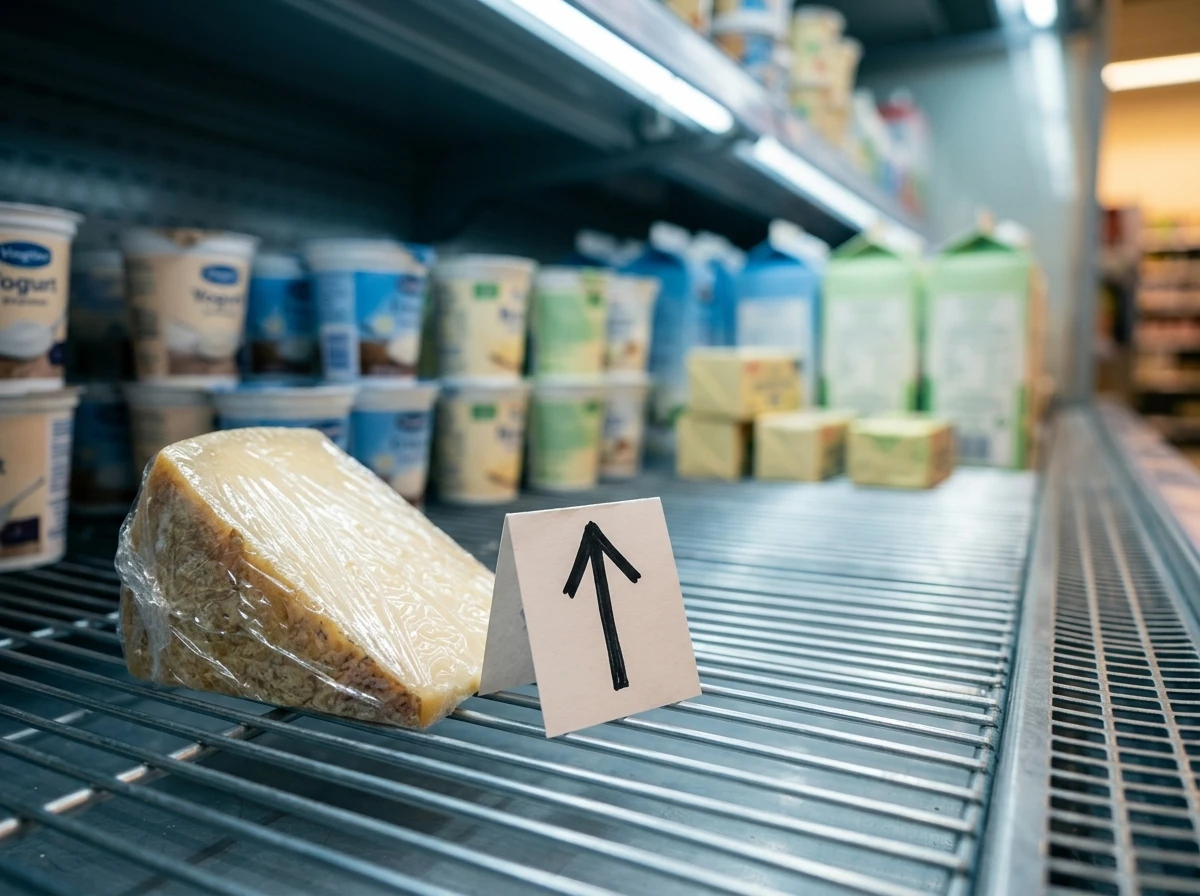
Packaged cheese typically ships in flexible plastic film that cannot currently be recycled under California’s rules. Danielle Quist, vice president of regulatory affairs and counsel at the International Dairy Foods Association, warned that “you may not be able to sell cheese” under the new standard, since “cheese has to be in a flexible film.”
Plastic clamshell containers face a similar bind. They keep berries from being crushed and extend shelf life, and producers say no widely available substitute exists, even though the 2032 deadline assumes one will exist by then.
We’re deeply concerned because we know that food costs are going to increase and products are going to come off the market because there literally is not a packaging solution within the required timeframe.
Davey said that in comments reported by CalMatters, describing the same pressure facing dairy producers statewide.
The statute’s own text bars producers from passing fees directly onto consumers, a provision Gail Delihant, senior director of California government affairs for the Western Growers Association, dismisses outright: “Even though the law states that we couldn’t pass the costs onto the consumer, that’s a joke.” Growers have separately pushed CalRecycle to preserve a exclusion pathway for fresh produce packaging, warning that food-safety rules leave no compliant alternative for items like bagged salad and berries.
Two Lawsuits Pulling in Opposite Directions
SB 54 is now fighting a legal battle on two fronts, and the two sides want opposite outcomes.
A coalition led by Nebraska Attorney General Mike Hilgers, joined by sixteen other states and the National Association of Wholesaler-Distributors, sued in the US District Court for the Eastern District of California on June 22, 2026. The group argues the law forces packaging changes on businesses nationwide that never chose to sell in California, violating the Commerce Clause.
“Once again, California is trying to enact a policy that negatively impacts the rest of the country,” Hilgers said.
Two environmental groups, the Natural Resources Defense Council and Californians Against Waste, are pursuing a separate case with the opposite complaint. They say CalRecycle’s final rules created loopholes that let plastic packaging dodge the law’s own targets. “These new rules create huge loopholes for plastic packaging that violate the law,” said Avinash Kar, NRDC’s senior director of the toxics program.
- Nebraska AG Mike Hilgers and sixteen other states call SB 54 unconstitutional overreach that forces national supply chains to bend to California rules.
- NRDC’s Avinash Kar and Californians Against Waste say the final regulations gutted the law’s own plastic reduction targets with new exemptions.
- State Sen. Ben Allen and CalRecycle maintain the law simply shifts an existing cost from taxpayers to the companies producing the waste.
Allen, the Santa Monica Democrat who wrote the bill, points to fairness. “Rather than forcing taxpayers and ratepayers to shoulder these costs, we are ensuring companies that profit from this mass pollution help pay for its cleanup,” he said in a June statement. CalRecycle backs that with its own math, estimating the program delivers roughly 2.5 times more in benefits than it costs to run, largely through reduced landfill and cleanup spending. Ocean Conservancy, which supports the law, separately projects it could keep about 23 million tons of single-use plastic out of circulation over the next decade.
Not everyone treats the fight as existential. USC sustainability researcher Joe Árvai has argued producer complaints are mostly about the pace of change rather than whether compliant packaging is possible at all. “Whether they like it or not, these changes are coming,” he said.
What Changes Before the Decade Is Out
Money is already moving regardless of how the lawsuits land. Total program costs for 2027 through 2031 alone are projected at up to $17.2 billion, funded entirely through fees, according to law firm DLA Piper’s review of the state’s plan. Circular Action Alliance expects to publish final fee rates in October, replacing the illustrative numbers producers are budgeting against right now.
California is not alone in testing this model. Colorado has already applied a similar producer-funded framework to a completely different product, requiring automakers to fund dead battery recycling. Oregon runs a comparable packaging law facing its own industry lawsuit, a case being watched closely as a preview of how California’s fight might end.
The law’s own targets escalate on a fixed schedule: a 10% cut to single-use plastic packaging by 2027, 20% by 2030, and a 25% cut alongside a 65% recycling rate and a 100% recyclable or compostable standard by 2032.
The next hard deadline lands January 1, 2027, when producers must hit that first reduction target and start paying the law’s full, material-specific fees.
Frequently Asked Questions
What Exactly Does SB 54 Require?
SB 54 requires companies selling packaged goods in California to help fund packaging recycling and eventually redesign that packaging to be recyclable or compostable. California’s approach joins its own packaging-specific producer-responsibility laws already running in Oregon, Colorado and Maine, with Minnesota’s version still phasing in.
How Is the Actual Fee Amount Calculated?
Circular Action Alliance uses a cents-per-pound base fee for each material category, then layers on additional reuse fees, plastic-specific surcharges or component-based charges depending on the packaging. Materials that are harder to recycle in California carry higher base rates because they cost more for the system to handle.
Are Small Businesses Exempt From SB 54?
Partially. Companies under $1 million in annual California sales qualify for a fee exemption, but CalRecycle still requires them to formally register and apply for that exemption rather than simply opting out on their own.
What Happens If a Company Ignores the Law?
Noncompliant producers can face civil penalties of up to $50,000 a day per violation, according to law firm Freshfields, on top of losing the right to sell noncompliant packaging in California at all.
Could Courts Still Strike Down SB 54?
It’s possible but slow. Legal analysts have estimated that a challenge like the 17-state case could take roughly four years to reach the US Supreme Court if appealed at every level, meaning compliance deadlines will likely arrive well before any final ruling.
Will Shoppers Outside California Feel This Too?
Possibly. Attorneys for the challenging states argue manufacturers cannot practically run separate packaging lines just for California, meaning redesigned, fee-compliant packaging could show up on shelves nationwide even where the fees themselves never appear on a receipt.


Walmart’s $50 Million Opioid Settlement Closes Case Without Admission

California Sues Over $120 Million Morro Bay Wind Lease Buyout

Gilead Bixlenvo FDA Nod Opens Single Pill Path for Complex HIV Cases

Meta’s $18B Kids Deal Forever Shields Data Used to Spot Under-13s

Lettuce Outbreak Drove Record Cyclospora Spike Across 20 States

Amazon Shaves $20 Off M6 Mac Mini Before It Even Ships

SpaceX Louisiana Port Tests Debt Markets on Orbital AI Scale

Microsoft High Lifts Indexes as Small Caps Crack Support

Apple Replays 2015 Saturday Midnight Preorder for iPhone 18 Pro

Updated COVID Shots Clear FDA but Access Friction Hits High-Risk Groups

Take-Two CEO Pushes Netflix Subs for GTA 6 Extended Look

Wildlands Free Update Hands Players the Tools They Already Invented

Quake Gets 19 Free Maps From MachineGames Quake Club

Destiny 2 Fans Unlock Vaulted Maps After Live Service Ends

Quordle Monday Delivers Gavel Crush Speed Ethos Cleanly

Stripe Bid Shows PayPal Moat Cracked After Years of Slide

Tyson’s Five-Year Utah Plant Falls to Cattle Shortage Reckoning

Silver Lake Workday Talks Signal Private Floor for Software

Kennedy Lewis Takes Majority Control of The Greenbrier in $500M Deal

Best Buy Marks 60 Years With Sale That Echoes Its Audio Shop Roots
-

 TECHNOLOGY3 years ago
How to Adjust a Bulova Watch Band – An Easy Guide
-

 News3 years ago
Fred Pentland: Athletic Bilbao’s English mentor who changed the essence of Spanish football
-

 FINANCE3 years ago
Tax Planning for Every Season: Guide to Maximizing Your Tax Benefits
-

 Education3 years ago
African Ministers New Education Plan
-

 BUSINESS3 years ago
What is Entrepreneurial Operating System? A Comprehensive Guide to EOS
-

 Education3 years ago
Innovate Your Learning Journey with Technology and Enhance Education
-

 News3 years ago
Russians formally out of World Athletics Championships
-

 BUSINESS3 years ago
Top 9 Most Expensive American Cities to Rent an Apartment