
News
Bose’s $299 Lifestyle Ultra Speaker Is Built Around Sonos’s Worst Year
Bose’s Lifestyle Ultra Speaker drops its own app for playback, a direct answer to the 2024 redesign disaster that cost Sonos its CEO, though gaps remain.

Bose built its newest speaker, the $299 Lifestyle Ultra Speaker, around an app it barely wants you to open. It streams through Apple AirPlay, Google Cast and Spotify Connect, with Amazon’s Alexa+ voice assistant built in, rather than leaning on the Bose Music app that ran its older Wi-Fi speakers. It will not talk to any of those older speakers at all.
Sonos’s chief executive lost his job over a broken app about sixteen months before Bose’s new lineup reached stores. Reviewers did not need much prompting to connect the two.
The App Update That Cost Sonos Its CEO
Sonos rebuilt its mobile app from scratch in May 2024, timed to launch the Sonos Ace, its first wireless headphones. The redesign stripped out familiar features, including sleep timers and the ability to build playlists, and shipped riddled with bugs. Customer anger spread across forums within days.
Patrick Spence, Sonos’s chief executive at the time, initially defended the update as a “better experience.” That did not calm anyone down. Sonos went on to spend tens of millions fixing the code, pushed its Arc Ultra soundbar and Sub 4 subwoofer into the holiday season so engineers could focus on repairs, and published a seven-step trust-rebuilding plan that October.
None of it saved Spence’s job. Sonos announced his resignation on January 13, 2025, alongside an 8% year-over-year revenue drop and a round of layoffs. Board member Tom Conrad stepped in as interim chief executive.
- May 2024: Sonos ships a redesigned app tied to the Ace headphones launch, cutting features and shipping full of bugs.
- October 2024: Sonos publishes a seven-step plan to rebuild customer trust after the backlash.
- January 13, 2025: CEO Patrick Spence resigns after leading the company for eight years; Tom Conrad becomes interim chief executive.
- May 2026: Bose launches the Lifestyle Ultra Speaker, Soundbar and Subwoofer built around AirPlay, Google Cast and Spotify Connect instead of a proprietary control app.
our customers are taken out of the moment and are right to feel that we’ve let them down
Tom Conrad, Sonos’s interim chief executive, said that of the app failures still haunting the brand. It is the backdrop every reviewer of Bose’s new speaker keeps circling back to, even when the review itself never mentions Sonos by name.
Three Drivers, One $299 Box
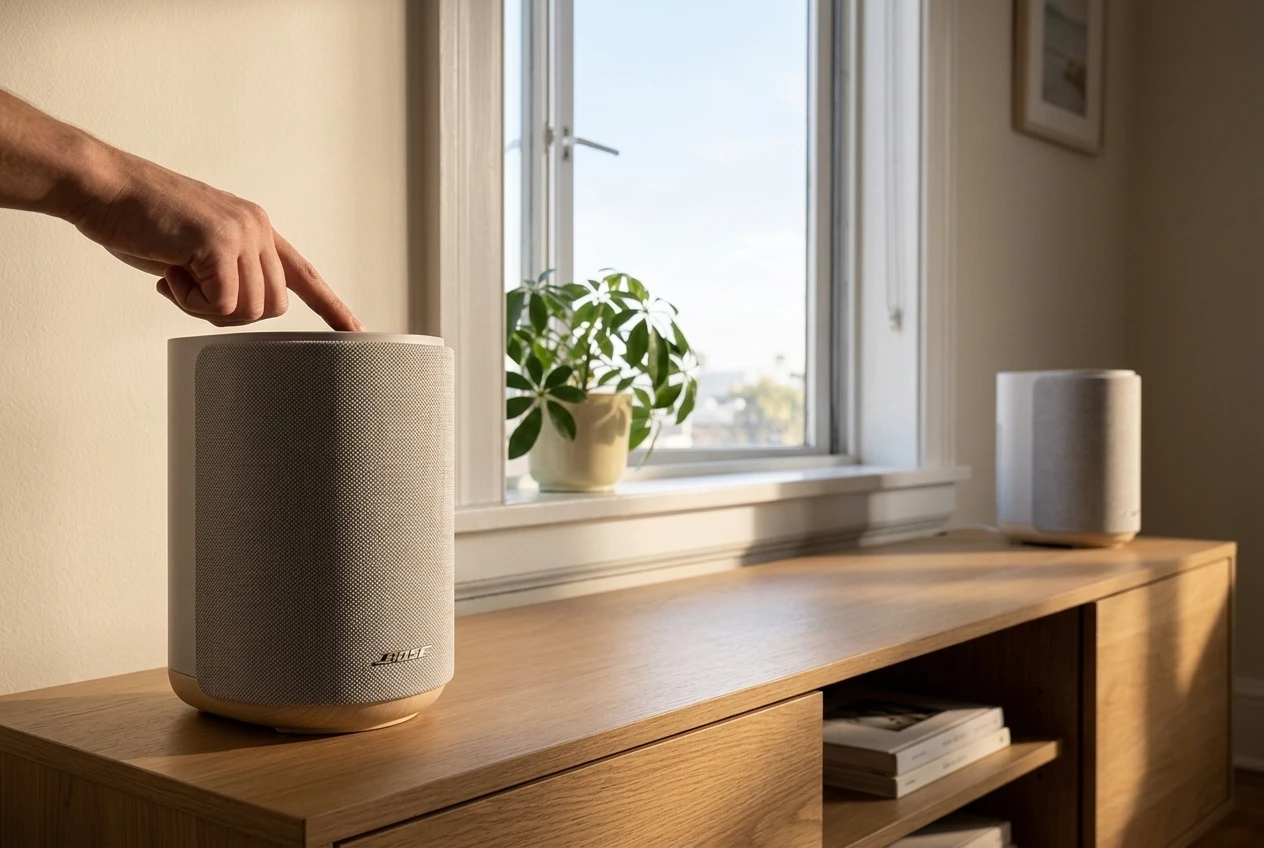
CNET’s David Carnoy, who tested the Lifestyle Ultra as both a standalone unit and a stereo pair, measured it at 7.3 by 4.8 by 6.6 inches and 3.7 pounds. It runs three drivers, two firing forward and one firing upward, using what Bose calls TrueSpatial technology to add height and width to the sound.
It has Bluetooth 5.3 and a 3.5mm aux input for a turntable or other wired source, but it needs a wall outlet. There is no battery and no outdoor rating. Bose is also the first company to put Alexa+, Amazon’s upgraded voice assistant that arrived in 2025, on a non-Echo device.
A single speaker runs $299 in black or white, or $349 for a limited Driftwood Sand edition with a real oak base. Two together cost $529, a $70 discount over buying them separately. The Lifestyle Ultra Soundbar adds Dolby Atmos decoding for $1,099, and the wireless Subwoofer costs $899.
| Speaker | Price | Playback Control | Voice Assistant |
|---|---|---|---|
| Bose Lifestyle Ultra Speaker | $299 single, $529 pair | Apple AirPlay, Google Cast, Spotify Connect | Alexa+ |
| Sonos Era 100 | $219 | Sonos app | Alexa |
| Sonos Era 300 | $479 | Sonos app | Alexa |
The Bose lands $80 above the Era 100 and roughly $180 below the bigger, bassier Era 300. It sits in the gap on purpose.
Where Bose’s Openness Still Has Limits
Google has been widening Cast’s reach elsewhere too. A software update adding native pairing with Cast speakers recently landed on the Google TV Streamer, the same kind of cross-brand grouping Bose now leans on for its own multiroom pitch.
But the Lifestyle Ultra’s version of openness stops short in a few places, and this is where the pitch gets complicated.
- No native hi-res audio. The speaker tops out at 24-bit/48kHz, CD-quality sound, unlike some newer rivals.
- No backward compatibility. None of Bose’s older Wi-Fi speakers can join a Lifestyle Ultra group.
- Still needs the Bose app. Setup, EQ adjustments, firmware updates and stereo pairing all run through Bose’s own software, even though playback does not.
- No Tidal or Qobuz Connect. Bose leans entirely on AirPlay, Cast, Spotify Connect and Bluetooth for streaming.
- No single-tap whole-home grouping. Sending music to every room at once takes more steps than rival systems like Denon’s HEOS.
Each gap is small on its own. Together they mean the speaker that markets itself as free from a walled garden still keeps one wall standing.
Do You Really Need Two Bose Lifestyle Ultra Speakers?
Yes, according to nearly every review: a single Lifestyle Ultra Speaker sounds good for its size, but pairing two adds real stereo width and height that one box cannot fake. Bose prices a pair at $529, a $70 discount versus buying two separately, making the pair the smarter default purchase for most rooms.
Carnoy tested the speaker solo and in stereo across a media room, a home office and a larger living room, placing it one to three feet from a wall. He found it played best around 60% to 65% volume rather than flat out, and that vocals came through clear with a balanced midrange in both configurations.
He also compared it directly against the pricier Sonos Era 300 and came away preferring two Lifestyle Ultras or two Era 100s for a small living room, since true stereo separation beat the Era 300’s bigger single-box sound. His verdict, in short: get a pair if you can afford it.
A Speaker Line Built by the Same Company That Just Bought McIntosh
The Lifestyle Ultra Speaker did not arrive in isolation. Bose sold its Bose Pro integrator business to Transom Capital Group in April 2023, narrowing its focus to consumer products. Then, in a much bigger reversal of direction, Bose bought McIntosh Group, parent of luxury brands McIntosh and Sonus faber, closing the deal on November 15, 2024, and announcing the acquisition four days later.
Lila Snyder, Bose’s chief executive, framed the deal as a way to reach places the Bose name cannot, pointing to McIntosh’s automotive tie-ins with Jeep and Sonus faber’s work with Lamborghini and Maserati. Sonus faber’s flagship loudspeakers sell for as much as $750,000, a universe away from a $299 bookshelf speaker built to group with a Google Home app.
That is the split Bose is now running at once: buy the pedigree at the top of the market, then chase Sonos at the bottom of it with an open, cross-brand speaker that costs $80 more than the Era 100 and still needs its own app to set up. The Lifestyle Ultra Speaker is Bose’s answer to one specific rival mistake, sold at a price built for a holiday season still months away.
Frequently Asked Questions
Does the Bose Lifestyle Ultra Speaker work with older Bose Wi-Fi speakers?
No. Bose confirmed the Lifestyle Ultra Speaker cannot join a multiroom group with older models like the Home Speaker 300 or Home Speaker 500, since the new lineup runs on a different software platform built around AirPlay and Google Cast rather than the original Bose Music app infrastructure.
Can the Bose Lifestyle Ultra Speaker play high-resolution audio?
Not natively. The speaker caps playback at 24-bit/48kHz, CD-quality sound, and automatically downsamples any higher-resolution stream to that rate, unlike rivals such as the Wiim Sound speaker that support full 24-bit/192kHz playback.
Does the Lifestyle Ultra Speaker support Dolby Atmos on its own?
Only as an add-on. Its upward-firing driver acts as a height channel for Atmos exclusively when the speaker is paired as a rear surround with the Lifestyle Ultra Soundbar. It cannot decode Atmos alone, and it is not compatible with any other Bose soundbar in the lineup.
How much does a full Bose Lifestyle Ultra home theater system cost?
A single speaker runs $299, and a stereo pair runs $529. Add the $1,099 Lifestyle Ultra Soundbar and the $899 Subwoofer, and a full 5.1.2 setup with two Lifestyle Ultra Speakers as surrounds tops $2,500 before any bundle discount.
Is the Bose Lifestyle Ultra Speaker portable?
No. It has Bluetooth for direct streaming, but it must stay plugged into a wall outlet, carries no internal battery, and has no IP rating for outdoor or splash exposure, so it is built to live permanently on a shelf or console rather than travel with you.


Citizens Bank Exits Private Prisons Right Into a Debanking Fight

FAA Restores Boeing’s Power to Self-Certify 737 Max and 787 Jets

Fairlife’s Ransomware Shutdown Hits a Milk Brand With No Spare Capacity

Taylor Farms Lettuce Recall Exposes a Pattern of Repeat Outbreaks

NHL’s Monday Matinee Push Puts Capitals Fans on the Clock

Iran’s Grip on Hormuz Is Becoming a Blueprint for Other Straits

Apple Watch’s New Siri AI Finally Works, and Google Built Its Brain

Kid Safety Phones Turn Parental Fear Into a Subscription Business

ZA/UM Lays Off 32 Staff as Zero Parades Wins Reviews, Not Players

SpaceX Delays Starship Flight 13 to July 20 After Raptor Failures

Halo Studios Reverses PS Plus for Halo: Campaign Evolved on PS5

Black Ops 1 and 2 PS5 Ports: $40 Price Tag Has Fans Uneasy

Matt Brown Dismisses Rousey and Paul’s MVP MMA Ratings Win Over UFC

Star Wars: Galactic Racer Is a Roguelite Racer With a Podracing Skin

Julius Randle Traded to Nets as Wolves Reclaim Cap Space for Dosunmu

Sega’s $49.99 Sonic Classic and Modern Bundles Hit Switch in October

Colombia Edge DR Congo as Muñoz Books World Cup Knockout Place

Warriors Take Yaxel Lendeborg, the Oldest Pick in the 2026 NBA Draft

Douze Dixièmes Closes Five Months After MIO: Memories in Orbit

Warhammer Horus Heresy Super-Heavy Tanks Share a Plastic Chassis
-

 TECHNOLOGY3 years ago
How to Adjust a Bulova Watch Band – An Easy Guide
-

 News3 years ago
Fred Pentland: Athletic Bilbao’s English mentor who changed the essence of Spanish football
-

 FINANCE3 years ago
Tax Planning for Every Season: Guide to Maximizing Your Tax Benefits
-

 Education3 years ago
African Ministers New Education Plan
-

 BUSINESS3 years ago
What is Entrepreneurial Operating System? A Comprehensive Guide to EOS
-

 Education3 years ago
Innovate Your Learning Journey with Technology and Enhance Education
-

 News3 years ago
Russians formally out of World Athletics Championships
-

 BUSINESS3 years ago
Top 9 Most Expensive American Cities to Rent an Apartment