
BUSINESS
Cracker Barrel’s Maple Street Sale Echoes Its Punch Bowl Bust
Cracker Barrel is unwinding its second failed 2019 diversification bet, following the $133 million Punch Bowl Social write-off, as Biscuit Belly triples in size.

Cracker Barrel paid $36 million for Maple Street Biscuit Company in 2019. On Monday, it sold what remained of that chain to a Kentucky rival for undisclosed terms and shut down the other 16 restaurants for good. A separate $77 million sale-leaseback deal, tied to 26 Cracker Barrel restaurants, will help pay down debt.
It is the second time in seven years that Cracker Barrel has unwound a bet made in 2019. The first, a stake worth up to $140 million in the eatertainment chain Punch Bowl Social, ended in bankruptcy and a $133 million write-off before that year was even over. The moves also land as Cracker Barrel tries to move past last summer’s backlash over a proposed logo and interior redesign, reversed within a week after customer complaints.
Cracker Barrel Raises $77 Million to Pay Down Debt
Cracker Barrel announced both transactions in a single release Monday. The company completed a sale-leaseback of 26 company-owned restaurant properties with what it called an institutional real estate investor, generating roughly $77 million in net proceeds.
Cracker Barrel will keep running those 26 restaurants as a tenant, leasing back the buildings it just sold. The deal is structured to be tax efficient, letting the company use capital loss carryforwards that would otherwise have expired.
“These efforts reflect the discipline we bring to managing our business and balance sheet as we position Cracker Barrel for long-term success and shareholder value creation,” said Julie Masino, Cracker Barrel’s president and chief executive, in the release.
The Maple Street exit carries its own price tag. Cracker Barrel expects roughly $37 million to $39 million in non-cash charges tied to the divestiture in its fiscal fourth quarter, plus another $6 million to $8 million in cash costs for severance and lease terminations. Combined, that is as much as $47 million in charges, on top of a sale price neither company disclosed.
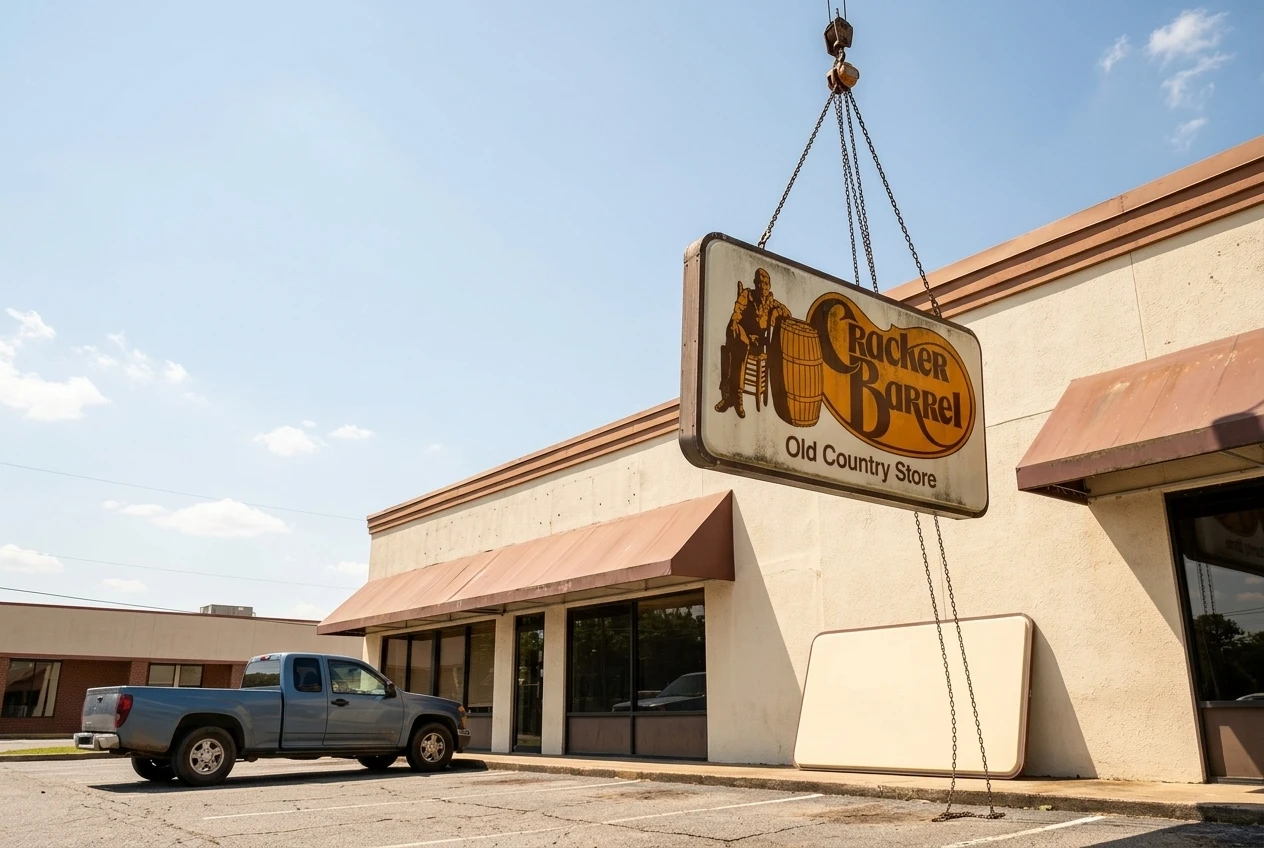
Cracker Barrel’s $36 Million Gamble on Biscuits
“Divesting Maple Street sharpens our focus on the core Cracker Barrel brand and is expected to improve profitability,” Masino said in the same release. The chain she is exiting began far from Cracker Barrel’s boardroom.
Maple Street Biscuit Company started in 2012, when Scott Moore and Gus Evans opened a scratch biscuit counter in Jacksonville’s San Marco neighborhood. By 2019 it had grown to 28 company-owned and five franchised restaurants across seven states, enough to catch Cracker Barrel’s attention.
Cracker Barrel bought the chain for $36 million in an all-cash deal that October, folding in its existing Holler & Dash Biscuit House concept, which investors had already called “an ill-conceived project destined to fail,” Restaurant Dive reported at the time. Cracker Barrel converted the Holler & Dash stores into Maple Street locations rather than run two competing biscuit brands at once.
The chain grew for a few years, then started shrinking. It closed 19 locations since the spring of 2025 alone, leaving it with 51 restaurants heading into this year’s deal. Cracker Barrel sold 35 of those to Biscuit Belly and closed the remaining 16. Maple Street had contributed less than 2% of Cracker Barrel’s annual revenue, a rounding error next to the parent chain’s roughly 660 restaurants across 43 states.
The $133 Million Warning from Punch Bowl Social
Maple Street was not Cracker Barrel’s only diversification bet that year. Three months earlier, in July 2019, the company took a non-controlling stake worth up to $140 million in Punch Bowl Social, a Denver-based chain that mixed scratch food with bowling, arcade games and karaoke.
The pandemic ended that experiment fast. Every Punch Bowl Social location closed in March 2020, and Cracker Barrel chose not to fund a rescue, taking a $133 million non-cash impairment charge instead. Punch Bowl Social filed for Chapter 11 bankruptcy in Delaware that December.
The financial toll of each 2019 bet, compared side by side:
| Detail | Maple Street Biscuit Company | Punch Bowl Social |
|---|---|---|
| Acquired | October 2019, $36 million all cash | July 2019, up to $140 million non-controlling stake |
| Footprint at the time | 28 company-owned, 5 franchised locations | 17 locations |
| What went wrong | Shrank to 51 restaurants after 19 closures since spring 2025 | All locations closed within days of pandemic shutdowns |
| Exit | 35 sold to Biscuit Belly, 16 closed, July 2026 | Chapter 11 bankruptcy, December 2020 |
| Cost to Cracker Barrel | Up to $47 million in charges and costs | $133 million non-cash impairment charge |
Cracker Barrel has never called the two exits related. Both bets, though, ran the same course: heavy investment placed outside the core brand, then a write-down once the concept could not sustain itself.
Why Is Biscuit Belly Tripling Its Size Overnight?
Biscuit Belly is a 15-location gourmet biscuit chain based in Louisville, Kentucky. This deal hands it 35 more restaurants and their trained staff in one stroke, skipping years of site hunting and hiring, and pushes it past 60 locations by the end of 2028, two years ahead of its own prior plan.
Over the next 18 to 24 months, we will convert Maple Street locations to Biscuit Belly locations, giving them all a refresh inside and out and introducing our scratch made menu to the current teams and communities around the Southeast, East Coast, Midwest and Texas.
Chad Coulter, co-founder and chief executive of Biscuit Belly, wrote in a LinkedIn post announcing the deal. The first conversions begin in greater Cincinnati and in Richmond, Virginia.
“When we looked at Maple Street’s geography, footprints, and established teams, a light bulb went off,” Coulter said in a statement. Maple Street’s own founders had made a similar case for selling to Cracker Barrel back in 2019, saying the deal would help them overcome the difficulty of finding well-sited restaurants and staff to run them.
Biscuit Belly was founded in 2019 by husband-and-wife pharmacists-turned-restaurateurs Chad and Lauren Coulter, who opened their first location in Louisville’s NuLu neighborhood. The brand has franchised since 2020. In January, with 13 locations open, Biscuit Belly set a goal of reaching 20 open units by the end of 2026 through ordinary franchise growth. The Maple Street acquisition alone adds 35 more, without a single new site search.
Cracker Barrel’s Debt Falls as Its Stock Nearly Doubles
Cracker Barrel closed its third fiscal quarter on May 1, 2026, with total debt of $486.6 million, including $149.9 million in short-term debt. The new $77 million from the sale-leaseback chips directly into that balance.
- $77 million in net proceeds from selling and leasing back 26 restaurant properties
- $486.6 million in total debt as of May 1, 2026, before the new proceeds arrived
- Less than 2% of Cracker Barrel’s annual revenue came from Maple Street
- Cracker Barrel shares are up nearly 100% year to date
Cracker Barrel also raised its outlook. It now expects fiscal 2026 revenue to reach or exceed the top of its prior $3.27 billion to $3.30 billion range, and adjusted EBITDA to exceed its earlier $120 million to $125 million guidance. That marks a shift from December, when Masino told investors “our recovery will take time.”
Same-store sales are still falling. Through the first 11 weeks of the fiscal fourth quarter, comparable restaurant sales dropped about 2.5% year over year, while comparable retail sales rose roughly 0.5%. The improved profit outlook rests on cost cuts and asset sales while foot traffic keeps sliding. Shares dipped slightly the morning the deals were announced, extending a rally now in its fourth straight month.
What Happens to the Other 16
Cracker Barrel’s announcement does not say what happens to workers at the 16 Maple Street locations set to close. There is no mention of severance, transfers or timelines beyond the fiscal fourth quarter that ends July 31, 2026.
There is also a small discrepancy in the numbers. Cracker Barrel says Biscuit Belly is acquiring 35 Maple Street locations. Biscuit Belly’s own materials put the figure at 34. Neither company has explained the gap.
What we know:
- Sixteen Maple Street restaurants close for good, with no buyer attached.
- Conversions of the acquired sites begin in greater Cincinnati and Richmond, Virginia, over the next 18 to 24 months.
- Combined charges and costs from the exit could run as high as $47 million.
What’s unconfirmed:
- Whether employees at the 16 closing locations get transfers, severance or nothing at all.
- The price Biscuit Belly paid for the Maple Street trademark and locations; both companies call it private.
- The identity of the institutional investor that now owns the 26 sale-leaseback properties.
Cracker Barrel’s fiscal fourth quarter closes July 31, 2026, when the first charges land on its books.
Frequently Asked Questions
Will Biscuit Belly Keep Franchising the Former Maple Street Locations?
Yes. Biscuit Belly has franchised since 2020, and the company described the Maple Street locations as adding to its existing growth pipeline, alongside its ongoing franchise development in other markets like Ohio and Texas.
What Happened to Punch Bowl Social After Cracker Barrel Walked Away?
Punch Bowl Social filed for Chapter 11 bankruptcy in Delaware in December 2020, months after Cracker Barrel wrote off $133 million of its investment. Secured lender CrowdOut Capital ultimately took control of the chain through a $32 million credit bid.
What’s on Biscuit Belly’s Menu?
Biscuit Belly is known for large biscuit sandwiches such as the Hot Brown, the Brisket Biscuit and the Boozy Bird, along with a doughnut-hole dessert called Bonuts. The chain describes itself as a scratch-made kitchen that bakes biscuits fresh every day.
Is Maple Street Biscuit Company Completely Gone?
Most of its restaurants will keep operating, rebranded as Biscuit Belly over the next 18 to 24 months. The Maple Street name itself will disappear, and the 16 closed locations will not reopen under any banner, ending a run that started in a single Jacksonville storefront in 2012.


SharePoint’s Fifth Exploited Flaw of 2026 Echoes Last July’s Hack

Claude Code Skips the Screen Takeover to Test iPhone Apps Live

Caitlin Clark Skips the WNBA 3-Point Contest for a Third Straight Year

Light Phone’s New Flip Runs Into the Same Chip Shortage as the iPhone

Apple’s $634 Million Masimo Verdict Stands, but Danaher Gets the Money

Rainout Gives Red Sox Two Shots at a Franchise-Record Win Streak

Apple Needed Four Tries to Truly Fix Its Hide My Email Leak

Samsung’s Record Chip Profits Are Shrinking Galaxy Z Fold 8 Deals

Sony’s PlayStation Disc Exit Repeats the Fight Xbox Lost in 2013

Samsung’s Record Chip Profits Are Quietly Pricing Its New Z Fold 8

Halo Studios Reverses PS Plus for Halo: Campaign Evolved on PS5

Black Ops 1 and 2 PS5 Ports: $40 Price Tag Has Fans Uneasy

Matt Brown Dismisses Rousey and Paul’s MVP MMA Ratings Win Over UFC

Star Wars: Galactic Racer Is a Roguelite Racer With a Podracing Skin

Julius Randle Traded to Nets as Wolves Reclaim Cap Space for Dosunmu

Sega’s $49.99 Sonic Classic and Modern Bundles Hit Switch in October

Colombia Edge DR Congo as Muñoz Books World Cup Knockout Place

Warriors Take Yaxel Lendeborg, the Oldest Pick in the 2026 NBA Draft

Douze Dixièmes Closes Five Months After MIO: Memories in Orbit

Warhammer Horus Heresy Super-Heavy Tanks Share a Plastic Chassis
-

 TECHNOLOGY3 years ago
How to Adjust a Bulova Watch Band – An Easy Guide
-

 News3 years ago
Fred Pentland: Athletic Bilbao’s English mentor who changed the essence of Spanish football
-

 FINANCE3 years ago
Tax Planning for Every Season: Guide to Maximizing Your Tax Benefits
-

 Education3 years ago
African Ministers New Education Plan
-

 BUSINESS3 years ago
What is Entrepreneurial Operating System? A Comprehensive Guide to EOS
-

 Education3 years ago
Innovate Your Learning Journey with Technology and Enhance Education
-

 News3 years ago
Russians formally out of World Athletics Championships
-

 BUSINESS3 years ago
Top 9 Most Expensive American Cities to Rent an Apartment