
FINANCE
Most US Workers Back an AI Sovereign Wealth Fund, Poll Finds
A Verasight poll finds 69% of Americans support forcing AI firms to hand over half their stock to a public wealth fund amid rising tech layoffs.

Most American workers now want Washington to seize half of Big AI’s stock. A new survey finds that 69% of US adults support forcing artificial intelligence companies to transfer 50% of their stock to a public sovereign wealth fund, even as the same companies keep cutting jobs while reporting higher profits. The finding lands weeks after Senator Bernie Sanders introduced legislation that would do close to exactly that.
The poll, conducted by research firm Verasight, arrives as tech layoffs pile up and a Goldman Sachs economist warns the AI transition could push millions of workers out of their current jobs. Verasight’s own reading of the numbers is direct.
A Bill to Hand the Public Half of Big AI
The national survey of 1,690 adults by research firm Verasight, which was carried out in June and published earlier this month, suggests that 69% of Americans now support “forcing” AI firms to transfer 50% of their stock to a public sovereign wealth fund. “In the eyes of the public, AI Sovereign funds are seen as a tool to distribute the gains from the AI industry back to broader society,” said Benjamin Leff, Verasight’s chief executive. Respondents were not reacting to an abstract idea. They were reacting, whether they knew it or not, to the bill’s plan to give the public a direct ownership stake in the country’s largest AI companies.
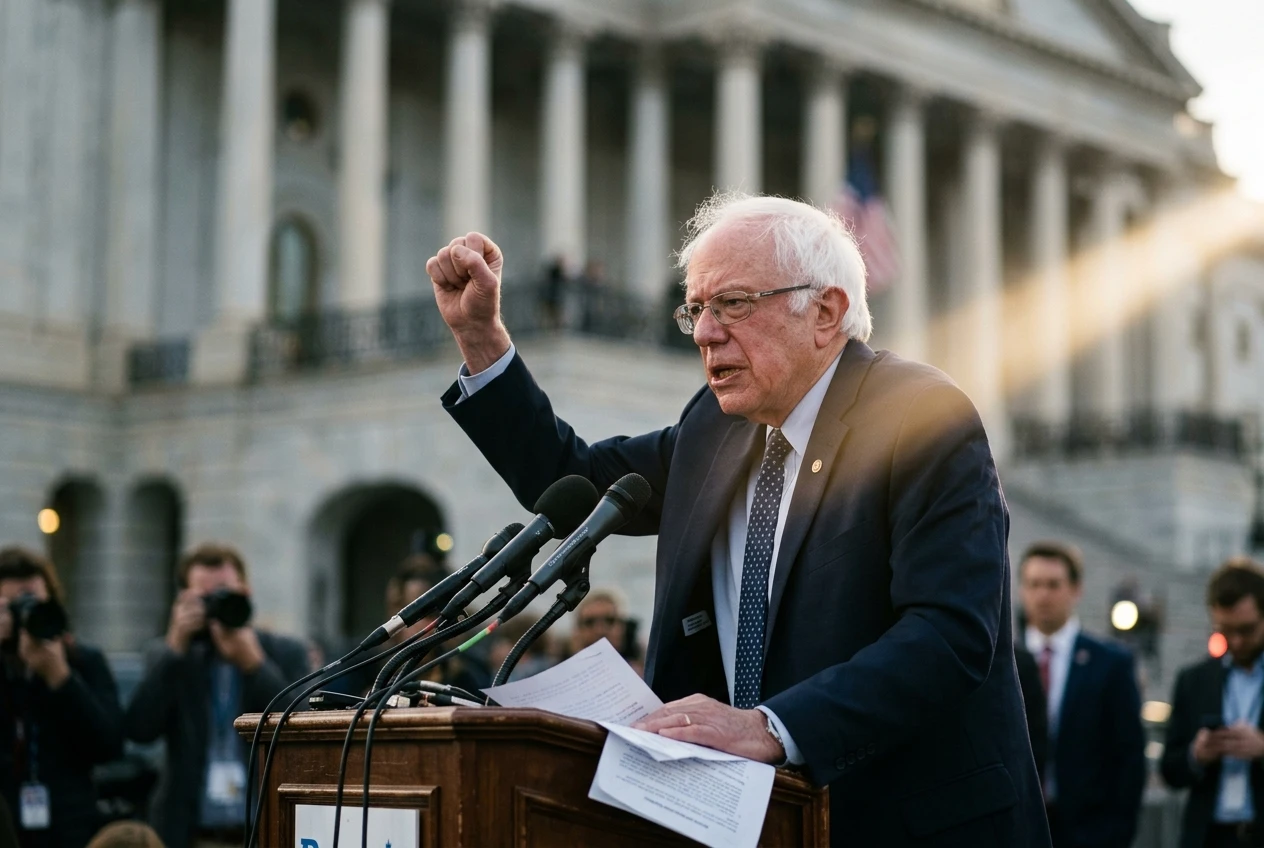
Sanders introduced the American AI Sovereign Wealth Fund Act on June 18, and the numbers in the poll track almost exactly what his bill proposes. The Vermont independent has been building toward this for weeks, tying the idea to warnings about job losses, privacy, and what AI could do to “every man, woman and child in America.”
His pitch rests on a familiar argument. AI was not, in his telling, a spontaneous invention of any single founder. It draws on decades of publicly funded research and on what he calls the collective creative output of millions of people, and he argues that fact alone justifies a public claim on the industry’s gains. Sanders has framed the fight as one between ordinary Americans and a small number of technology executives, a framing the Verasight numbers suggest a majority of the public is inclined to accept. Whether Congress agrees is a separate question entirely.
The future of AI and the fate of humanity must not be decided behind closed doors in Silicon Valley by billionaires seeking to maximize their power and profit. It must be decided by workers, parents, teachers, artists, scientists, communities, and the American people.
Sanders said that in the statement announcing his bill, and it captures the argument he has repeated in interviews since. The line is less a policy detail than the emotional case he is making to the public, and the poll numbers suggest it is landing.
How the $7 Trillion Fund Would Work
Strip away the rhetoric and the bill is a tax measure. The text, released the day Sanders introduced it, would put a one-time tax on AI companies with more than $200 million in annual sales, paid in stock rather than cash. That stock would flow into a Treasury trust fund overseen by a new Independent Commission for Democratic AI, a body that would exist specifically to manage the public’s new stake. Sanders estimates the resulting pool could be worth roughly $7 trillion at current company valuations, with 5% of that value paid out to Americans every year.
The governance structure is not an afterthought. Sanders’ bill would create an Independent Commission for Democratic AI to manage the sovereign wealth fund in the public interest, with the commission using voting shares in these companies to block decisions that hurt the American people and to push for policies that help them. That commission would have seven members nominated by the president and confirmed by the Senate, drawn from a bipartisan list Congress would supply. It would also require large companies that run both AI and non-AI businesses to split those operations apart, so the public’s stake attaches only to the AI side.
- $7 trillion: what Sanders says the fund could be worth at today’s AI company valuations
- $200 million: the annual gross receipts threshold that triggers the one-time stock tax
- Seven members: the size of the Independent Commission for Democratic AI that would run the fund
- 5% a year: the share of the fund’s value Sanders wants distributed to Americans annually
- $1,000: the yearly check Sanders has said the dividend could eventually put in most Americans’ pockets
This is not a new concept, Sanders has argued. Over 100 sovereign wealth funds exist all over the world, from Norway to Alaska, built on the same premise that when a public resource generates wealth, the public should share in it.
Layoffs Are Fueling the Anger
The poll did not appear in a vacuum. Corporations have continued to ramp up capital expenditure for AI expansion even as layoffs tied to the technology spread through the workforce, and workers have noticed the gap between rising profits and shrinking headcounts. Verasight’s numbers reflect that gap.
Goldman Sachs senior global economist Joseph Briggs put a number on the scale of what could be coming. In a recent research report titled “An AI Job Apocalypse?”, he estimated that more than 9% of the US labor force, or around 15 million workers, could be displaced during what he expects to be a 10-year AI transition period. Briggs also estimates AI is already reducing monthly job growth in the most exposed industries, tech, management consulting, and graphic design, by between 10,000 and 15,000 positions.
Despite our expectation that AI-related job losses will lead to a meaningful amount of labor displacement, we continue to expect that labor market headwinds will be temporary.
Briggs wrote that in the Goldman Sachs report, and he is not predicting a permanent hole in the labor market. His case rests on the same argument he has made about past waves of automation: that the research modeling a decade of AI-driven job displacement also expects the economy to generate enough new roles to absorb most of the disruption over time, even if the transition is rough for the workers caught in the middle of it.
The Money Isn’t There Yet
There is a problem with the arithmetic behind the $1,000 checks, and it is not a small one. Many of the AI companies Sanders’ bill is aimed at, including OpenAI and Anthropic, are not profitable. A tax paid in stock is only worth as much as that stock eventually earns, and a fund built to distribute 5% of its value every year needs actual cash coming in to make good on that promise.
Critics have pressed on exactly this point. Many frontier AI firms are valued on expectations rather than mature cash flows, and paying out 5% of a fund’s market value each year risks turning paper gains into hard fiscal promises, forcing asset sales when cash is not available. Sanders’ own suggestion that the fund could eventually pay every American roughly $1,000 a year is, on this reading, premature for companies that have not yet turned a profit on their AI businesses at all.
What a Sovereign Fund Can and Can’t Fix
A single sovereign wealth fund can serve more than one purpose. Research firm Windfall Trust has laid out the range of roles such a fund could play if the US built one around AI.
- Lead development of AI at a national level by funding capital-intensive AI infrastructure
- Take equity stakes in AI companies directly
- Capture a share of AI-driven economic gains for the public treasury
But the same research group flags a structural problem baked into the idea before it is ever put into practice. There is a tension between the financial mandate to maximize returns for citizens and the strategic mandate to build national AI capacity and maintain influence over frontier systems, since those objectives can conflict when the best financial investment is a foreign AI company rather than a domestic one. the policy breakdown of what a sovereign fund could and could not do lays out that conflict in plain terms.
Sanders’ Seizure Versus Trump’s Softer Version
Sanders is not the only person in Washington talking about a government stake in AI. President Trump has told reporters he is meeting with AI companies to discuss the possibility of federal government stakes in the firms, floating a version of the idea that looks nothing like a 50% mandatory tax.
| Feature | Sanders’ American AI Sovereign Wealth Fund Act | Trump Administration’s Approach |
|---|---|---|
| Ownership sought | 50% stake via one-time stock tax | Passive minority stake, such as the 10% Intel position tied to prior federal support |
| Mechanism | Mandatory tax on companies with over $200 million in gross receipts | Negotiated, company-by-company arrangements |
| Governance | Independent Commission for Democratic AI with voting shares | Not detailed as a standing public body |
“There’s so much money and it’s so big that there are concepts where pieces could be given to the American public, where the American public essentially becomes a partner,” Trump has said of his own version of the idea. The two proposals share a premise, that the public deserves some claim on AI’s upside, without sharing a mechanism for getting there.
Support Slips the Moment Sanders’ Name Comes Up
The 69% figure held up in Verasight’s polling only up to a point. Support barely wavered when the policy was explicitly linked to Sanders, dropping only to 64%.
Critics of the bill itself are less diplomatic. Adam Thierer, a resident senior fellow of technology and innovation at the R Street Institute, has called Sanders’ bill “the most hideous form of crony capitalism” and said it contains a “lot of counterintuitive reasoning.” The bill, released the day Sanders introduced it, is unlikely to become law under Republican control of Congress, though the idea of creating a system for the public to benefit from AI profits has supporters within the industry and on both sides of the political spectrum. Sanders has said he is not in conversation with the White House about the bill but is talking with other senators about a path forward.
Frequently Asked Questions
What is an AI sovereign wealth fund?
It is a government-controlled investment vehicle, modeled on funds like Norway’s or Alaska’s, built to hold public equity stakes in AI companies and route a share of the industry’s gains back to citizens rather than only to shareholders.
How would Sanders’ bill actually collect the stock?
The American AI Sovereign Wealth Fund Act would impose a one-time tax, paid in stock rather than cash, on AI companies with more than $200 million in annual gross receipts, transferring 50% ownership to a Treasury trust fund.
Why do the survey numbers matter if the bill won’t pass?
Roll Call reported the bill is unlikely to become law under the current Republican-controlled Congress, but the poll suggests the underlying idea of public equity in AI now draws support well beyond Sanders’ own political base.
Can the fund really pay $1,000 a year to every American?
That promise depends on AI companies generating real profits to distribute, and critics note that many of the largest targets of the bill, including OpenAI and Anthropic, are not yet profitable.
Is Sanders alone in pushing for public equity in AI?
No. President Trump has separately discussed federal stakes in AI companies, though his administration’s approach, exemplified by a passive 10% Intel position, looks far smaller and more voluntary than Sanders’ mandatory 50% tax.


Spotify Running Mode hits Android and revives its old tempo experiment

Galaxy Tab S12 Ultra Renders Keep the Notch Fans Hate

Novato Spinning Round House Sells With Six Neighbors for $3.3 Million

Crop Tour Finds Indiana and Nebraska Corn Yields Lagging 2025

Best Buy 60th sale brings Android deals back to its roots

American Airlines reverses seatback screen bet years too late

Iran Hormuz Strikes Force Gulf Oil Onto Costlier Paths

Plague Tale Prequel Day One Joins Game Pass Wave 2 as Witcher Exits

NBA 2K27 opens The City to everyone and rewrites career eras

iOS 26.6.1 Patches 29 Flaws as AI Forces Faster Apple Updates

Day-One Big Walk Lifts PS Plus August Beyond Recycled AAA

Double Fine Cuts 23 Jobs Weeks After Xbox Independence

John Hight Exits Wizards After Digital Reckoning Hits

Curtis Mead’s Red Sox Debut Ends With Fractured Wrist

Red Sox Squander Hot Streak Chance in 4-3 Loss to Athletics

Moesch and Dressel Rewrite Night One at 2026 U.S. Nationals

Boutte’s Quiet Camp Takeover Forces Patriots Receiver Choices

Take-Two CEO Pushes Netflix Subs for GTA 6 Extended Look

Halo Campaign Evolved Skulls Meet Death Barriers That Kill the Hunt

Wildlands Free Update Hands Players the Tools They Already Invented
-

 TECHNOLOGY3 years ago
How to Adjust a Bulova Watch Band – An Easy Guide
-

 News3 years ago
Fred Pentland: Athletic Bilbao’s English mentor who changed the essence of Spanish football
-

 FINANCE3 years ago
Tax Planning for Every Season: Guide to Maximizing Your Tax Benefits
-

 Education3 years ago
African Ministers New Education Plan
-

 BUSINESS3 years ago
What is Entrepreneurial Operating System? A Comprehensive Guide to EOS
-

 Education3 years ago
Innovate Your Learning Journey with Technology and Enhance Education
-

 News3 years ago
Russians formally out of World Athletics Championships
-

 BUSINESS3 years ago
Top 9 Most Expensive American Cities to Rent an Apartment