
News
Perseid Meteor Shower Begins This Week Under a Rare Earthshine Moon
The Perseid meteor shower starts this week and peaks Aug. 12 to 13 under a new moon, its clearest run in years and the same night as a total solar eclipse.

The moon goes dark at 5:43 a.m. EDT on Tuesday, and by Friday a sliver of crescent will hang beside Venus in the evening sky. It is the quiet opening of the Perseid meteor shower, one of the year’s most dependable displays of shooting stars, which starts this week and builds toward a peak on the night of Aug. 12 into Aug. 13.
That peak lands during a new moon, so there is almost no moonlight left to wash out the show, and it falls on the same night as a total solar eclipse crossing Greenland, Iceland and Spain. Last year’s Perseids drowned under an 84 percent lit gibbous moon. This year, skywatchers get the opposite.
A New Moon Opens A Week Built For Moon Watching
Tuesday’s new moon is the sky’s clean slate. With the moon’s lit side turned away from Earth, rural skies go properly dark, and the Milky Way arches overhead after midnight without any glow to compete with it.
The dark does not last long. By Wednesday evening, a 4 percent lit crescent reappears low in the west near Regulus, the bright heart of the constellation Leo, thin enough to show off Earthshine, the pale glow on the moon’s dark limb caused by sunlight bouncing off Earth and back onto the lunar surface. Each night after, the crescent climbs a little higher and swings closer to Venus.
- Tuesday, July 14: New moon at 5:43 a.m. EDT, the best night of the week for deep sky viewing under a dark, moonless sky.
- Wednesday, July 15: A 4 percent lit waxing crescent appears low in the west about 45 minutes after sunset, prime conditions for spotting Earthshine.
- Thursday, July 16: A 10 percent lit crescent hangs low at dusk with Venus to its upper left, another good night for Earthshine.
- Friday, July 17: A 17 percent lit crescent shines just left of Venus after dark, the same night the Perseid meteor shower quietly gets underway.
Venus is the fixed point through all of it. It stays a bright evening object right through the summer, long after this week’s crescent has grown into a full moon and faded again.
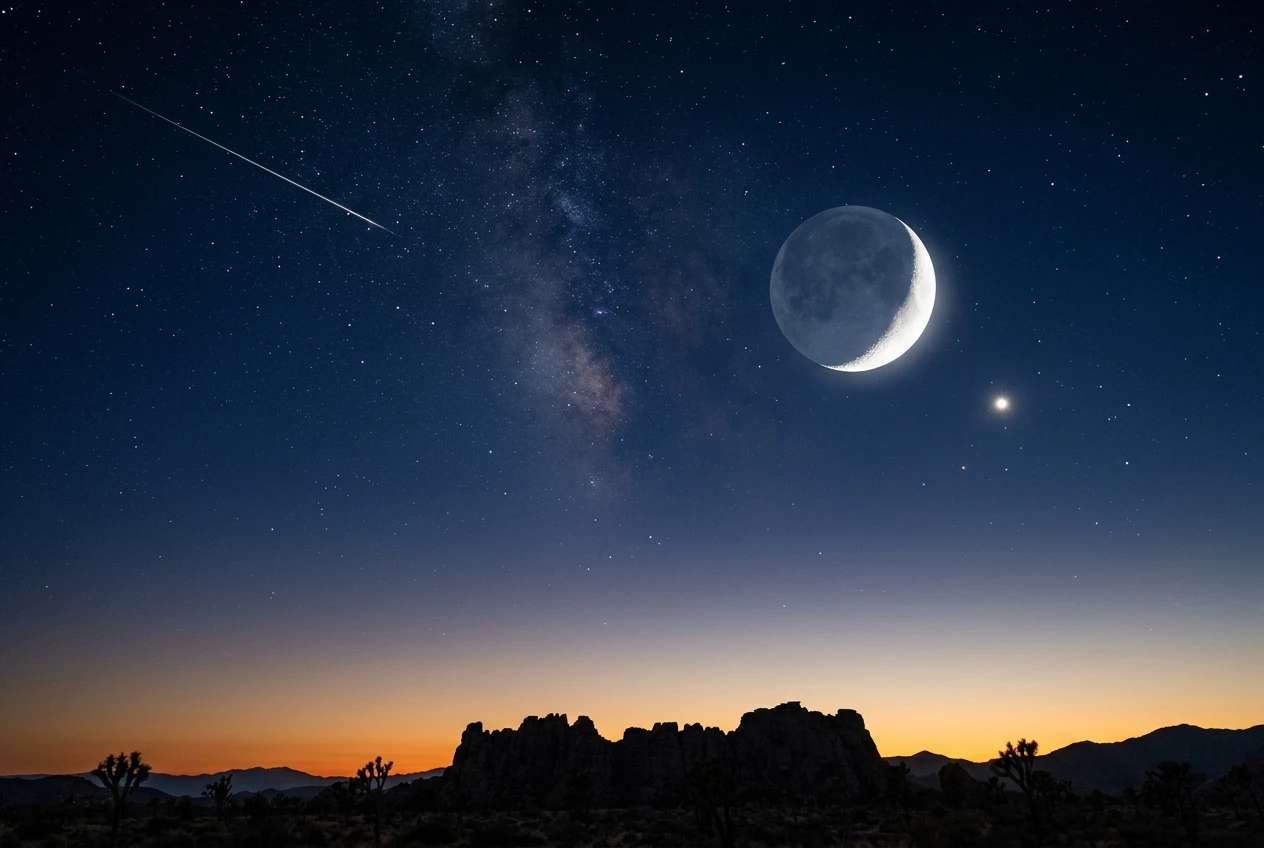
The Perseids Begin, Building Toward An August Peak
Friday marks the start of the Perseids, active from July 17 through Aug. 24 according to the American Meteor Society, though the show does not really get going for weeks yet. The shower is debris shed by Comet 109P/Swift-Tuttle, discovered independently in 1862 by astronomers Lewis Swift and Horace Tuttle. Its nucleus runs about 16 miles wide, one of the largest objects known to repeatedly cross Earth’s path, and it swings through the inner solar system only once every 133 years.
Swift-Tuttle last passed near Earth in 1992 and will not return until 2126. An early orbital calculation once raised the possibility that the 2126 pass could bring it dangerously close to Earth; refined calculations ruled that out, and the comet’s next genuinely close approach, within about a million miles, will not come until the year 3044. In old Catholic tradition, the shower’s meteors were known as the tears of Saint Lawrence, whose feast day falls in mid-August.
Under a truly dark sky, the Perseids can throw 60 to 100 meteors an hour at their best, streaking in at roughly 133,000 mph and often leaving glowing trains that linger for seconds after the streak itself is gone. NASA’s own roundup of the year’s sky events calls 2026 a year when skywatchers should see “excellent viewing opportunities across most of the world,” weather permitting.
What Makes This Year’s Peak Different?
The Perseids peak during a new moon this year, on the night of Aug. 12 into Aug. 13, leaving skies free of moonlight for the entire night. That kind of alignment is rare, since the lunar cycle rarely lines up this cleanly with mid-August, and 2025 proved the point by peaking under an 84 percent lit gibbous moon that blotted out all but the brightest streaks.
The gap between the shower’s theoretical ceiling and what people actually see is wide. The 100 per hour figure quoted almost everywhere is a Zenithal Hourly Rate. That number assumes a perfectly dark sky with the radiant sitting directly overhead, a condition almost nobody observes from. The American Meteor Society’s own calendar is blunter, putting normal rates from rural locations at 30 to 50 members an hour at maximum, not 100.
Even so, a moonless sky changes the math. Suburban observers who would normally see a handful of meteors an hour should see noticeably more with the moon entirely out of the picture, and rural observers get the closest look at the shower’s real ceiling in years.
An Eclipse Crashes The Peak Night
Hours before the Perseids reach their best, the moon slides in front of the sun. A total solar eclipse traces a path from the Arctic across Greenland, Iceland and northern Spain on Aug. 12, the first total eclipse to touch mainland Europe since 1999.
Totality lasts under two minutes for most places along the path, stretching to just under two and a half minutes near the centerline off Iceland’s coast, according to NASA. Skywatchers across the northern United States, from Alaska to North Carolina, along with most of Canada and much of Europe, will catch a partial eclipse instead.
There’s going to be something of a celestial double whammy visible that day.
BBC Sky at Night Magazine put it that way in its preview of the pairing. Eclipse chasers watching totality might even catch a Perseid streak across the darkened sky, according to EarthSky, since the shower is already active by the time the moon covers the sun.
How 2026’s Meteor Showers Stack Up
The Perseids are not the year’s strongest shower by the numbers, but they are the best placed one this year. The Southern Delta Aquariids peak first, in late July, and the moon ruins that view almost completely.
| Shower | Peak Night | Theoretical Rate (ZHR) | Moon Condition |
|---|---|---|---|
| Southern Delta Aquariids | July 30 to 31 | 25 per hour | 98 percent full, badly washed out |
| Perseids | Aug. 12 to 13 | About 100 per hour | New moon, no interference |
| Orionids | Oct. 21 to 22 | 20 per hour | 80 percent full, some glare |
| Geminids | Dec. 13 to 14 | About 150 per hour | Crescent moon sets early evening |
By that measure, the Geminids remain the year’s strongest shower on paper. But no other major shower in 2026 pairs a high rate with a completely moonless night the way the Perseids do this August.
Getting The Most Out Of Peak Night
None of this requires special equipment, just planning. A few habits make the difference between seeing a handful of meteors and seeing dozens.
- Get away from artificial light. A backyard works, but a rural site away from streetlights and city glow shows far more faint meteors.
- Let your eyes adjust. It takes 15 to 20 minutes in the dark before faint meteors become visible, and a glance at a phone screen resets the clock.
- Skip the binoculars. Meteors can streak anywhere across the sky, so a wide naked eye view beats a narrow magnified one.
- Look off to the side. Meteors near the radiant in Perseus appear short. Looking about two thirds of the way up the sky, away from Perseus, shows longer trails.
- Get comfortable. A reclining chair or a blanket on the ground beats a stiff neck, and body heat escapes fast on a clear night even in summer.
Patience matters more than any of it. Rates build steadily after midnight and are usually best in the hour or two before dawn.
Vega, Lyra And A 12,000 Year Wobble
While the crescent moon climbs this week, look east after dark for a small parallelogram of faint stars anchored by one bright point. That is Lyra, the Harp, and the bright star is Vega, one of the sky’s brightest. Lyra sits high overhead through the same summer hours the Perseids are active, an easy landmark to return to while waiting between meteors.
Vega carries more history than its size suggests. About 12,000 years ago, the slow wobble of Earth’s axis, known as precession, made Vega the pole star, the point the sky appeared to turn around. It will hold that role again in another 12,000 years. In the meantime, astronomers use its brightness as the yardstick against which every other star gets measured.
Frequently Asked Questions
When exactly do the Perseids peak in 2026?
The peak runs overnight from Aug. 12 into the predawn hours of Aug. 13, with the American Meteor Society and other forecasters pointing to the hours after midnight through dawn as the best window. Because the peak coincides with a new moon, the nights immediately before and after, Aug. 11 to 14, should also produce strong rates.
How many meteors will I actually see?
Expect far fewer than the headline 100 per hour figure, which assumes perfect darkness and the radiant directly overhead. Light pollution alone can cut visible meteors by half or more, and sky brightness comparisons built around the Bortle scale, the standard astronomers use to rate how dark a sky really is, show five to seven times more meteors from a truly dark site than from a merely rural one.
Does the eclipse interfere with watching the meteor shower?
No, and if anything it helps. The eclipse happens by definition at new moon, exactly the dark sky condition meteor watchers want for that night’s peak. The total eclipse sweeps from the Arctic across Greenland, Iceland and northern Spain hours before the Perseids become active after dark, so the two events barely overlap in time for most viewers.
What exactly is Earthshine, and why is this week good for it?
Earthshine is sunlight that bounces off Earth’s clouds and oceans, hits the moon’s dark portion, then reflects back to your eyes, letting you see the whole lunar disk faintly even when only a sliver is directly lit. Thin crescents like the ones visible July 15 through 17 show it best, because more of the shadowed surface is angled toward Earth and the sky is still dim enough at dusk to see the contrast.
Do I need binoculars or a telescope to see the Perseids?
No. Meteors can appear anywhere in the sky, so binoculars and telescopes actually hurt your chances by narrowing your field of view to a small patch. The one piece of gear worth bringing is something to lie back on, since craning your neck upward for hours gets uncomfortable fast.
Will future Perseid showers be even better than this one?
Possibly. Forecasters are already watching 2028 for a potential outburst that could push rates well above normal, according to Space.com. Nothing is guaranteed years out, but comet debris streams do get denser in some years than others, and 2028 is the one currently drawing attention.


Spotify Running Mode hits Android and revives its old tempo experiment

Galaxy Tab S12 Ultra Renders Keep the Notch Fans Hate

Novato Spinning Round House Sells With Six Neighbors for $3.3 Million

Crop Tour Finds Indiana and Nebraska Corn Yields Lagging 2025

Best Buy 60th sale brings Android deals back to its roots

American Airlines reverses seatback screen bet years too late

Iran Hormuz Strikes Force Gulf Oil Onto Costlier Paths

Plague Tale Prequel Day One Joins Game Pass Wave 2 as Witcher Exits

NBA 2K27 opens The City to everyone and rewrites career eras

iOS 26.6.1 Patches 29 Flaws as AI Forces Faster Apple Updates

Double Fine Cuts 23 Jobs Weeks After Xbox Independence

Day-One Big Walk Lifts PS Plus August Beyond Recycled AAA

John Hight Exits Wizards After Digital Reckoning Hits

Curtis Mead’s Red Sox Debut Ends With Fractured Wrist

Red Sox Squander Hot Streak Chance in 4-3 Loss to Athletics

Moesch and Dressel Rewrite Night One at 2026 U.S. Nationals

Boutte’s Quiet Camp Takeover Forces Patriots Receiver Choices

Take-Two CEO Pushes Netflix Subs for GTA 6 Extended Look

Halo Campaign Evolved Skulls Meet Death Barriers That Kill the Hunt

Wildlands Free Update Hands Players the Tools They Already Invented
-

 TECHNOLOGY3 years ago
How to Adjust a Bulova Watch Band – An Easy Guide
-

 News3 years ago
Fred Pentland: Athletic Bilbao’s English mentor who changed the essence of Spanish football
-

 FINANCE3 years ago
Tax Planning for Every Season: Guide to Maximizing Your Tax Benefits
-

 Education3 years ago
African Ministers New Education Plan
-

 BUSINESS3 years ago
What is Entrepreneurial Operating System? A Comprehensive Guide to EOS
-

 Education3 years ago
Innovate Your Learning Journey with Technology and Enhance Education
-

 News3 years ago
Russians formally out of World Athletics Championships
-

 BUSINESS3 years ago
Top 9 Most Expensive American Cities to Rent an Apartment