
FINANCE
Singapore’s Second Currency Tightening Squeezes Its Own Exporters
MAS tightened Singapore’s currency band again to blunt oil driven inflation risk, a move that quietly pressures the exporters and tourism trade behind its AI.

Singapore’s central bank tightened its currency policy for the second time in three months on Monday, moving to blunt an oil price shock before it ever shows up in the inflation data. The Monetary Authority of Singapore, or MAS, said it would raise the pace of appreciation in the Singapore dollar’s trading band, a smaller step than April’s move, even though most economists polled going into the review had expected no change at all.
The same currency strength MAS is leaning on to soften import costs lands squarely on the electronics exporters and tourism operators currently powering the country’s growth.
A Second Move Nobody Had Priced In
MAS does not set an interest rate the way the Federal Reserve or the European Central Bank does. It instead manages the currency against an undisclosed trading partner basket, letting the Singapore dollar’s nominal effective exchange rate, or S$NEER, rise inside a policy band whose width, slope and center point are never published.
On Monday, MAS steepened that slope again, if only slightly. “In an environment of continued heightened uncertainty, this calibrated adjustment to the policy stance builds on the tightening in April,” the central bank said in its policy statement released Monday. The band’s width and its center were left unchanged. Only the pace of appreciation moved.
The majority was calling for no change in MAS policy this round, so the move was not quite a consensus trade.
Selena Ling, chief economist and head of OCBC Group Research, told CNBC that back-to-back tightenings signal MAS will not get complacent about imported inflation. Economists surveyed by Reuters heading into the review had broadly expected the central bank to stand pat.
| Policy Review | What MAS Did | Price Backdrop Cited |
|---|---|---|
| April 2026 | Raised the S$NEER slope for the first time in four years | Inflation risk seen building as global costs climbed |
| July 2026 | Raised the slope again, a smaller step than April’s | Core inflation at 1.6% in June, headline at 1.9%, Brent crude back above $100 a barrel |
The gap between the two moves matters almost as much as the moves themselves. MAS typically reviews its stance about twice a year, and three months is tight by that measure.
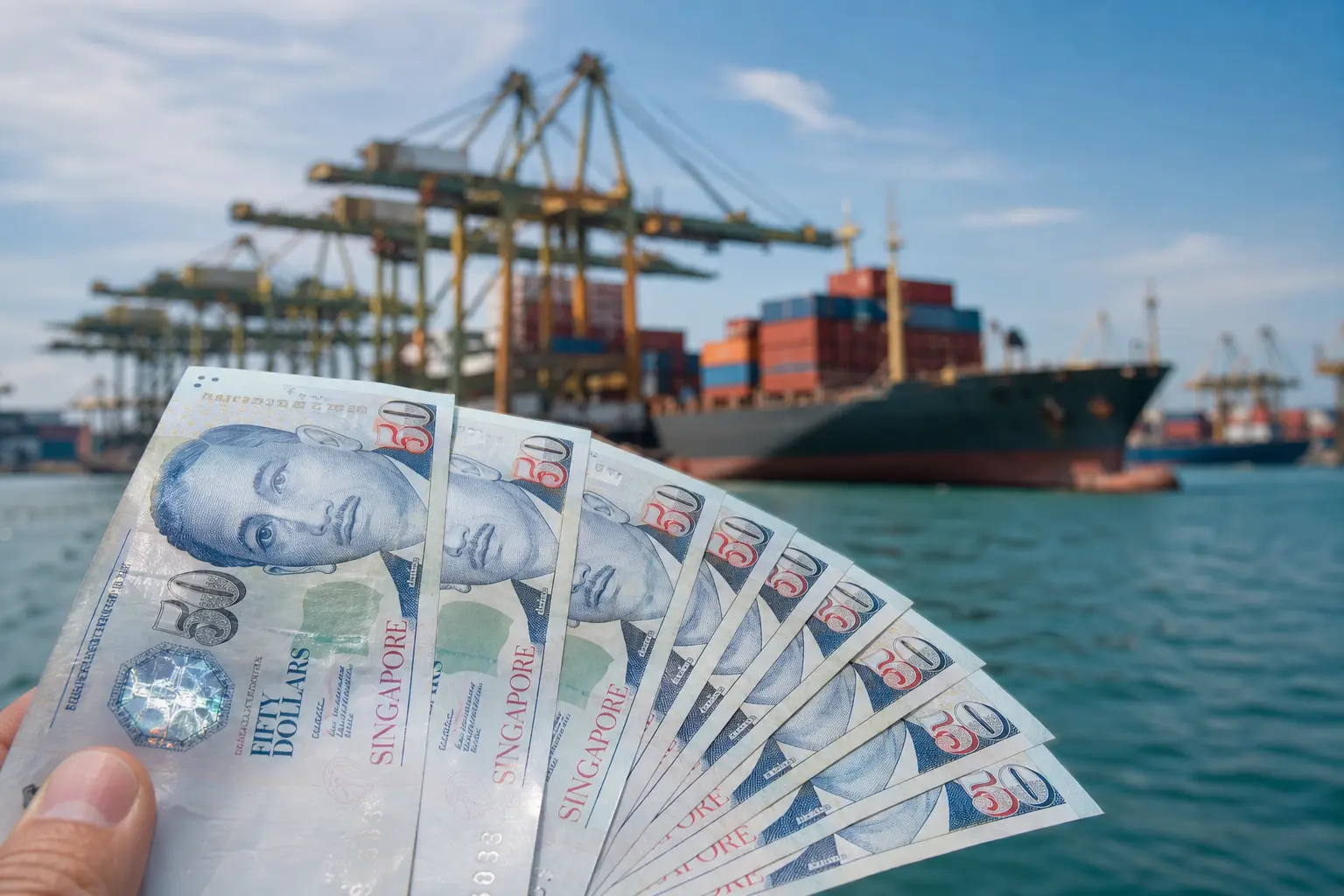
Oil’s Return to Triple Digits
Brent crude spiked more than 6% overnight last week to around $100 a barrel, its highest level since May. Houthi rebels said they had struck two tankers, the Encelia and the Layla, in the Red Sea, and fires broke out on both vessels.
The attacks followed the group’s declared blockade of Saudi-linked shipping through the Bab el Mandeb Strait, itself retaliation for a Saudi blockade on Yemen. They came just after a fragile Middle East ceasefire collapsed, ending a brief easing in supply fears. MAS’s own July statement even noted that global oil, gas and related chemical prices had retreated from their April peaks before this latest flare-up. The Red Sea attacks now threaten to erase that relief.
The crude spike is already colliding with Wall Street’s AI spending boom, pushing up bond yields tied to data center financing thousands of miles from the Persian Gulf. In the United States, the same conflict pushed pump prices back above $4 a gallon, retracing gains that had briefly lifted consumer sentiment 10% earlier in July. Goldman Sachs has forecast Brent could still climb toward $120 a barrel by the fourth quarter if the disruptions persist.
Who Pays for a Stronger Singapore Dollar?
A stronger Singapore dollar cuts both ways. It lowers the cost of imported oil, food and fuel for consumers, which is exactly why MAS leans on it as an inflation tool. But it also raises the relative price of Singapore’s electronics exports and tourism offerings just as regional currencies stay weak, squeezing the businesses that sell to the rest of the world.
- Consumers and importers gain purchasing power on every barrel of oil, sack of grain and imported good, directly offsetting the price pressure MAS is trying to head off.
- Electronics and chip exporters face pricier goods for overseas buyers just as AI-linked semiconductor demand drives Singapore’s growth, though long-term supply contracts have cushioned the impact so far.
- Tourism and travel operators compete for regional visitors at a currency disadvantage against destinations such as Malaysia and Indonesia, whose currencies have weakened.
- Singaporean travelers and savers find overseas trips and remittances stretch further, a rare consumer upside to the same policy squeezing exporters.
Manufacturers have so far been largely insulated, cushioned by long-term supply contracts that lock in prices well ahead of currency swings, The Star reported. Most firms are taking a wait-and-see approach, reluctant to reprice deals while conditions keep shifting so fast.
The Tightest Policy Gap in Years
MAS typically reviews its currency band about every six months. This decision landed just three months after April’s statement, one of the tightest gaps between moves in its own record of scheduled policy reviews.
MAS’s statement pointed to a widening positive output gap, a sign the economy is running hotter than its long-run capacity, alongside a firm pace of growth expected for 2026 as a whole. That combination gives the central bank room to keep tightening even while headline price growth still looks tame.
Singapore’s near-total reliance on imported energy explains the urgency. The city-state produces essentially none of its own crude. A Middle East supply shock reaches its pump prices and shipping costs almost immediately, long before it shows up in slower-moving categories like rent or wages.
Where Prices Go From Here
Singapore’s core inflation, which strips out accommodation and transport costs, ticked up to 1.6% in June from 1.4% in May, near the bottom of MAS’s 1.5% to 2.5% forecast range for the year. Headline inflation stood at 1.9%.
Softer services prices, particularly healthcare, communication and education, have offset much of the pressure from fuel costs so far. “Imported-cost pressures typically pass through to broader consumer prices with a lag, so we still expect inflation to rise in the coming months,” said BMI, a Fitch Solutions research unit.
OCBC expects both measures to run hotter from here, forecasting headline and core inflation to overshoot to around 2.5% and 2.3% respectively, with inflation only slipping back under 2% from the second half of 2027. MAS’s own projection points the same direction: core inflation is expected to step up from July and stay elevated before moderating discernibly around the middle of 2027.
- 1.6% – Singapore’s core inflation reading for June, near the bottom of MAS’s forecast range.
- $100+ – the price of a barrel of Brent crude after last week’s Red Sea tanker attacks.
- 2.3% – OCBC’s forecast for where core inflation could overshoot to in the coming months.
- 5.7% – Singapore’s year-on-year GDP growth in the second quarter, beating estimates.
That growth, powered by AI-linked electronics exports, beat the 5.5% median estimate in a Reuters survey and ran well above the government’s own 2% to 4% full-year projection. It is also the cushion MAS is counting on to absorb a stronger currency without denting the export engine outright.
OCBC does not expect headline inflation back under 2% until the second half of 2027, a full year after this week’s decision.
Frequently Asked Questions
Does MAS set interest rates the way the Federal Reserve does?
No. MAS manages monetary policy by steering the Singapore dollar’s exchange rate against a basket of its trading partners’ currencies rather than a benchmark interest rate. Everyday borrowing costs, including mortgages tied to the Singapore Overnight Rate Average, or SORA, move mostly with global funding conditions rather than MAS’s currency band decisions.
Why doesn’t MAS reveal the exact width of its currency band?
Keeping the basket’s currencies, their weights and the band’s width undisclosed gives MAS flexibility to manage the Singapore dollar without inviting speculative bets against its exact settings. Only the direction of a change, such as this week’s steeper slope, gets announced.
How does Singapore’s approach compare with how the Fed fights inflation?
Singapore’s small, trade-dependent economy imports almost everything it consumes, so shifting the exchange rate changes import prices directly and quickly. The Fed’s interest rate tool works mainly through borrowing costs and asset prices, a slower channel aimed more at domestic demand than at a shipment of crude arriving next month.
Could MAS reverse course if oil prices retreat?
It can. The band’s slope, width and center are reset at every review rather than fixed, so MAS can ease appreciation again if the Middle East conflict cools and Brent crude retreats. For now, prices remain elevated enough that most analysts expect no quick reversal.


A Stalled Volkswagen EV Triggered a Deadly Loop 202 Pileup

ChatGPT, Gemini and Claude Traded Praise as Billions Ride on It

New Jersey Bans Surveillance Pricing After a Union Push

SpaceX Stock Sits Just $15 From a Zero Value AI Verdict

ChatGPT Health Data Skips HIPAA as Telehealth Stocks Slide

Apple Wagers Years of Delay on Smart Glasses Privacy

FDA Recall Pulls Nearly 19 Million Eggs Over Salmonella

Ubisoft’s New Far Cry Game Rides on Tencent’s Billions

PlayStation Blackout Protest Could Hit the Wrong Targets

Taylor Farms Gave Trump Allies $2 Million Before Its Recall Call

Pokémon GO Developer Niantic Rebrands as Scopely Explore

Persona 4 Revival Hands All Anime Cutscenes to Studio MAPPA

Jaylen Brown Traded to 76ers for Paul George and Four Draft Picks

Doom Studio id Software Cuts Half Its Staff in Xbox Layoffs

Nintendo Switch Online Adds Four Classics and One Japan-Only Title

Jordan Henderson Hospitalized After Wrist Injury at the Azteca

Mexico’s World Cup Run Ends at Azteca as England Hold On 3-2

Meta’s Muse Image Lets Anyone Use Your Instagram Photos in AI

Louis Vuitton Beats Molly Tea in China, Triggers Cultural Backlash

Pink Bearista Cup Returns July 13 as Starbucks Pink Vibes Drops
-

 TECHNOLOGY3 years ago
How to Adjust a Bulova Watch Band – An Easy Guide
-

 News3 years ago
Fred Pentland: Athletic Bilbao’s English mentor who changed the essence of Spanish football
-

 FINANCE3 years ago
Tax Planning for Every Season: Guide to Maximizing Your Tax Benefits
-

 Education3 years ago
African Ministers New Education Plan
-

 BUSINESS3 years ago
What is Entrepreneurial Operating System? A Comprehensive Guide to EOS
-

 Education3 years ago
Innovate Your Learning Journey with Technology and Enhance Education
-

 News3 years ago
Russians formally out of World Athletics Championships
-

 BUSINESS3 years ago
Top 9 Most Expensive American Cities to Rent an Apartment