
News
Starship Survives Its Splashdown, Clearing SpaceX’s Path to a Historic Catch
Starship’s upper stage survived an intact ocean splashdown for the first time, clearing SpaceX toward attempting to catch the vehicle itself on Flight 14.

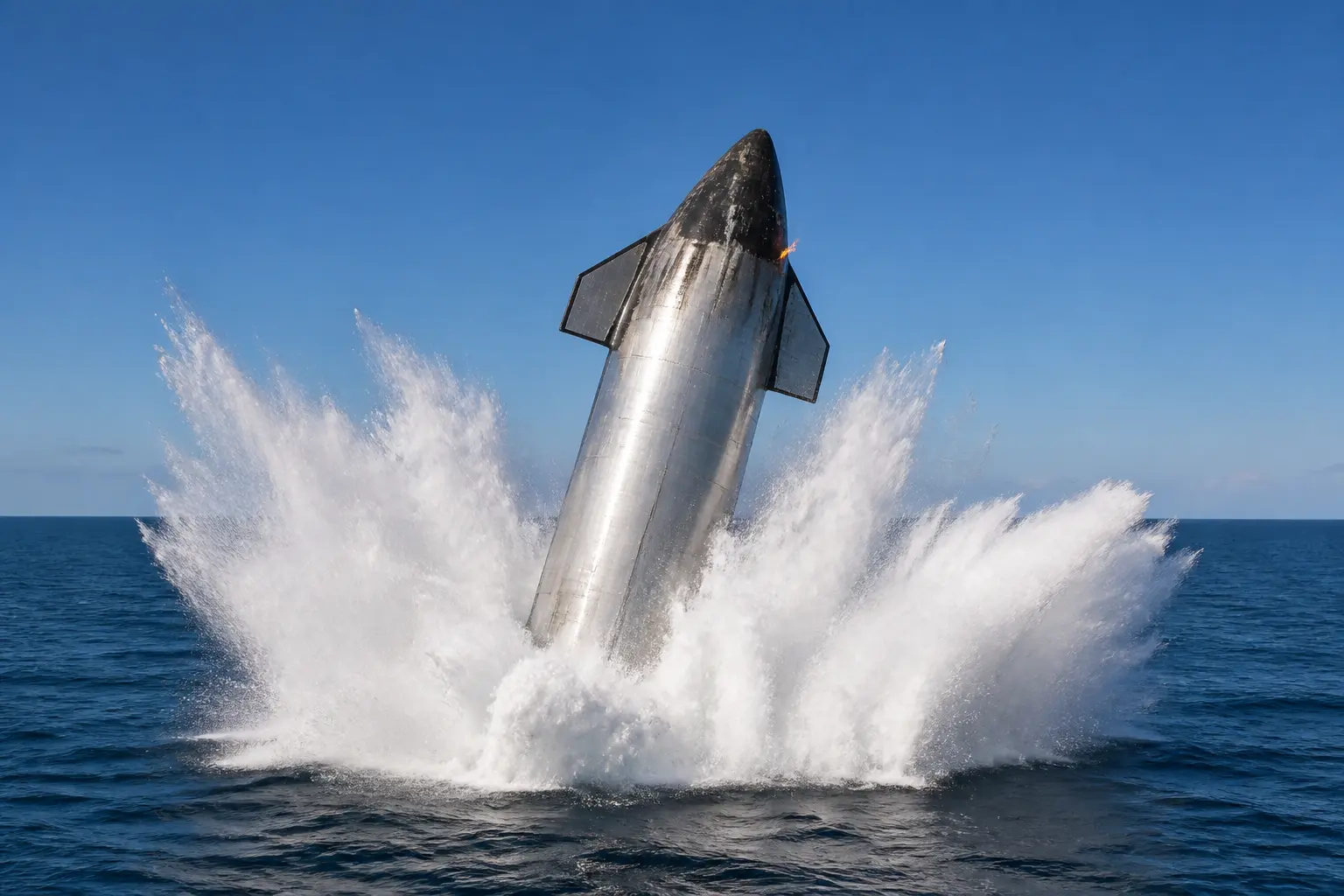
SpaceX’s Starship splashed down intact in the Indian Ocean on Friday, the first time the vehicle’s upper stage has survived hitting open water without blowing apart. Flight 13 sent the 408 foot tall (124 meter) Starship Version 3 rocket up from Starbase in South Texas, deployed 20 next generation Starlink satellites, relit a Raptor engine in orbit and brought Ship down off the coast of Western Australia gently enough to stay in one piece, despite a fire that broke out near its nose.
Super Heavy, the booster that does the heavy lifting off the pad, did not have as clean a return. As many as eight of its 13 landing engines failed to relight on the way down, SpaceX said. Engineers now have to explain that shortfall before Flight 14, when SpaceX hopes to attempt something no Starship has ever done: catching Ship itself out of the sky, just as SpaceX’s stock is caught in its own argument over what the company is actually worth.
A Splashdown Nobody Has Walked Away From Before
Ship’s job on Flight 13 was straightforward on paper and brutal in practice. After lifting off atop Super Heavy on Friday (July 24), the upper stage separated from its booster, coasted through a suborbital arc and released 20 next generation Starlink V3 satellites into their intended orbit. Partway through the flight, Ship relit one of its Raptor engines while coasting through space, a maneuver SpaceX had planned to test the engine’s ability to restart away from the ground.
Then came the finale. Ship steered itself from sky to sea over the Indian Ocean, off Western Australia’s coast, in a controlled descent. SpaceX’s drone footage of the dramatic splashdown caught the vehicle intact on the surface, even as a sizable fire broke out near its nose. It did not explode. No Starship test flight had ended that way before. CNN’s live coverage of the mission called it “Lucky 13.”
Both stages fly on Raptor engines, which burn methane and liquid oxygen. Both Ship and Super Heavy are designed to be fully and rapidly reusable, eventually flying back to the launch site for capture by the tower’s mechanical arms, refurbishment and reflight. Friday’s flight tested how each half of that plan holds up under pressure, and the two halves gave very different answers.
Two Stages, Two Very Different Endings
SpaceX’s own footage of Ship cruising away from Super Heavy shows six Raptor engines glowing against a blue Earth moments after the two stages separated. Both vehicles looked healthy in that instant. What happened in the minutes after did not match.
| Vehicle | Job on Flight 13 | What Happened | Verdict |
|---|---|---|---|
| Ship (upper stage) | Deploy 20 Starlink satellites, relight a Raptor engine in orbit, splash down intact | Hit all three marks and survived an ocean impact despite a fire near its nose | Objectives met |
| Super Heavy (booster) | Relight 13 Raptor engines for a controlled landing burn | Only about five engines were still firing by splashdown, and the booster hit the water harder than planned | Objective missed, though the booster was already set to be discarded |
SpaceX spokesperson Dan Huot said it appeared that not all 13 of the booster’s engines lit for the landing burn. That booster was never going to fly again regardless of how it performed. SpaceX intentionally expends early Version 3 boosters in the ocean rather than attempting a tower catch on every flight, reserving that maneuver for boosters built to fly again.
Wall Street Is Still Arguing About What SpaceX Is Worth
The rocket’s performance landed in the middle of a rough stretch for SpaceX’s stock. Shares in the company, which trade under the ticker SPCX, hit an all time intraday high of $225.64 on June 16, then slid for weeks as Flight 13 worked through a delay and an aborted countdown. By Monday they were changing hands around $113, down enough to erase roughly $1 trillion in peak valuation.
Morgan Stanley analyst Adam Jonas has written that a $100 share price would effectively value SpaceX’s AI business at zero. Forbes framed the stock’s recent level as sitting just $15 above that zero value threshold, a gap Friday’s splashdown did little to widen on its own. The three biggest banks covering the stock do not agree on what it is worth.
- Morgan Stanley’s Adam Jonas holds a $300 price target, with SpaceX’s AI ambitions accounting for more than half of that figure.
- Goldman Sachs holds a far more conservative $205 target, a gap versus Morgan Stanley that market watchers have pegged at close to $1 trillion in implied valuation.
- Deutsche Bank called Flight 13 “solid progress” despite the booster’s rough return, treating the setback as a footnote rather than a warning sign.
A bigger test for the stock arrives Aug. 6, when SpaceX’s post listing lockup expires. That unlock frees 911 million shares held by early investors, worth roughly $105 billion at recent prices, to trade for the first time. Flight 13’s clean half and Super Heavy’s rough one both land on the balance sheet before that date.
Does Flight 13 Keep NASA’s Moon Plan on Track?
Partly. NASA has booked Starship to carry astronauts to the moon’s south pole under the Artemis program, and Flight 13’s mixed results feed directly into whether that timeline holds. The crewed landing itself has already slipped a year, to 2028, regardless of Friday’s outcome.
Artemis III, once billed as the mission that would put astronauts on the surface, is now a lunar orbit docking test set for late 2027, with the actual landing pushed to Artemis IV. SpaceX has estimated that mission could fly as early as September 2028, aiming to put boots near the moon’s south pole for the first time since Apollo.
Getting there still depends on a chain of unproven steps.
- Flight 14 must catch Ship out of the sky, the milestone Musk has now targeted after Friday’s splashdown.
- SpaceX still owes NASA an uncrewed lunar lander demonstration before any crew climbs aboard a Starship near the moon.
- Blue Origin, building NASA’s second human landing system, has its own lander milestones to clear before Artemis IV.
Delays, an Abort, Then Liftoff
Friday’s launch almost did not happen when it did. SpaceX pushed the flight back once, then aborted a countdown entirely after an engine problem forced an early shutdown. Engineers spent the following days chasing a fix for the booster problem that caused it before clearing Ship and Super Heavy for another attempt.
Flight 13 is only the latest chapter in a program that has moved in fits and starts since 2023.
- April 2023: Starship flies for the first time and breaks apart minutes after launch.
- October 2024: SpaceX catches a Super Heavy booster with the launch tower’s arms for the first time, on the program’s fifth flight.
- July 16, 2026: A post ignition anomaly forces SpaceX to abort a Flight 13 countdown.
- July 24, 2026: Flight 13 lifts off, deploys 20 Starlink satellites and brings Ship down intact for the first time.
Three Super Heavy catches since October 2024 gave SpaceX enough confidence to expend this particular booster instead of risking a tower catch on a vehicle with faulty engines. Nobody was near the booster when it hit the Gulf waters hard.
Musk Sets Up Starship’s Hardest Trick Yet
Elon Musk set the bar for Flight 14 within hours of the splashdown, replying to a question on X about what comes next.
Unless we discover problems after mission data review, SpaceX will attempt to catch the ship with the tower on next flight.
Musk, SpaceX’s founder and CEO, confirmed the plan for Flight 14 in that reply, tying the milestone to a review of Friday’s telemetry that has not yet finished. A caught Super Heavy is now routine. A caught Ship would be a first for any orbital class rocket stage, matching a feat SpaceX has managed only with the smaller booster before.
SpaceX has not set a date for Flight 14. Its calendar does have one fixed point already: Aug. 6, when 911 million unlocked shares hit the market whether or not Ship gets caught this time.
Frequently Asked Questions
How Tall Is Starship Compared to Other Famous Rockets?
Starship Version 3 stands 408 feet (124 meters) tall, taller than the Saturn V rockets that carried Apollo astronauts to the moon, which topped out at 363 feet with their launch escape tower attached. The extra height reflects Version 3’s status as the first Starship model built for regular operations rather than pure testing.
Who Is Building NASA’s Other Artemis Moon Lander?
Blue Origin, the space company founded by Jeff Bezos, is building a second human landing system alongside SpaceX’s Starship. NASA plans to test dock both landers against the Orion capsule during Artemis III before either vehicle attempts a crewed lunar landing on Artemis IV.
How Often Has SpaceX Launched Starship Since 2023?
SpaceX has now flown Starship 13 times since its debut in April 2023, a pace of roughly one flight every three months. The company caught a Super Heavy booster out of the sky for the first time in October 2024, on the program’s fifth flight, and has landed three since.
What Is a Stock Lockup, and Why Does SpaceX’s Matter Now?
A lockup bars company insiders, employees and early investors from selling shares for a set period after a public listing. SpaceX’s expires Aug. 6, 2026, freeing an estimated 911.5 million shares, worth roughly $105 billion at recent prices, to trade for the first time.
Disclaimer: This article is for informational purposes only and is not investment advice. SpaceX stock figures reflect market data available at publication, and readers should consult a licensed financial advisor before making investment decisions.


Spotify Running Mode hits Android and revives its old tempo experiment

Galaxy Tab S12 Ultra Renders Keep the Notch Fans Hate

Novato Spinning Round House Sells With Six Neighbors for $3.3 Million

Crop Tour Finds Indiana and Nebraska Corn Yields Lagging 2025

Best Buy 60th sale brings Android deals back to its roots

American Airlines reverses seatback screen bet years too late

Iran Hormuz Strikes Force Gulf Oil Onto Costlier Paths

Plague Tale Prequel Day One Joins Game Pass Wave 2 as Witcher Exits

NBA 2K27 opens The City to everyone and rewrites career eras

iOS 26.6.1 Patches 29 Flaws as AI Forces Faster Apple Updates

Double Fine Cuts 23 Jobs Weeks After Xbox Independence

John Hight Exits Wizards After Digital Reckoning Hits

Day-One Big Walk Lifts PS Plus August Beyond Recycled AAA

Curtis Mead’s Red Sox Debut Ends With Fractured Wrist

Moesch and Dressel Rewrite Night One at 2026 U.S. Nationals

Red Sox Squander Hot Streak Chance in 4-3 Loss to Athletics

Boutte’s Quiet Camp Takeover Forces Patriots Receiver Choices

Take-Two CEO Pushes Netflix Subs for GTA 6 Extended Look

Halo Campaign Evolved Skulls Meet Death Barriers That Kill the Hunt

Wildlands Free Update Hands Players the Tools They Already Invented
-

 TECHNOLOGY3 years ago
How to Adjust a Bulova Watch Band – An Easy Guide
-

 News3 years ago
Fred Pentland: Athletic Bilbao’s English mentor who changed the essence of Spanish football
-

 FINANCE3 years ago
Tax Planning for Every Season: Guide to Maximizing Your Tax Benefits
-

 Education3 years ago
African Ministers New Education Plan
-

 BUSINESS3 years ago
What is Entrepreneurial Operating System? A Comprehensive Guide to EOS
-

 Education3 years ago
Innovate Your Learning Journey with Technology and Enhance Education
-

 BUSINESS3 years ago
Top 9 Most Expensive American Cities to Rent an Apartment
-

 News3 years ago
Russians formally out of World Athletics Championships