
News
SpaceX Preps Starship Flight 13 to Fix Its Booster Failure
SpaceX aims to launch Starship Flight 13 as soon as July 16, testing fixes to the booster failure that marred Flight 12 and Version 3’s debut.

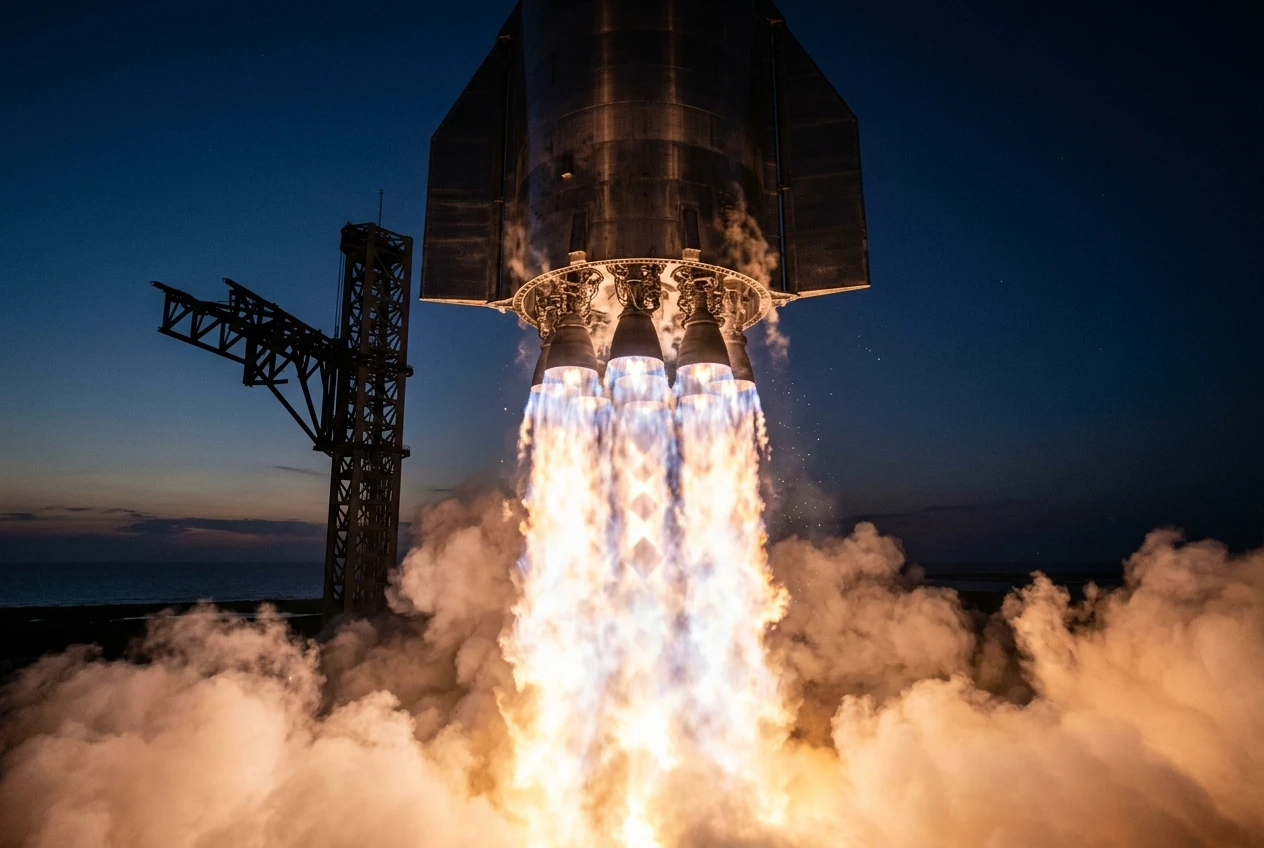
SpaceX will try again as soon as July 16 to fix the booster failure that sent its rocket crashing into the Gulf at nearly 1,450 kilometers per hour (900 mph). Starship Flight 13 opens a 90 minute window at 6:45 p.m. Eastern from Starbase, Texas, and this time the upper stage will release 20 working Starlink V3 satellites instead of dummy weights.
It is also the first Starship test since SpaceX went public. A repeat of Flight 12’s booster failure would now land on the balance sheets of the retail investors who bought into the company’s initial public offering (IPO), not on an internal engineering log alone.
Booster 20 Chases a Fix for a Hard Splashdown
SpaceX completed a full duration static fire of Super Heavy Booster 20 on July 10, the last major test before flight. The company said the following day it is targeting the Flight 13 window, flying a similar 65 minute suborbital profile to Flight 12 on May 22, which was mostly successful despite some anomalies.
The biggest problem was the Super Heavy booster’s failure to make a controlled, soft splashdown in the Gulf of Mexico. SpaceX traced it to the ship’s engines igniting while still attached to the booster.
“At stage separation on Flight 12, slight differences in engine startup on the ship caused the directional flip of the booster to be off by approximately 90 degrees,” SpaceX said in its mission preview. Five Raptor engines failed to ignite for the boostback burn, cutting it short before the booster fell into the Gulf largely uncontrolled.
“The startup sequence has been modified to be more robust to timing variability and more reliably flip in the desired direction,” the company said, adding that Booster 20 “has hardware modifications to improve relight reliability, along with updates to engine alarms and aborts.” NASASpaceflight.com’s launch tracker called Booster 20’s test a marathon static fire over Starbase, running far longer than prior tests.
| Detail | Flight 12 (May 22) | Flight 13 (July 16 target) |
|---|---|---|
| Vehicles | Booster 19, Ship 39 | Booster 20, Ship 40 |
| Payload | 22 Starlink mass simulators | 20 functioning Starlink V3 satellites |
| Booster outcome | Hard splashdown at about 900 mph | Soft splashdown targeted, no catch confirmed |
| Ship outcome | Controlled splashdown, Indian Ocean | Same suborbital arc, Indian Ocean targeted |
| In-space Raptor relight | Skipped after an ascent engine loss | Attempted again on Ship 40 |
Twenty Working Satellites Replace the Dummy Weights
Every prior V3 test carried mass simulators standing in for Starlink hardware. Flight 13 changes that. The ship will deploy 20 functioning Starlink V3 satellites, SpaceX’s first attempt at delivering real, revenue-generating payload on the new vehicle.
The satellites will go through a short but real checkout sequence before reentering with Starship minutes later.
- Separate from Starship and extend solar arrays and antennas
- Attempt contact with a ground station in South Africa
- Try inter-satellite laser links with the working Starlink constellation
- Reenter and burn up within minutes on the same suborbital arc as Starship
The window is brief because the satellites share Starship’s suborbital trajectory rather than reaching a stable orbit of their own, so any live network demonstration has to happen fast before reentry.
A Public Company Faces Its First Real Booster Test
SpaceX completed the largest initial public offering in history on June 12, raising roughly $75 billion at a $1.77 trillion valuation when shares began trading on Nasdaq under the ticker SPCX, Tech Times reported. Shares closed up 19% on the first day and added further gains the following Monday, per the outlet’s account.
Tech Times noted that hundreds of thousands of retail investors bought into that offering, and that Elon Musk holds roughly 85% of voting power despite owning about 42% of the equity, a structure that concentrates control even as public money rides on results like Flight 13.
Wall Street is not united on what that stock is worth.
- James Ratzer of NewStreet Research set a $165 price target, citing a launch capability lead he pegs at more than a decade, while cautioning the valuation only works out over a 20 to 25 year horizon.
- Morgan Stanley set a target near $300, nearly double Ratzer’s figure, a spread wide enough that a $300 target that splits six banks covering the stock.
A single booster test result will not settle that 25 year debate either way. But Flight 13 is one of the few near-term data points that can move the argument in either direction, which is exactly why it draws more attention than a routine test flight otherwise would.
The Artemis Clock Ticks Beside a New Rival
NASA restructured its Artemis program in February, redesignating Artemis III as a crewed Earth-orbit docking demonstration planned for late 2027 rather than a lunar landing. Artemis IV, now the program’s first planned crewed landing, targets early 2028. Both timelines assume Starship reaches orbital, human-rated status well before then.
NASA’s Office of the Inspector General flagged in a March report that Starship has not yet achieved orbital flight, in-space propellant transfer, or an uncrewed lunar landing demonstration, all listed as prerequisites for Artemis IV. The in-space Raptor relight Flight 13 is attempting underlies each of those milestones, since every orbital departure, transfer, or lunar approach depends on an engine that can restart cleanly in a vacuum.
Getting to an orbital operational status here this year is extremely important.
Don Platt, an aerospace expert at Florida Tech, told WFTV that the stakes reach beyond Starbase, tying orbital readiness to plans for flying Starship from Florida and to next year’s Artemis III mission. The company’s next big technical gate, the orbital refueling milestone still ahead, cannot begin until a V3 ship holds a stable orbit.
Tech Times also reported that on July 10, the same day Booster 20 fired its engines, China’s Long March 10B rocket landed its first stage after an orbital launch for the first time, narrowing the reusable launch lead SpaceX has held since 2015. That detail has not been widely corroborated elsewhere, but it frames Flight 13 as a test running against a clock that includes more than just NASA’s.
Seven Mishaps and Counting
One factor in the timing of Flight 13 is a mishap investigation the Federal Aviation Administration (FAA) ordered after Flight 12. As of July 10, the FAA had not announced that the investigation was complete. Some trade coverage this week suggested the review was effectively wrapping up, pointing to FAA advisories clearing pad operations for a mid-July window, but the agency had issued no public statement closing the case.
That grounding order landed within days of what was then billed as a $1.75 trillion stock listing, producing the mishap investigation ordered days before its IPO as its own headline separate from the technical story.
This is not new territory for the program. Yahoo News reported that Starship and Super Heavy have drawn seven separate FAA mishap investigations to date, four of which required corrective actions, including one that alone demanded 17 fixes before flights could resume. The agency has said it will oversee SpaceX’s investigation, participate at every stage, and approve the final report before granting clearance.
Flight 14 Already Has a Ship Waiting
Even before Booster 20 leaves the pad, SpaceX is working on what comes after it. Ship 41, built for Flight 14, is already undergoing its own testing at Starbase alongside Flight 13’s final preparations, according to trade coverage of the pad schedule. A launch date that FAA advisories once pointed to as July 14 slipped through July 15 before SpaceX settled on July 16, and a launch date sliding through mid-July was tracked in near real time by independent launch watchers.
Gwynne Shotwell, SpaceX’s president and chief operating officer, has said the company is targeting roughly one Starship launch a month, with hopes of reaching full orbital injection on Flight 14 and eventually expanding launches to a new pad at Kennedy Space Center in Florida. Flight 14 is widely expected to attempt the program’s first V3 booster catch since the redesign began; no catch attempt is confirmed for Flight 13, which is expected to repeat the Gulf splashdown instead.
The 90 minute window opens at 6:45 p.m. Eastern on July 16, and this time SpaceX needs Booster 20 to behave the whole way down.
Frequently Asked Questions
When Is SpaceX Launching Starship Flight 13?
The primary target is a 90 minute window opening at 6:45 p.m. Eastern (5:45 p.m. Central) on July 16 from Pad 2 at Starbase, Texas. FAA advisories had earlier pointed to July 14 and then July 15 before SpaceX settled on the later date, so another short slip remains possible if weather or last minute checks intervene.
How Many Starlink Satellites Will Flight 13 Carry?
Twenty functioning Starlink V3 satellites, replacing the mass simulators flown on earlier tests. Six of the satellites carry cameras specifically to photograph Starship’s heat shield during flight, continuing an imaging effort that began on Flight 12.
What Went Wrong on Starship Flight 12?
The Super Heavy booster failed to relight enough engines for its boostback burn after five Raptors did not ignite, and only a single engine lit during the failed landing burn attempt before the booster broke apart on impact with the Gulf. The Starship upper stage, by contrast, reached its planned suborbital trajectory and completed a controlled splashdown in the Indian Ocean.
Will Starship Attempt an Orbital Flight This Time?
No. Gwynne Shotwell has confirmed Flight 13 will repeat Flight 12’s roughly 65 minute suborbital profile rather than attempt orbit. SpaceX has pointed to Flight 14 as the mission most likely to attempt full orbital injection.
Will Booster 20 Try a Tower Catch?
No catch attempt has been confirmed for Flight 13. SpaceX plans another Gulf of Mexico splashdown for Booster 20, with the program’s first V3 catch attempt expected to wait for Flight 14.


Halo Campaign Evolved Skulls Meet Death Barriers That Kill the Hunt

Spotify Running Mode Returns After the 2015 Experiment Failed

Amazon AWS Hits Fastest Growth in Years as AI Spend Pays Off

Amazon Bets Platform Beats Models in the AI Race

Apple C2 Modem Edges Into iPhone 18 Pro After Qualcomm Drop

Google Earth Adds Nano Banana 2 to Reimagine Real Places

Apple Upgrade Turns Phones Into Monthly Utility Bills

Asha Sharma Bets Xbox Growth on Console and Four C’s

MacBook Ultra Design Follows Apple’s Familiar Cascade Path

TAG Heuer Carrera x Team Ikuzawa Revives 1970s Roadmaster Stopwatch DNA

Pokémon GO Developer Niantic Rebrands as Scopely Explore

Jaylen Brown Traded to 76ers for Paul George and Four Draft Picks

Doom Studio id Software Cuts Half Its Staff in Xbox Layoffs

Nintendo Switch Online Adds Four Classics and One Japan-Only Title

Jordan Henderson Hospitalized After Wrist Injury at the Azteca

Mexico’s World Cup Run Ends at Azteca as England Hold On 3-2

Meta’s Muse Image Lets Anyone Use Your Instagram Photos in AI

Louis Vuitton Beats Molly Tea in China, Triggers Cultural Backlash

Pink Bearista Cup Returns July 13 as Starbucks Pink Vibes Drops

Samsung Sets Galaxy Unpacked for July 22 in London With a Wider Fold
-

 TECHNOLOGY3 years ago
How to Adjust a Bulova Watch Band – An Easy Guide
-

 News3 years ago
Fred Pentland: Athletic Bilbao’s English mentor who changed the essence of Spanish football
-

 FINANCE3 years ago
Tax Planning for Every Season: Guide to Maximizing Your Tax Benefits
-

 Education3 years ago
African Ministers New Education Plan
-

 BUSINESS3 years ago
What is Entrepreneurial Operating System? A Comprehensive Guide to EOS
-

 Education3 years ago
Innovate Your Learning Journey with Technology and Enhance Education
-

 News3 years ago
Russians formally out of World Athletics Championships
-

 BUSINESS3 years ago
Top 9 Most Expensive American Cities to Rent an Apartment