
FINANCE
Stocks Hit Records as the Strait of Hormuz Oil Threat Builds

All three major U.S. stock indexes closed at records on Monday, and by early Tuesday the futures tied to them were already sliding. The S&P 500 finished at 7,599.96, its ninth consecutive up week and the first such streak since December 2023, carried by an artificial intelligence (AI) rally that has shrugged off almost everything thrown at it. Then S&P 500 futures slipped 0.37% and Nasdaq 100 futures shed 0.55% ahead of the Tuesday open, with Dow futures down 212 points.
The variable the screens were not pricing sat in the oil market. Brent crude jumped more than 6% toward $97 a barrel after Iran said it would stop exchanging messages with Washington and move to fully block the Strait of Hormuz. For nine weeks the rally has absorbed that kind of headline without blinking. The question now is how much longer it can.
Nvidia and HPE Did the Heavy Lifting
Monday’s records had two clear engines. Nvidia, the chipmaker at the center of the AI build-out, climbed 6.2% to $224.27 after chief executive Jensen Huang used a Computex keynote in Taiwan to push the company into personal computers. The new RTX Spark superchip, built around an N1X processor designed with Microsoft, is set to ship in the fall inside Windows laptops from Dell, HP, ASUS, Lenovo and MSI. The move lifted Nvidia’s market value to roughly $5.47 trillion and reset expectations for whether its growth story can travel beyond the data center.
The second engine arrived after the closing bell. Hewlett Packard Enterprise (HPE), the Texas-based server and networking maker, surged more than 27% in extended trading on a quarter that beat the Street by the widest margin since 2018.
HPE posted $10.68 billion in revenue, up 40% from a year earlier, against the roughly $9.8 billion analysts had modeled. Adjusted earnings of 79 cents a share blew past the 53 cents expected, and management lifted full-year earnings-per-share (EPS, profit per share) guidance to a range of $3.35 to $3.45, far above its prior $2.30 to $2.50. You can read more in our coverage of HPE’s record quarterly beat and AI server demand.
Not everyone won on the same news. Nvidia’s PC push rippled straight through the chip group.
| Stock | Monday move | Driver |
|---|---|---|
| Nvidia | +6.2% | New RTX Spark PC chip unveiled at Computex |
| Arm Holdings | +17% | Arm-based design at the core of the chip |
| HPE | +27% (after hours) | Record Q2 beat, raised full-year guidance |
| Intel | -3.7% | New competitive threat in PC silicon |
| Qualcomm | -7.3% | Arm-PC turf encroached on |
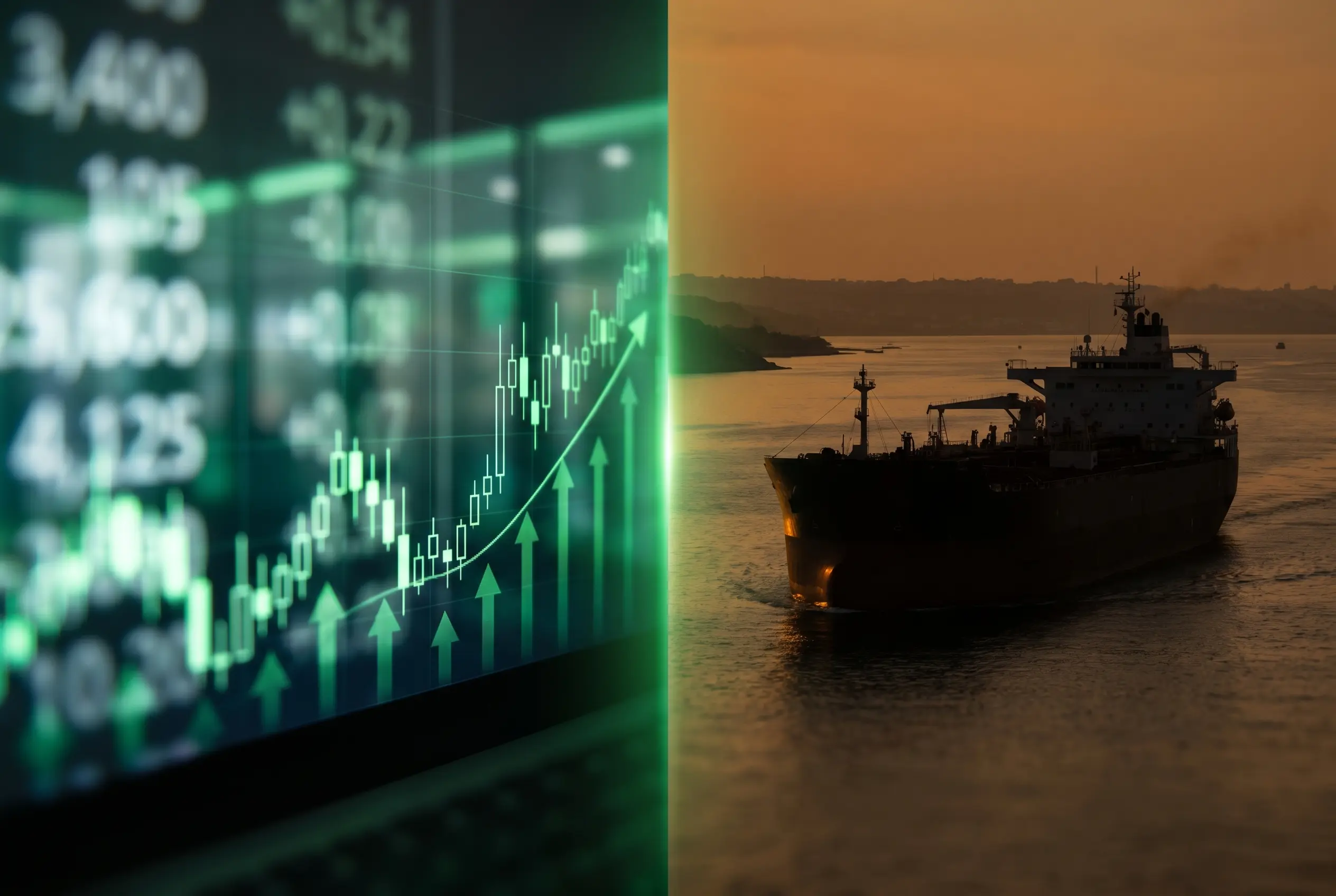
Brent Crept Toward $100 While Screens Stayed Green
While equity traders chased chips, the energy desk was reading a different story. Oil climbed Monday after Iran’s state-affiliated outlet Tasnim reported that the country’s negotiators would stop passing messages to the United States through intermediaries. The same report said Tehran would move to fully block the strait, and that “no dialogue will take place” until Israel halts all attacks in Lebanon and Gaza and withdraws from occupied areas in Lebanon.
The political signals were mixed, which is part of why stocks held. President Donald Trump told CNBC in a phone interview that he “couldn’t care less” whether peace talks with Iran were over. Hours later he posted that he had held “a very productive call” with Israeli Prime Minister Benjamin Netanyahu, and in a separate post said talks with Iran were “continuing, at a rapid pace.”
Markets chose to believe the second message. Brent settled near $97 a barrel, up more than 6%, yet the S&P 500 still printed a record close because a rotation into technology more than offset the drag from higher crude. That gap, between an oil market pricing escalation and an equity market pricing momentum, is the tension underneath Tuesday’s softer futures.
One-Fifth of the World’s Oil Passes Through Hormuz
The reason an oil-tanker headline can outrank a record close is geography. The waterway between Iran and Oman is the busiest oil artery on Earth, and there is no easy way around most of it.
- 20 million barrels a day moved through the channel in 2024, about 20% of all the petroleum the world consumes, according to the U.S. Energy Information Administration (EIA, the federal energy statistics agency).
- That flow is more than one-quarter of total global seaborne oil trade.
- China, India, Japan and South Korea took a combined 69% of the crude that passed through, making Asia the most exposed region by far.
- The United States imported only about 0.5 million barrels a day through the route, roughly 2% of its consumption.
- Saudi and Emirati pipelines can divert only about 2.6 million barrels a day around the strait, a fraction of what flows through it.
The math explains why the shock is lopsided. The U.S. economy is largely insulated on physical supply, but oil is a global price, so a blockade that strands Asian cargoes still feeds straight into American gasoline costs and inflation expectations. The EIA’s full breakdown of the Strait of Hormuz oil transit chokepoint shows how few alternatives exporters actually have once the lane closes.
Nine Up Weeks, and a Narrow Bench
Strip away the daily noise and two facts define this market. The streak is genuinely rare, and the leadership is genuinely thin. The S&P 500 has logged only a handful of nine-week winning runs since 1945, and a small cluster of AI-linked names, semiconductors, memory, servers and data-center suppliers, has done most of the lifting this time.
That concentration is the part bulls and bears actually agree on. It is why the index can keep climbing through an oil scare, and it is why a reversal in those same few stocks would hurt more than a broad pullback. Katie Stockton, founder of research firm Fairlead Strategies, told CNBC’s “Closing Bell” on Monday that momentum was still pointing higher across every time frame, with no confirmed sell signal yet. Her caveat was the warning.
These run-ups are really explosive. Unfortunately, that also means they tend to end in dramatic fashion, but we don’t have indications yet, any confirmed sell signals from our overbought oversold metrics to suggest that this is over.
Stockton, speaking on CNBC’s “Closing Bell” on Monday afternoon, pointed to a series of “flag pattern” breakouts, sharp advances followed by brief pauses that then resolve higher. The setup keeps the trend alive. It also leaves little cushion if a single catalyst, say a hard close of the strait, flips the tape.
Asia Gave the First Read
Because Asian buyers absorb the bulk of Hormuz crude, the region usually reacts to a blockade threat before Wall Street wakes up. It did again on Tuesday, trading mostly lower while U.S. futures were still digesting Monday’s records.
- Japan’s Nikkei 225 fell 1.32% and the Topix lost 1.14%.
- South Korea’s Kospi dropped 1.92%, and the small-cap Kosdaq slid 3.13%.
- Australia’s S&P/ASX 200 declined 0.71%.
- Hong Kong’s Hang Seng edged up 0.13%, while mainland China’s CSI 300 added 0.1%.
The South Korean selloff is the one to note, since Korea runs heavily on imported crude and its exporters carry the most direct energy sensitivity. This is the same pattern that played out earlier in the crisis, when Asian indexes tumbled on fresh U.S. strikes in Iran and the Kosdaq led the region lower.
What Separates a Dip From a Top
Tuesday brings its own small tests before the larger one. Dollar General, Victoria’s Secret and Signet Jewelers report earnings before the bell, and traders get April’s reading on the Job Openings and Labor Turnover Survey (JOLTS, the government’s gauge of unfilled positions). None of those will move the index the way a barrel of crude can right now.
The honest read is that the rally has earned its momentum and the risk has earned its respect, and the two are pointing in opposite directions. If Brent settles back as the diplomatic noise cools, the ninth up week becomes the tenth and the AI names keep setting the tape. If the strait stays shut and crude pushes through $100, the same momentum that ignored every headline finally meets the one it cannot.












Spotify Running Mode hits Android and revives its old tempo experiment

Galaxy Tab S12 Ultra Renders Keep the Notch Fans Hate

Novato Spinning Round House Sells With Six Neighbors for $3.3 Million

Crop Tour Finds Indiana and Nebraska Corn Yields Lagging 2025

Best Buy 60th sale brings Android deals back to its roots

American Airlines reverses seatback screen bet years too late

Iran Hormuz Strikes Force Gulf Oil Onto Costlier Paths

Plague Tale Prequel Day One Joins Game Pass Wave 2 as Witcher Exits

NBA 2K27 opens The City to everyone and rewrites career eras

iOS 26.6.1 Patches 29 Flaws as AI Forces Faster Apple Updates

Double Fine Cuts 23 Jobs Weeks After Xbox Independence

Day-One Big Walk Lifts PS Plus August Beyond Recycled AAA

John Hight Exits Wizards After Digital Reckoning Hits

Curtis Mead’s Red Sox Debut Ends With Fractured Wrist

Moesch and Dressel Rewrite Night One at 2026 U.S. Nationals

Red Sox Squander Hot Streak Chance in 4-3 Loss to Athletics

Boutte’s Quiet Camp Takeover Forces Patriots Receiver Choices

Take-Two CEO Pushes Netflix Subs for GTA 6 Extended Look

Halo Campaign Evolved Skulls Meet Death Barriers That Kill the Hunt

Wildlands Free Update Hands Players the Tools They Already Invented
-

 TECHNOLOGY3 years ago
How to Adjust a Bulova Watch Band – An Easy Guide
-

 News3 years ago
Fred Pentland: Athletic Bilbao’s English mentor who changed the essence of Spanish football
-

 FINANCE3 years ago
Tax Planning for Every Season: Guide to Maximizing Your Tax Benefits
-

 Education3 years ago
African Ministers New Education Plan
-

 BUSINESS3 years ago
What is Entrepreneurial Operating System? A Comprehensive Guide to EOS
-

 Education3 years ago
Innovate Your Learning Journey with Technology and Enhance Education
-

 News3 years ago
Russians formally out of World Athletics Championships
-

 BUSINESS3 years ago
Top 9 Most Expensive American Cities to Rent an Apartment