
BUSINESS
Tyson’s Five-Year Utah Plant Falls to Cattle Shortage Reckoning
Tyson Foods will shut its five-year-old Eagle Mountain case-ready plant by mid-October, cutting 723 jobs as the U.S. cattle herd hits multi-decade lows.

Tyson Foods will close its Eagle Mountain, Utah, case-ready meat facility around Oct. 12, cutting 723 jobs at a plant that opened only five years ago after a $300 million build. The company cited a historic U.S. cattle shortage as it restructures its beef network.
The same announcement ends operations at the much larger Joslin, Illinois, beef plant and seeks a buyer for the Pasco, Washington, facility. Capacity shifts to older core sites while workers in a fast-growing Utah County suburb face abrupt unemployment.
A Plant Built for Western Growth Lasted Five Years
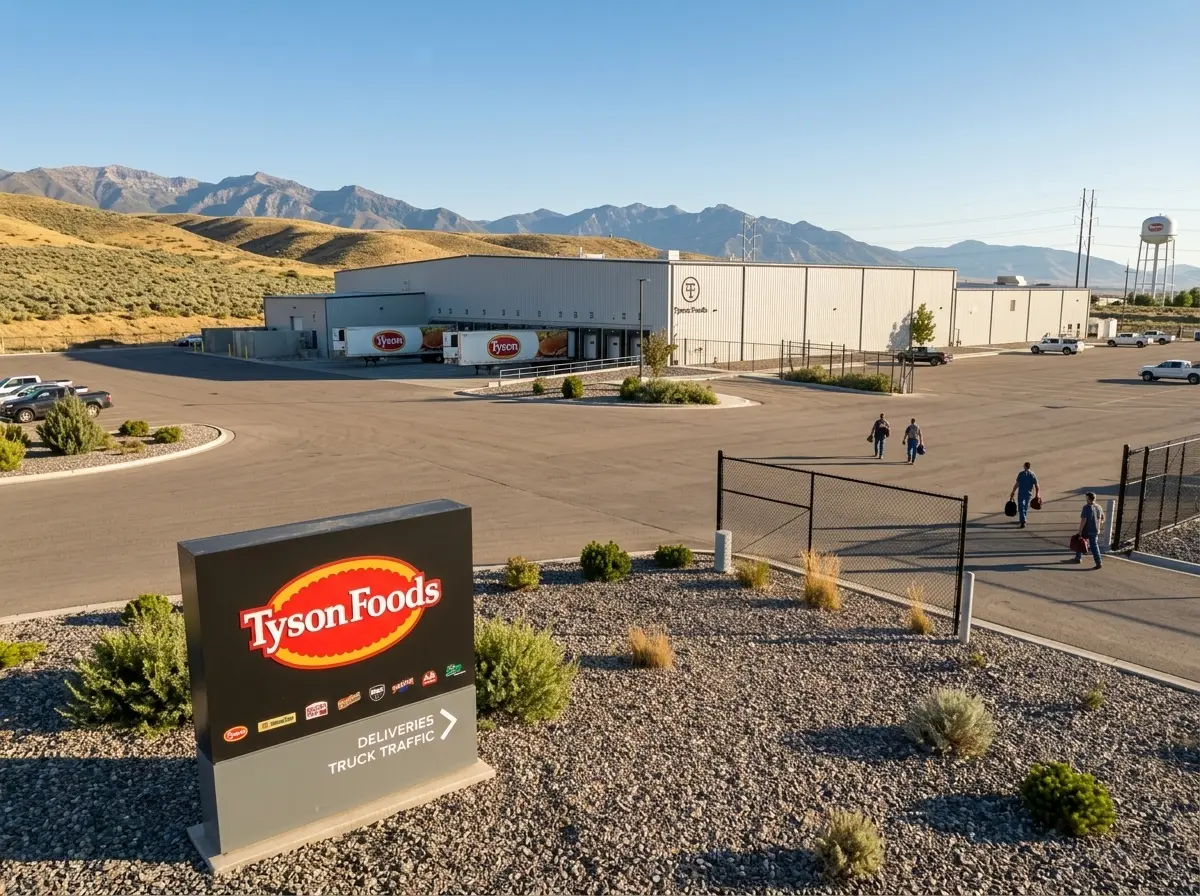
Tyson broke ground on the Eagle Mountain site as a bet on rising demand for retail-ready beef and pork in the West. The company described a $300 million case-ready plant investment that would employ 800 workers at start and expand toward 1,200, with a projected $44 million annual local payroll.
The facility at 3817 N. Tyson Parkway took large sub-primal cuts and turned them into steaks, chops, roasts and ground meat already trayed and labeled for grocery shelves. It performed no livestock slaughter. Operations began in 2021.
- Original pitch: fourth case-ready site after Texas, Iowa and Tennessee plants
- Target: meet western U.S. fresh protein demand without long-haul finished product
- Community framing: industrial park jobs plus infrastructure upgrades
That model assumed steady upstream supply of sub-primals from harvest plants. Without slaughter on site, every trayed steak and labeled roast depended on cattle first moving through the wider beef network. When that network tightens, a case-ready plant has little to process.
Marydel Lewis, an Eagle Mountain resident who has worked there since opening day, expected a five-year anniversary bonus. Instead she received notice of the “difficult decision” to close. “I’m really heartbroken right now,” she told KSL. “It’s hard to take in. It’s like, is it true?”
The gap between the original staffing pitch and the closing headcount is itself a marker of how far plans drifted. The plant never reached the upper employment target before the network decision arrived.
The Herd Numbers Behind the Decision
USDA data show the cattle cycle remains deep in contraction. On Jan. 1, 2026, the U.S. cattle inventory at 86.2 million head marked a 75-year low, down 300,000 head from the prior year. Beef cows that had calved stood at 27.6 million, the lowest since 1961. The 2025 calf crop hit another record low.
A mid-year July count put total cattle and calves at 94.2 million, the lowest July figure in data back to 1973. Drought across key grazing regions, elevated feed and interest costs, and strong slaughter prices earlier in the cycle encouraged ranchers to liquidate rather than retain heifers for rebuilding.
Snapshot of the shortage
- 86.2 million, all cattle and calves, Jan. 1 2026 (75-year low)
- 27.6 million, beef cows that have calved (lowest since 1961)
- Record-low calf crops two years running
- Year 8 of herd contraction inside a longer cycle
Replacement heifer numbers ticked up slightly, a possible early signal of rebuilding, yet any meaningful expansion still sits years away. Packers face higher cattle costs and thinner throughput. Tyson earlier widened its fiscal 2026 beef operating-loss forecast to as much as $650 million.
Those loss figures explain why a five-year-old plant can still be first on the list. Fixed costs stay high when lines run short of cattle. Newer case-ready capacity, built for growth that has not yet returned, becomes easier to idle than older harvest sites the company wants to keep fully loaded.
Three Closures and a Tighter Core Network
In its Aug. 13 release, Tyson said it would anchor its beef business around three facilities in the central United States: Dakota City, Nebraska; Holcomb, Kansas; and Amarillo, Texas. The company plans to restore a second shift at Amarillo once more cattle become available.
| Facility | Type | Action | Jobs Impact |
|---|---|---|---|
| Eagle Mountain, UT | Case-ready | Close ~Oct. 12 | 723 |
| Joslin, IL | Beef harvest/processing | End operations | ~2,500 |
| Pasco, WA | Beef | Pursue sale | Not specified |
| Amarillo, TX | Beef | Add second shift later | Growth potential |
Capacity from the closed sites moves to the remaining network. Tyson said the changes let it maintain similar overall harvest levels on a more efficient footprint “amidst one of the most historic cattle shortages the country has ever experienced.”
Company statement: “Tyson Foods recognizes the impact these decisions have on team members and communities. The company is committed to supporting our team members through this transition, including helping them apply for open positions at other facilities.”
The geography of the surviving core is deliberate. Nebraska, Kansas and Texas sit closer to the remaining cattle concentrations than a Utah case-ready satellite or a Washington plant now headed for sale. Concentrating volume there is how the company plans to protect harvest levels while cutting the number of roofs it must keep staffed.
Workers and the City Scramble for a Soft Landing
I’m really heartbroken right now. We thought we were going to get a bonus because it’s our five-year anniversary.
Marydel Lewis, Eagle Mountain resident and plant employee since 2021, said the notice landed hard. She is already looking for new work and worried about covering expenses.
Abby Ivory, Eagle Mountain economic development director, called the city “really concerned.” Officials are coordinating with the state and Tyson on transition help that goes beyond job placement to short-term family hardships. Utah Department of Workforce Services tracks these events through Utah WARN notices for mass layoffs, which trigger rapid-response services.
Kelly Pehrson, Utah commissioner of Food and Agriculture, linked the closure directly to national herd weakness driven by drought, fires, a closed border for some cattle movements, and high feed costs. He noted the $300 million investment had been a genuine community asset and said the episode underscores the value of local food production. The state is advancing a food-security grant program, yet that does little for the 723 workers in the near term. “It’s very sad,” Pehrson said.
For a fast-growing suburb, the sudden loss of a large private payroll lands on housing costs, school planning and local retail at the same time. Transition help can soften the first months. It cannot replace the $44 million annual payroll the plant was once projected to deliver.
Ranchers See Record Prices While Packers Bleed
The same tight supplies that idle packing lines have lifted prices paid to cattle producers. Fed cattle have set successive records; ground beef at retail has also climbed. For ranchers who kept animals through the drought years, the cycle finally pays. For integrated packers with high fixed costs, the math turns negative when plants run below efficient capacity.
Observers on X and in ag circles note that large packers spent years exercising leverage over feeders. Now the herd is simply too small to feed every facility. Communities that landed new plants during the expansion phase discover they absorbed the cyclical risk. Trucking, feed, local retail and school enrollment all feel the secondary pull when hundreds of paychecks stop at once.
The pattern echoes earlier Tyson moves, including a prior Kansas plant closure tied partly to cattle availability. Broader labor reports already flag signs of deeper labor market softness even before sector-specific shocks. Manufacturing cuts on the scale of large-scale manufacturing job reductions elsewhere show how quickly industrial payrolls can shrink when demand or inputs shift.
In short, high cattle prices and idle plant capacity are two sides of one inventory problem. Ranchers capture the scarcity premium. Packers carry the empty-hook cost until the footprint shrinks to match the herd.
Utah’s Food Ambitions Meet National Supply Reality
Pehrson and local leaders frame the episode as a reminder that Utah still depends heavily on national protein supply chains. Case-ready capacity located inside the state looked like progress toward shorter, more resilient lines. When the upstream herd contracts, that capacity becomes stranded assets.
Eagle Mountain itself is a rapidly growing suburb. Losing one of its larger private employers tests the economic-development model that courts big industrial projects. Transition services, unemployment claims, and any retraining programs will occupy city and state staff for months. Some workers may relocate to remaining Tyson sites; many will stay and re-enter a local market that suddenly has more job seekers than openings in comparable roles.
Beef production forecasts already point lower for 2026 even as imports fill part of the gap. Consumer prices stay elevated. Herd rebuilding, if it takes hold, requires successive years of heifer retention and favorable weather. Until then, packers will keep matching footprint to available animals.
How the Timeline Ran From Buildout to Exit
The Eagle Mountain story compresses a full cattle cycle into a short local arc. The same years that brought a western case-ready bet also deepened the national herd contraction that later undid it.
- 2021: Operations begin at the $300 million Eagle Mountain case-ready plant, pitched for western retail demand and hundreds of local jobs.
- Mid-cycle years: Drought, high feed and interest costs, and strong slaughter prices push ranchers to liquidate rather than rebuild, extending herd contraction into year 8.
- Jan. 1, 2026: U.S. cattle inventory hits 86.2 million head, a 75-year low, with beef cows at 27.6 million, the lowest since 1961.
- July 2026: Total cattle and calves stand at 94.2 million, the lowest July figure in data back to 1973.
- Aug. 13, 2026: Tyson announces the network restructuring, Eagle Mountain closure, Joslin shutdown, Pasco sale effort, and a tighter three-plant beef core.
- ~Oct. 12, 2026: Eagle Mountain lines stop and 723 jobs end.
Each step follows from the one before it. A plant built to shorten western supply lines still needed cattle somewhere upstream. When the national count fell to multi-decade lows, the newest satellite became surplus.
Why the Central Plants Keep the Volume
Tyson’s surviving beef anchor points share a practical advantage the closed and sale-bound sites lack. Dakota City, Holcomb and Amarillo sit inside the central corridor where remaining cattle are more readily assembled. Restoring a second shift at Amarillo later is a bet that any recovery in animals will show up first in that lane.
Eagle Mountain never slaughtered. It only finished and packaged product that began as live cattle elsewhere. Joslin’s much larger harvest and processing workforce of about 2,500 shows what full-scale kill capacity looks like when it is removed. Pasco, still seeking a buyer, faces the same tight-cattle math that prompted Tyson to walk away.
- Core keepers: Dakota City, Holcomb, Amarillo
- Direct closures: Eagle Mountain case-ready and Joslin harvest and processing
- Sale path: Pasco beef facility
- Later growth lever: second shift at Amarillo when cattle allow
Moving volume onto fewer floors lets the company chase similar overall harvest levels without paying to staff every building it opened in better times. The $650 million fiscal 2026 beef operating-loss ceiling is the balance-sheet pressure behind that choice. Efficiency here means fewer plants running closer to capacity, not more plants waiting on a herd that is still years from meaningful rebuild.
Communities that won projects during expansion now carry the contraction. The western growth thesis was real when the plant was announced. The inventory numbers simply moved faster than the local payroll could adapt.
What the October Deadline Leaves Behind
By mid-October the Eagle Mountain lines stop. The 723 notices become final. Tyson’s remaining beef plants absorb the volume that still exists. Joslin’s larger workforce faces the same calendar. Pasco’s future depends on finding a buyer who sees value in a tight-cattle environment.
For Lewis and her coworkers the immediate task is practical: new applications, benefits paperwork, family budgets. For Eagle Mountain the task is cushioning a sudden payroll hole. For the broader industry the reckoning is structural. A multi-year liquidation that rewarded ranchers with high prices is now forcing packers to shrink the very capacity built during better times. The cattle cycle has simply moved on, and the newest western plant is among the first casualties.


Sony and Warner Sue Anthropic Over Torrented Song Lyrics

Microsoft 365 Auth Fault Took Down Exchange and Teams

Honor’s Robot Phone Works, Then Prices Itself Out

Florida Cities Top Retirement Rankings the Scores Cannot Explain

Walmart’s $50 Million Opioid Settlement Closes Case Without Admission

California Sues Over $120 Million Morro Bay Wind Lease Buyout

Gilead Bixlenvo FDA Nod Opens Single Pill Path for Complex HIV Cases

Meta’s $18B Kids Deal Forever Shields Data Used to Spot Under-13s

Lettuce Outbreak Drove Record Cyclospora Spike Across 20 States

Amazon Shaves $20 Off M6 Mac Mini Before It Even Ships

Take-Two CEO Pushes Netflix Subs for GTA 6 Extended Look

Quake Gets 19 Free Maps From MachineGames Quake Club

Destiny 2 Fans Unlock Vaulted Maps After Live Service Ends

Wildlands Free Update Hands Players the Tools They Already Invented

Stripe Bid Shows PayPal Moat Cracked After Years of Slide

Quordle Monday Delivers Gavel Crush Speed Ethos Cleanly

Tyson’s Five-Year Utah Plant Falls to Cattle Shortage Reckoning

Silver Lake Workday Talks Signal Private Floor for Software

Kennedy Lewis Takes Majority Control of The Greenbrier in $500M Deal

Best Buy Marks 60 Years With Sale That Echoes Its Audio Shop Roots
-

 TECHNOLOGY3 years ago
How to Adjust a Bulova Watch Band – An Easy Guide
-

 News3 years ago
Fred Pentland: Athletic Bilbao’s English mentor who changed the essence of Spanish football
-

 FINANCE3 years ago
Tax Planning for Every Season: Guide to Maximizing Your Tax Benefits
-

 Education3 years ago
African Ministers New Education Plan
-

 BUSINESS3 years ago
What is Entrepreneurial Operating System? A Comprehensive Guide to EOS
-

 Education3 years ago
Innovate Your Learning Journey with Technology and Enhance Education
-

 News3 years ago
Russians formally out of World Athletics Championships
-

 BUSINESS3 years ago
Top 9 Most Expensive American Cities to Rent an Apartment