
BUSINESS
Walmart’s $50 Million Opioid Settlement Closes Case Without Admission
Walmart settles DOJ and DEA claims over invalid opioid prescriptions for $50 million it calls immaterial.

Walmart will pay $50 million to resolve U.S. Department of Justice and Drug Enforcement Administration claims that its pharmacies filled thousands of invalid opioid and controlled-substance prescriptions starting in 2013. The company admits no liability and has described the payout as immaterial in a regulatory filing.
The deal ends a civil case first filed in December 2020. It also locks Walmart into a memorandum of agreement that requires a new reporting hotline, active monitoring of dispensing patterns, and a process for reviewing suspect prescribers.
What the Settlement and DEA Deal Require
On August 28, 2026, the Justice Department and DEA announced the $50 million settlement and DEA memorandum. The claims resolved are allegations only; there has been no determination of liability.
Walmart said it is pleased to resolve the matter and will continue supporting the work its pharmacists do every day to provide patient care. Shares moved little after the news.
- $50 million cash payment to the government
- Hotline for employees and patients to report suspected illegal dispensing
- Proactive monitoring of pharmacy dispensing patterns
- Prescriber evaluation process for those suspected of illegal prescribing
The memorandum addresses future obligations under the Controlled Substances Act. Walmart operates nearly 4,600 pharmacies across the United States.
Cash closes the civil file. The memorandum keeps the company under ongoing federal expectations on how those pharmacies handle controlled substances day to day.
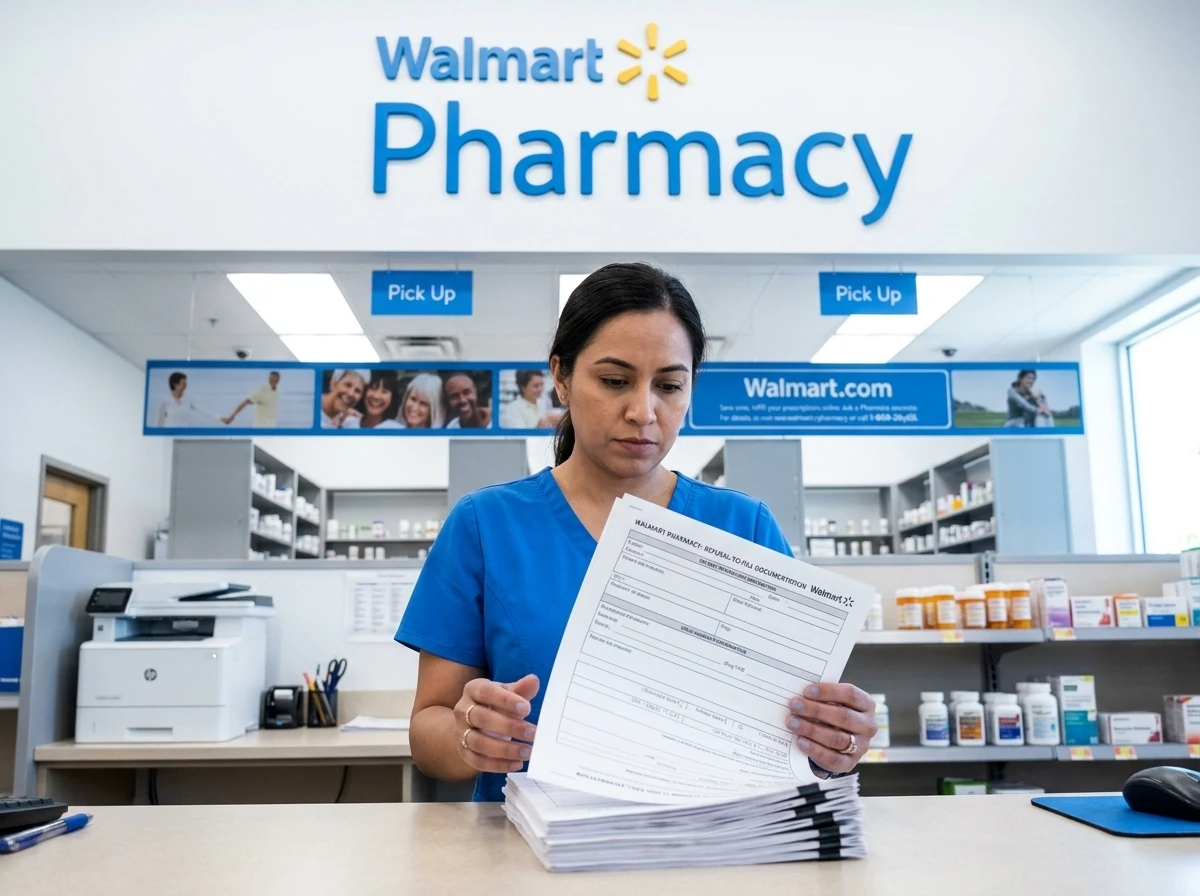
Pharmacists Flagged Problems That Compliance Set Aside
The complaint, filed December 22, 2020, in the U.S. District Court for the District of Delaware and amended in 2022, alleged violations dating to June 26, 2013. It said members of Walmart’s compliance team knew certain prescribers ran pill mills yet still filled those prescriptions.
Walmart’s own pharmacists submitted thousands of refusal-to-fill forms reporting the problems. The government said the compliance team prioritized other goals.
As one director on the compliance team acknowledged in an email, rather than analyzing the refusal-to-fill reports, the compliance team viewed “[d]riving sales and patient awareness,” as “a far better use of our Market Directors and Market manger’s time.”
Department of Justice complaint summary, DEA and DOJ releases
Pharmacists allegedly filled prescriptions they knew were invalid. Red flags included:
- Dangerous opioid and non-opioid cocktails
- Repeated early fill requests for frequently abused drugs
- High dosages of often-abused opioids
- Prescriptions from known pill-mill prescribers
A federal judge earlier narrowed parts of the case, dismissing some failure-to-report claims while leaving the knowing-invalid-fill theories intact.
That ruling shaped the remaining exposure. The surviving theories focused on fills the government said pharmacists recognized as improper, not solely on paperwork gaps around suspicious orders.
Refusal-to-fill forms created an internal paper trail. The complaint cast those forms as warnings that never produced the compliance response pharmacists expected when they flagged the same patterns again and again.
Earlier Pharmacy Settlements Ran Into the Billions
This federal closeout sits against a much larger backdrop. In 2022 Walmart agreed to pay $3.1 billion to resolve thousands of state, local and tribal lawsuits over its pharmacies’ role in the opioid crisis. That deal moved money faster than parallel CVS and Walgreens agreements.
| Company | Approx. Amount | Year / Type | Notes |
|---|---|---|---|
| Walmart | $3.1 billion | 2022 states/locals/tribes | Mostly front-loaded |
| CVS | ~$5 billion | 2022 states/locals | Over ~10 years |
| Walgreens | ~$5+ billion | 2022 states/locals | Longer payment schedule |
| Walmart | $50 million | 2026 federal DOJ/DEA | No liability finding |
Together the three pharmacy chains reached roughly $13 billion-plus in the 2022 wave. Manufacturers and distributors had already settled for tens of billions more. CDC figures put opioid-involved overdose deaths above 800,000 from 1999 through recent years, with annual counts still elevated even after a post-2022 decline.
The 2022 Walmart package stood out for speed of payment relative to the longer CVS and Walgreens schedules. The 2026 federal figure is a separate ledger line, aimed at the government’s own civil claims rather than state or local abatement funds.
Why the Federal Number Looks Small on the Ledger
When the Justice Department sued in 2020 it noted potential civil penalties of $67,627 for each unlawful prescription filled and $15,691 for each suspicious order not reported. Multiplied across thousands of scripts, the theoretical exposure ran into the billions.
Walmart’s net income for the six months ended July 31 reached about $11.79 billion. Against that base the $50 million payment registers as a rounding item, which is why the company labeled it immaterial. On X, reactions quickly noted the absence of any admission: the company paid and moved on.
The pattern fits other large corporate resolutions with the government. A recent example is another recent DOJ corporate settlement figure in a different context that also closed claims without rewriting the balance sheet.
Statutory maximums and negotiated cash rarely match. The complaint’s per-script figures explained why early headlines spoke in billions; the signed deal shows what both sides accepted to end the case without a liability finding.
| Measure | Figure |
|---|---|
| Civil penalty per unlawful prescription (as cited in 2020 suit) | $67,627 |
| Civil penalty per unreported suspicious order | $15,691 |
| Negotiated federal payment (2026) | $50 million |
| Walmart net income, six months ended July 31 | About $11.79 billion |
| 2022 state, local and tribal settlement | $3.1 billion |
New Rules Bind the Pharmacy Floor Going Forward
The cash is one-time. The memorandum of agreement is ongoing. Walmart must now run a hotline open to both staff and patients, watch dispensing data for illegal patterns, and maintain a formal path to evaluate high-risk prescribers.
Those steps sit on top of whatever internal controls the company already tightened after the 2022 state deals. With nearly 4,600 pharmacy locations, even small process changes touch millions of fills. The same retail pharmacy infrastructure that scaled insulin and Walmart pharmacy scale with GLP-1 programs now carries extra controlled-substance scrutiny.
DEA Assistant Administrator Cheri Oz said the settlement makes clear that pharmacies have a responsibility to identify and prevent unlawful dispensing. Filling illegitimate prescriptions puts patients and communities at risk, she said.
Associate Attorney General Stanley Woodward statement framed the outcome as proof the department puts Americans’ flourishing first and will not let potential profits justify aiding the opioid epidemic. The case was handled by the Civil Division Enforcement and Affirmative Litigation Branch together with several U.S. Attorney’s offices.
Proactive monitoring turns dispensing data into a compliance feed rather than a retrospective audit trail. The prescriber evaluation process gives the company a defined route when the same names keep surfacing in refusal reports or pattern alerts.
Patients, Pharmacists and the Next Prescriptions
For patients the practical change is the new hotline and tighter monitoring. Legitimate pain patients should see little difference if scripts clear red-flag checks. Prescribers already under scrutiny may face faster internal review at Walmart counters.
Pharmacists who once filled refusal-to-fill forms now have a formal external channel. Corporate compliance can no longer treat those reports as secondary to sales metrics without risking the new agreement.
Communities that absorbed the earlier state settlement money still wait for measurable abatement results. The federal $50 million does not flow to local treatment programs the same way; it closes the government’s own civil claim.
Walmart’s pharmacies remain open and filling scripts. The litigation chapter that began in the final weeks of the first Trump administration and continued through the Biden years is finished. The monitoring obligations are just starting.
The Case Stretched From 2013 to 2026
The public docket and agency releases mark a long arc from alleged conduct to cash resolution. Dates already on the record sketch how slowly a pharmacy controlled-substance case can move.
- June 26, 2013 – earliest conduct date cited in the federal complaint
- December 22, 2020 – DOJ files in the U.S. District Court for the District of Delaware
- 2022 – complaint amended; Walmart separately pays $3.1 billion to states, localities and tribes
- August 28, 2026 – DOJ and DEA announce the $50 million settlement and memorandum
More than seven years of alleged dispensing problems preceded the suit. Another five-plus years of litigation followed before the federal civil file closed.
Along the way a judge trimmed failure-to-report theories and left knowing-invalid-fill claims in place. That narrowing helped define what the 2026 payment actually resolved: allegations about fills, paired with forward-looking controls, not a full replay of every theory first pleaded in 2020.
The 2022 state deals and the 2026 federal deal answered different plaintiffs. One wave funded state, local and tribal claims; the other ended the United States’ own civil action and added DEA memorandum duties.
Monitoring Duties Reach Every Pharmacy Counter
Nearly 4,600 locations means the memorandum’s hotline, pattern watch and prescriber review are national systems, not pilot programs. A report filed in one store can inform review of a prescriber whose scripts appear in many others.
The hotline’s dual audience matters. Employees already used internal refusal-to-fill forms; patients now have a stated channel as well. That design widens the set of people who can surface the same red flags the complaint listed: cocktails, early fills, high opioid dosages and known pill-mill sources.
Oz’s remarks tied pharmacy responsibility to community risk. Woodward’s statement cast the outcome as a refusal to let profit goals excuse epidemic harm. Together they frame the memorandum as conduct insurance for the government after a payout the company calls immaterial.
Scale cuts both ways. The chain that can expand insulin access and GLP-1 bridge programs can also propagate a compliance rule set quickly. The open question is whether monitoring and prescriber evaluation change fill decisions at the counter as clearly as the settlement changed the docket.
- Hotline intake from staff and patients
- Ongoing review of dispensing pattern data
- Formal evaluation path for high-risk prescribers
- Obligations layered on controls built after the 2022 deals
Those tools do not reopen the closed civil claims. They set the baseline against which future Controlled Substances Act performance will be judged for this operator.
Frequently Asked Questions
What exact amount did Walmart agree to pay in the 2026 DOJ opioid settlement?
Walmart agreed to pay $50 million to resolve the federal allegations. The company described the amount as immaterial relative to its earnings and the settlement contains no determination of liability.
When was the original DOJ complaint against Walmart filed?
The government complaint was filed on December 22, 2020, in the U.S. District Court for the District of Delaware and was amended in 2022. It alleged conduct beginning June 26, 2013.
What new compliance steps must Walmart take under the DEA agreement?
Walmart must establish a hotline for employees and patients to report suspected illegal dispensing, proactively monitor pharmacy dispensing patterns, and create a process to evaluate prescribers suspected of illegal prescribing.
Did Walmart admit liability in the $50 million settlement?
No. The Justice Department and DEA releases state the claims resolved are allegations only and there has been no determination of liability. Walmart’s public statement expressed pleasure at resolving the matter without admitting wrongdoing.
How does the $50 million compare with Walmart’s earlier opioid settlements?
In 2022 Walmart agreed to pay $3.1 billion to settle state, local and tribal claims. The 2026 federal payment is roughly 1.6 percent of that earlier figure and far below the theoretical statutory penalties of more than $67,000 per unlawful prescription.


Walmart’s $50 Million Opioid Settlement Closes Case Without Admission

California Sues Over $120 Million Morro Bay Wind Lease Buyout

Gilead Bixlenvo FDA Nod Opens Single Pill Path for Complex HIV Cases

Meta’s $18B Kids Deal Forever Shields Data Used to Spot Under-13s

Lettuce Outbreak Drove Record Cyclospora Spike Across 20 States

Amazon Shaves $20 Off M6 Mac Mini Before It Even Ships

SpaceX Louisiana Port Tests Debt Markets on Orbital AI Scale

Microsoft High Lifts Indexes as Small Caps Crack Support

Apple Replays 2015 Saturday Midnight Preorder for iPhone 18 Pro

Updated COVID Shots Clear FDA but Access Friction Hits High-Risk Groups

Take-Two CEO Pushes Netflix Subs for GTA 6 Extended Look

Halo Campaign Evolved Skulls Meet Death Barriers That Kill the Hunt

Wildlands Free Update Hands Players the Tools They Already Invented

Destiny 2 Fans Unlock Vaulted Maps After Live Service Ends

Quake Gets 19 Free Maps From MachineGames Quake Club

Quordle Monday Delivers Gavel Crush Speed Ethos Cleanly

Stripe Bid Shows PayPal Moat Cracked After Years of Slide

Tyson’s Five-Year Utah Plant Falls to Cattle Shortage Reckoning

Silver Lake Workday Talks Signal Private Floor for Software

Kennedy Lewis Takes Majority Control of The Greenbrier in $500M Deal
-

 TECHNOLOGY3 years ago
How to Adjust a Bulova Watch Band – An Easy Guide
-

 News3 years ago
Fred Pentland: Athletic Bilbao’s English mentor who changed the essence of Spanish football
-

 FINANCE3 years ago
Tax Planning for Every Season: Guide to Maximizing Your Tax Benefits
-

 Education3 years ago
African Ministers New Education Plan
-

 BUSINESS3 years ago
What is Entrepreneurial Operating System? A Comprehensive Guide to EOS
-

 Education3 years ago
Innovate Your Learning Journey with Technology and Enhance Education
-

 News3 years ago
Russians formally out of World Athletics Championships
-

 BUSINESS3 years ago
Top 9 Most Expensive American Cities to Rent an Apartment