
News
Unitree’s 629% IPO Pop Puts a Public Price on Humanoid Hype
Unitree opened at 1,100 yuan after a $904 million raise, giving the humanoid sector its first public profitable benchmark against private rivals still.

Unitree Robotics shares opened at 1,100 yuan on Shanghai’s STAR Market on Wednesday, a 629% jump from the 150.80 yuan offer price, before easing toward 900 yuan. The Hangzhou firm raised about 6.1 billion yuan ($904 million) by selling 40.45 million new shares, valuing it near 61 billion yuan ($9 billion) at the IPO price and far higher on the open.
The debut makes Unitree the first pure-play humanoid robot maker listed on the Chinese mainland and hands the sector something it lacked: a daily public price on a company that already ships thousands of machines and turns a profit.
Shares opened six times the offer price
The stock, ticker 688836, hit 1,100 yuan at the open. That move turned a single lot of new shares into a paper gain of roughly 475,000 yuan for the few retail investors who won the lottery. Retail demand had already set a STAR Market record, with orders running more than 5,500 times the available shares and some tallies above 8,000 times.
Strategic buyers including DeepSeek, Tencent’s Qishan Investment and PetroChina’s Kunlun Capital took placements. The raise sits well above earlier plans that implied a valuation nearer $5.9 billion. Founder and CEO Wang Xingxing, 36, saw his stake push him into billionaire territory on the pricing alone.
- Offer price: 150.80 yuan per share
- Shares sold: 40.45 million (10% of enlarged capital)
- Amount raised: ~6.1 billion yuan ($904 million)
- Open: 1,100 yuan (+629%)
The first-day print measures excitement more than settled value. What lasts is the multiple that remains after the froth clears.
Even the pullback toward 900 yuan left the stock many times the offer. That gap between the lottery open and the later tape is the first public stress test of how much scarcity premium pure-play humanoid exposure can hold once early winners take profits.
The raise that valued a profitable shipper at nine billion
Unitree, officially Yushu Technology, reported 2025 revenue of roughly 1.7 billion yuan with gross margins near 60% and a net profit in the mid-to-high 200 million yuan range. It shipped more than 5,500 humanoid robots last year, more than any peer. By mid-2026 the cumulative humanoid delivery figure had climbed higher still.
First-quarter 2026 revenue rose more than 68% to 423 million yuan, yet adjusted net profit fell over 52% as R&D and sales spending climbed. That squeeze arrived just as the IPO machinery accelerated.
| Metric | Unitree 2025 | Context |
|---|---|---|
| Revenue | ~1.7 billion yuan | More than quadrupled year on year |
| Humanoid shipments | 5,500+ | World leader by volume |
| Gross margin | ~60% | Rare among pure humanoid peers |
| Post-IPO valuation at offer | ~61 billion yuan ($9B) | ~36 times sales |
At the offer price the company traded at roughly 36 times last year’s sales and more than 200 times earnings. The open stretched those multiples further. Private US rival Figure AI closed a round last year at a $39 billion mark with far fewer public shipment numbers and no comparable profit line.
The contrast is sharp. Unitree already posts volume, margin and a profit line. Figure’s private mark is higher in absolute dollars, yet it lacks the same disclosed shipment and earnings base. Investors pricing Unitree are paying for proof of scale, not only a roadmap.
The Q1 profit drop also shows the cost of staying ahead. Growth in revenue did not protect the bottom line once R&D and sales outlays rose. The IPO cash arrives as that spending race intensifies.
Retail orders hit record multiples
The online tranche alone drew orders measured in the trillions of yuan. The winning rate fell to about 0.018%. Crypto-linked perpetual contracts on Hyperliquid had already priced a fourfold jump before the open; the actual print exceeded even those bets.
Nomura later initiated coverage with a Buy rating and a 122% revenue compound annual growth forecast through 2028. The frenzy ignored recent US moves. A US ban on new foreign humanoid robots and related covered-list actions landed weeks earlier, yet Chinese retail demand barely blinked. Unitree still derives a slice of revenue from the US research market, but the domestic capital flood proved larger.
Record oversubscription and a sub-0.02% win rate left almost all retail bids empty-handed. That scarcity fed the open as much as any fundamental model. The Hyperliquid contracts showed leveraged traders were already leaning long; the cash market still outran them.
A live price tag for every humanoid bet
Until Wednesday the category floated on private marks and promises. Unitree now supplies a profitable volume leader whose shares anyone with access to the STAR Market can trade daily. That number becomes the reference every other prospectus, secondary sale and Tesla Optimus assumption must sit beside.
UBTech, already listed in Hong Kong, ships at similar scale yet loses hundreds of millions of yuan a year. More Chinese names including AgiBot and Leju are lining up. The Unitree multiple will set the bar they have to clear or explain. It also supplies an external check on the intelligence layer that powers most of these machines, much of it still running on the NVIDIA open humanoid robot stack.
Crowd reaction on X treated the open as confirmation that pure-play robotics exposure remains scarce and therefore explosive, while warning that chasing the first-day price invites pain once the lottery winners sell.
A daily quote changes negotiation math for every rival still private. Bankers, limited partners and strategic buyers can now point to a shipping, profitable name instead of a peer set built only on marked rounds. That does not freeze the multiple. It does remove the claim that no public yardstick exists.
Unitree ships while rivals promise
The company’s edge is simple: products with checkout buttons and prices that undercut Western rivals by an order of magnitude. The child-sized G1 starts around $13,500 and ships today. The smaller R1 begins near $4,900. Full-size H1 models list higher, often behind contact-sales placeholders. Robot dogs such as the Go2 start near $1,600 to $2,700, against Boston Dynamics Spot figures near $70,000.
| Model | Type | Approx. price | Status |
|---|---|---|---|
| G1 | Humanoid | From $13,500 | Orderable, shipping |
| R1 | Compact humanoid | From $4,900 | Orderable |
| H1 | Full-size humanoid | ~$90,000 | Contact sales |
| Go2 | Quadruped | $1,600-$4,500 | Orderable |
| Tesla Optimus | Humanoid | $20-30k target | Not commercially shipping |
Unitree’s G1 humanoid listed from 13500 dollars and the rest of the range appear on the official store with live pricing for several consumer and research units. A full current Unitree robot price list shows the same pattern: orderable machines at the low end, industrial placeholders higher up. Tesla has not begun customer deliveries of Optimus. Boston Dynamics keeps Spot in the enterprise tier.
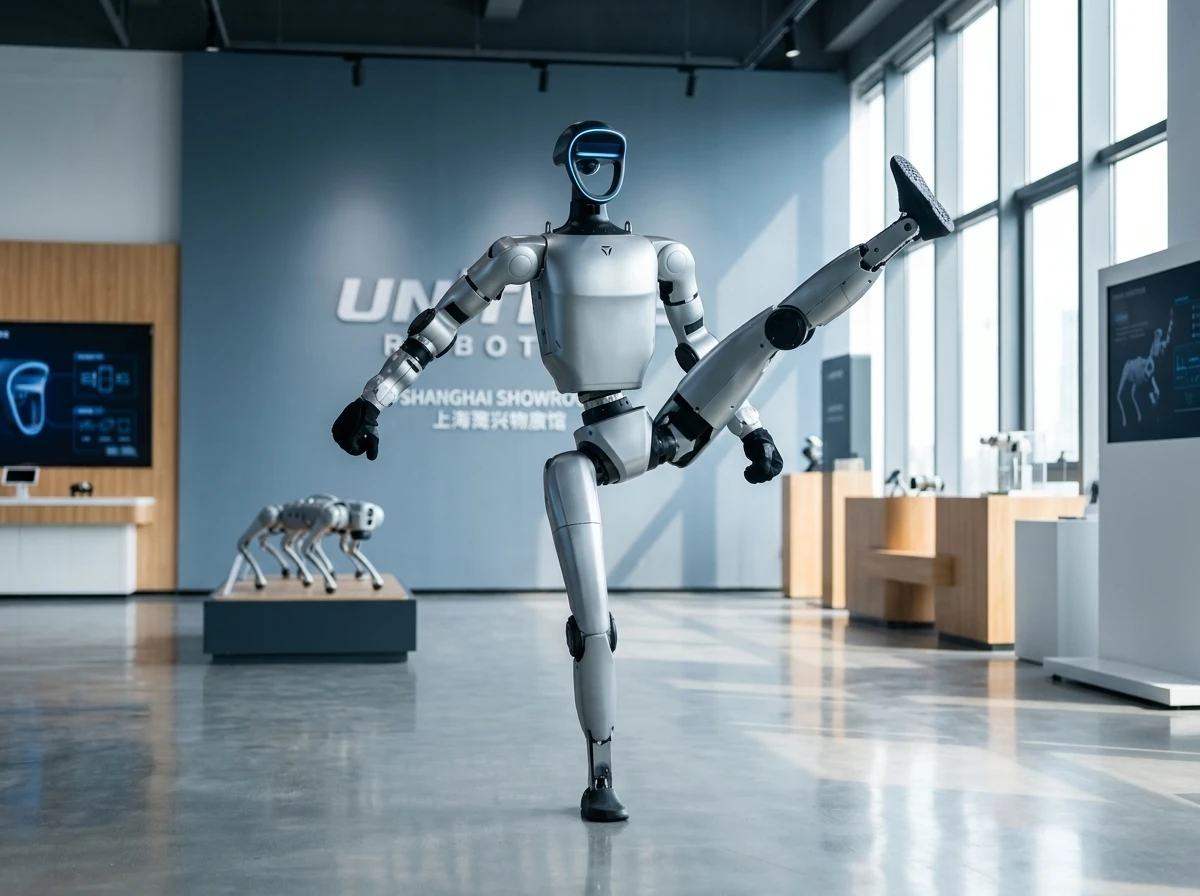
Just before the listing Unitree showed a new “Superman” humanoid capable of a two-metre standing jump and 12.66 metres per second top speed, developed in roughly three months. The machines perform martial arts, backflips and dance routines that filled Spring Festival Gala broadcasts and the World Humanoid Robot Games in Beijing this week.
Orderable prices matter more than demo reels for lab buyers working from fixed grants. A G1 or R1 can clear a purchase process that a contact-sales industrial unit or a non-shipping prototype cannot. The same storefront logic applies to the Go2 against Spot: research groups can field several quadrupeds for the cost of one enterprise platform.
Most sales still feed labs and demos
Nearly three-quarters of humanoid revenue in the first nine months of 2025 came from research and education. Corporate tours made up more than half of the still-small industrial slice. Battery life typically runs a few hours. Hands lack the precision and durability for sustained factory or household work. Privacy, reliability and task-specific training remain open problems.
Wood Mackenzie estimates average humanoid prices fell 93% from 2020 to 2025 to about $58,000. The firm sees the global fleet growing more than 90% a year toward 10 million units by 2035, with China already dominating installations. Unitree’s own G1 can cost as little as $82 a year in electricity for eight-hour days, yet the power draw of large fleets would add pressure to grids already strained by AI data centres.
What we know
- Unitree is profitable and ships at commercial scale today
- Research and education remain the largest revenue pool
- Prices have collapsed industry-wide, helped by Chinese manufacturing
What stays unconfirmed
- Timeline for reliable home or complex factory autonomy
- Whether current multiples survive once demo demand normalises
- How quickly US and other buyers replace Chinese hardware under new restrictions
Harold Soh of the National University of Singapore has said robots remain years from effective home use. Fei Qin of the University of Bath notes Beijing treats the sector as a strategic priority partly because of the country’s ageing workforce. David Hsu, another robotics researcher, called the Gala performance “an indication of a rise of an industry” and observed that Chinese firms have replaced American ones as the names making daily news.
Lab and education demand can support shipment leadership and healthy gross margins without solving full autonomy. That is the current business. The open question is how much of the IPO multiple already prices a later shift into factories and homes that researchers still describe as years away.
Public Marks Now Bind Rival Fundraises
Unitree’s offer valued the firm near $9 billion, about 36 times 2025 sales. The open pushed the figure higher still. Figure AI’s $39 billion private round remains larger in headline dollars, yet it comes with fewer public shipment figures and no matching profit disclosure. UBTech ships on a similar scale and already trades in Hong Kong, but it loses hundreds of millions of yuan a year.
| Company | Status | Scale signal | Profit picture |
|---|---|---|---|
| Unitree | STAR Market, live quote | 5,500+ humanoids in 2025 | Net profit, mid-to-high 200 million yuan range |
| Figure AI | Private | Far fewer public shipment numbers | No comparable profit line disclosed |
| UBTech | Hong Kong listed | Similar shipping scale | Loses hundreds of millions of yuan a year |
AgiBot, Leju and other Chinese names still lining up now face a clearer ask. They must clear or explain a multiple tied to a profitable volume leader, not only to private marks. Tesla Optimus assumptions sit beside the same tape whenever backers debate shipping timelines and price targets.
Scarcity of pure-play listed exposure helped the first-day spike. As more names arrive, that scarcity fades. The reference price remains; the monopoly on public attention does not.
How Low Prices Keep Labs Buying First
Industry average humanoid prices fell 93% from 2020 to 2025 to about $58,000, per Wood Mackenzie. Unitree’s orderable G1 and R1 sit far below that average, with the G1 from $13,500 and the R1 from $4,900. Against that backdrop, research and education taking nearly three-quarters of humanoid revenue in the first nine months of 2025 is less a surprise than a mechanism.
- 2020 to 2025: Average humanoid prices drop 93% to about $58,000.
- First nine months of 2025: Research and education supply nearly three-quarters of Unitree humanoid revenue.
- Full year 2025: More than 5,500 humanoids shipped; revenue near 1.7 billion yuan.
- Weeks before the IPO: US bans on new foreign humanoid robots and covered-list actions land.
- Just before listing: Superman humanoid shown, two-metre jump, 12.66 metres per second.
- Wednesday debut: Shares open at 1,100 yuan, raise about 6.1 billion yuan.
Low hardware cost lets universities and labs absorb units for demos, teaching and narrow experiments even while battery life stays measured in hours and hands still lack factory-grade durability. Corporate tours fill much of the small industrial slice because the machines impress visitors without yet carrying full production loads.
Electricity near $82 a year for a G1 on eight-hour days keeps operating budgets light for single units. Fleet-scale draw is a different problem, one that collides with grids already feeding AI data centres. Until autonomy and reliability close the gap, cheap shipping plus lab budgets remain the path that funds volume.
Beijing’s cluster meets Washington’s lists
Unitree sits inside Hangzhou’s dense robotics zone that has grown more than threefold in firm count since 2020 on heavy government support. China already installs the bulk of the world’s industrial robots. Humanoids are the next layer Beijing wants to own. Rare-earth leverage in motors and actuators adds another edge.
The same cost advantage that fills university labs also triggers security responses. Unitree robots have appeared in some US institutional settings, drawing congressional scrutiny. Access to advanced chips and simulation software remains a vulnerability if export rules tighten further. Still, other countries may hesitate to cut Chinese suppliers when the alternative is slower or far more expensive automation.
We no longer hear about American robotics companies in the news. It’s the Chinese robot companies that are making news today. They have replaced America as the cool kids on the block.
Hsu’s line captures the mood the IPO just capitalised. The public market has now put a number on it. Whether that number holds once the research orders slow and the real factory and hospital work begins will decide if Wednesday’s pop was a beginning or a peak.


Spotify Running Mode hits Android and revives its old tempo experiment

Galaxy Tab S12 Ultra Renders Keep the Notch Fans Hate

Novato Spinning Round House Sells With Six Neighbors for $3.3 Million

Crop Tour Finds Indiana and Nebraska Corn Yields Lagging 2025

Best Buy 60th sale brings Android deals back to its roots

American Airlines reverses seatback screen bet years too late

Iran Hormuz Strikes Force Gulf Oil Onto Costlier Paths

Plague Tale Prequel Day One Joins Game Pass Wave 2 as Witcher Exits

NBA 2K27 opens The City to everyone and rewrites career eras

iOS 26.6.1 Patches 29 Flaws as AI Forces Faster Apple Updates

Caitlin Clark Skips the WNBA 3-Point Contest for a Third Straight Year

Rainout Gives Red Sox Two Shots at a Franchise-Record Win Streak

Double Fine Cuts 23 Jobs Weeks After Xbox Independence

Day-One Big Walk Lifts PS Plus August Beyond Recycled AAA

John Hight Exits Wizards After Digital Reckoning Hits

Curtis Mead’s Red Sox Debut Ends With Fractured Wrist

Moesch and Dressel Rewrite Night One at 2026 U.S. Nationals

Red Sox Squander Hot Streak Chance in 4-3 Loss to Athletics

Boutte’s Quiet Camp Takeover Forces Patriots Receiver Choices

Take-Two CEO Pushes Netflix Subs for GTA 6 Extended Look
-

 TECHNOLOGY3 years ago
How to Adjust a Bulova Watch Band – An Easy Guide
-

 News3 years ago
Fred Pentland: Athletic Bilbao’s English mentor who changed the essence of Spanish football
-

 FINANCE3 years ago
Tax Planning for Every Season: Guide to Maximizing Your Tax Benefits
-

 Education3 years ago
African Ministers New Education Plan
-

 BUSINESS3 years ago
What is Entrepreneurial Operating System? A Comprehensive Guide to EOS
-

 Education3 years ago
Innovate Your Learning Journey with Technology and Enhance Education
-

 News3 years ago
Russians formally out of World Athletics Championships
-

 BUSINESS3 years ago
Top 9 Most Expensive American Cities to Rent an Apartment