
FINANCE
FedEx Freight Spinoff Places a Bet on the LTL Premium

The FedEx Freight spinoff closed on June 1, 2026, turning the largest less-than-truckload carrier in North America into a standalone public company. Shareholders received one FedEx Freight share for every two FedEx shares held on the May 15 record date, and the new stock began trading on the New York Stock Exchange under the ticker FDXF.
The number that explains the whole move is a valuation gap. FedEx spun off a unit the market valued at roughly 18 times earnings inside the parent and dropped it into a corner of the market where pure-play freight operators trade closer to 40 times. The wager is that the premium holds up, even with a freight downturn grinding through its second year.
The Trade FedEx Is Making
The freight business was profitable and expanding margins when FedEx decided to cut it loose. The trigger was a pricing problem in the stock market, where investors valued the unit far below the standalone competition. That logic runs through every page of the completed separation of the freight unit the company confirmed this week.
The Conglomerate Discount
Inside FedEx, the freight segment routinely earned more profit per dollar of revenue than the sprawling parcel network, yet the combined company carried a multiple weighed down by the lower-margin express and ground operations. Standalone less-than-truckload (LTL, the business of bundling freight from several shippers into one trailer) names traded at roughly double FedEx’s price-to-earnings (P/E) ratio.
FedEx Freight generated $8.9 billion in revenue and $1.4 billion in operating income in fiscal 2025, at an operating ratio of 84.2% (operating costs as a share of revenue, the headline efficiency gauge in trucking). Those are real earnings the conglomerate structure was, in the company’s own telling, failing to surface.
Why a Spin and Not a Sale
The board weighed several options and landed on a clean distribution. A sale was impractical given the size, a tracking stock would not have unlocked the multiple, and a spin let FedEx hand the business directly to existing owners. The company first disclosed the plan on December 19, 2024, two years after activist investor D.E. Shaw pressed it for board changes and tighter cost discipline.
Goldman Sachs and J.P. Morgan advised on the separation. FedEx distributed 80.1% of the shares to stockholders and kept a 19.9% stake it has committed to sell within 24 months, a slug of stock that will hang over the new shares until it clears.
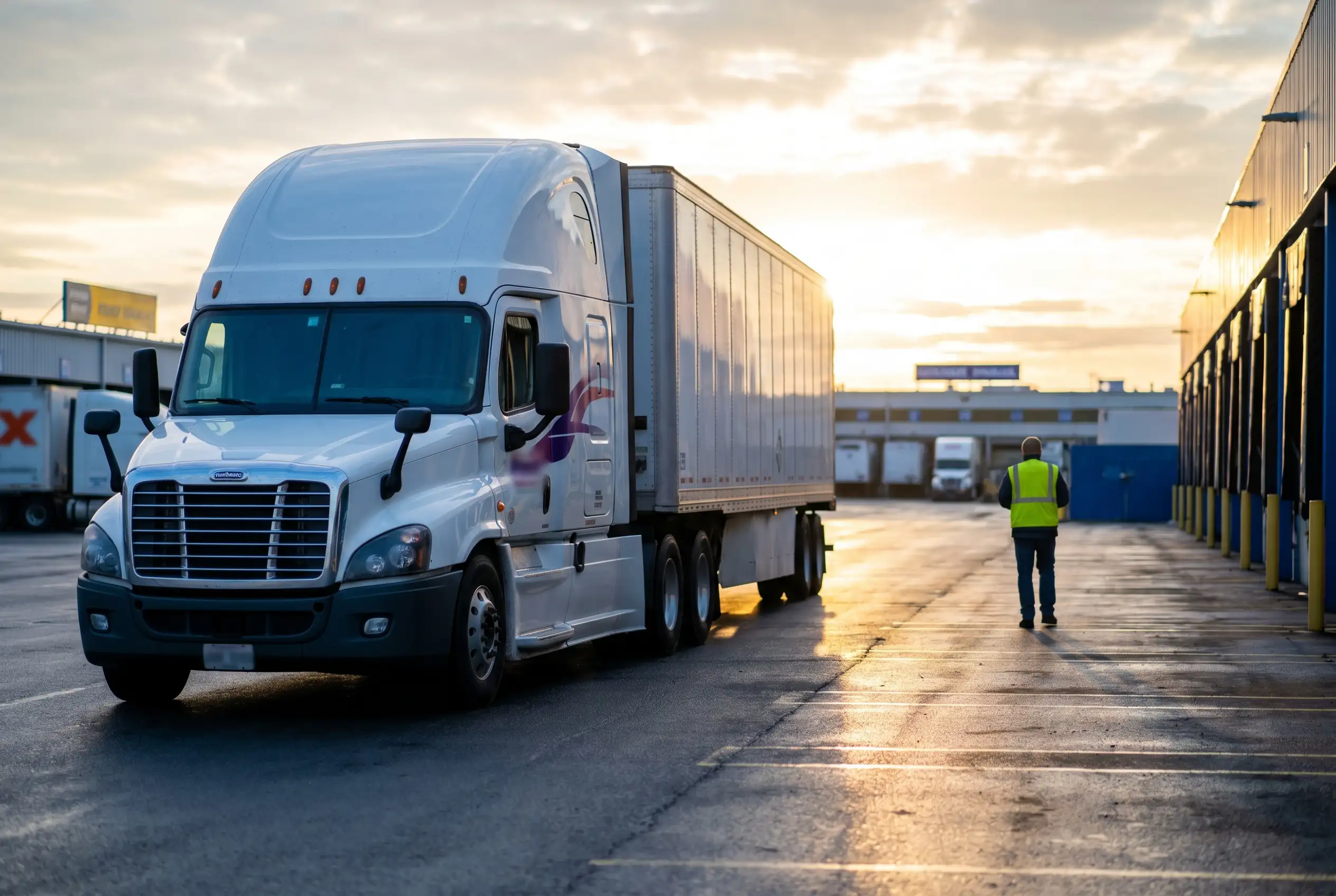
FedEx Freight’s Standalone Footprint
What investors now own outright is the biggest network in its niche. FedEx Freight runs across all 50 states plus Canada, Mexico, Puerto Rico and the U.S. Virgin Islands, and it does so on a fixed terminal network that is expensive to build and hard to replicate.
- 40,000 team members across the network
- 365+ service centers in North America
- Nearly 30,000 vehicles, including about 17,000 tractors
- Largest LTL carrier in North America by revenue
Leadership is where the bet gets personal. John A. Smith, a three-decade FedEx veteran, took over as president and chief executive of the independent company, with R. Brad Martin, a longtime FedEx director, as chairman. Wall Street greeted the internal picks coolly, having wanted an outside operator with a turnaround record.
Today begins the next chapter for the new FedEx Freight. We move forward as an independent company with a sharpened focus and disciplined strategy to build on our competitive advantages and accelerate profitable growth.
Smith said that on the first day of trading, per FedEx Freight’s debut as an independent carrier. The phrase he leaned on, profitable growth, is the exact metric skeptics doubt the company can hit while a rival earns far fatter margins on less revenue.
The Multiple Gap With Old Dominion
The benchmark every FedEx Freight investor will be measured against is Old Dominion Freight Line, the LTL carrier that turned service consistency into the industry’s richest valuation. The comparison is unflattering on the metric that matters most in trucking.
| Metric | FedEx Freight | Old Dominion |
|---|---|---|
| Annual revenue | $8.9 billion | About $5.7 billion |
| Operating income | $1.4 billion | About $1.5 billion |
| Operating ratio | 84.2% | About 74% |
| Network role | Largest LTL by revenue | Highest-margin LTL operator |
The premium carrier earns more operating profit than FedEx Freight on roughly two-thirds the revenue. That gap of about ten percentage points on the operating ratio is the difference between a premium multiple and a discounted one, and closing even half of it is the heart of the new company’s pitch.
A Bet Placed Into a Freight Downturn
Timing is the uncomfortable part. FedEx Freight starts life in the middle of an extended freight recession, the longest stretch of soft industrial demand the trucking sector has seen in years. LTL tonnage is expected to stay slightly negative through the first half of 2026 before any second-half recovery, according to the 2026 LTL freight market outlook from logistics firm C.H. Robinson.
There is a cushion. Unlike truckload trucking, where excess capacity crushes rates, LTL runs on fixed terminal networks held by a small group of carriers, so pricing discipline tends to hold even when volumes sag. The industry is still pushing mid-single-digit rate increases of 3% to 5% into 2026.
That cushion does not erase the specific risks stacked against the new stock.
- Tonnage and volume metrics where FedEx Freight has trailed peers for several quarters
- One-time transition and standalone costs that come with running a public company alone
- An internal leadership team that investors wanted filled from outside
- The 19.9% stake FedEx still holds, due to be sold within 24 months and capping the upside until it clears
Each of those is a reason the market may keep the new shares a notch below the premium names until the operating numbers prove otherwise.
Index Inclusion Forces the Passive Bid
One tailwind is mechanical. FedEx Freight skipped the usual waiting room and won fast-track entry into the major U.S. benchmarks, treatment normally reserved for larger spinoffs and a signal that index providers expect deep, liquid trading.
The path from announcement to index membership ran on a tight calendar that closed in a single week at the end of May.
- December 19, 2024: FedEx announces the planned separation of its freight business, as detailed in the spin-off terms posted to investor relations
- May 15, 2026: record date set for the one-for-two share distribution
- June 1, 2026: FedEx Freight joins the Dow Jones Transportation Average, replacing American Airlines, with FedEx Corp staying in the index
- June 2, 2026: the stock joined the S&P 500, replacing EPAM Systems
Membership in both the S&P 500 and the Dow transports index forces every fund tracking those benchmarks to buy the stock regardless of the freight cycle, putting a structural floor of demand under the shares in their first weeks. It is a friendly backdrop for a debut that lands in an unfriendly freight market.
What Wall Street Is Modeling
Analysts are split on how much credit to give the new shares up front. UBS, valuing the two companies separately, pegged the parcel business at $338 a share and FedEx Freight at $213, which works out to a combined $445 for each old FedEx share once the one-for-two ratio is applied. The freight piece in that model trades near 39 times earnings, right in line with the LTL peer group.
Not everyone is that generous. J.P. Morgan analyst Brian Ossenbeck said he values FedEx Freight below its rivals “given execution risk and transition costs related to the spin as well as persistent underperformance on service and volume metrics.” If Smith narrows the gap with the premium leaders over the next few earnings cycles, the 40-times multiple becomes real; if the service metrics stay soft through the downturn, FDXF spends its first year as a pure-play in name and a discount in price.
Frequently Asked Questions
What is the FedEx Freight spinoff distribution ratio?
FedEx shareholders received one FedEx Freight share for every two FedEx shares they held as of the May 15, 2026 record date. Cash was paid in place of any fractional shares.
What ticker does FedEx Freight trade under?
FedEx Freight trades on the New York Stock Exchange as FDXF. It entered the Dow Jones Transportation Average on June 1 and the S&P 500 the following day.
Is the FedEx Freight spinoff taxable for shareholders?
FedEx structured the distribution to be tax-free to U.S. stockholders for federal income tax purposes. The cash paid in lieu of fractional shares is generally taxable, and holders should confirm their own situation with a tax adviser.
What happens to the stake FedEx kept?
FedEx retained 19.9% of FedEx Freight and has committed to dispose of that stake within 24 months of the separation. Until then it acts as an overhang on the new shares.
Does FedEx still belong to the Dow Jones Transportation Average?
Yes. FedEx Corp remains in the Dow Jones Transportation Average, while FedEx Freight was added separately, replacing American Airlines. EPAM Systems was the stock removed from the S&P 500 to make room.
Disclaimer: This article is for informational and educational purposes only and is not investment advice. Securities and spinoff shares carry market risk, including loss of principal, and past performance does not guarantee future results. Consult a qualified financial or tax professional before acting. Figures are accurate as of publication on June 2, 2026.






Halo Campaign Evolved Skulls Meet Death Barriers That Kill the Hunt

Spotify Running Mode Returns After the 2015 Experiment Failed

Amazon AWS Hits Fastest Growth in Years as AI Spend Pays Off

Amazon Bets Platform Beats Models in the AI Race

Apple C2 Modem Edges Into iPhone 18 Pro After Qualcomm Drop

Google Earth Adds Nano Banana 2 to Reimagine Real Places

Apple Upgrade Turns Phones Into Monthly Utility Bills

Asha Sharma Bets Xbox Growth on Console and Four C’s

MacBook Ultra Design Follows Apple’s Familiar Cascade Path

TAG Heuer Carrera x Team Ikuzawa Revives 1970s Roadmaster Stopwatch DNA

Pokémon GO Developer Niantic Rebrands as Scopely Explore

Jaylen Brown Traded to 76ers for Paul George and Four Draft Picks

Doom Studio id Software Cuts Half Its Staff in Xbox Layoffs

Nintendo Switch Online Adds Four Classics and One Japan-Only Title

Jordan Henderson Hospitalized After Wrist Injury at the Azteca

Mexico’s World Cup Run Ends at Azteca as England Hold On 3-2

Meta’s Muse Image Lets Anyone Use Your Instagram Photos in AI

Louis Vuitton Beats Molly Tea in China, Triggers Cultural Backlash

Pink Bearista Cup Returns July 13 as Starbucks Pink Vibes Drops

Samsung Sets Galaxy Unpacked for July 22 in London With a Wider Fold
-

 TECHNOLOGY3 years ago
How to Adjust a Bulova Watch Band – An Easy Guide
-

 News3 years ago
Fred Pentland: Athletic Bilbao’s English mentor who changed the essence of Spanish football
-

 FINANCE3 years ago
Tax Planning for Every Season: Guide to Maximizing Your Tax Benefits
-

 Education3 years ago
African Ministers New Education Plan
-

 BUSINESS3 years ago
What is Entrepreneurial Operating System? A Comprehensive Guide to EOS
-

 Education3 years ago
Innovate Your Learning Journey with Technology and Enhance Education
-

 News3 years ago
Russians formally out of World Athletics Championships
-

 BUSINESS3 years ago
Top 9 Most Expensive American Cities to Rent an Apartment