
News
Blue Origin’s New Glenn Pad Rebuild Faces a 15-Month Clock
Blue Origin says New Glenn will fly again within months of the May 28 pad explosion. SpaceX’s 2016 AMOS-6 rebuild took fifteen and a half. Here’s the gap.

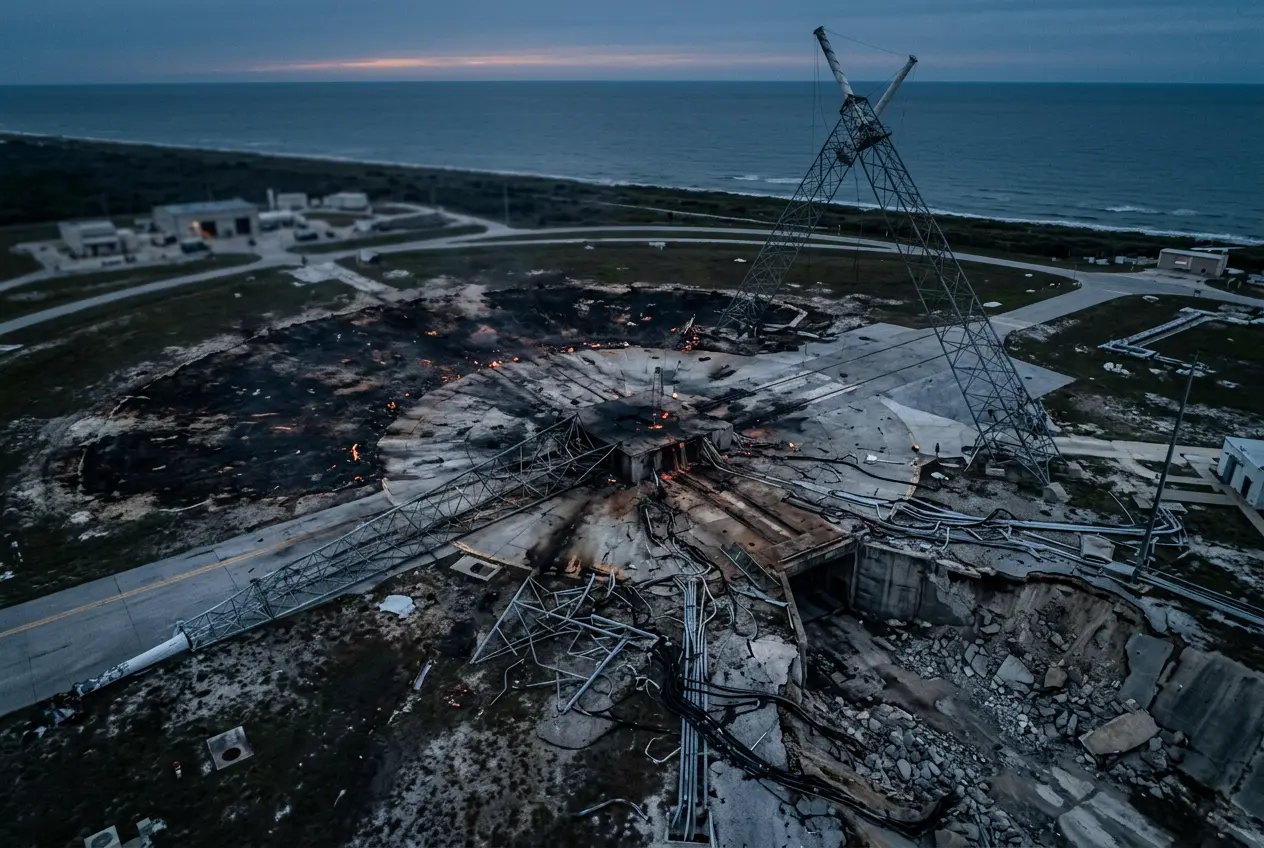
Blue Origin’s New Glenn launch pad rebuild is the company’s real bottleneck after a rocket exploded at Launch Complex 36 on May 28. Chief executive Dave Limp says New Glenn will fly again before the end of this year. The last time a rocket destroyed its own Florida launch pad, back in 2016, the rebuild and return to flight took fifteen and a half months.
The engineers who lived through that recovery, the AMOS-6 explosion that wrecked SpaceX’s Cape Canaveral pad, don’t think seven months is anywhere close to realistic. Their range runs from twelve months at best to eighteen as the safer bet.
The Explosion That SpaceX Veterans Recognized Instantly
The fireball that consumed New Glenn on the evening of May 28 looked familiar to the engineers who built SpaceX. The rocket was running a static fire, the standard pre-launch test where the main engines briefly ignite while the vehicle is clamped to the pad. New Glenn got as far as engine ignition before it erupted, gutting Launch Complex 36 at Cape Canaveral and toppling one of the pad’s lightning towers. No one was hurt.
Blue Origin has not said what failed. Outside speculation has centered on one of the seven BE-4 engines (the methane-fueled main engines Blue Origin designs and builds itself) on the first stage. For a group of former SpaceX employees, the scene replayed a night from September 2016, when a Falcon 9 blew up during fueling for a similar test and destroyed its launch site along with the AMOS-6 satellite already bolted on top.
Hans Koenigsmann led that investigation as SpaceX’s vice president of build and flight reliability. He told Ars Technica the New Glenn video brought the old wound straight back. “My AMOS-6 scar started itching when I saw the video of New Glenn,” he said. “It’s really terrible.”
SpaceX’s SLC-40 Rebuild Set the Benchmark
The hard part for Blue Origin is rebuilding the concrete and steel of the pad itself. After the 2016 failure, SpaceX couldn’t even start rebuilding Space Launch Complex-40 until January 2017, because federal investigators were still combing the surrounding wetlands grid by grid for booster debris. Engineers spent those first four months redesigning the pad on paper. The construction itself ran about eleven months. The first Falcon 9 lifted off the rebuilt pad in December 2017.
Add it up and SpaceX went from explosion to launching off the same wrecked pad in well over a year, and this is a company famous for moving faster than anyone in the business. That is the closest analog to what Blue Origin now faces at Launch Complex 36.
| Milestone | SpaceX after the 2016 explosion | Blue Origin’s stated plan |
|---|---|---|
| Rebuild start | January 2017, four months after | “Repair in place,” as soon as possible |
| Return to flight | January 2017, from a different pad | Before end of 2026, same pad |
| Launch off the rebuilt pad | December 2017 | Before end of 2026 |
| Total time to fly again | 15.5 months | Under 7 months (claimed) |
Blue Origin reached orbit on its very first New Glenn flight in January 2025, a feat logged on the company’s NG-1 mission page, so it is no stranger to hard engineering on a deadline. The pad math is a different kind of problem.
What Makes a Launch Pad So Hard to Rebuild
A rocket is a product Blue Origin already knows how to mass-produce. A launch pad is closer to a one-off building, and the visible damage is the easy part to fix. The toppled steel towers and the cracked concrete under the rocket will take real time, but they’re the kind of work crews can see and price out.
The buried systems are the trap. Trip Harriss, who ran Falcon 9 fleet operations during the 2016 recovery, says the parts that worry him are the ones nobody photographs:
- Electrical wiring threaded across the pad, almost all of it cooked by the fireball and rebuilt by hand.
- Bespoke tubing that feeds gas and liquids into the rocket’s main tanks and dozens of smaller pressurized vessels.
- The flame trench and foundation, the tons of reinforced concrete that channel the blast at ignition.
- The launch tower, tall enough and strong enough to hold a fully fueled rocket steady on the pad.
“I’m worried about the tubing,” Harriss said, noting that every pad carries its own plumbing, with welding and wire-splicing that has to be done by hand. “It takes a lot of time and effort to put that into place.” That handwork is what doesn’t compress, no matter how big the workforce.
Blue Origin Has No Vandenberg to Fall Back On
Blue Origin’s problem differs from SpaceX’s in one decisive way. When SLC-40 was wrecked, SpaceX had options. Within five months it was launching Falcon 9 again from Vandenberg in California, a pad already being upgraded for the Full Thrust version of the Falcon 9 and its densified propellant. A second site, Launch Complex 39A at Kennedy Space Center, came online weeks later. The SLC-40 rebuild was urgent, but it was never the thing blocking SpaceX from flying.
Blue Origin has no such cushion. Launch Complex 36 is the only New Glenn pad in existence. There’s no backup tower in California, no leased NASA site down the road. Until the concrete and plumbing there are back, New Glenn doesn’t fly, full stop. That makes the pad rebuild the single gating item for the whole program, which is exactly why a damaged pad threatens Blue Origin’s schedule more than the engine failure that caused it.
The stakes reach past one company. As earlier coverage of the LC-36 pad damage noted, this is the only Moon-ready pad Blue Origin owns, and the static fire that ended in flames was clearing the way for a flight to deploy 49 satellites for Amazon’s broadband constellation. Right now that pad is a burn scar visible from orbit.
Limp’s Seven-Month Promise Meets a Fifteen-Month Clock
On June 1, Blue Origin chief executive Dave Limp went on X and committed to a date: New Glenn would fly again before the end of this year. He argued the damage looks worse than it is. The propellant farm survived, he said, including the liquid oxygen, hydrogen and methane tanks. The support tower is hurt but can be fixed where it stands rather than torn down. And the company had already been planning to drop the transporter-erector that wheels the rocket to the pad, so it will skip rebuilding that piece entirely.
The former SpaceX hands who lived through the last rebuild don’t buy that timeline. Asked for a realistic figure, none of them landed under a year; twelve months was the best case anyone offered, and eighteen was the more common guess. NASA administrator Jared Isaacman has floated an even longer horizon, calling a 2028 return for the pad “within the realm” of possibility.
The honest range tops out near eighteen months, more than double what Limp has promised. The agency that licenses U.S. commercial launches, the FAA, said it would not open a fresh investigation into the static fire, which clears one obstacle SpaceX had to wait out. The agency’s blessing doesn’t pour concrete, though.
A Wrecked Pad Was SpaceX’s Chance to Build a Faster One
There’s a real upside buried in this, and the SpaceX veterans were the ones to flag it. Losing SLC-40 forced the company to redesign the pad instead of just patching it, and the new version was built for speed the first design could only guess at.
John Muratore, the former NASA engineer who was SpaceX’s launch director the night the 2016 rocket exploded and helped redraw the pad afterward, put it plainly:
It’s certainly a tremendous tragedy and a setback, but looking back on it rebuilding SLC-40 enabled us to make key improvements that we really needed to achieve high flight rates.
SpaceX reworked the strongback that holds the rocket upright so it would swing clear faster at liftoff and spare its umbilical connections. It rebuilt the flame trench to take less damage and upgraded the water system that dampens sound and heat. The payoff showed up years later: by early this year, SpaceX was launching Falcon 9s off that pad 45 hours apart.
Blue Origin gets a version of the same opening. It designed Launch Complex 36 before New Glenn’s specs were even locked, and it now has three flights of real data to tune a faster pad around, with NASA counting on the heavy-lift New Glenn for its lunar missions. The work to fly the rocket again runs entirely through that one stretch of repaired concrete, and the clock the company set itself started on May 28.






Halo Campaign Evolved Skulls Meet Death Barriers That Kill the Hunt

Spotify Running Mode Returns After the 2015 Experiment Failed

Amazon AWS Hits Fastest Growth in Years as AI Spend Pays Off

Amazon Bets Platform Beats Models in the AI Race

Apple C2 Modem Edges Into iPhone 18 Pro After Qualcomm Drop

Google Earth Adds Nano Banana 2 to Reimagine Real Places

Apple Upgrade Turns Phones Into Monthly Utility Bills

Asha Sharma Bets Xbox Growth on Console and Four C’s

MacBook Ultra Design Follows Apple’s Familiar Cascade Path

TAG Heuer Carrera x Team Ikuzawa Revives 1970s Roadmaster Stopwatch DNA

Pokémon GO Developer Niantic Rebrands as Scopely Explore

Jaylen Brown Traded to 76ers for Paul George and Four Draft Picks

Persona 4 Revival Hands All Anime Cutscenes to Studio MAPPA

Doom Studio id Software Cuts Half Its Staff in Xbox Layoffs

Nintendo Switch Online Adds Four Classics and One Japan-Only Title

Jordan Henderson Hospitalized After Wrist Injury at the Azteca

Mexico’s World Cup Run Ends at Azteca as England Hold On 3-2

Meta’s Muse Image Lets Anyone Use Your Instagram Photos in AI

Louis Vuitton Beats Molly Tea in China, Triggers Cultural Backlash

Pink Bearista Cup Returns July 13 as Starbucks Pink Vibes Drops
-

 TECHNOLOGY3 years ago
How to Adjust a Bulova Watch Band – An Easy Guide
-

 News3 years ago
Fred Pentland: Athletic Bilbao’s English mentor who changed the essence of Spanish football
-

 FINANCE3 years ago
Tax Planning for Every Season: Guide to Maximizing Your Tax Benefits
-

 Education3 years ago
African Ministers New Education Plan
-

 BUSINESS3 years ago
What is Entrepreneurial Operating System? A Comprehensive Guide to EOS
-

 Education3 years ago
Innovate Your Learning Journey with Technology and Enhance Education
-

 News3 years ago
Russians formally out of World Athletics Championships
-

 BUSINESS3 years ago
Top 9 Most Expensive American Cities to Rent an Apartment