
FINANCE
Gas Prices Top $4 Again as Iran War Repeats Its Boom Bust Cycle
AAA’s national average hit $4.019 as strikes resumed, the war’s second $4 spike this year, with the EIA not forecasting real relief until 2027.

The national average price for a gallon of regular gas hit $4.019 on July 21, AAA said, up from $4.003 the day before and $3.141 a year ago, a jump of nearly 28% in twelve months. It is the second time in five months the war between the United States and Iran has pushed pump prices through that line.
The first time it happened, in the spring, prices retreated within weeks. This time, the government’s own energy forecasters do not see real relief arriving until 2027.
Washington Trades Blame as Pump Prices Cross $4 Again
The White House framed the spike as temporary. White House spokeswoman Taylor Rogers told Fox News Digital that as the U.S. military degrades Iran’s ability to disrupt shipping through the Strait of Hormuz, oil and gas prices will fall back to pre-conflict levels, and that President Trump remains committed to unleashing American energy dominance.
Trump’s own language was sharper.
Every time Iran kills an American Soldier they will pay for that killing many times over! This directive has been passed on to Secretary of War, Pete Hegseth, Chairman of the Joint Chiefs of Staff, Daniel Caine, and every Leader in the Military.
He posted that on Truth Social Monday. U.S. Central Command said it had carried out another round of strikes against Iran at 9 p.m. ET that same day, targeting Iranian military command centers, maritime capabilities, missile and drone launch sites, and air defense systems.
Not every Republican is on board. Former Rep. Marjorie Taylor Greene, who left Congress earlier this year after a public falling out with Trump, wrote on X that American soldiers would not be dying to reopen a strait that was already open, adding that gas ran under $2 during Trump’s first term and urging him to repeat that instead of the war.
House Minority Leader Hakeem Jeffries, D-N.Y., went further in his own post. He wrote on X that gas prices are back above $4 per gallon and asked why Defense Secretary Pete Hegseth is still around, calling the conflict a war of choice that is making life more expensive.
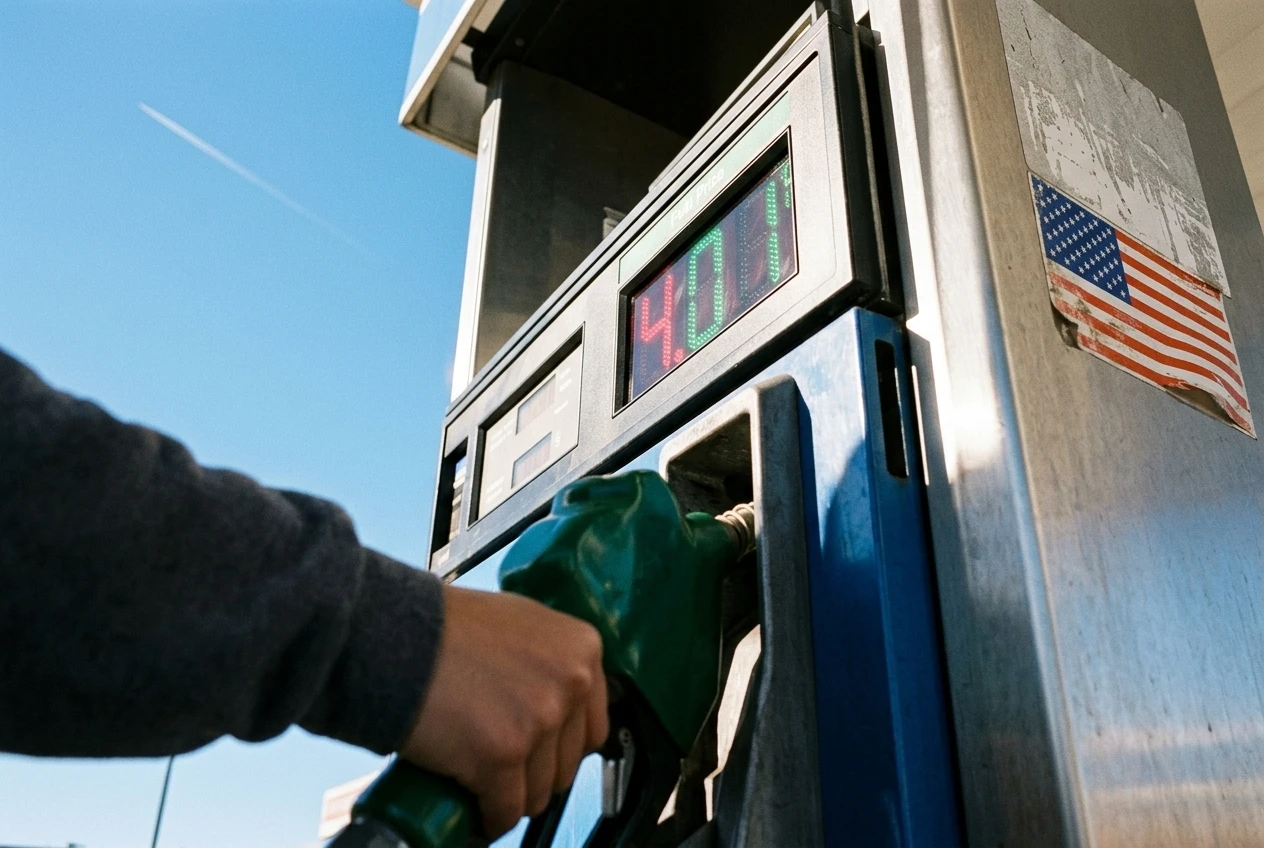
The War’s Second Trip Past $4
Gas at $4 today is not a new shock. It is the second lap of a cycle this same war already produced once.
The national average sat near $2.89 in December 2025, among the cheapest gas had been in years. That changed on February 28, 2026, when U.S. and Israeli strikes killed Iran’s supreme leader and the Islamic Revolutionary Guard Corps declared the Strait of Hormuz closed to Western-linked shipping. Tanker traffic collapsed almost immediately, from a historical daily average of 138 vessels to as few as one ship on a single day in early March.
By spring, pump prices had followed crude oil higher and crossed $4 nationally for the first time in the war, a run-up that undercut an earlier pledge of cheap gas from the administration. Prices then eased as a truce took hold. AAA’s own site recorded the average holding below $4 for a second straight week in late June, and it kept sliding into July, touching roughly $3.79 a gallon in the first week of the month before ticking back to $3.859 by July 14.
Then the ceasefire cracked again. Here is how the year has moved:
- December 2025: National average near $2.89 a gallon, among the lowest levels in years.
- February 28, 2026: Strikes kill Iran’s supreme leader; the IRGC declares the Strait of Hormuz closed to Western-linked shipping.
- Early March 2026: Daily tanker transits through the strait collapse from a historical average of 138 ships to as few as one.
- Spring 2026: Brent crude tops $140 a barrel, the highest since 2008, and the national gas average crosses $4 for the first time in the war.
- June 21, 2026: Average eases to $3.938 as a fragile truce holds and shipping partially recovers.
- Early July 2026: Average slips further, to around $3.79 a gallon.
- July 20 to 21, 2026: Average jumps to $4.003, then $4.019, as strikes resume for a ninth straight night.
CENTCOM said in Monday’s release that since early May it has helped facilitate the transit of roughly 900 commercial vessels and 450 million barrels of crude oil through the strait, evidence that shipping has partly recovered from March’s near total stop even as prices swing again.
Brent Crude’s Round Trip From $71 to $140
Pump prices track crude with a lag, and crude has been on its own wild ride since the war began.
| Date | Benchmark Price | What Was Happening |
|---|---|---|
| Feb. 27, 2026 | Brent near $71/barrel | The day before strikes killed Iran’s supreme leader |
| Early March 2026 | Brent tops $140/barrel | Highest since 2008 as Hormuz shuts to Western-linked shipping |
| June 9, 2026 | Brent averaging $105/barrel | EIA outlook cites an 11 million b/d Mideast output cut |
| July 20, 2026 | Brent $89.22, WTI $83.23 | Trump vows Iran will pay for killing U.S. troops |
| Around July 21, 2026 | Brent near $91/barrel | Highest since June 10, ninth straight night of strikes |
Today’s price sits well below the war’s spring peak. It is also nearly 30% above where Brent traded the day before the fighting started, and it has not stopped moving for five months.
A Rare Mid-Year Move at the IRS
The clearest sign of how deep this is cutting into ordinary budgets did not come from AAA. It came from the IRS.
The agency raised its standard business mileage rate to 76 cents a mile for the second half of 2026, up from 72.5 cents, citing rising fuel costs. The original 2026 rate had been set in late December, when gas was near multi-year lows. Medical and moving mileage rates rose too, from 20.5 cents to 23.5 cents a mile.
Mid-year changes are rare. The IRS last did one in 2022, after Russia’s invasion of Ukraine sent gas toward roughly $5 a gallon that June. This is only the second such adjustment since then.
The mileage rate is one number. A few others show how far the pain radiates beyond the pump.
- The IRS mileage bump to 76 cents a mile is its first off cycle change since the 2022 Ukraine shock.
- Middle Eastern producers have cut output by more than 11 million barrels a day, according to the U.S. Energy Information Administration.
- OECD oil inventories have fallen to their lowest level since 2003 as those barrels stay off the market.
None of those numbers show up on a receipt at the pump. All of them show up eventually, in freight costs, airfares and grocery bills.
Why Drivers Pay More for Oil America Barely Imports
The U.S. imported only about 0.5 million barrels a day of crude from Persian Gulf countries through Hormuz in 2024, down by more than half since 2018 as domestic shale production climbed. By several measures, the country is less exposed to a Hormuz shutdown than at any point in roughly 40 years.
China is not so insulated. It drew about 5.35 million barrels a day through the strait in a recent quarter, more than any other buyer, with India, South Korea and Japan close behind. Those economies carry the physical risk of a closed strait far more directly than the United States does.
Americans still pay more anyway, because oil trades on one global market. A barrel priced in Singapore or Rotterdam feeds into the same benchmark that sets what a refinery in Texas pays, no matter where the crude itself started its trip. That is the mechanism Rogers pointed to when she said prices would fall once the military degrades Iran’s ability to threaten shipping. It also means prices rise the same way, regardless of how little of the disrupted oil ever reaches a U.S. refinery.
One force has kept the damage from being worse. The EIA’s June outlook found the world is consuming about 1 million fewer barrels of oil a day on average than it did last year, as high prices and reduced availability curb demand, particularly across Asia. Expensive gas is, in effect, rationing its own demand.
The Houthis Open a Second Front on Oil Supply
Iran’s Houthi allies in Yemen declared a maritime embargo against Saudi Arabia on July 20, a move that threatens the one workaround that has kept the crisis from being far worse.
Saudi Arabia has been diverting millions of barrels a day through its East-West pipeline to a Red Sea export terminal, bypassing Hormuz entirely. Those exports have acted as a crucial relief valve for the global crude market through the war. The Houthis have repeatedly threatened to close the Bab el-Mandeb Strait that connects the Red Sea to global markets, and Iran’s tactics at Hormuz are already becoming a template other choke points could follow.
Traders had largely priced this in already. Prediction markets were showing 93% odds gas would top $4 again before AAA’s Tuesday numbers confirmed it.
Politics is layered on top of the barrels. Ahead of November’s midterm elections, Holger Schmieding, chief economist at Berenberg, said in a research note that Trump wants low oil prices while Iran’s Revolutionary Guards want the money that would come from eventual sanctions relief, a split in incentives that keeps the standoff from resolving quickly.
The EIA’s own June forecast put Brent averaging $105 a barrel through June and July, easing only to $79 in 2027 once Middle East supply and shipping fully resume. Rogers promised prices would plummet back to pre-conflict levels. The government’s own forecasters are not pricing that in until next year.
Frequently Asked Questions
Why do U.S. gas prices rise when the fighting is thousands of miles from any American refinery?
Crude oil trades on a single global market, so a supply threat anywhere pushes the benchmark price everywhere, even in a country like the U.S. that imports very little crude through the Strait of Hormuz itself.
How wide is the Strait of Hormuz, and how much oil moves through it?
The strait is about 21 nautical miles wide at its narrowest point and normally carries roughly a quarter of the world’s seaborne oil trade, with almost no alternate route for most of that volume.
Which states have the highest and lowest gas prices right now?
AAA has listed Hawaii, at $5.53 a gallon, and California, at $5.50, among the nation’s most expensive markets, while Indiana and Texas have ranked among the cheapest, near $3.30 to $3.36.
Does the IRS mileage rate change apply to more than business driving?
Yes. Alongside the business rate rising to 76 cents a mile, the IRS raised its medical and military moving mileage rate to 23.5 cents a mile, up from 20.5 cents, effective July 1, 2026.
Could a new ceasefire bring gas prices back down quickly?
It has happened before this year: the national average fell from over $4 in the spring to about $3.79 a gallon in early July before this latest rebound, showing prices can retreat fast when fighting pauses, though no durable truce is currently in place.


SharePoint’s Fifth Exploited Flaw of 2026 Echoes Last July’s Hack

Claude Code Skips the Screen Takeover to Test iPhone Apps Live

Caitlin Clark Skips the WNBA 3-Point Contest for a Third Straight Year

Light Phone’s New Flip Runs Into the Same Chip Shortage as the iPhone

Apple’s $634 Million Masimo Verdict Stands, but Danaher Gets the Money

Rainout Gives Red Sox Two Shots at a Franchise-Record Win Streak

Apple Needed Four Tries to Truly Fix Its Hide My Email Leak

Samsung’s Record Chip Profits Are Shrinking Galaxy Z Fold 8 Deals

Sony’s PlayStation Disc Exit Repeats the Fight Xbox Lost in 2013

Samsung’s Record Chip Profits Are Quietly Pricing Its New Z Fold 8

Halo Studios Reverses PS Plus for Halo: Campaign Evolved on PS5

Black Ops 1 and 2 PS5 Ports: $40 Price Tag Has Fans Uneasy

Matt Brown Dismisses Rousey and Paul’s MVP MMA Ratings Win Over UFC

Star Wars: Galactic Racer Is a Roguelite Racer With a Podracing Skin

Julius Randle Traded to Nets as Wolves Reclaim Cap Space for Dosunmu

Sega’s $49.99 Sonic Classic and Modern Bundles Hit Switch in October

Colombia Edge DR Congo as Muñoz Books World Cup Knockout Place

Warriors Take Yaxel Lendeborg, the Oldest Pick in the 2026 NBA Draft

Douze Dixièmes Closes Five Months After MIO: Memories in Orbit

Warhammer Horus Heresy Super-Heavy Tanks Share a Plastic Chassis
-

 TECHNOLOGY3 years ago
How to Adjust a Bulova Watch Band – An Easy Guide
-

 News3 years ago
Fred Pentland: Athletic Bilbao’s English mentor who changed the essence of Spanish football
-

 FINANCE3 years ago
Tax Planning for Every Season: Guide to Maximizing Your Tax Benefits
-

 Education3 years ago
African Ministers New Education Plan
-

 BUSINESS3 years ago
What is Entrepreneurial Operating System? A Comprehensive Guide to EOS
-

 Education3 years ago
Innovate Your Learning Journey with Technology and Enhance Education
-

 News3 years ago
Russians formally out of World Athletics Championships
-

 BUSINESS3 years ago
Top 9 Most Expensive American Cities to Rent an Apartment