
ENTERTAINMENT
Double Fine Cuts 23 Jobs Weeks After Xbox Independence
Psychonauts studio Double Fine cut about a quarter of staff to reach a sustainable independent size just three weeks after Xbox spun it out with its IP intact.

Double Fine Productions cut 23 staff members on July 28, roughly a quarter of its workforce, three weeks after Xbox spun the Psychonauts studio back into independence with its full IP and catalog intact. Founder Tim Schafer said only studio survival justified the move.
The San Francisco team now aims for a size its own releases can fund without a corporate parent. That trade-off sits at the center of the story. Independence restored control and ownership. It also removed the overhead cushion that had let headcount climb during the Xbox years.
The sequence is tight. The studio thanked Microsoft on July 6. By July 28 it had already resized. The gap shows how quickly the new math asserted itself once the parent stepped away.
Schafer Calls the Cuts Painful but Necessary
In a Bluesky post that served as the studio’s public notice, Schafer wrote the decision came after the team became independent again. The full statement is direct.
Today, Double Fine Productions let go of 23 members of our staff. As a small, tightly-knit team, these actions are not taken lightly. Only the survival of our studio would ever make us consider such a painful action. Our transition to becoming an independent company also means becoming a size that we can sustain. The people we are losing are all important. They all made an impact on our games and culture, and they will be missed.
Double Fine added it is supporting affected people “as best we can.” Bloomberg’s Jason Schreier reported around 90 people were employed at Double Fine before the cuts, putting the reduction near 25 percent.
An Xbox spokesperson told Kotaku the studio “fully returned to independent management earlier this week, with their IP, catalog, and runway for their next games.” Xbox declined to detail the size of that runway.
Schafer’s wording ties the cuts to survival and to a sustainable headcount in the same breath. The studio is not framing the move as optional pruning. It is framing a smaller payroll as the price of remaining open once corporate support ends. The support pledge for departing staff sits beside that hard line without softening it.
Public notice arrived on Bluesky rather than through a long corporate memo. That choice matches a studio that has long spoken in a personal register. The substance still tracks the same numbers every outlet has used: 23 departures, prior headcount near 90, and a cut of roughly one quarter.
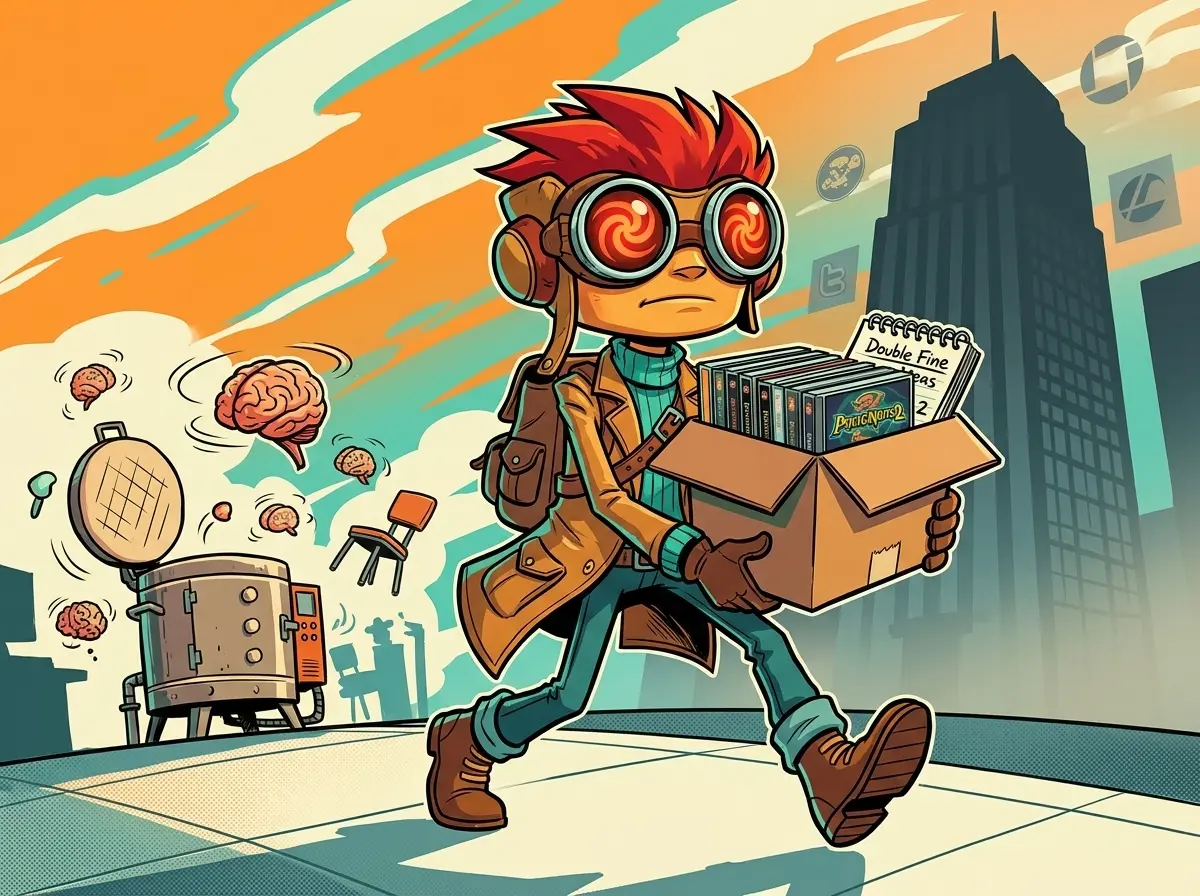
Independence Landed on July 6
The split formed part of Xbox’s larger July 2026 reset under CEO Asha Sharma. Microsoft cut about 3,200 roles across the division, roughly 20 percent, and moved five studios out of the first-party fold.
- July 6, 2026, Sharma’s memo confirms Double Fine and Compulsion Games return to independent management with IP, catalog and runway. Ninja Theory and Undead Labs enter sale terms. Arkane begins French works-council consultation.
- July 6, 2026, Double Fine posts its “Independence Day” note thanking Xbox for seven years and the deal that returns ownership of our games to us.
- July 28, 2026, The studio announces the 23 departures as the first public staff cut among the spun-off groups.
Compulsion kept rights to Contrast, We Happy Few and South of Midnight. Double Fine kept Psychonauts, Keeper, Kiln and the rest of its back catalog. Both avoided outright closure.
The July 6 language was careful. Microsoft handed back IP, catalog, and runway in the same package. It did not promise that every role built during the first-party years would survive the handoff. Three weeks later Double Fine made that implication concrete.
Among the five studios moved that day, Double Fine and Compulsion took the independence path. The other three faced sale talks or mandatory consultation. The shared reset produced different outcomes almost immediately, and Double Fine became the first to confirm staff reductions after the split.
What Seven Years Inside Xbox Built
Microsoft bought Double Fine in 2019 while Psychonauts 2 was still in troubled development. The deal stabilized the studio. Psychonauts 2 launched in 2021 to strong reviews and a Game Awards nomination. Keeper followed in 2025 as a warmly received atmospheric adventure. Kiln, a multiplayer pottery party game, arrived in April 2026 across Xbox, PlayStation and Steam.
| Era | Key Releases | Ownership Context |
|---|---|---|
| Pre-2019 indie | Psychonauts (2005), Brutal Legend, Broken Age | Self-funded, crowdfunded, publisher deals; frequent money stress |
| Xbox years | Psychonauts 2 (2021), Keeper (2025), Kiln (2026) | First-party support, larger headcount, Game Pass exposure |
| Post-July 2026 | Next projects under runway | Independent again, IP owned, smaller sustainable team |
The corporate years grew the headcount. Once the parent stepped away, that size became the problem. Earlier in 2026 the studio had petitioned to unionize with the Communications Workers of America, covering a bargaining unit of roughly 42 regular employees inside the larger group.
The 2019 acquisition arrived at a fragile moment. Psychonauts 2 needed finishing support that crowdfunding and publisher deals had not fully supplied. First-party backing delivered that finish, then carried Keeper and Kiln to release under the same umbrella. Game Pass exposure widened the audience for those titles. Headcount rose with the work.
The union petition earlier in 2026 covered a bargaining unit of roughly 42 regular employees inside a larger roster near 90. That filing captured a studio still operating at corporate scale. The July cuts arrived after the ownership change and reduced the whole group by about a quarter. The two events sit weeks and months apart, yet both speak to how staff size and studio structure were already under review.
Four Other Studios Took Different Roads
Double Fine’s path was one of several.
- Compulsion Games also went independent with full IP rights and similar runway language.
- Ninja Theory and Undead Labs were sold to new owners with funding to finish Senua’s next game and State of Decay 3.
- Arkane Studios entered mandatory consultation in France; its Blade project and long-term fate remain open.
| Studio | July 2026 Path | What They Kept or Faced |
|---|---|---|
| Double Fine | Independent management | Full IP and catalog; later cut 23 roles |
| Compulsion Games | Independent management | Contrast, We Happy Few, South of Midnight |
| Ninja Theory | Sale terms | Funding to finish Senua’s next game |
| Undead Labs | Sale terms | Funding for State of Decay 3 |
| Arkane Studios | French works-council consultation | Blade project and long-term fate open |
Double Fine is the first of the group to confirm layoffs after the split. The pattern fits a wider industry contraction in which mid-size creative houses lose the cushion of big-publisher overhead. That same pressure shows up in Xbox strategy that still puts big games on PC and in broader platform shifts that reshape studio economics.
Independence and sale are not the same remedy. Compulsion and Double Fine kept their catalogs and stepped off the first-party roster with runway language attached. Ninja Theory and Undead Labs moved to new owners who brought project-specific funding. Arkane’s consultation process leaves more unresolved. Each path tries to preserve work already in motion. Only Double Fine has so far shown what the payroll adjustment looks like once the parent is gone.
Who Feels the Impact First
The 23 people leaving carried years of institutional knowledge on Psychonauts, Keeper and Kiln. Schafer stressed they shaped both games and culture. For a studio that built its reputation on internal jams and oddball ideas, losing a quarter of the roster changes daily creative capacity overnight.
Snapshot of the numbers
- 23 staff let go on July 28
- ~90 total headcount just before the cuts
- ~25% reduction
- 3 weeks between independence announcement and layoffs
Online reaction split cleanly. Many players and developers treated the news as another loss for a beloved quirky house. Others framed the downsizing as an overdue market correction after years of acquisition-driven staffing that outran hit rates. Both readings sit on the same facts: independence preserved the IP, yet the books still required a smaller payroll.
Institutional knowledge does not transfer cleanly. People who shipped Psychonauts 2, Keeper, and Kiln carried process habits, tone references, and unwritten craft details that jams and postmortems only partly capture. A quarter of the roster leaving compresses the circle that can still draw on that shared memory. Daily creative capacity shrinks before the next project even reaches full production.
The split in public reaction tracks two familiar industry stories. One mourns a distinctive studio under strain. The other treats post-acquisition headcount as a bubble that market reality was always going to prick. Neither reading invents new numbers. Both start from the same 23 departures and the same retained catalog.
Owning the Catalog Rewrites the Old Risk
Before 2019, Double Fine financed work through self-funding, crowdfunding, and publisher deals. Money stress was frequent. Projects moved forward, yet the studio rarely escaped the next funding cliff. The Microsoft years interrupted that cycle long enough to finish Psychonauts 2 and ship Keeper and Kiln.
Independence returns the studio to self-reliance with one structural change the pre-2019 era lacked. Double Fine now owns its full catalog outright. Psychonauts, Keeper, Kiln, and the earlier titles sit on the studio’s side of the ledger. Back-catalog revenue and licensing options belong to the same team that must fund the next games.
That ownership does not erase the need for a smaller payroll. It does change what survival can look like if the runway holds and the next releases perform. The studio no longer needs a parent or a new publisher deal simply to keep the IP alive. It needs enough income, from new work and from the catalog it now controls, to match the headcount it has chosen.
- Pre-Xbox: projects advanced under repeated funding pressure without full IP control.
- Xbox years: first-party support finished and shipped major titles while headcount grew.
- Post-split: IP owned outright, runway in place, team resized to what releases can sustain.
The upgrade is real and limited at once. Ownership removes one historic vulnerability. It does not guarantee that Kiln’s tail or the next launch will cover a mid-size burn rate. Schafer’s cuts treat that limit as settled fact.
A Size the Studio Can Fund
Schafer’s core claim is simple. An independent Double Fine cannot carry the same headcount Xbox once supported. The runway buys time for the next games. The cuts buy a chance that those games can keep the lights on without another sale or closure.
The studio’s pre-Xbox history already showed the pattern. Crowdfunding and publisher deals kept projects alive but rarely removed financial pressure. Psychonauts 2 only finished after the Microsoft acquisition. Returning to independence reopens that older equation with one major upgrade: Double Fine now owns its catalog outright.
Whether Kiln finds a longer tail, whether the next title lands hard enough, and how far the runway stretches will decide if the new size holds. For now the studio has drawn the line it believes it can live behind.
The three-week gap between the Independence Day note and the layoff announcement left little ambiguity. Runway funds future work. It does not freeze the roster at first-party scale. By moving first among the spun-off studios, Double Fine set an early marker for what independence can require when the books open without a corporate parent.
The bet is now public. A smaller team, full ownership of the catalog, and enough runway to reach the next releases form the whole plan. Success depends on whether that resized studio can fund itself the way Schafer described. Failure would reopen the sale-or-closure choices the July split was meant to avoid.
Frequently Asked Questions
How many people did Double Fine lay off in July 2026?
Double Fine confirmed 23 staff members were let go on July 28, 2026. Reporting from Jason Schreier and multiple outlets placed prior headcount near 90, making the cut roughly one quarter of the studio.
When did Double Fine leave Xbox and regain independence?
Xbox CEO Asha Sharma’s July 6, 2026 memo and Double Fine’s own “Independence Day” post the same day confirmed the studio’s return to independent management after seven years under Microsoft.
Did Double Fine keep its games and intellectual property?
Yes. The spin-off terms returned full ownership of the studio’s IP and catalog, including Psychonauts, Keeper, Kiln and earlier titles, along with runway funding for upcoming projects.
What games has Double Fine released most recently?
Kiln, a multiplayer pottery party game, launched in April 2026. Keeper arrived in 2025. Psychonauts 2 shipped in 2021 under Xbox ownership and earned widespread critical praise.
What happened to the other studios Xbox spun off at the same time?
Compulsion Games also went independent with its IP. Ninja Theory and Undead Labs were sold to new owners with project funding. Arkane Studios entered mandatory consultation under French labor rules.


Red Cross Rations Type O as Second National Blood Crisis Hits

eBay Ex-CEO Funds Free Speech Charity After Steiner Settlement

Kospi Drops 6% as Chip Concentration and Leverage Amplify Miss

US Ban Locks Out New Chinese Humanoid Robots and Hands Home Makers the Field

Florida’s $800 Million Mega Millions Win Shrinks Fast After Tax

American Airlines Outage Met Storms and Stretched Delays

Audi Bets Big on the 2027 Q9 as Its US Flagship SUV

Micron’s Contracts Raise Floors but Market Still Prices a Peak

Pixel 11 UK Leak Hides Flat Batteries Behind Storage Bump

Oil Rebounds as Strikes Hit and SPR Hits 1983 Floor

Pokémon GO Developer Niantic Rebrands as Scopely Explore

Persona 4 Revival Hands All Anime Cutscenes to Studio MAPPA

Jaylen Brown Traded to 76ers for Paul George and Four Draft Picks

Doom Studio id Software Cuts Half Its Staff in Xbox Layoffs

Nintendo Switch Online Adds Four Classics and One Japan-Only Title

Jordan Henderson Hospitalized After Wrist Injury at the Azteca

Mexico’s World Cup Run Ends at Azteca as England Hold On 3-2

Meta’s Muse Image Lets Anyone Use Your Instagram Photos in AI

Louis Vuitton Beats Molly Tea in China, Triggers Cultural Backlash

Pink Bearista Cup Returns July 13 as Starbucks Pink Vibes Drops
-

 TECHNOLOGY3 years ago
How to Adjust a Bulova Watch Band – An Easy Guide
-

 News3 years ago
Fred Pentland: Athletic Bilbao’s English mentor who changed the essence of Spanish football
-

 FINANCE3 years ago
Tax Planning for Every Season: Guide to Maximizing Your Tax Benefits
-

 Education3 years ago
African Ministers New Education Plan
-

 BUSINESS3 years ago
What is Entrepreneurial Operating System? A Comprehensive Guide to EOS
-

 Education3 years ago
Innovate Your Learning Journey with Technology and Enhance Education
-

 BUSINESS3 years ago
Top 9 Most Expensive American Cities to Rent an Apartment
-

 News3 years ago
Russians formally out of World Athletics Championships