
News
Zuckerberg’s AI Letter Joins a Wave of Tech Manifestos
Meta’s 6,500-word AI essay joins Altman, Amodei and Andreessen letters that double as policy and market plays on open models and power.

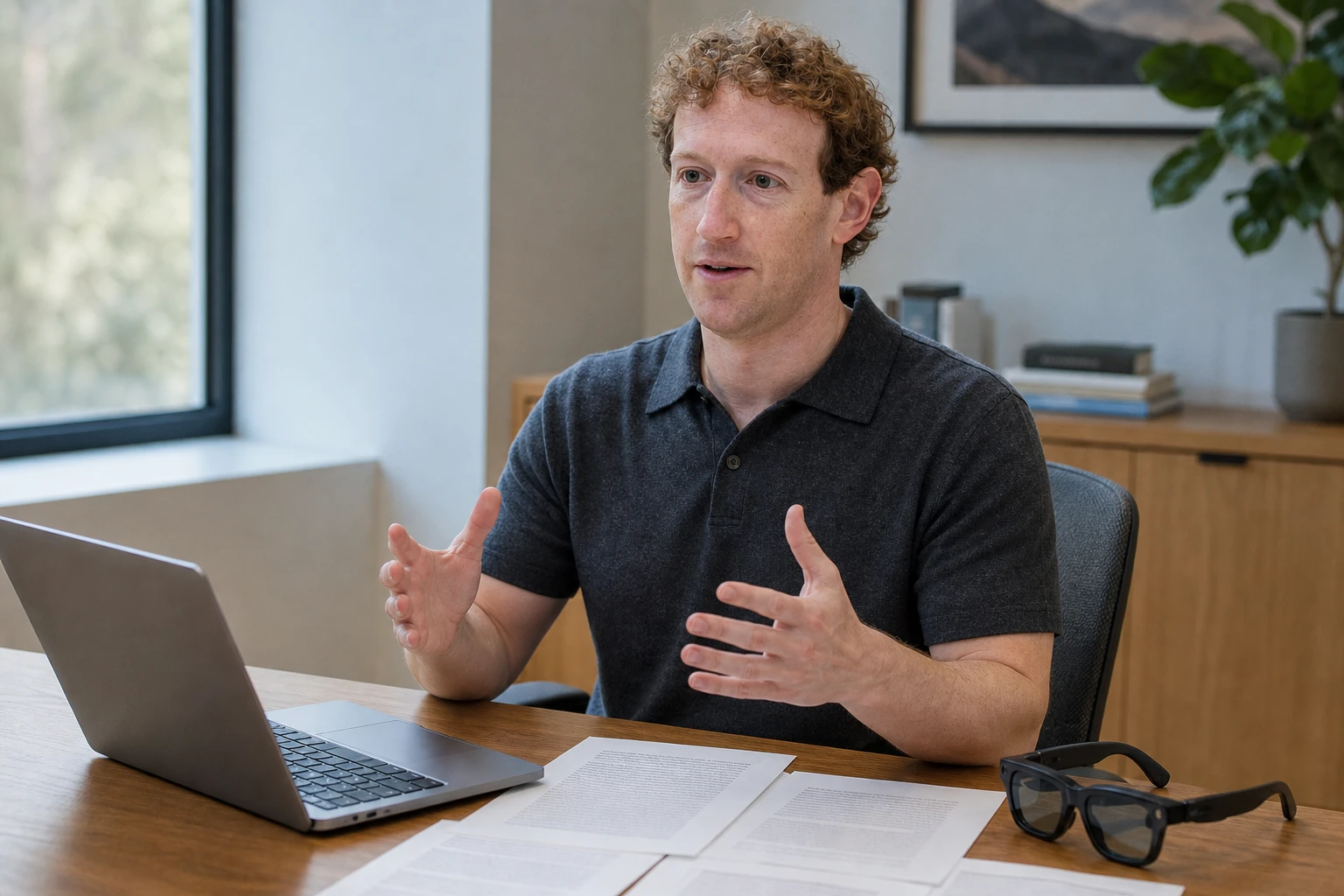
Mark Zuckerberg published a 6,500-word open letter on August 10 arguing that superintelligence should reach every person as a personal tool rather than sit inside a few labs. The Meta CEO’s piece, titled “The Future is for Everyone,” is the latest long-form statement from a tech leader trying to set the terms of the AI debate.
These essays keep arriving because the commercial and policy stakes now run higher than product launches. They double as arguments for open weights, data-center expansion and a particular view of safety built on distributed power.
What Zuckerberg Put on the Page
The letter lays out three pillars: individual empowerment as the source of prosperity, invention as the main job of superintelligence, and balance of power as the basis for safety. Zuckerberg rejects what he calls doom-filled discourse from other AI builders. He writes that he does not understand why anyone who believes AI will wipe out most jobs and human relevance would race to build that future.
He contrasts concentration with distribution. “The notion that AI is so dangerous that the only safe path is an extreme concentration of power seems inherently problematic,” he states in the 6,500-word open letter on personal superintelligence. History, he adds, shows that hoping an absolute power will stay benevolently enlightened has not produced safe outcomes.
Concrete promises fill the middle:
- A 24/7 personal agent that knows a user’s goals, handles relationships, health, career and finances, and runs with strong privacy controls comparable to WhatsApp encryption.
- Creation tools that let children and adults code, design and invent far faster than before.
- Business-building capacity that lowers the need for large teams or big capital raises.
- Personalized tutors with PhD-level depth in every subject.
- Open scientific models, including biology work from Biohub, plus free or low-cost access for billions via auctions for extra compute.
Meta also announced a Future Is For Everyone Fund aimed at communities hosting its data centers, plus America’s Workforce Academy for skilled-trades training. In Richland Parish, Louisiana, teachers received $50,000 bonuses tied to tax revenue from a Meta project. The company frames these steps as a community compact.
Earlier Letters Set the Pattern
Zuckerberg’s essay did not appear in a vacuum. Marc Andreessen’s 5,000-word Techno-Optimist Manifesto from 2023 attacked “lies” that technology destroys jobs, wages and the environment. It celebrated markets, intelligence and energy as engines of abundance and called growth the path to vitality.
Sam Altman followed in September 2024 with “The Intelligence Age.” The OpenAI chief argued deep learning scaled predictably and that the path forward runs through compute, energy and will. He promised shared prosperity on a scale hard to imagine today and said superintelligence could arrive in a few thousand days. The Intelligence Age essay on shared prosperity still flagged labor-market disruption while insisting new work would appear.
Dario Amodei of Anthropic released “Machines of Loving Grace” the same year. The piece sketched radical upsides in biology, mental health, poverty reduction, governance and meaningful work if powerful AI goes right. Amodei noted he usually emphasizes risks to avoid sounding like a propagandist, yet insisted an inspiring positive vision still matters. His Machines of Loving Grace upside sketch runs more than 14,000 words in places and stays concrete on disease timelines and lifespan gains.
| Author | Title | Year | Core claim |
|---|---|---|---|
| Marc Andreessen | Techno-Optimist Manifesto | 2023 | Technology and markets drive endless growth; pessimism is a lie |
| Sam Altman | The Intelligence Age | 2024 | Deep learning scale delivers shared prosperity if compute is abundant |
| Dario Amodei | Machines of Loving Grace | 2024 | Powerful AI can transform health, mind, poverty and peace if risks are managed |
| Mark Zuckerberg | The Future is for Everyone | 2026 | Distribute personal superintelligence widely; balance of power beats concentration |
Economics blogger Noah Smith told the BBC the stakes feel so high that leaders feel obligated to shape the technology’s direction. Tulane professor Rob Lalka called the form a classic businessman-philosopher move on the corporate blog, timed against rising public anger over jobs and energy use.
Open Weights Meet a Chinese Lead
Zuckerberg’s letter spends heavy space on open models. He wants American open-source systems to lead globally and argues that extra U.S. restrictions on training data and distillation put domestic labs at a disadvantage. Restricting foreign open models, he writes, would only centralize power and lower quality for users.
That argument lands against hard numbers. By early 2026 Alibaba’s Qwen family had passed one billion cumulative downloads on Hugging Face and at times captured more than half of global open-source model downloads. In one month Qwen alone generated more downloads than the next eight competitors combined. Chinese open-weight systems, including DeepSeek and others, now supply a large share of enterprise and sovereign deployments outside the United States. Meta’s Llama family and Google’s Gemma remain major Western open options, yet the download lead has shifted.
Decisions about open-sourcing the most capable systems carry real weight. Smith asked whether anyone should open-source technology that could kill humanity; treating the question lightly, he said, makes someone a fool. Closed labs such as OpenAI and Anthropic have often favored tighter control. Meta positions itself as the company focused on personal superintelligence for individuals rather than institutions. The letter is therefore also a competitive document aimed at policy makers who write export, data and safety rules.
Jobs, Data Centers and the Compact
Zuckerberg predicts invention will outrun pure automation and that employment will rise over time as people gain new capabilities. He notes infinite human demand for new experiences. At the same time Meta has already cut roughly 10 percent of its global workforce, about 8,000 jobs, while reorganizing around AI. The optimism and the restructuring sit inside the same company at the same moment.
It is surprising that the discourse from many developing AI is so filled with doom. I do not understand why anyone who believes that AI will eliminate most jobs and much of humanity’s relevance would rush to build that future.
Zuckerberg wrote those lines while his firm poured capital into multi-gigawatt data-center plans. Local pushback over power, water and land has grown. The $1 billion fund, teacher bonuses and trades academy form a direct response. They also serve as evidence for regulators and communities that the build-out brings tangible returns.
Broader markets still price heavy AI infrastructure demand. Chip and networking suppliers continue to report order strength even when individual stocks swing, a pattern visible in recent coverage of AI infrastructure orders still climbing. Software firms exposed to automation face their own pressure, including private-equity interest in names hit by AI disruption such as the PE interest in AI-hit software names.
The Form Keeps Working for the Writers
Long essays let CEOs plant flags in the marketplace of ideas. They demonstrate seriousness, court talent, reassure investors about capital plans, and give lawmakers language to quote. Altman’s later industrial-policy notes and Amodei’s risk-focused public posture show the genre flexes to fit each lab’s needs. Zuckerberg’s version adds the open-versus-closed fault line and the personal-agent product roadmap.
Sen. Bernie Sanders recently wrote to Altman, Amodei and Zuckerberg urging them to honor earlier safety language and pause development of systems humans cannot control. The letter arrived in the same news cycle as the Meta essay. Public trust remains uneven. Many readers treat the pieces as sophisticated lobbying rather than pure philosophy.
Skeptics Focus on the Messenger
Reaction on X and in tech commentary split along familiar lines. Supporters praised the rejection of centralized “AI priesthood” control and the defense of open weights. Critics noted Meta’s own history of concentrating social platforms, monetizing attention, and slowing earlier open efforts once competitive pressure eased. One detailed thread argued the good arguments on decentralization remain true even if Zuckerberg is an unreliable champion who discovered the virtues of openness after falling behind in the closed-model race.
Parallel points keep surfacing:
- Abundance rhetoric collides with large-scale layoffs and efficiency drives inside the same firms.
- Calls for balance of power come from companies that already hold enormous data, compute and distribution advantages.
- Personal agents with deep knowledge of users raise fresh privacy and dependency questions even when encryption language is strong.
- Data-center community funds address symptoms of local resistance without resolving national energy and grid constraints.
Fortune and others have asked who actually finishes these multi-thousand-word documents. Tech journalists and policy specialists do. The general public largely does not. That limited reach still leaves the letters useful inside the rooms that write rules and allocate capital.
Distribution Remains the Live Bet
Every major letter ends on some version of the same claim: the upside can be enormous if the technology is steered wisely. Zuckerberg’s distinctive move is to treat wide distribution itself as the safety mechanism. Give everyone a superintelligent lawyer, cybersecurity tool and business engine, and competing interests will check one another the way democratic institutions do. A single aligned superintelligence, he argues, cannot serve a monoculture that does not exist.
Whether that bet holds depends on model quality, cost curves, regulation of distillation and training data, and whether open systems from the United States can reclaim leadership from Chinese alternatives. The next wave of letters will almost certainly appear when those variables shift again. Until then the current stack of manifestos stands as both vision statements and competitive instruments written for a moment when the direction of the technology still feels contestable.


Stripe Bid Shows PayPal Moat Cracked After Years of Slide

FDA Class I Tag Hits Finished Egg Recall Weeks Later

Berkshire’s Alphabet Surge Marks Abel’s Cash Deployment Shift

Aston Martin Bets 150 Valen V12s Will Print the Cash

Walmart Took Most of the Recalled Lettuce Behind Cyclospora Wave

Silver Lake Workday Talks Signal Private Floor for Software

Zuckerberg’s AI Letter Joins a Wave of Tech Manifestos

Pixel 11 Takes Battery Edge as Galaxy S26 Keeps the Power Lead

Trump Economy Faces Reckoning as Sentiment and Sales Slide

Apple’s 15% External Cut Still Faces Its Own Zero Admission

ZA/UM Lays Off 32 Staff as Zero Parades Wins Reviews, Not Players

EA’s New In-Game Ad Platform Skips the Games That Need It Most

Mortgage Rates Climb to 6.55%, the Highest Level in Nearly a Year

Colby Covington Stuns Tsarukyan as Askren Retires in Tears at RAF 11

Netflix Heads Into Earnings With Its 2022 Playbook Already Spent

Spain’s Diaspora-Rooted Squad Wins Over New York Ahead of the Final

NHL’s Monday Matinee Push Puts Capitals Fans on the Clock

DeChambeau’s Two-Shot Penalty Rewrites the Open’s Weekend Draw

Guardians Rout Twins With Seven Homers, Leave Joe Ryan One Shy of Record

England Beats France 6-4 to Claim World Cup Bronze Medal
-

 TECHNOLOGY3 years ago
How to Adjust a Bulova Watch Band – An Easy Guide
-

 News3 years ago
Fred Pentland: Athletic Bilbao’s English mentor who changed the essence of Spanish football
-

 FINANCE3 years ago
Tax Planning for Every Season: Guide to Maximizing Your Tax Benefits
-

 Education3 years ago
African Ministers New Education Plan
-

 BUSINESS3 years ago
What is Entrepreneurial Operating System? A Comprehensive Guide to EOS
-

 Education3 years ago
Innovate Your Learning Journey with Technology and Enhance Education
-

 News3 years ago
Russians formally out of World Athletics Championships
-

 BUSINESS3 years ago
Top 9 Most Expensive American Cities to Rent an Apartment