
AUTOMOBILE
Aston Martin Bets 150 Valen V12s Will Print the Cash
Aston Martin’s Valen packs 838 hp, sheds 110 kg and limits output to 150 cars as the brand doubles down on scarce high-margin V12 specials.

Aston Martin revealed the Valen at Monterey Car Week as its world’s most powerful front-engined production car, an 838-horsepower carbon-bodied V12 limited to 150 examples and priced from roughly $2 million before Q options. Deliveries start in the second quarter of 2027. The car is the brand’s clearest recent wager that scarce, high-margin specials can generate the cash its volume models still struggle to produce.
Built on the Vanquish platform by the Special Vehicle Operations team and finished through Q by Aston Martin, the Valen trades the elegant grand-tourer brief for something sharper, louder and deliberately sinister.
That wager is not abstract. The same twin-turbo V12 architecture, the same aluminum structure, and the same factory customization pipeline already proved themselves on Valour and Valiant. Valen simply turns the volume up on power, sound, carbon content and unit count while keeping the commercial logic intact.
838 Horsepower and 110 Kilograms Less
The twin-turbo 5.2-liter V12 is rated at 850 PS (838 hp) and 1,000 Nm (738 lb-ft) from 2,500 rpm. That is about 15 hp more than the current Vanquish and more than 100 hp above the earlier Valiant. Aston quotes 0-60 mph in 3.0 seconds and a limited top speed of 214 mph.
An eight-speed ZF transaxle carries shift strategies developed for the Vantage GT4 race car. Drive modes are Sport, Sport+ and Track. There is no soft GT setting. Throttle maps shorten for road aggression and lengthen for precision at the limit in Track.
| Model | Power | Transmission | Units | Key trait |
|---|---|---|---|---|
| Valour | ~715 PS | 6-speed manual | 110 | Anniversary special |
| Valiant | 745 PS | 6-speed manual | 38 | Track-focused aero |
| Valen | 850 PS | 8-speed auto | 150 | Lightest, loudest |
| Vanquish (core) | ~824-835 PS | 8-speed auto | Series | Baseline GT |
Weight drops by up to 110 kg (242-243 lb) versus the core V12 platform. Full carbon-fiber body panels, a titanium exhaust, magnesium 21-inch wheels and an optional machined-aluminum suspension pack with titanium bolts deliver the bulk of the saving. Rear tires are 325-section Pirelli P Zero R rubber carrying Cyber Tyre sensors that feed live data to the stability systems.
The power step over Vanquish is modest on paper. The mass cut is not. Together they reshape how the same basic hardware answers the throttle and how quickly the chassis can change direction once the tires are loaded.
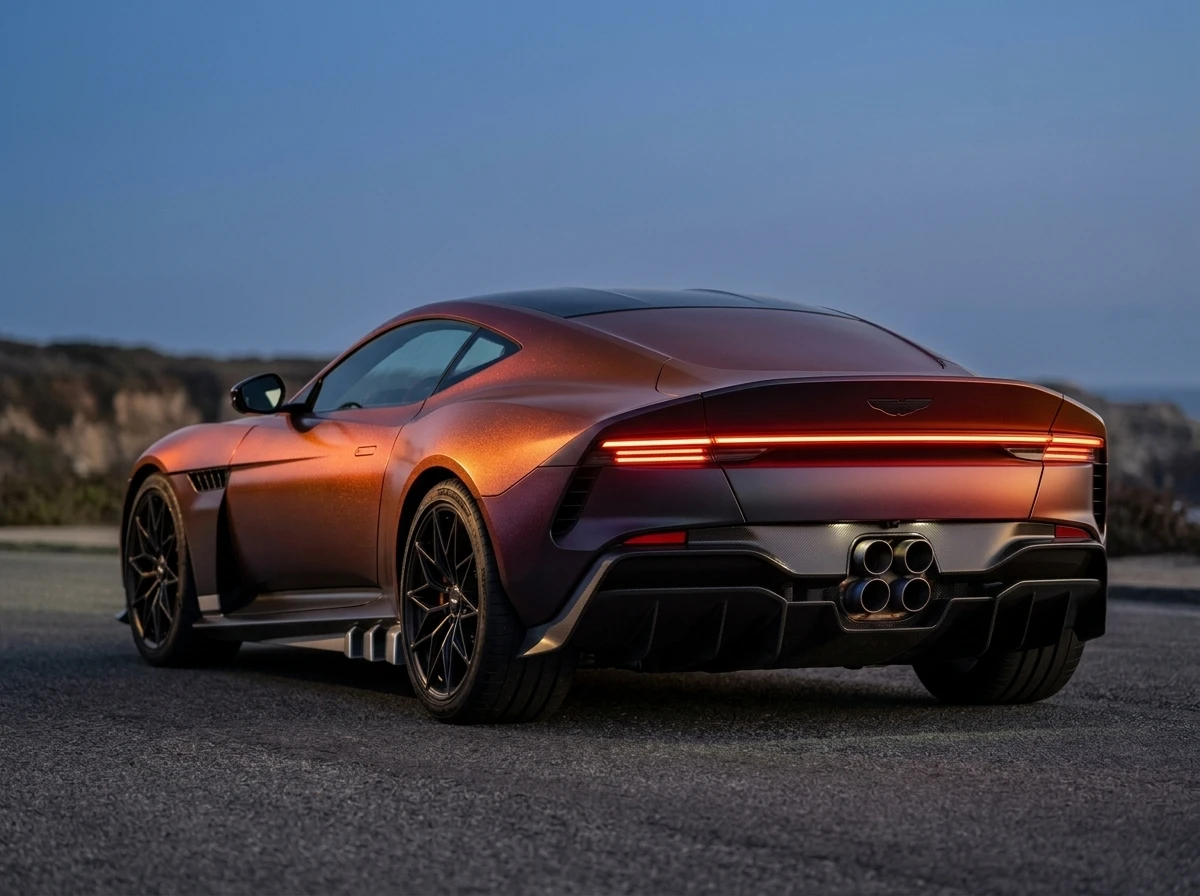
Where the Weight and Decibels Went
Carbon bodywork alone trims about 25 kg. The titanium exhaust system cuts another 14.8 kg and is engineered to sound roughly 50 percent louder than the Vanquish from outside. Engineers raised low-rpm and part-throttle volume so the car announces itself while puttering through London or Beverly Hills, yet still meets European drive-by rules. Four 3D-printed titanium tips exit in a two-up, two-down layout, two of them valved.
The rear window is gone. A solid tailgate with an integrated aerodynamic wing and full-width light bar replaces it; a camera and full-display mirror handle the view aft. The trunk still holds 170 liters and accepts an optional touring luggage set, complete with a protective cover so hot exhaust does not scorch paint or cases.
- Magnesium wheels reduce unsprung mass by 6 kg
- Optional lightweight suspension pack saves 16.9 kg
- Solid-mounted rear subframe and Bilstein DTX dampers tighten response
- Carbon-ceramic brakes (410 mm front, 360 mm rear) get a firmer booster tune
The result is a front-mid-engined car that Aston says behaves like a shorter, lighter machine while remaining usable for real journeys.
Each saving compounds the next. Less unsprung mass at the wheels lets the Bilstein DTX dampers work with smaller inputs. The solid rear subframe then feeds those inputs to the driver without the soft isolation of a pure grand tourer. The louder exhaust is not decoration alone; it is the audible proof that titanium replaced heavier steel and that the calibration team was told to keep the theater present at part throttle.
Third Time Through the V Specials Playbook
Valen continues a short, deliberate line. The Valour marked the 110th anniversary with a manual gearbox and 110 cars. The 38-unit Valiant with six-speed manual pushed aero and weight reduction further for track work. Valen keeps the carbon commitment and the raw soundtrack but switches to the automatic and raises volume to 150 cars.
- 2023, Valour debuts as manual V12 special, 110 units
- 2024, Valiant arrives as harder, lighter manual track car, 38 units
- August 2026, Valen revealed at Monterey as auto, higher-power, higher-volume special
- Q2 2027, First customer deliveries scheduled
Each project reuses the 5.2-liter twin-turbo architecture and aluminum structure. Engineering costs are largely sunk. The premium comes from carbon, titanium, magnesium, calibration hours and the Q customization process that makes every car unique.
The pattern is consistent. Anniversary storytelling on Valour gave way to track severity on Valiant. Valen now takes the automatic route, widens the buyer pool to 150, and leans hardest on sound and visual aggression. The mechanical core barely moves. The brief around it keeps sharpening.
Design That Reads Like an Antihero
Chief Creative Officer Marek Reichman described the brief as extreme emotion and an attacking stance. Slim recessed headlamps sit under a sharp bonnet brow. Side strakes stretch into long functional vents. Saw-tooth vortex generators line the sills. The rear is abrupt: no glass, exposed carbon, the light bar acting as a Gurney flap, and those stacked titanium tips.
The Monterey show car wore Satin Andromeda Red, a Q Ultra color that shifts through red, copper, gold and dark undertones. Exposed carbon in herringbone weave, tinted or gloss, is optional. Interior focus is visual lightness: a slim driver-angled center console with 3D-printed Scalmalloy components, Sport Plus seats or carbon buckets, and the Valhalla-derived switch pack.
With more power, less weight, and a spectacular soundtrack, the dramatic design is backed up by equally dramatic performance.
CEO Adrian Hallmark said those words at the reveal. The manifesto words floating around the design studio were ruthless, ominous, experimental, alter ego, antihero. The Bond association is intentional. Earlier Astons played the hero. This one is built to look like the car that would chase him.
Removing the rear glass is the clearest single decision. It hardens the tail, frees the wing and light bar to work as aero devices, and forces the camera mirror solution that keeps the cabin modern. The stacked tips and herringbone carbon then finish the message: this is not a quiet coachbuilt GT wearing extra badges.
Why 150 Cars Matter More Than the Power Figure
Starting price sits around $2 million before taxes and Q options; some reports place the base nearer $1.7 million. Either way the math is the point. One closely watched analysis on X noted that 150 cars at that price point can generate revenue on the order of hundreds of regular Astons while riding on an already-paid platform. Car and Driver reported that applicants already outnumber the 150 slots.
Aston’s mainline has faced repeated financial pressure. Special series from Q and the new SVO department have become the reliable high-margin channel. Valour and Valiant sold out to collectors who often deal directly with the factory. Valen follows the same path, aimed both at traditional clients and at younger buyers who first met the brand through the mid-engined Valhalla and want technical difference rather than pure coachbuilt elegance.
The “most powerful front-engined production car” claim rests on beating Aston’s own Vanquish by a modest margin and outranking other current front-engine V12s such as Ferrari’s naturally aspirated 12Cilindri. The qualifier list is long, yet the marketing works because the car looks and sounds the part.
Scarcity does the rest of the work. One hundred fifty units is large enough to matter on the revenue line and small enough to keep every car a commission. Demand already exceeding supply is the condition the model needs before the first delivery in 2027.
How Sunk Costs Turn Specials Into Cash
The commercial mechanism is straightforward once the hardware is viewed as shared. Valour, Valiant and Valen all draw on the same 5.2-liter twin-turbo V12 and the same aluminum structure that underpins the core Vanquish. The heavy engineering bill for that powertrain and platform is already paid. What customers fund on a Valen is the delta: carbon bodywork, titanium exhaust, magnesium wheels, suspension machining, calibration time and the Q process that makes each car unique.
- Shared V12 and aluminum structure keep base engineering costs off the special’s books
- Carbon, titanium and magnesium supply the visible and tactile premium
- SVO build and Q finish convert a platform car into a commission piece
- Unit caps of 110, 38 and now 150 protect margin and collector appetite
That is why the jump from a series Vanquish to a Valen can support a price near $2 million even when the power gap is only about 15 hp. Buyers are not paying solely for peak output. They are paying for a lighter shell, a louder exhaust, a harder calibration and a production run small enough that every example stays rare.
Valour and Valiant already showed the channel works. Both sold out through direct factory relationships. Valen widens the gate slightly with an automatic gearbox and 150 slots, then aims part of the list at clients who arrived via Valhalla and expect technical theater rather than classic elegance alone.
What the Automatic Change Signals
Valour and Valiant both used a six-speed manual. Valen switches to the eight-speed ZF automatic with Vantage GT4 shift strategies. The change is not a retreat from involvement. It is a deliberate widening of who can live with the car day to day while the rest of the package grows more extreme.
Sport, Sport+ and Track are the only modes. There is no soft GT program to blunt the throttle or exhaust. Maps still shorten for road aggression and lengthen for limit work in Track. The automatic simply removes the manual’s barrier for buyers who want the carbon body, the 850 PS output and the 50 percent louder soundtrack without working a third pedal in London traffic.
Paired with the 170-liter trunk, the optional touring luggage set and the retained Bowers & Wilkins system, the gearbox choice keeps the car inside the usable extreme rather than the pure track toy. That balance matches the allocation strategy: more units than Valiant, still few enough to feel exclusive, and equipped so owners can drive and show the cars instead of parking them as static assets.
What Drivers Will Feel
Steering is retuned for sharper on-center response and the sense of a shorter wheelbase. The electronic limited-slip differential reacts in 135 milliseconds. Helper springs and a solid rear subframe cut roll and pitch. Brake pedal feel is firmer. The exhaust routes under and behind the seats so cabin volume rises with the exterior bark.
Aston still expects owners to tour. Luggage pods sit behind the seats. The Bowers & Wilkins 1,170-watt system remains. Adaptive cruise, lane keep and a full camera suite are standard. The car is extreme in presentation and calibration, not a stripped track weapon. That balance is the bet: enough theater and performance to justify the price and the wait, enough usability that the cars get driven and shown rather than locked away.
The 325-section Pirelli P Zero R rear tires with Cyber Tyre sensors close the loop. Live data feeds the stability systems while the firmer brake booster and carbon-ceramics (410 mm front, 360 mm rear) give the driver a cleaner pedal. Nothing here is accidental. Every retune points at the same shorter, louder, more immediate character Aston promised against the core Vanquish.
First cars reach customers in Q2 2027. Every one will be a commission. No open-top version is planned. For a brand that has repeatedly relied on limited V12 statements, the Valen is the latest and loudest version of a formula that has so far paid the bills the volume cars could not cover alone.
The titanium tips will be heard first. The carbon body and the allocation list will decide who gets to keep listening.


Sony and Warner Sue Anthropic Over Torrented Song Lyrics

Microsoft 365 Auth Fault Took Down Exchange and Teams

Honor’s Robot Phone Works, Then Prices Itself Out

Florida Cities Top Retirement Rankings the Scores Cannot Explain

Walmart’s $50 Million Opioid Settlement Closes Case Without Admission

California Sues Over $120 Million Morro Bay Wind Lease Buyout

Gilead Bixlenvo FDA Nod Opens Single Pill Path for Complex HIV Cases

Meta’s $18B Kids Deal Forever Shields Data Used to Spot Under-13s

Lettuce Outbreak Drove Record Cyclospora Spike Across 20 States

Amazon Shaves $20 Off M6 Mac Mini Before It Even Ships

Take-Two CEO Pushes Netflix Subs for GTA 6 Extended Look

Quake Gets 19 Free Maps From MachineGames Quake Club

Destiny 2 Fans Unlock Vaulted Maps After Live Service Ends

Wildlands Free Update Hands Players the Tools They Already Invented

Stripe Bid Shows PayPal Moat Cracked After Years of Slide

Quordle Monday Delivers Gavel Crush Speed Ethos Cleanly

Tyson’s Five-Year Utah Plant Falls to Cattle Shortage Reckoning

Silver Lake Workday Talks Signal Private Floor for Software

Kennedy Lewis Takes Majority Control of The Greenbrier in $500M Deal

Best Buy Marks 60 Years With Sale That Echoes Its Audio Shop Roots
-

 TECHNOLOGY3 years ago
How to Adjust a Bulova Watch Band – An Easy Guide
-

 News3 years ago
Fred Pentland: Athletic Bilbao’s English mentor who changed the essence of Spanish football
-

 FINANCE3 years ago
Tax Planning for Every Season: Guide to Maximizing Your Tax Benefits
-

 Education3 years ago
African Ministers New Education Plan
-

 BUSINESS3 years ago
What is Entrepreneurial Operating System? A Comprehensive Guide to EOS
-

 Education3 years ago
Innovate Your Learning Journey with Technology and Enhance Education
-

 News3 years ago
Russians formally out of World Athletics Championships
-

 BUSINESS3 years ago
Top 9 Most Expensive American Cities to Rent an Apartment