
News
Pixel 11 Takes Battery Edge as Galaxy S26 Keeps the Power Lead
Both start at $899 but Samsung owns raw speed and stock while Google claims the bigger battery and Gemini AI tools in this Android flagship face-off.

Google unveiled the Pixel 11 this week at $899 for 256 GB, matching the Galaxy S26 base price while packing a 4,985 mAh battery and the new Tensor G6. The Samsung flagship has been on shelves since March and already carries real-world discounts, setting up a pure Android choice between fresh software and proven power.
Shoppers who want either phone right now face different clocks. One is still in pre-order. The other is in stock and often cheaper today.
The $899 Standoff Hits Different This August
Both phones open at the same $899 mark for 12 GB of RAM and 256 GB of storage, with 512 GB options higher. Google dropped the old 128 GB tier, so the Pixel 11 floor matches last year’s higher storage SKU rather than rising from a true $799 base. The Galaxy S26 launched in the same neighborhood and now sees street prices dip, with some unlocked units reported near $775.
That street gap is the first real wedge. An $899 MSRP looks identical on a spec sheet, yet a phone already clearing near $775 changes the math for anyone who treats list price as a starting point rather than a final number. Google’s pre-order window has not yet faced that pressure.
Pre-orders for the Pixel 11 are live. Units reach Google Store shelves and partners on August 20. Anyone who needs a handset this weekend can walk out with an S26 today. That availability gap matters more than the shared MSRP for buyers replacing a broken phone or locking a carrier deal.
- Pixel 11: pre-order now, shipping and retail August 20, colors Frost, Pistachio, Hibiscus, Obsidian.
- Galaxy S26: available immediately, frequent trade-in and instant discounts, colors including Cobalt Violet, White, Black, Sky Blue.
- Shared floor: 12 GB RAM + 256 GB storage at $899 before promotions.
Both promise seven years of OS and security updates. The calendar difference still tilts short-term decisions toward Samsung.
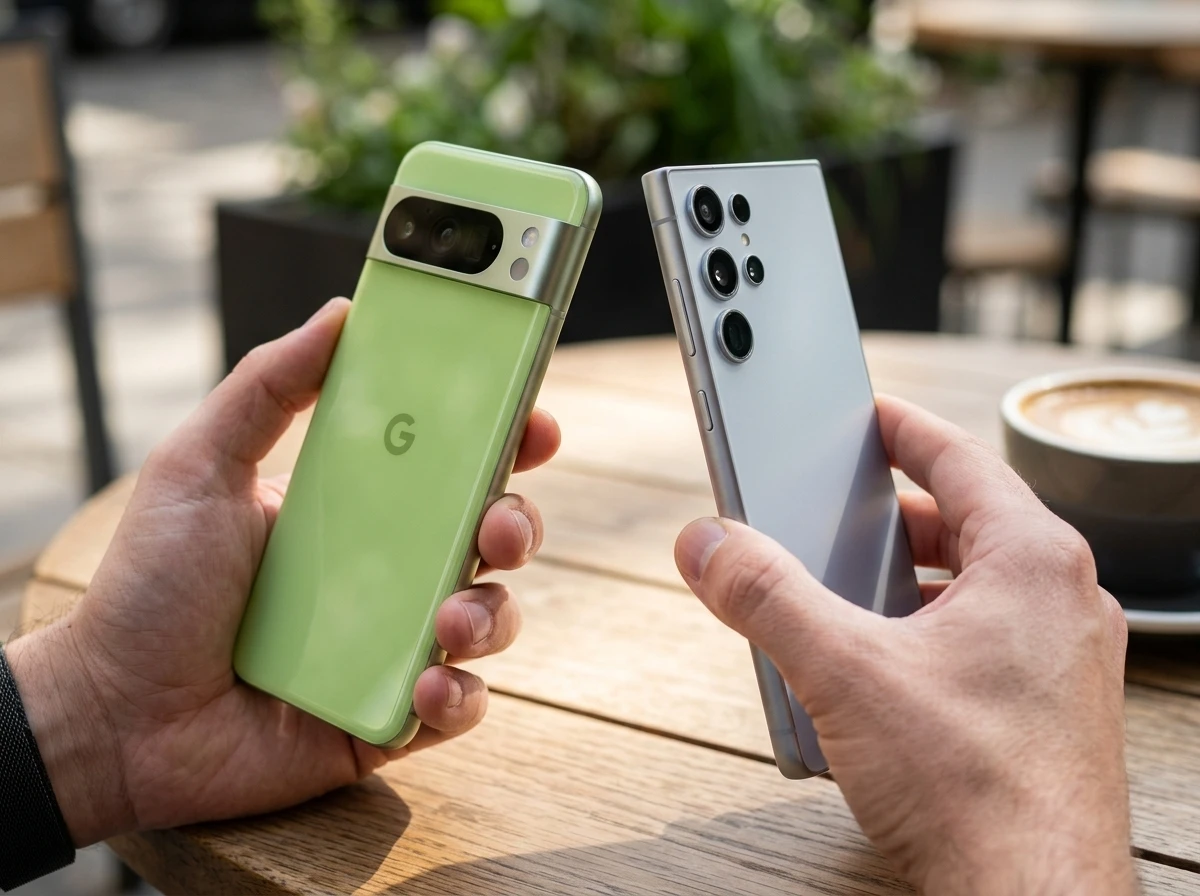
Side by Side the Numbers Line Up Close
On paper the two 6.3-inch flagships look like twins until you reach battery, weight and video. Displays both hit 120 Hz. RAM and storage bins match. Cameras sit within a few megapixels of each other.
| Spec | Google Pixel 11 | Samsung Galaxy S26 |
|---|---|---|
| Display | 6.3-inch OLED, 2424×1080, 60-120 Hz | 6.3-inch AMOLED, 2340×1080, 1-120 Hz adaptive |
| Processor | Google Tensor G6 | Snapdragon 8 Elite Gen 5 for Galaxy |
| RAM / Storage | 12 GB / 256 or 512 GB | 12 GB / 256 or 512 GB |
| Main / UW / Tele | 48 MP / 13 MP / 10.8 MP (5x) | 50 MP / 12 MP / 10 MP (3x) |
| Selfie | 10.5 MP | 12 MP |
| Video | 4K 60 fps | 8K |
| Battery | 4,985 mAh | 4,300 mAh |
| Weight | 195 g (6.9 oz) | 167 g (5.89 oz) |
| Thickness | 7.6 mm | 7.2 mm |
| OS at launch | Android 17 | Android 16 (One UI 8.5) |
| Starting price | $899 | $900 (often lower now) |
Peak brightness favors the Pixel outdoors at roughly 3,000 nits against the S26’s 2,600 nits. The Galaxy can drop to 1 Hz for efficiency while the Pixel bottoms at 60 Hz. Both carry IP68 ratings and under-display fingerprints.
Resolution and refresh tell a similar story of near parity with small lean points. The Pixel’s 2424×1080 panel edges the Galaxy’s 2340×1080 count, while Samsung’s adaptive floor down to 1 Hz is the efficiency card Google does not match. Neither gap alone decides a purchase. Together they hint at where each brand spent its engineering focus.
Snapdragon Still Runs Ahead on Raw Power
Google positions the Tensor G6 as purpose-built for Gemini. Official claims include 25 percent faster web browsing and 15 percent quicker app launches versus the G5, plus Tensor G6 packs 50% more TPU compute and up to 3.5 times faster on-device AI at lower energy. The chip moves to a MediaTek modem and keeps a security focus with the Titan M3.
Early leaked multi-core Geekbench numbers put the G6 well behind the Snapdragon 8 Elite Gen 5 for Galaxy. Some comparisons show the Pixel trailing by nearly half in multi-core versus S26 Ultra variants. That gap shows up in gaming, sustained loads and pure CPU tasks. Samsung’s customized Snapdragon also brings a larger vapor chamber and thermal claims of cooler sustained performance.
Tensor G6 highlights Google is selling:
- 50 percent more TPU compute for Gemini Nano workloads
- Up to 3.5 times faster AI tasks with lower power draw
- 25 percent faster browsing and 15 percent quicker app starts
- Efficiency first design after years of Tensor heat and drain complaints
Daily UI and AI features will feel snappy on both. Heavy multi-taskers and gamers still get more headroom on the Galaxy. That is the hardware win Samsung keeps.
The MediaTek modem shift is Google’s quiet efficiency bet after prior Tensor generations drew heat and drain complaints. Pair that with the Titan M3 security path and the G6 pitch becomes clear: specialize for on-device AI and steady daily use rather than chase peak multi-core charts. Samsung’s larger vapor chamber and cooler sustained claims answer a different buyer, the one who loads games and long CPU jobs.
Cameras Split on Software Magic Not Megapixels
Hardware sensors sit close enough that most users will not notice megapixel differences. The Pixel 11’s 48 MP main gains 56 percent more light sensitivity than its predecessor and pairs with a 13 MP ultrawide and 10.8 MP 5x telephoto that now reaches 30x Super Zoom. The S26 runs a 50 MP wide with 2x optical-quality zoom, 12 MP ultrawide and 10 MP 3x telephoto.
Video is the clear hardware split. The Galaxy records native 8K. The Pixel tops out at 4K 60 fps. Software then decides the rest.
Pixel side tools include Magic Capture, which records a short clip and automatically pulls the best stills with crop and unblur, plus Camera Looks for film-style profiles. Galaxy AI counters with Photo Assist natural-language edits, object removal, outfit changes and Horizontal Lock, a gimbal-like steady mode that keeps the horizon level even if you rotate the phone.
- Pixel zoom path: 10.8 MP 5x telephoto, Super Zoom to 30x, Magic Capture stills from short clips.
- Galaxy zoom path: 10 MP 3x telephoto, 2x optical-quality step on the main, native 8K video.
- Shared ground: AI-heavy processing, capable ultrawides, flagship selfies within a few megapixels.
Both lean hard on AI processing. Pixel owners get the newest Gemini integration and Android 17 day-one features such as improved voice-to-text cleanup. Samsung owners get deeper customization through Good Lock and Expert Raw plus years of real-world Galaxy AI polish. The camera contest is less about sensors and more about which editing style and AI assistant you prefer.
One Ounce Lighter Versus Half a Thousand Extra mAh
Hold both and the difference is immediate. The Galaxy S26 lists a 167 g weight and 4300 mAh battery in a 7.2 mm body. The Pixel 11 comes in around 195 g with the larger 4,985 mAh cell and slightly thicker 7.6 mm frame. That is nearly a full ounce and a noticeable pocket change.
| Build measure | Pixel 11 | Galaxy S26 |
|---|---|---|
| Weight | 195 g (6.9 oz) | 167 g (5.89 oz) |
| Battery | 4,985 mAh | 4,300 mAh |
| Thickness | 7.6 mm | 7.2 mm |
| Wired charging | 30 W | Similar speeds in practice |
| Wireless | 25 W Qi2.2, built-in magnets | PowerShare reverse; magnets need a case |
Google thinned the camera bar by 40 percent so the phone sits flatter with a case and wobbles less on a table. The S26 uses a translucent camera island and Armor Aluminum with Gorilla Glass Victus 2. Both feel premium. One simply disappears in the hand more easily.
Battery capacity favors the Pixel on paper. Real-world life depends on the Tensor G6’s efficiency gains versus the Snapdragon’s track record and the Galaxy’s 1 Hz display trick. Previous Pixels sometimes lost the endurance fight despite similar cells because of modem and thermal behavior. Google is betting the G6 efficiency fixes close that gap. Early claims of longer life remain unproven until independent tests land after August 20.
Charging sits in the same ballpark. Pixel offers 30 W wired and 25 W Qi2.2 with built-in magnets for PixelSnap accessories. The S26 reaches similar wired speeds in practice and supports wireless PowerShare reverse charging, though magnets require a case.
Seven Years of Updates Start on Different Clocks
Both makers now pledge seven years of OS and security updates, so the long tail of support looks matched on a brochure. The starting lines still differ. The Pixel 11 ships with Android 17 on day one. The Galaxy S26 launched on Android 16 with One UI 8.5 and has already collected months of firmware polish in the wild.
That polish gap cuts two ways. Samsung buyers inherit known battery behavior, settled camera tuning and live trade-in stacks. Pixel buyers inherit the newest platform features immediately, including improved voice-to-text cleanup and the latest Gemini hooks, with the full seven-year clock starting from Android 17 rather than a prior release.
Customization depth also splits. Good Lock and Expert Raw give Galaxy owners fine-grained control that pure Android does not mirror. Pixel owners trade that toolkit for a cleaner stock interface and earlier access to Google’s own AI stack. Neither path is incomplete. Each simply assumes a different comfort zone once the unboxing dust settles.
Availability Tilts the Scale Right Now
If you need a phone this week, the Galaxy S26 is the practical winner. It is in retail channels, often discounted, and carries months of firmware polish and known battery behavior. Trade-in values and carrier promotions are already live and competitive.
- Now through mid-August: Galaxy S26 in stock, street prices reported near $775 on some unlocked units, carrier and trade-in deals active.
- Pre-order window: Pixel 11 orders open, Google Store perks available, units not yet in hand.
- August 20: Pixel 11 ships to Google Store and retail partners, seven-year Android 17 clock starts for new owners.
If you can wait until August 20 and value pure Android, the newest Gemini features, Magic Capture and the bigger cell, the Pixel 11 is the software and capacity play. Pixel 11 pre-order starting at $899 also unlocks early Google Store perks and the full seven-year update clock from day one of Android 17.
Neither phone is a radical redesign. Both refine last year’s formula. The zero-sum pressure lands on buyers who want the lighter, faster, 8K-capable handset that is already cheap and those who want the AI-specialized, higher-capacity device that just arrived. Switching ecosystems is not required, yet choosing one still means forgoing the other’s clearest strengths.
Google’s own bet on Tensor G6 efficiency is the long-term variable. If the efficiency and AI gains deliver, the Pixel’s capacity advantage becomes real endurance. If multi-core and gaming remain distant second, the Snapdragon lead stays decisive for power users. Play Points discounts already trimming Pixel 11 pricing could narrow the immediate cost gap further once stock lands.
For now the market offers two $899 Android flagships with mirrored storage and RAM but opposite timing and priority lists. Pick the one whose win matches the job you actually need the phone to do.


Sony and Warner Sue Anthropic Over Torrented Song Lyrics

Microsoft 365 Auth Fault Took Down Exchange and Teams

Honor’s Robot Phone Works, Then Prices Itself Out

Florida Cities Top Retirement Rankings the Scores Cannot Explain

Walmart’s $50 Million Opioid Settlement Closes Case Without Admission

California Sues Over $120 Million Morro Bay Wind Lease Buyout

Gilead Bixlenvo FDA Nod Opens Single Pill Path for Complex HIV Cases

Meta’s $18B Kids Deal Forever Shields Data Used to Spot Under-13s

Lettuce Outbreak Drove Record Cyclospora Spike Across 20 States

Amazon Shaves $20 Off M6 Mac Mini Before It Even Ships

Take-Two CEO Pushes Netflix Subs for GTA 6 Extended Look

Quake Gets 19 Free Maps From MachineGames Quake Club

Destiny 2 Fans Unlock Vaulted Maps After Live Service Ends

Wildlands Free Update Hands Players the Tools They Already Invented

Stripe Bid Shows PayPal Moat Cracked After Years of Slide

Quordle Monday Delivers Gavel Crush Speed Ethos Cleanly

Tyson’s Five-Year Utah Plant Falls to Cattle Shortage Reckoning

Silver Lake Workday Talks Signal Private Floor for Software

Kennedy Lewis Takes Majority Control of The Greenbrier in $500M Deal

Best Buy Marks 60 Years With Sale That Echoes Its Audio Shop Roots
-

 TECHNOLOGY3 years ago
How to Adjust a Bulova Watch Band – An Easy Guide
-

 News3 years ago
Fred Pentland: Athletic Bilbao’s English mentor who changed the essence of Spanish football
-

 FINANCE3 years ago
Tax Planning for Every Season: Guide to Maximizing Your Tax Benefits
-

 Education3 years ago
African Ministers New Education Plan
-

 BUSINESS3 years ago
What is Entrepreneurial Operating System? A Comprehensive Guide to EOS
-

 Education3 years ago
Innovate Your Learning Journey with Technology and Enhance Education
-

 News3 years ago
Russians formally out of World Athletics Championships
-

 BUSINESS3 years ago
Top 9 Most Expensive American Cities to Rent an Apartment