
Health
FDA Class I Tag Hits Finished Egg Recall Weeks Later
Nearly 19 million eggs already recalled in July now carry the FDA’s highest Class I risk label for salmonella, with 98 illnesses and open questions on other sources.

The Food and Drug Administration this week gave its highest-risk Class I label to a July recall of nearly 19 million eggs after samples from Texas farms matched a Salmonella Enteritidis outbreak strain. Midwest Poultry Services, L.P. had already pulled the product weeks earlier as a precaution.
The timing leaves many cartons potentially still sitting in refrigerators while investigators say the company does not explain every illness. The gap between the voluntary pull and the formal risk label is now the part of the story that reaches households still holding product.
The Label Landed After the Pull Finished
On Wednesday the agency classified the action Class I. That designation means there is a reasonable probability of serious adverse health consequences or death from use or exposure.
Midwest Poultry voluntarily recalled the eggs on July 22. A company representative pointed Friday to a statement from Emily Metz, president and chief executive of the American Egg Board.
What you’re seeing in the news today is not a new recall. Midwest Poultry voluntarily recalled affected eggs out of an abundance of caution for consumer health and safety, and that recall is already complete.
The FDA itself noted that classification follows a risk determination and “should not be seen as an expansion or change to a firm’s voluntary public warning.”
Product moved into stores and homes in June and early July. The hazard rating arrived in mid-August, after most sell-by dates had begun to expire and after many households had already used or discarded the eggs. The delay does not soften the risk language. It does change who still needs to act.
The sequence of public milestones already in the record runs as follows:
- November 21, 2025 – earliest illness onset in the outbreak window
- June 6 to July 3, 2026 – production dates for the recalled Texas lots
- June 30, 2026 – latest illness onset reported so far
- July 22, 2026 – Midwest Poultry voluntary recall announced
- July 20 through August 17, 2026 – sell-by and best-by range on affected cartons
- Mid-August (Wednesday) – FDA Class I classification issued
Read in order, those dates show why a finished recall can still generate new urgency. Eggs left the farms before the July notice. The top risk label arrived only after many of those cartons had already reached kitchens.
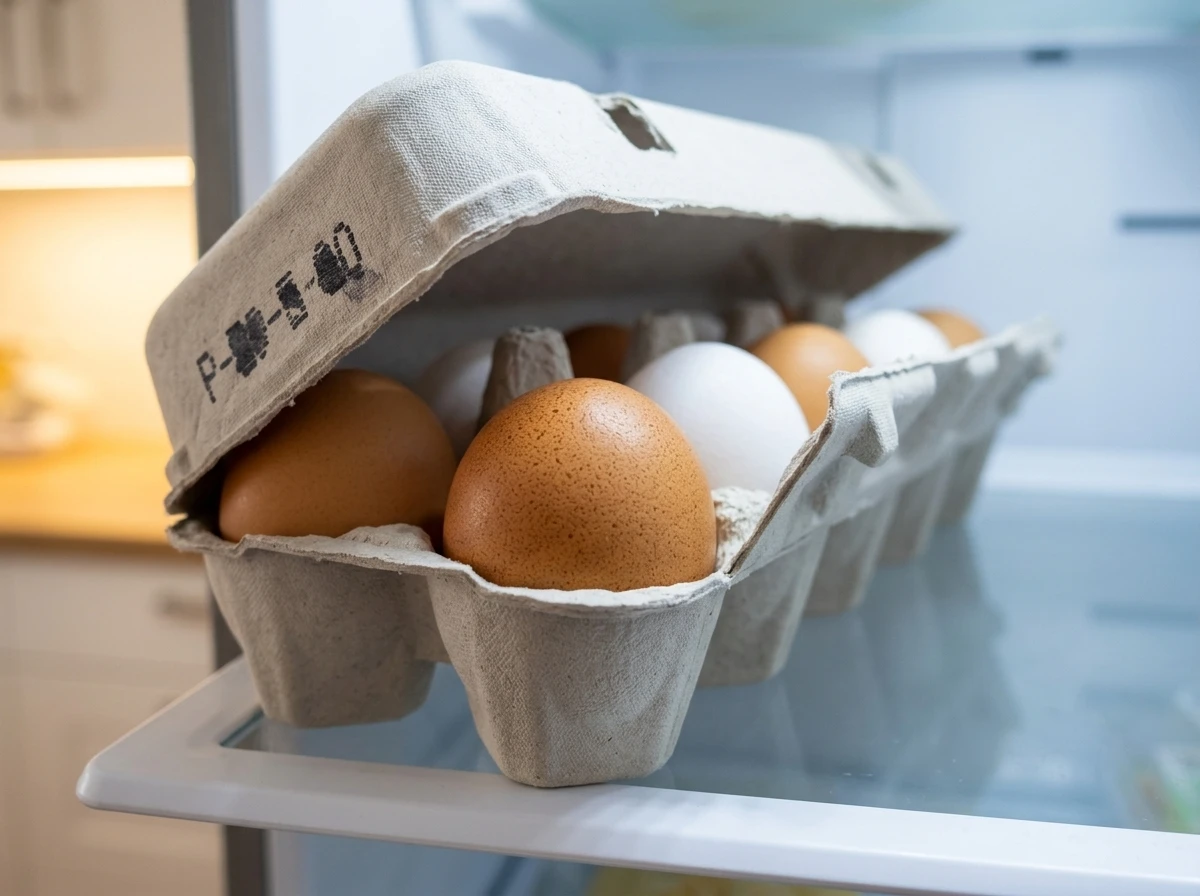
Exact Codes Printed on the Carton Sides
The firm recalled 1,589,577 dozen white and brown eggs produced on its Texas farms between June 6 and July 3, 2026. Sell-by or best-by dates run from July 20 through August 17, 2026. That volume is the nearly 19 million eggs cited in the Class I notice.
Only cartons carrying plant codes P-1950 or 0840962 with Julian dates 157 through 184 are included. The codes appear in date-coding ink on the left or right side of the carton, not the top. Shoppers who check only the lid or the front panel can miss the match.
| Brand / Description | Size Examples | Key Identifier |
|---|---|---|
| Kroger white shell | 12, 18, 30, 60 ct; medium to jumbo | P-1950 or 0840962 |
| Simple Truth cage-free brown | 12, 18, 24 ct medium/large | P-1950 |
| Brookshire’s | 6, 12, 18, 36, 60 ct large/jumbo | P-1950 |
| Country Morning | 12, 18, 30 ct medium to jumbo | P-1950 |
| Sunups / Cal-Maine | 30 ct medium bulk | P-1950 |
| Bulk foodservice grades | 15- and 30-dozen packs | P-1950 |
Retail and foodservice shipments went to Texas, Oklahoma and Louisiana. Consumers could find them at Kroger stores in Texas and Louisiana, Brookshire Grocery outlets in Texas, Oklahoma, Arkansas and Louisiana, plus smaller retailers and foodservice accounts that also reached Mississippi and New Mexico.
Bulk 15- and 30-dozen packs widen the exposure path beyond home kitchens. A single foodservice cooler can hold product that later appears in prepared meals rather than in a labeled carton a diner can inspect.
Outbreak Numbers Leave Room for Other Sources
CDC and FDA data show 98 cases and 26 hospitalizations across 17 states. Illness onset dates stretch from November 21, 2025, to June 30, 2026. No deaths have been reported.
- 98 confirmed infections with the outbreak strain
- 26 people hospitalized
- 0 deaths
- 17 states with cases: AZ, CA, CO, GA, IL, LA, MI, MO, MS, NC, NM, NV, NY, OK, SC, TX, WV
Of 44 people with available food history, 40 (91 percent) reported eating eggs before they got sick. Laboratory work, epidemiology and traceback pointed to Midwest Poultry eggs as a likely source. Farm environmental samples collected by the company tested positive; whole-genome sequencing matched the outbreak strain.
Yet the producer does not account for all the illnesses. FDA said additional investigation continues to determine whether other sources exist. That open question shaped the late Class I decision: the risk is real enough for the top designation, but the map of exposure is incomplete.
Hospitalization at 26 of 98 confirmed infections is a sizable share of the known case count. The zero death figure does not cancel that severity signal. It helps explain why the agency still applied its highest-risk label after the voluntary pull was already done.
How Investigators Tied the Farms to Cases
The public record describes a three-part chain rather than a single test result. Epidemiology first showed that egg exposure was common among people who got sick. Traceback then pointed at product from the Texas farms. Laboratory work closed the loop when environmental samples and whole-genome sequencing matched the outbreak strain.
Each leg of that chain carries a different kind of weight:
- Food histories – 40 of 44 interviewed patients (91 percent) reported eating eggs before illness.
- Company monitoring – Midwest Poultry found contamination through its own environmental sampling and root-cause work.
- Genetic match – sequencing linked farm samples to the strain already circulating in patients.
The firm has said it was not aware of specific illnesses linked to its products when it announced the July recall. That statement sits beside the later CDC and FDA case totals without canceling them. Voluntary action based on farm findings can precede a full patient count, and it did so here.
Because the investigation remains open on other possible sources, the match to Midwest Poultry is described as a likely source rather than the sole source. Class I still applies to the eggs that were recalled. It does not freeze the broader search.
Brands That Carried the Eggs Into Stores
The cartons left the Texas farms under multiple private-label and house brands. Shoppers who never heard of Midwest Poultry still brought the product home under names they trust.
Kroger and its Simple Truth line, Brookshire’s, Country Morning and Cal-Maine Sunups all appear on the official list. Bulk packs went to foodservice without retail branding. Once eggs move under a grocery banner, the brand owns the consumer relationship even when the farm owns the recall.
Midwest Poultry said it identified the issue through its own environmental monitoring and root-cause work. It stopped distributing fresh eggs from the two Texas farms. The firm stated it was not aware of specific illnesses linked to its products at the time of the July announcement.
Private-label packaging is why code checks matter more than brand memory. A household may remember buying Kroger or Brookshire’s eggs and still need to read the side ink for P-1950 or 0840962 and the Julian range. The farm name on the recall notice is not the name most people saw at the shelf.
Shipping Paths and Case States Only Partly Match
Documented retail and foodservice destinations for the recalled lots are concentrated in a smaller set of states than the full outbreak map. The comparison does not prove extra sources on its own. It does show why FDA continues to look past a single farm network.
| Lens | States named in the record |
|---|---|
| Primary shipment states | Texas, Oklahoma, Louisiana |
| Extended retail and foodservice reach | Arkansas, Mississippi, New Mexico |
| Outbreak case states (17) | AZ, CA, CO, GA, IL, LA, MI, MO, MS, NC, NM, NV, NY, OK, SC, TX, WV |
Texas, Oklahoma, Louisiana, Mississippi and New Mexico appear on both the shipping side and the case list. Other case states sit farther from the named distribution footprint. People also travel, and eggs move through foodservice menus that do not carry retail plant codes to the plate.
Those facts leave two ideas in play at once. Matching farm samples and traceback make Midwest Poultry eggs a likely source for a large share of known illnesses. The wider case geography keeps open the possibility that additional sources still belong in the investigation.
What Class I Changes for Households Right Now
Class I does not restart the recall or add new product codes. It elevates the public language around a finished action. For anyone who still has matching cartons, the practical steps stay the same and are more urgent.
- Check the side of every egg carton for P-1950 or 0840962 and Julian dates 157-184.
- Throw recalled eggs away or return them for a refund; do not eat them.
- If eggs were removed from the original carton and the code is lost, discard them.
- Wash hands, utensils, counters and containers that touched the eggs with hot soapy water.
- Sanitize surfaces that may have held the cartons.
Salmonella symptoms usually start 12 to 72 hours after exposure and last four to seven days: diarrhea, fever and abdominal cramps. Young children, older adults and people with weakened immune systems face higher odds of severe illness that can reach the bloodstream.
People who develop high fever, bloody diarrhea, prolonged symptoms or signs of dehydration should contact a health care provider. The same tracking logic that local departments use when they map measles clusters applies here; see how local health officials track outbreaks for the parallel reporting chain.
Sell-by dates that run into mid-August are the reason a Wednesday Class I notice still has a direct audience. Unopened cartons can outlast the first wave of July headlines. Foodservice stock in coolers can lag even further behind retail turn rates.
Internal Contamination Changes the Kitchen Math
Salmonella Enteritidis can infect the inside of an egg before the shell forms. Surface washing therefore offers limited protection once the egg is cracked. Cooking eggs until both white and yolk are firm reduces risk; recipes that use raw or lightly cooked eggs (hollandaise, homemade mayonnaise, soft-boiled) carry higher exposure.
FDA guidance on buying, storing and cooking eggs remains the everyday baseline. Refrigerate promptly, keep eggs in their carton, and follow the FDA egg safety handling advice that covers temperature and cross-contamination.
Crowd discussion on X noted the internal-contamination detail immediately after the Class I news broke: washing the shell does not neutralize bacteria already inside. That observation matches the science and explains why the agency stresses cooking and discard over simple rinsing.
For households deciding what to do tonight, the hierarchy is simple.
- Matching codes: discard or return, then clean.
- Unknown codes after eggs left the carton: discard.
- Unrelated cartons kept for meals: cook until white and yolk are firm.
Sell-by dates on the recalled lots run through mid-August. Some households may still hold unopened cartons past the initial July headlines. The Class I language is aimed at those remaining packages and at any foodservice stock still in coolers.
What the Gap Between Recall and Rating Reveals
Midwest Poultry acted on its own test results and notified FDA before the public announcement. The outbreak investigation had already logged cases for months. Classification came later, after the risk-to-health review.
That sequence is standard FDA process. It also means the most severe public label can arrive after product has already moved through the supply chain and into kitchens. Consumers who checked once in late July and threw nothing away may need a second look now that the risk language has sharpened.
The investigation remains open. Additional sources of the same Salmonella strain have not been ruled out. Until that work closes, the Class I designation stands as a permanent risk flag on a completed recall rather than a fresh product withdrawal.
Voluntary speed and regulatory labeling run on different clocks. The company pull on July 22 aimed to stop further distribution from the two Texas farms. The Wednesday Class I action aimed to harden public understanding of what those already-shipped eggs could still do in a refrigerator or a cooler.
For now the concrete steps are local and immediate: read the side of the carton, match the codes, discard or return, and clean the surfaces. The eggs that left Texas farms in June and early July have already lived most of their retail life. The highest-risk label simply confirms what the matching farm samples and the 26 hospitalizations already showed.


Stripe Bid Shows PayPal Moat Cracked After Years of Slide

FDA Class I Tag Hits Finished Egg Recall Weeks Later

Berkshire’s Alphabet Surge Marks Abel’s Cash Deployment Shift

Aston Martin Bets 150 Valen V12s Will Print the Cash

Walmart Took Most of the Recalled Lettuce Behind Cyclospora Wave

Silver Lake Workday Talks Signal Private Floor for Software

Zuckerberg’s AI Letter Joins a Wave of Tech Manifestos

Pixel 11 Takes Battery Edge as Galaxy S26 Keeps the Power Lead

Trump Economy Faces Reckoning as Sentiment and Sales Slide

Apple’s 15% External Cut Still Faces Its Own Zero Admission

ZA/UM Lays Off 32 Staff as Zero Parades Wins Reviews, Not Players

EA’s New In-Game Ad Platform Skips the Games That Need It Most

Mortgage Rates Climb to 6.55%, the Highest Level in Nearly a Year

Colby Covington Stuns Tsarukyan as Askren Retires in Tears at RAF 11

Netflix Heads Into Earnings With Its 2022 Playbook Already Spent

Spain’s Diaspora-Rooted Squad Wins Over New York Ahead of the Final

NHL’s Monday Matinee Push Puts Capitals Fans on the Clock

Guardians Rout Twins With Seven Homers, Leave Joe Ryan One Shy of Record

DeChambeau’s Two-Shot Penalty Rewrites the Open’s Weekend Draw

England Beats France 6-4 to Claim World Cup Bronze Medal
-

 TECHNOLOGY3 years ago
How to Adjust a Bulova Watch Band – An Easy Guide
-

 News3 years ago
Fred Pentland: Athletic Bilbao’s English mentor who changed the essence of Spanish football
-

 FINANCE3 years ago
Tax Planning for Every Season: Guide to Maximizing Your Tax Benefits
-

 Education3 years ago
African Ministers New Education Plan
-

 BUSINESS3 years ago
What is Entrepreneurial Operating System? A Comprehensive Guide to EOS
-

 Education3 years ago
Innovate Your Learning Journey with Technology and Enhance Education
-

 News3 years ago
Russians formally out of World Athletics Championships
-

 BUSINESS3 years ago
Top 9 Most Expensive American Cities to Rent an Apartment