
AUTOMOBILE
Revuelto SV Revives Super Veloce 55 Years After Miura
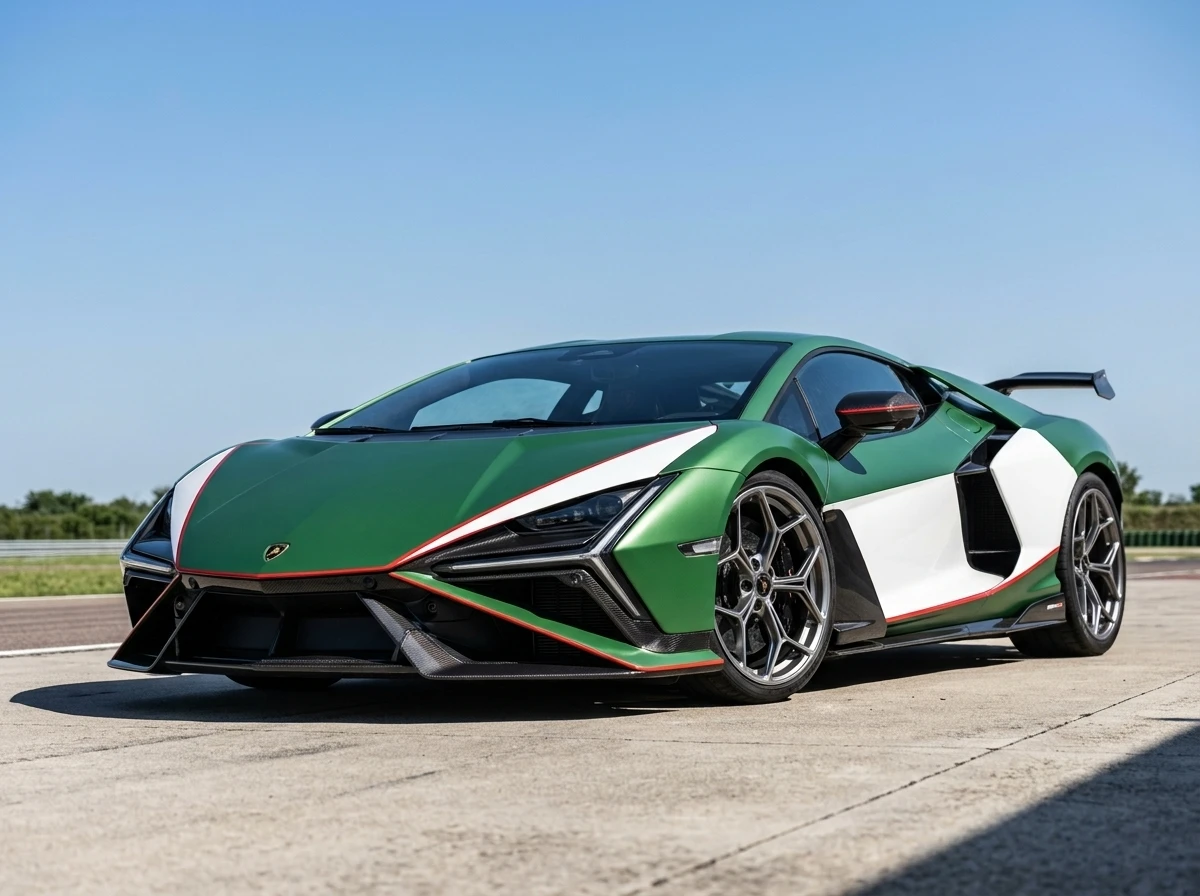
Limited to 1,963 units, the hybrid Revuelto SV delivers 80 percent more downforce and a 1:41.6 Hockenheim lap as Super Veloce returns after the Miura.

Lamborghini’s Revuelto SV delivers 1,065 CV, 80 percent more downforce than the standard car and a 2.4-second sprint to 100 km/h as a limited run of 1,963 hybrids. Unveiled 14 August 2026, it is the brand’s most powerful production model and the latest Super Veloce, 55 years after the Miura SV.
The numbers are only half the claim. Product line director Alessandro Farmeschi calls the goal “the quantum of driving,” the instant the car and driver lock together so completely that everything else drops away. That phrase frames every upgrade that follows: aero that holds the nose, brakes that refuse to fade, and a battery that keeps the electric half of the powertrain honest lap after lap.
The Numbers That Separate SV From Base Revuelto
The plug-in hybrid layout stays familiar: a 6.5-liter naturally aspirated V12 paired with three electric motors. Output climbs roughly 50 CV to 1,065 CV and 1,425 Nm of system torque. Peak V12 power is 825 CV at 9,250 rpm with a 9,500-rpm redline. The eight-speed dual-clutch shifts 30 percent faster.
A revised 7.3 kWh high-voltage battery (90 percent more capacity and 35 percent higher peak power output versus the standard Revuelto’s pack) supplies the extra and, more important, far greater consistency across a hard lap. Lamborghini quotes up to four times better performance repeatability under sustained track use. Power-to-weight reaches 1.66 kg/CV against 1.75 kg/CV for the base car. Dry weight is listed at 1,772 kg.
| Metric | Revuelto SV | Standard Revuelto |
|---|---|---|
| Combined power | 1,065 CV (783 kW) | ~1,015 CV |
| System torque | 1,425 Nm | ~1,062 Nm |
| 0-100 km/h | 2.4 s | 2.5 s |
| 0-200 km/h | 6.7 s | n/a |
| Top speed | >345 km/h | ~350 km/h |
| Downforce vs base | +80 % | baseline |
| Power-to-weight | 1.66 kg/CV | 1.75 kg/CV |
| Battery capacity | 7.3 kWh | ~3.8 kWh |
Full official Revuelto SV technical specifications remain in type-approval stage for consumption figures. Electric-only range sits near 15 km, enough for silent driveway exits or restricted zones.
The sprint gains look modest on paper until the torque and battery columns are read together. System torque jumps well beyond the base car’s figure, and the larger pack is what keeps that torque available when a standard hybrid would begin to protect its cells. The 0.09 kg/CV power-to-weight edge is the quiet result of that balance rather than a crash diet alone.
Super Veloce Began With the 1971 Miura
SV has always meant Super Veloce, superfast. The badge first appeared on the Miura SV in 1971, a lighter, more powerful, sharper-handling evolution of Lamborghini’s original mid-engine masterpiece. After a long absence it returned on the Diablo SV, then the Murciélago SV and the Aventador SuperVeloce and SVJ.
- 1971 Miura SV: the origin, more power, less weight, wider track
- 1995-1999 Diablo SV: stripped, louder, more focused road version
- 2009-2010 Murciélago LP 670-4 SuperVeloce: carbon diet and aero
- 2015 Aventador LP 750-4 SuperVeloce and later SVJ: extreme aero and track times
- 2026 Revuelto SV: hybrid consistency added to the same formula
Each generation followed the same logic: cut mass, raise power, sharpen chassis and aero, limit volume. The Revuelto SV continues that line with motorsport-derived dampers, CCM-R Plus brakes and a fixed double-element rear wing. Chairman and CEO Stephan Winkelmann called it Lamborghini DNA in its purest form.
What changes in 2026 is the toolset, not the intent. Earlier Super Veloces chased lightness and peak output in isolation. This one still does both, yet it also treats electrical endurance as a chassis attribute. The badge still signals a car built for the driver who wants the flagship turned up, only now the volume knob stays up for longer.
How the Aero and Brakes Glue the Front End
The front bumper is new. An angled fin seals the wheel wells and feeds the side coolers. Front downforce doubles versus the base Revuelto. The rear wing merges two motorsport profiles with a Gurney flap that also improves radiator extraction. Total downforce rises 80 percent; aerodynamic efficiency (downforce-to-drag) climbs 60 percent. Lamborghini notes the figure is also 10 percent higher than the Aventador SVJ.
Key gains over standard Revuelto
- +80 % total downforce
- +100 % front-end downforce balance
- +60 % aero efficiency
- +17 % agility and +10 % lateral grip from GT3-derived adjustable dampers
- +11 % peak deceleration and better heat management from CCM-R Plus discs
The CCM-R Plus carbon-ceramic discs are larger and thicker, with radial ventilation holes and floating construction. An Integrated Brake Control system reads inertia in real time. Front discs measure roughly 16.5 inches. Drivers can brake later and harder with less fade.
Doubling front downforce matters because a mid-engine hybrid already carries mass ahead of the cockpit in the form of motors and pack. The angled fin and sealed wells push load onto the nose so the axial-flux motors can vector without the front axle washing wide. The same airflow that cools the side radiators therefore does double duty as a handling aid.
On the other end of the car, the fixed double-element wing and Gurney flap trade some top-speed margin for stable rear load. The base Revuelto’s roughly 350 km/h claim sits a shade higher than the SV’s figure above 345 km/h. That is the efficiency bargain made explicit: more grip in the braking zone and mid-corner, a few kilometers per hour left on the table in a straight line.
Why the Bigger Battery Matters More Than Peak Power
The extra 50 CV is real, yet Farmeschi stresses consistency. The upgraded pack keeps electrical boost available lap after lap instead of fading. Torque vectoring from the front axial-flux motors stays sharper. The hybrid system also lets the car crawl out of residential streets in silence, a small social grace Farmeschi noted with a grin.
With Revuelto SV, our goal was to give the driver an even more direct, racing-inspired and emotional connection with the car. Every element, from the enhanced aerodynamics\ldots to the new Pilota driving mode, has been developed to maximize confidence, consistency and driving engagement.
Alessandro Farmeschi, Revuelto product line director, said those words while explaining why the battery weight is worth carrying. After Lamborghini shelved pure-electric sports-car plans, the company doubled down on high-performance electrified vehicles. The approach contrasts with the uneven public reception to the Ferrari Luce, a reminder that specialized makers still walk a narrow path between tradition and regulation.
Four times better performance repeatability is the line that separates a headline horsepower figure from a car that still pulls hard on lap three. The 90 percent capacity jump and 35 percent higher peak output give the front motors a deeper well to draw from, so vectoring does not soft-pedal when cell temperatures climb. Peak power sells the brochure; sustained boost sells the stopwatch.
Pilota Mode Puts Five Levels of Race Electronics on the Wheel
A red helmet icon and rotary on the steering wheel activate Pilota, a five-stage traction and stability program drawn from Lamborghini’s GT racing program. A six-dimensional sensor in the center tunnel feeds vertical, lateral, longitudinal, roll and pitch data. Drivers can loosen the car for rotation or keep it precise, matching personal style and track surface. Presets exist for flat, bumpy or wet conditions.
What the driver can shape from the wheel
- Five traction and stability stages, from tight to loose
- Six-dimensional sensor data: vertical, lateral, longitudinal, roll and pitch
- Surface presets for flat, bumpy or wet tracks
- Red helmet icon and rotary integrated with the ANIMA selector
Interior carbon multiplies. Standard Sport seats use carbon shells; optional monocoque Race seats cut more weight and add lateral support. Carbon door panels replace conventional trim. The ANIMA drive-mode selector and Pilota controls sit in red. Bridgestone Potenza Race R semi-slicks are developed specifically for the car; winter Blizzaks are optional. Optional 20/21-inch Dromos center-lock forged wheels echo race monolock practice.
Pilota is the electronic half of Farmeschi’s quantum idea. The hardware already multiplies downforce, bite and boost consistency. The five-stage program lets the driver decide how much of that hardware the computers are allowed to polish. A bumpy-preset run with a looser stage will feel different from a flat-track, high-intervention setup even though the wing, dampers and battery remain the same.
Only 1,963 Cars and a Fresh Hockenheim Benchmark
Production is capped at 1,963 units, a direct nod to the year Automobili Lamborghini was founded. Deliveries begin in early 2027. Pricing remains unannounced. The base Revuelto starts above $600,000; observers place the SV between roughly $650,000 and $750,000 before options and Ad Personam customization.
- 6 August 2026, factory driver Marco Mapelli records a 1:41.6 production-car lap at Hockenheimring, the fastest yet for a street-legal car at the circuit.
- 14 August 2026, world premiere at The Quail during Monterey Car Week.
- Late 2026 / early 2027, production ramp and first customer deliveries.
Mapelli described extraordinary harmony between car and driver that inspired confidence at the limit. Winkelmann framed the record as proof that innovation and emotion still translate into measurable results. On X, Lamborghini’s own reveal post drew heavy engagement; replies split between pure excitement and design critiques that the shape still echoes the Aventador generation too closely. The fixed wing and aggressive front leave little doubt about track intent, even if some fans wanted a more radical silhouette.
Collectors who already chase SV badges will treat the 1,963-car run as the modern equivalent of earlier limited Super Veloces. The same buyers who sample Lamborghini’s wider brand experiments now have a clear halo for the hybrid V12 era.
Hybrid Consistency Extends the Super Veloce Formula
Strip the Revuelto SV back to its inherited logic and the checklist is familiar: more power, sharper aero, firmer chassis hardware, a hard cap on volume. The new variable is how long the car can hold that peak character.
Earlier Super Veloces answered fade with lighter bodywork and louder exhausts. This one answers it with a 7.3 kWh pack that is larger and stronger than the base car’s unit, plus dampers and brakes drawn from GT work. The result is a Super Veloce defined as much by repeatability as by a single hot lap.
- Power and torque rise, yet the battery’s endurance claim is the larger shift
- Aero efficiency up 60 percent keeps the extra downforce from becoming pure drag
- Pilota’s five stages let drivers spend that grip and boost on their own terms
- A 1,963-unit ceiling keeps the badge scarce in the collector market
Farmeschi’s “quantum of driving” line is marketing language, yet it maps onto the hardware. When boost, front-axle vectoring and brake temperature stay predictable, the driver stops managing systems and starts placing the car. That is the mechanism the larger battery and CCM-R Plus discs are built to protect.
The Hockenheim Lap Ties the Package Together
Mapelli’s 1:41.6 at Hockenheimring arrived eight days before the Quail premiere. The timing was deliberate: a production-car circuit benchmark first, then the public unveil. Winkelmann treated the time as evidence that the hybrid V12 path still produces emotion you can measure.
Read against the spec sheet, the lap is less a mystery. Eighty percent more downforce, doubled front load, faster shifts, and electrical boost that does not fall away all shorten the same corners. The six-dimensional sensor and Pilota stages give a factory driver the authority to run closer to the limit without guessing what the car will do next.
Public reaction on X split along familiar lines. Enthusiasts cheered the record and the 1,065 CV figure. Critics saw Aventador echoes in the silhouette and wanted a cleaner break. Neither camp disputed the track intent signaled by the fixed wing and the aggressive front. For collectors, the argument is simpler: the run is finite, the badge is SV, and the Hockenheim number gives the car a date-stamped claim no base Revuelto holds.
Frequently Asked Questions
What does SV stand for on a Lamborghini?
SV means Super Veloce, Italian for superfast. The designation began with the 1971 Miura SV and has marked higher-performance, lighter, more aero-focused versions of subsequent flagships including the Diablo, Murciélago, Aventador and now Revuelto.
How many Lamborghini Revuelto SV cars will be built?
Exactly 1,963 units worldwide. The number commemorates the year Automobili Lamborghini was founded and reserves the model for the brand’s most loyal customers and collectors.
What is the 0-100 km/h time of the Revuelto SV?
Lamborghini quotes 2.4 seconds to 100 km/h (62 mph) and 6.7 seconds to 200 km/h. Top speed exceeds 345 km/h. The figures place it among the quickest production cars the company has ever built.
How much power does the Revuelto SV hybrid system make?
Combined output is 1,065 CV (783 kW) and 1,425 Nm of system torque. The 6.5-liter V12 alone produces 825 CV; three electric motors and the upgraded 7.3 kWh battery supply the rest and sustain boost under repeated hard use.
Did the Revuelto SV set a lap record?
Yes. On 6 August 2026, factory driver Marco Mapelli posted a 1:41.6 lap at the Hockenheimring, the fastest time recorded by a production car at that circuit before the model’s public debut.
The Super Veloce formula has never been about restraint. Fifty-five years on, the Revuelto SV simply applies it to a hybrid V12 that refuses to fade on the third flying lap.


Stripe Bid Shows PayPal Moat Cracked After Years of Slide

FDA Class I Tag Hits Finished Egg Recall Weeks Later

Berkshire’s Alphabet Surge Marks Abel’s Cash Deployment Shift

Aston Martin Bets 150 Valen V12s Will Print the Cash

Walmart Took Most of the Recalled Lettuce Behind Cyclospora Wave

Silver Lake Workday Talks Signal Private Floor for Software

Zuckerberg’s AI Letter Joins a Wave of Tech Manifestos

Pixel 11 Takes Battery Edge as Galaxy S26 Keeps the Power Lead

Trump Economy Faces Reckoning as Sentiment and Sales Slide

Apple’s 15% External Cut Still Faces Its Own Zero Admission

ZA/UM Lays Off 32 Staff as Zero Parades Wins Reviews, Not Players

EA’s New In-Game Ad Platform Skips the Games That Need It Most

Mortgage Rates Climb to 6.55%, the Highest Level in Nearly a Year

Colby Covington Stuns Tsarukyan as Askren Retires in Tears at RAF 11

Netflix Heads Into Earnings With Its 2022 Playbook Already Spent

Spain’s Diaspora-Rooted Squad Wins Over New York Ahead of the Final

NHL’s Monday Matinee Push Puts Capitals Fans on the Clock

DeChambeau’s Two-Shot Penalty Rewrites the Open’s Weekend Draw

Guardians Rout Twins With Seven Homers, Leave Joe Ryan One Shy of Record

England Beats France 6-4 to Claim World Cup Bronze Medal
-

 TECHNOLOGY3 years ago
How to Adjust a Bulova Watch Band – An Easy Guide
-

 News3 years ago
Fred Pentland: Athletic Bilbao’s English mentor who changed the essence of Spanish football
-

 FINANCE3 years ago
Tax Planning for Every Season: Guide to Maximizing Your Tax Benefits
-

 Education3 years ago
African Ministers New Education Plan
-

 BUSINESS3 years ago
What is Entrepreneurial Operating System? A Comprehensive Guide to EOS
-

 Education3 years ago
Innovate Your Learning Journey with Technology and Enhance Education
-

 News3 years ago
Russians formally out of World Athletics Championships
-

 BUSINESS3 years ago
Top 9 Most Expensive American Cities to Rent an Apartment