
FINANCE
Netflix Stock Sinks Nearly 9% on a Revenue Miss and Weak Guidance
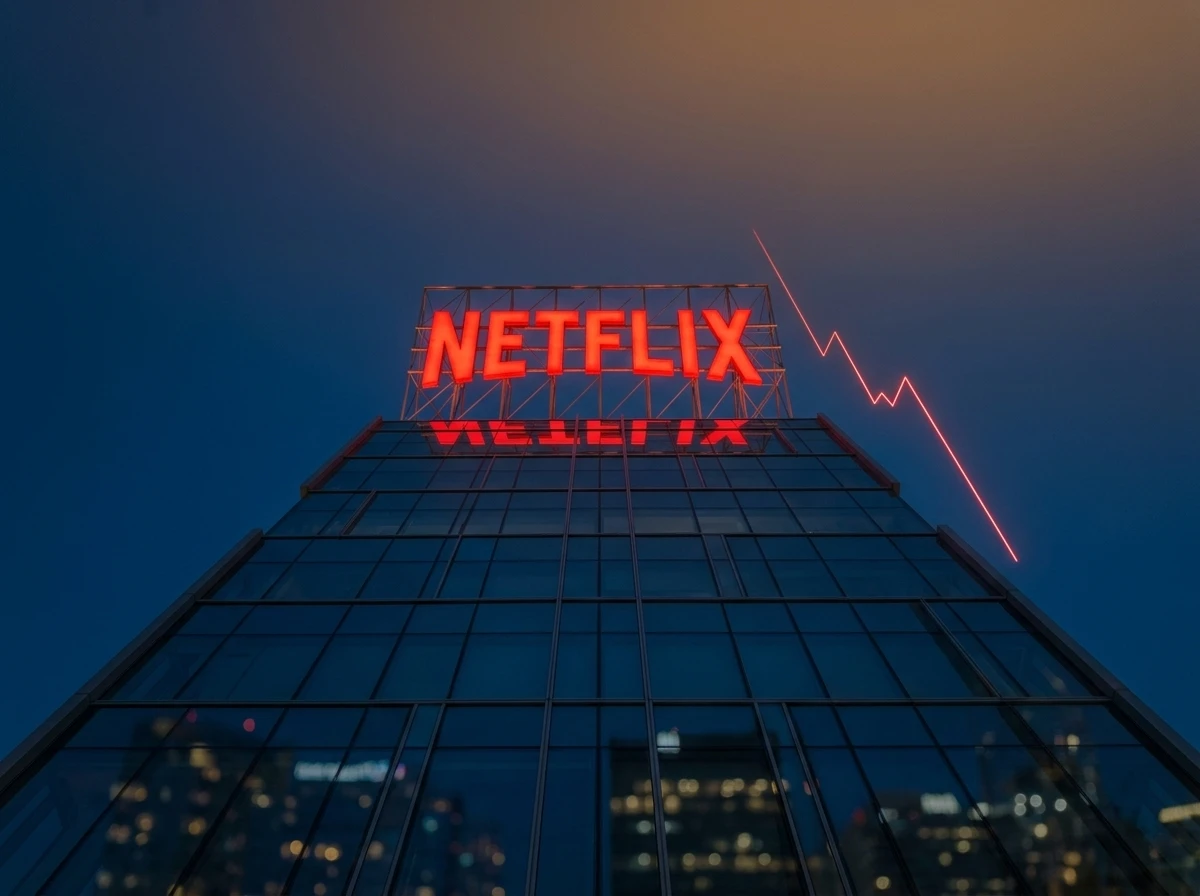
Netflix shares fell nearly 9% after hours as second-quarter revenue narrowly missed forecasts and weak third-quarter guidance rattled Wall Street.

Netflix shares fell nearly 9% in after-hours trading Thursday after the streaming giant’s second-quarter revenue narrowly missed Wall Street’s target and its third-quarter forecast landed even softer. The company beat on profit. It missed on the number investors actually wanted: growth.
The bigger problem wasn’t the size of the miss. Free cash flow collapsed by a third, and Netflix used the same earnings call to tell investors it will share less engagement data going forward, not more, right as the market is trying to decide whether its growth story is maturing or simply stalling.
Netflix Posts a Record Quarter and Still Gets Punished
Second-quarter revenue reached $12.56 billion, up 13% from a year earlier and just shy of the $12.59 billion analysts polled by LSEG (London Stock Exchange Group) had penciled in. Earnings per share came in at 80 cents, a penny ahead of the 79-cent estimate and up from 72 cents a year earlier. Net income rose to $3.40 billion from $3.13 billion.
Operating margin slipped to 33.4% from 34.1% in the year-earlier quarter, something Netflix attributed to content costs that run heavier in the first half of the year. None of that was the problem. The problem showed up in what came next.
| Metric | Q2 2026 Actual | Wall Street Estimate | Year-Ago Comparison |
|---|---|---|---|
| Revenue | $12.56 billion | $12.59 billion | Up 13% year over year |
| Earnings per share | $0.80 | $0.79 | Up from $0.72 |
| Net income | $3.40 billion | Not disclosed | Up from $3.13 billion |
| Free cash flow | $1.5 billion | ~$2.9 billion | Down from $2.3 billion |
| Q3 2026 revenue guide | $12.86 billion | $13.00 billion | Up from $11.51 billion in Q3 2025 |
| Full-year 2026 revenue guide | $51.0 to $51.4 billion | $51.38 billion | Narrowed from $50.7 to $51.7 billion |
The quarter itself was close to fine. What spooked the market was everything Netflix said about the one after it.
The Guidance Gap
Shares had closed Thursday’s regular session up 0.91%, at $74.35. Then the third-quarter numbers landed: revenue of $12.86 billion against a Wall Street target of $13 billion, and earnings of 82 cents a share against an 84-cent estimate. The stock fell 8.98% to $67.78 in after-hours trading once the guidance posted, according to TradingView data cited by Yahoo Finance.
That guide implies revenue growth of roughly 11.7% for the third quarter, which Invezz called the weakest pace since late 2023. Growth has now slowed for three straight quarters, from 16.2% in the first quarter to 13% in the second to a 12% guide for the third.
Analysts pointed to a handful of reasons the reaction ran hotter than a one-point revenue miss would normally justify:
- Third-quarter revenue and profit guidance both landed below Street estimates, echoing the same pattern that hit the stock in April.
- Free cash flow fell to $1.5 billion from $2.3 billion, missing Wall Street’s roughly $2.9 billion estimate by a wide margin.
- Netflix will now publish its viewership report once a year instead of twice, thinning one of the few engagement signals investors have left.
- Growth has decelerated for three consecutive quarters, feeding a broader argument that Netflix’s premium valuation no longer fits a maturing business.
Even before Thursday’s slide, Netflix had already erased about $257 billion in market value since its all-time high on June 30, 2025, according to Bloomberg figures cited by Advisor Perspectives. The stock is now down more than 21% year to date and has fallen 41% over the past twelve months, according to Yahoo Finance, sitting far below the roughly $133 peak it touched in June 2025.
Free Cash Flow Craters, and Wall Street Notices
Netflix produced $1.5 billion in free cash flow during the quarter, down from $2.3 billion a year earlier and well below the roughly $2.9 billion Wall Street expected. Long Player, a pseudonymous investor writing on TipRanks, argued “the stock price is anticipating way too much growth,” and said the missing free cash flow growth deserved more scrutiny than the one-cent profit beat.
Part of the gap traces back to a deal that never happened. Netflix spent months last year exploring a bid for Warner Bros. Discovery’s studio and streaming business before Paramount Skydance won the assets in a bidding war, and Netflix walked away, saying the price was no longer financially attractive. Paramount Skydance still owed Netflix a breakup fee, and higher cash tax payments tied to that $2.8 billion fee ate into this quarter’s free cash flow. Media dealmakers were still picking over that fallout at this year’s Sun Valley gathering of media moguls, where the scrapped bid and ballooning AI infrastructure costs both came up.
Alongside the cash flow drop, Netflix confirmed it bought back $4.7 billion of its own stock in the quarter, the largest single buyback in company history. In its shareholder letter filed with securities regulators, Netflix said it projects a 33.2% operating margin for the third quarter, up from 28.2% a year ago, and that its capital allocation approach has not changed: reinvest in the business, organically and through selective mergers, while keeping a healthy balance sheet.
Netflix Wants to Tell Investors Less, Not More
Buried in Thursday’s release was a disclosure change that irritated more than a few analysts. Netflix said it will cut the frequency of its “What We Watched” engagement report, moving from twice a year to once, starting in the first quarter of 2027. The company said the goal is to keep the focus on financial metrics like revenue and operating profit.
It is the second time in two years Netflix has pulled back on disclosure. The company stopped reporting quarterly subscriber counts in 2025, leaving 325 million, its last disclosed global subscriber total, as the final hard number outsiders have to work with. TradingKey flagged the pattern earlier this month as an opaque-reporting risk, arguing the shift toward less frequent metrics could mask a slowing growth trajectory in core markets rather than clarify it.
Wall Street was split on how much any of it should matter.
- Bears: Geetha Ranganathan, a senior media analyst at Bloomberg Intelligence, told Yahoo Finance there is “definitely some kind of slowdown,” adding, “All around, there’s really nothing here to get excited about.”
- Bulls: Eric Clark, portfolio manager at Accuvest Global Advisors, called the business “high-margin” with “strong free cash flow generation,” and said engagement typically firms up again once fall programming lands.
- Believers: Ross Gerber of Gerber Kawasaki, which owns Netflix shares, said flatly, “Every time the stock’s been down, it always comes back,” citing his confidence in the leadership team.
None of the three had a subscriber count left to check their math against.
Does This Look Like Netflix’s 2022 Crisis Again?
Not exactly, but the comparison keeps surfacing. In 2022, Netflix lost subscribers for the first time in a decade and answered by launching an ad-supported tier and cracking down on password sharing. Those two moves rebuilt its growth story for the next three years. Now, with engagement flat and the ad tier still a small slice of total revenue, some analysts are asking whether that playbook has anything left to give.
Deadline noted that some analysts have drawn parallels between the current period and 2022, when Netflix shed subscribers and turned to advertising and password-sharing enforcement to reignite growth. The difference now is that both levers have already been pulled. TradingKey pointed out that the password-sharing crackdown is entering an exhaustion phase, with the easy converts largely used up. One line of argument, that Netflix’s 2022 growth playbook has already been spent, gained more weight after Thursday’s numbers landed.
The Ad Business Is Carrying the Whole Bull Case
Netflix said it remains on track to deliver about $3 billion in advertising revenue in 2026, roughly double what it made the year before. TD Cowen analyst John Blackledge called the ad tier, “now more than 250 million monthly active users,” the real story investors should be watching instead of engagement, and kept a buy rating with a $112 price target.
Live sports and events are the wedge Netflix is using to grow that ad audience. Six of its ten biggest new-member sign-up days over the past five years were driven by live events, the company said, even though live programming still accounts for only about 1% of total viewing hours against roughly 5% of the content budget. That strategy traces back to Netflix’s earlier live-sports experiments, including its mixed martial arts debut, one of the events that first proved live programming could pull a crowd worth chasing.
The competitive backdrop makes the ad push more urgent. YouTube’s share of television viewing time rose to 13.4% in April, up from 12.4% a year earlier, according to Nielsen data. Netflix Chief Financial Officer Spencer Neumann told analysts the company is still “entertaining an audience approaching a billion people,” with room to grow since it captures “only about 5 percent of TV view share globally.”
Wall Street’s own numbers show the size of the disagreement. Analysts tracked by Bloomberg rate the stock a buy in 51 of 64 cases, with an average price target of $112.51, implying roughly 52% upside from Thursday’s close. The math behind that target requires shares to rise more than half again in a year that has, so far, gone the other direction.
Frequently Asked Questions
Why Did Netflix Stock Fall After Its Q2 2026 Earnings?
Netflix stock dropped mainly because third-quarter guidance came in below Wall Street estimates, not because of the quarter it had just reported. Second-quarter revenue and earnings were close to forecasts, but the outlook for the current quarter, $12.86 billion in revenue against a $13 billion estimate, triggered an 8.98% after-hours slide.
Did Netflix Miss on Revenue or Earnings in the Second Quarter?
Netflix missed narrowly on revenue, $12.56 billion against a $12.59 billion estimate, while beating on earnings per share, 80 cents against a 79-cent estimate. Free cash flow was the bigger disappointment, falling to $1.5 billion from $2.3 billion a year earlier.
What Are Analysts Saying About Netflix Stock After the Drop?
Wall Street remains mostly bullish despite the selloff. Jefferies rates the stock a buy with a $110 price target, and Bank of America rates it a buy with a $125 target, while Bloomberg Intelligence’s Geetha Ranganathan has warned there is little in the report to get excited about near term.
Is Netflix Launching a Free, Ad-Only Tier?
Not yet. Co-CEO Greg Peters said a free tier “could make sense in some markets, but we have to be thoughtful about cannibalization of paid tiers,” adding Netflix has “no near-term plans to launch something.” The company is instead pushing further into cloud gaming, where it says monthly active players are up elevenfold since it entered the category.
Disclaimer: This article is for informational purposes only and does not constitute investment advice. Stock prices and analyst price targets are volatile and can change quickly; figures above reflect trading and analyst data as of July 17, 2026. Consult a licensed financial professional before making investment decisions.


NFL Three-Strike Safety Fouls Now Pull Coaches and Clubs In

Browns Fans Tape Protest Signs to Jim Brown Statue Over Watson

Amazon Pixel 11 Deal Erases the $100 Hike for One More Day

Elden Ring on Switch 2 Turns Its Own Worst Label Into a Portable Win

Ternus Takes the Stage With Apple’s Foldable Debut

Ikea Xbox Yxstaby Turns Controller Thumbstick Into Home Furniture

Pokémon Center Turns Past Worlds Wins Into Bundles and a Pikachu Coin

NFL Scraps Pro Bowl Game to Restore Pure Player Honor

New Twitter.now Bets the Brand Musk Left Behind

Bella Mir’s Famous First Loss Meets the Accountant Who Won

Double Fine Cuts 23 Jobs Weeks After Xbox Independence

Day-One Big Walk Lifts PS Plus August Beyond Recycled AAA

John Hight Exits Wizards After Digital Reckoning Hits

Curtis Mead’s Red Sox Debut Ends With Fractured Wrist

Moesch and Dressel Rewrite Night One at 2026 U.S. Nationals

Red Sox Squander Hot Streak Chance in 4-3 Loss to Athletics

Boutte’s Quiet Camp Takeover Forces Patriots Receiver Choices

Take-Two CEO Pushes Netflix Subs for GTA 6 Extended Look

Halo Campaign Evolved Skulls Meet Death Barriers That Kill the Hunt

Wildlands Free Update Hands Players the Tools They Already Invented
-

 TECHNOLOGY3 years ago
How to Adjust a Bulova Watch Band – An Easy Guide
-

 News3 years ago
Fred Pentland: Athletic Bilbao’s English mentor who changed the essence of Spanish football
-

 FINANCE3 years ago
Tax Planning for Every Season: Guide to Maximizing Your Tax Benefits
-

 Education3 years ago
African Ministers New Education Plan
-

 BUSINESS3 years ago
What is Entrepreneurial Operating System? A Comprehensive Guide to EOS
-

 Education3 years ago
Innovate Your Learning Journey with Technology and Enhance Education
-

 News3 years ago
Russians formally out of World Athletics Championships
-

 BUSINESS3 years ago
Top 9 Most Expensive American Cities to Rent an Apartment