
News
Gus the T. Rex Could Fetch $30 Million, and Never Be Studied
Gus, a nearly complete 38 foot Tyrannosaurus rex from South Dakota, goes to auction at Sotheby’s Tuesday with bids expected to top $30 million.

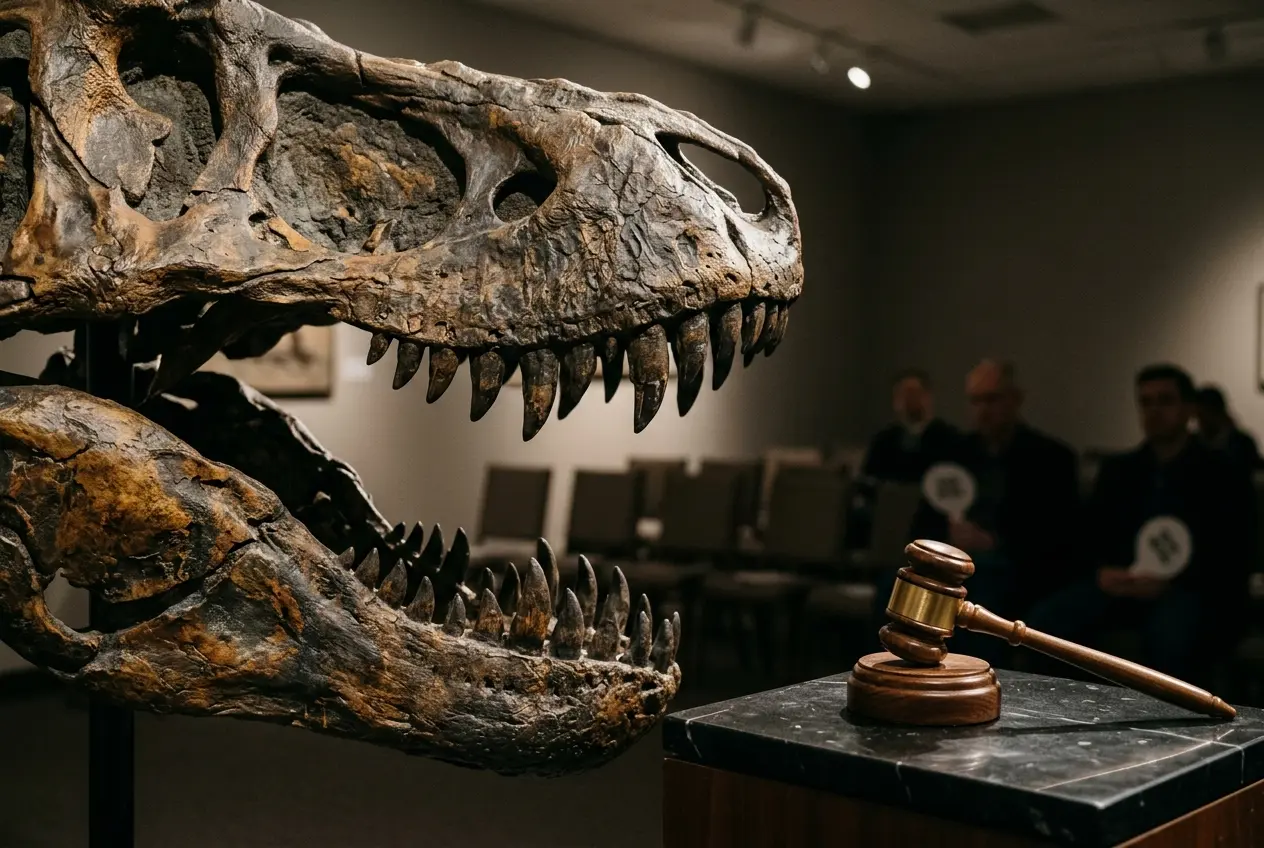
A Tyrannosaurus rex skeleton named Gus goes under the hammer at Sotheby’s in New York on Tuesday. The auction house says bidding could climb past $30 million, the highest presale estimate ever placed on a dinosaur fossil. The 38 foot skeleton, dug from a South Dakota cattle ranch, carries 183 fossil bones and opens at $19 million.
The same completeness that makes Gus a record contender is also what will likely keep it out of formal science. A skeleton this polished, mounted and posed for a saleroom, has already been altered in ways that make it useless for the repeatable research paleontology depends on.
A Rancher’s Hunch Becomes One of the Largest T. Rex Ever Found
Gary “Gus” Licking, a cattle rancher in Harding County, South Dakota, spent decades walking his 6,500 acre property and picking up dinosaur teeth and bone fragments. He never found the whole animal. His land sits inside the Hell Creek Formation, the fossil bed stretching across Montana, Wyoming and the Dakotas that produced the first T. rex skeleton in 1902 and gave the species its name.
Licking’s chance came when he crossed paths with Thomas Heitkamp, a commercial paleontologist and founder of Theropoda Expeditions, a Texas company that excavates fossils on private land.
Heitkamp’s team hiked the ranch for a year before finding bone in a small valley in 2021. Over three field seasons, working only the five months a year the ground wasn’t frozen, they hand dug roughly 7,000 square feet and pulled out nearly a thousand fossil pieces.
Licking died a year into the excavation and never saw the finished mount. His widow, Dana Licking, stayed with the project through its completion in early 2026, nearly five years after the first bone turned up.
Sotheby’s places Gus at about 61% complete by bone count and 75 to 80% complete by mass, among the highest completeness figures ever recorded for the species. Several features go beyond size alone.
- Skull – about 82% of the original bones are present, including all six tooth bearing bones.
- Wishbone – a furcula survived intact, a bone rarely preserved in any T. rex skeleton.
- Pelvis – completely represented, one of the hardest elements to recover whole.
- Feet – both feet are well preserved; Sotheby’s says only one other known T. rex specimen has that.
- Belly ribs – 30 of 32 gastralia recovered, delicate bones usually lost to erosion.
Sotheby’s lists a femur measuring 50.39 inches, longer than Stan’s, and notes bite marks on the skull and healed fractures on several ribs, injuries Gus survived roughly 67 million years ago.
A Runaway Market
Sotheby’s held the first dinosaur auction in 1997, when a T. rex named Sue sold for $8.36 million to a consortium anchored by Chicago’s Field Museum. Sue’s discovery had already triggered an FBI raid and a years long ownership fight before the bones ever reached a saleroom. It was a niche sale mostly attended by museums.
That world is gone now. Stan, another T. rex from the same South Dakota county as Gus, sold for $31.8 million at Christie’s in 2020, a record at the time, bought by Abu Dhabi’s Department of Culture and Tourism. Four years later, a Stegosaurus named Apex blew past that mark, selling for $44.6 million against a presale estimate of just $6 million. A juvenile Ceratosaurus followed in 2025, fetching $30.5 million on a $4 million to $6 million estimate.
Every major dinosaur sale of the past six years has cleared $30 million.
| Specimen | Species | Year Sold | Sale Price | Buyer or Outcome |
|---|---|---|---|---|
| Sue | T. rex | 1997 | $8.36 million | Field Museum, Chicago |
| Stan | T. rex | 2020 | $31.8 million | Abu Dhabi Department of Culture and Tourism |
| Apex | Stegosaurus | 2024 | $44.6 million | Ken Griffin, four year museum loan |
| Ceratosaurus | Ceratosaurus | 2025 | $30.5 million | Undisclosed buyer |
| Gus | T. rex | 2026 (pending) | Est. $20 million to $30 million | To be decided Tuesday |
Scott Persons, curator of natural history at the South Carolina State Museum, says the pattern reflects demand rather than scientific merit. “More and more dinosaurs are being sold this way and at ridiculous prices,” he told NPR.
Why Won’t Scientists Ever Study Gus?
Almost certainly never, according to paleontologists, because reputable journals will not publish research based on a specimen held in private hands. Independent researchers have already examined Gus informally, Heitkamp says, but informal viewing falls well short of the peer reviewed, repeatable access that scientific societies require before a fossil counts as studied.
Stuart Sumida, a professor of biology at California State University, San Bernardino, and president of the Society of Vertebrate Paleontology (SVP), said members of his organization are barred from formally studying specimens outside public collections. “If you sell something, it’s generally lost to science,” he said.
Sumida argues the mounting process itself closes the door for good. Once a skeleton is rebuilt in plaster, painted and posed, researchers can no longer examine individual bones or how they were arranged in the ground.
People will get to see it, but once you mount a specimen, you can’t study it. Gus has also been mounted to look very, very pretty, so that someone will buy it. It’s now unstudiable.
Sumida made that assessment about Gus specifically. Steve Brusatte, a professor of paleontology and evolution at the University of Edinburgh, frames the stakes around who controls access. “We cannot live in a world where some oligarch is the gatekeeper, deciding which scientists can study a fossil, and which scientists are denied,” he said.
A Skeleton Built Free of Stan’s Shadow
Gus carries something Sotheby’s calls “full rights”, meaning none of its bones were filled in with cast material copied from another skeleton. The detail sounds technical, but it changes what a buyer actually owns.
Most T. rex skeletons on public display, including many museum mounts, include cast bones borrowed from Stan, long the only specimen complete enough to copy from.
Cassandra Hatton, Sotheby’s vice chairman and worldwide head of science and natural history, said that dependence runs deep. “In most museums that have a T. rex, what you actually see is a casting of Stan,” she said, adding that most market specimens “have been partially Stan, because that has been the only place to get full replica material.”
Heitkamp’s team scanned and molded its own material throughout the dig, so Gus needed no borrowed bone. “This T. rex has no Stan material in it,” Hatton said. Hatton has explained why completeness commands such a premium across Sotheby’s recent sales, and a buyer here could turn that rarity into a business, licensing casts to museums and collectors in direct competition with the replica trade Stan has anchored for decades.
The Society That Says Science Already Lost
The SVP has fought this fight before. It asked Christie’s to restrict Stan’s 2020 sale to public institutions, a request the auction house did not follow.
David Hone, a paleontologist and reader in zoology at Queen Mary University of London, said museums could recover fossils like Gus themselves if landowners chose that route instead of a commercial dig. “Five million would pretty much guarantee it,” he said of the cost to find and excavate a T. rex, though he conceded the result “might not be as good as this one.”
Susannah Maidment, a senior researcher at London’s Natural History Museum, said the private market has already outgrown public budgets. “I’ve heard of private sales of T. rex specimens that have achieved more than $50 million,” she said, an amount she called enough to “absolutely revolutionize the collections, facilities and galleries of any museum or university across the UK.”
Most journals refuse studies on privately owned fossils no matter how a specimen was found, which is why commercial outfits like Theropoda Expeditions operate entirely outside the peer reviewed system even as they keep supplying it with new discoveries.
With bidding a day away, several basic questions remain open.
What we know:
- Gus measures 38 feet long and 12.5 feet tall, carries 183 fossil bones, and opens bidding at $19 million with an estimate of $20 million to $30 million.
- No peer reviewed research has been published on the specimen, and outside researchers have only viewed it informally.
What’s unconfirmed:
- The final sale price and the identity of the winning bidder.
- Whether Gus goes to a museum, a private home, or a temporary loan arrangement similar to Apex’s.
A Sotheby’s spokeswoman referred one South Dakota outlet to the company’s media team ahead of the sale, which did not respond to further questions about where Gus might end up.
A Four-Year Loan Is the Best Case on Record
The closest thing to a happy ending in this market so far belongs to Apex. Ken Griffin, the hedge fund manager who paid $44.6 million for the Stegosaurus, loaned it to the American Museum of Natural History (AMNH) in New York for four years starting in December 2024. Visitors can see it. Researchers mostly cannot.
The SVP wrote to the museum objecting to that loan, arguing a temporary arrangement cannot support the permanent access science requires. The museum has pointed to digital 3D scans of Apex released for outside research, though the SVP maintains scans cannot substitute for the original bone.
Cassandra Hatton said she hopes Gus lands somewhere she could bring her own son to see it. Where that turns out to be will be decided Tuesday morning, when bidding opens at Sotheby’s saleroom in New York, with or without a museum among the paddles in the room.
Frequently Asked Questions
How Much Is Gus the T. Rex Expected to Sell For?
Sotheby’s set a $19 million opening bid and an estimate of $20 million to $30 million. The skeleton was on public preview at Sotheby’s Breuer building from July 1 through July 14, giving the public a last look before the gavel decides whether it disappears into private hands.
Why Can’t Scientists Formally Study Fossils Like Gus?
Reputable journals will not publish research on specimens held in private collections because future access cannot be guaranteed. Germany maintains a national register of culturally significant fossils that can still be studied if scientific access is guaranteed, but the United States has no similar system.
Is It Legal to Sell a Dinosaur Fossil Found on Private Land?
Yes. Fossils discovered on privately owned land in the United States belong to the landowner and can be sold without restriction, which is why Gary Licking’s estate could legally send Gus to auction. Fossils found on federal land cannot be sold commercially.
Besides T. Rex and Stegosaurus Fossils, What Else Has Sold Recently?
A Triceratops nicknamed Trey sold for $5.55 million through the auction platform Joopiter in March 2026, and Phillips auction house sold its first dinosaur fossil, another Triceratops, for $5.4 million in November 2025.
Where Exactly Was Gus Discovered?
Excavators found the first bone, a metatarsal from the dinosaur’s foot, sticking out of the ground on the Licking family’s 6,500 acre ranch in Harding County, South Dakota, in 2021. The site sits inside the Hell Creek Formation, the same fossil bed that produced Stan.


Spotify Running Mode hits Android and revives its old tempo experiment

Galaxy Tab S12 Ultra Renders Keep the Notch Fans Hate

Novato Spinning Round House Sells With Six Neighbors for $3.3 Million

Crop Tour Finds Indiana and Nebraska Corn Yields Lagging 2025

Best Buy 60th sale brings Android deals back to its roots

American Airlines reverses seatback screen bet years too late

Iran Hormuz Strikes Force Gulf Oil Onto Costlier Paths

Plague Tale Prequel Day One Joins Game Pass Wave 2 as Witcher Exits

NBA 2K27 opens The City to everyone and rewrites career eras

iOS 26.6.1 Patches 29 Flaws as AI Forces Faster Apple Updates

Double Fine Cuts 23 Jobs Weeks After Xbox Independence

Day-One Big Walk Lifts PS Plus August Beyond Recycled AAA

John Hight Exits Wizards After Digital Reckoning Hits

Curtis Mead’s Red Sox Debut Ends With Fractured Wrist

Red Sox Squander Hot Streak Chance in 4-3 Loss to Athletics

Moesch and Dressel Rewrite Night One at 2026 U.S. Nationals

Boutte’s Quiet Camp Takeover Forces Patriots Receiver Choices

Take-Two CEO Pushes Netflix Subs for GTA 6 Extended Look

Halo Campaign Evolved Skulls Meet Death Barriers That Kill the Hunt

Wildlands Free Update Hands Players the Tools They Already Invented
-

 TECHNOLOGY3 years ago
How to Adjust a Bulova Watch Band – An Easy Guide
-

 News3 years ago
Fred Pentland: Athletic Bilbao’s English mentor who changed the essence of Spanish football
-

 FINANCE3 years ago
Tax Planning for Every Season: Guide to Maximizing Your Tax Benefits
-

 Education3 years ago
African Ministers New Education Plan
-

 BUSINESS3 years ago
What is Entrepreneurial Operating System? A Comprehensive Guide to EOS
-

 Education3 years ago
Innovate Your Learning Journey with Technology and Enhance Education
-

 News3 years ago
Russians formally out of World Athletics Championships
-

 BUSINESS3 years ago
Top 9 Most Expensive American Cities to Rent an Apartment