
News
Python Blood’s 1,000-Fold Molecule Spike Sparks a New Weight-Loss Bet
CU Boulder scientists found a python blood molecule that spikes 1,000-fold after meals and curbs appetite in mice, now the basis of a new startup.

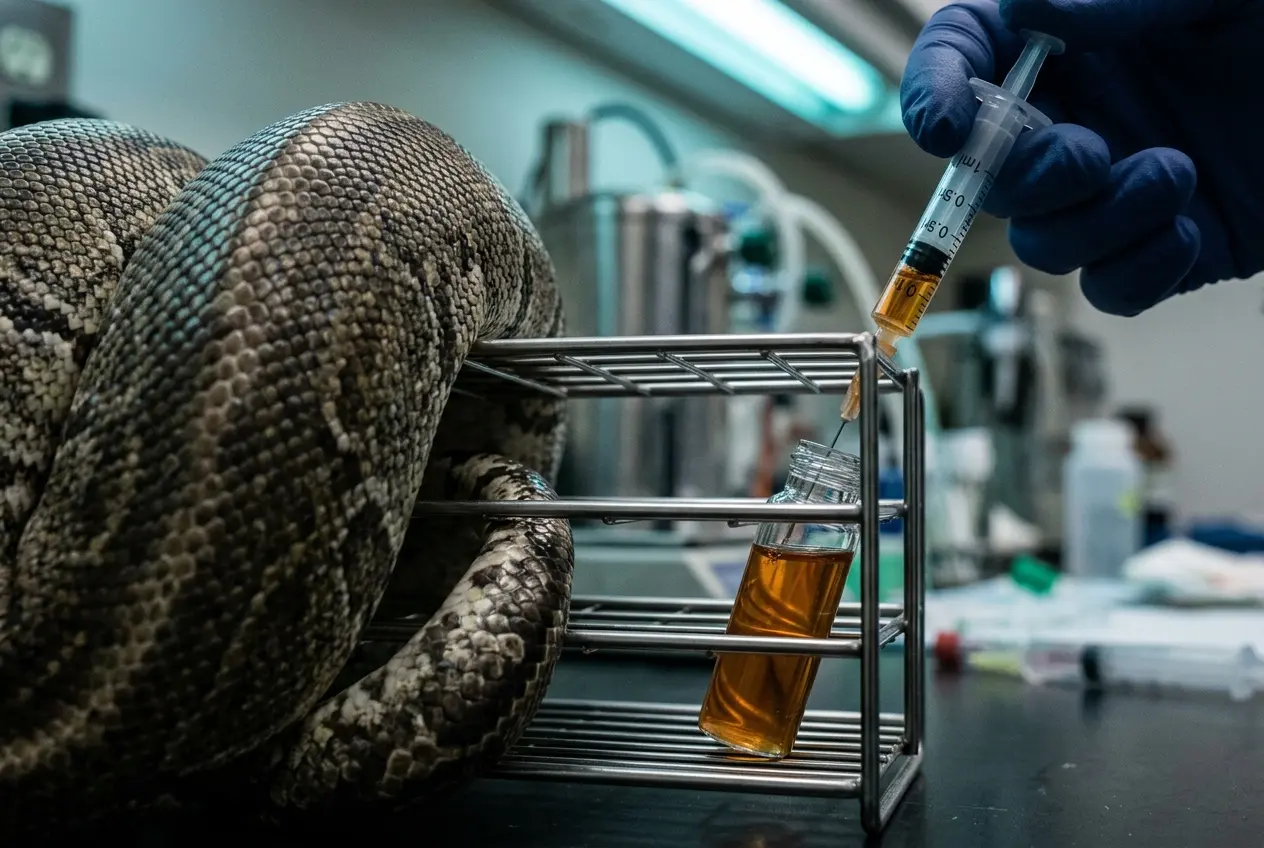
A molecule in python blood spikes more than 1,000-fold within days of a meal, and scientists at the University of Colorado Boulder (CU Boulder) think a synthetic version could someday curb human appetite. The finding, published this spring in the journal Nature Metabolism, caps two decades of one lab’s work cataloging what makes pythons medically strange, and it just spun into a startup called Arkana Therapeutics.
The last time a drug company pulled a metabolic breakthrough out of an animal most people avoid, it took fifteen years to go from a lizard’s venom gland to an approved diabetes pill. Python blood is only now starting that same climb, and it has not gotten far.
The Python That Skips Dinner for Over a Year
Skip Maas, a molecular biologist at CU Boulder, adopted a mottled ball python named Agrapina who hadn’t eaten in 14 months. She was still, as he put it, a coiled spring of muscle. Presented with a rat, she struck, constricted and gorged within minutes.
Then her body did something else pythons are known for. Her metabolism accelerated to handle the sudden load of protein and fat, helping her, as Maas described it, “help break down that meal and extract all of its nutrients.”
Most people keep their distance from pythons, and for good reason. A quick strike followed by sustained constriction can be lethal, as a deadly python encounter in an Indonesian village made clear. But Maas and his colleagues argue the snakes carry biological secrets that could help people live longer and heal better.
Leslie Leinwand, a geneticist who first proposed studying python biology for medical clues two decades ago, is now executive science officer of CU Boulder’s BioFrontiers Institute. “It makes a lot of sense that pythons, because they live in such extreme environments, would have secrets that would apply to humans,” she said.
- Metabolism swing: a python’s metabolic rate can climb 10 to 40 times its resting level after a big meal, depending on size, according to Tommy Martin, an assistant professor at the University of Nebraska Medical Center and a former researcher in Leinwand’s lab.
- Fasting record: Agrapina went 14 months between meals and still had the strength to strike and constrict on the first try.
- Organ regrowth: the heart and gut can enlarge within days of feeding, with the digestive tract sometimes doubling in size, then shrink back to normal roughly a month later.
- Cell renewal: cardiac muscle cells increase in number after a meal, a trick human hearts cannot perform after damage.
“I think it’s a really great avenue to look at something that evolution has already figured out to take inspiration,” Maas said.
Pythons Rebuild Their Hearts on a Deadline
Jack Gugel, a molecular biologist at CU Boulder and a former student of Leinwand’s, compares a fed python’s metabolism to “the equivalent of a Kentucky Derby racehorse at rest, compared to when they’re sprinting around the track.” Except a python holds that sprint for days, maintaining “that high metabolic state for days as they digest the meal,” he said.
To keep up, the snake’s organs remodel almost overnight. “Their organs will actually grow,” Gugel said, including the heart, which pumps harder to move blood and oxygen through digestion.
Human hearts enlarge too, usually over years of high blood pressure or after a heart attack. Unlike a python’s heart, an enlarged human heart typically stays stiff and stays enlarged, sometimes with fatal results. “Some people, no matter what they do, even if they have the perfect diet and they’re exercising every day, they’re still going to have heart disease,” Gugel said.
A python’s heart, by contrast, returns to its resting size about a month after a meal. Yuxiao Tan, a CU Boulder molecular biologist who worked under Leinwand, found in a soon-to-be-published study that the organ does more than swell. “Their heart can not only become bigger,” he said, “but their cardiac muscle cells also increase in numbers after they eat.” Human cardiac cells cannot do that. After a heart attack, they scar instead of regenerating, leaving damage in place rather than fresh muscle.
A 1,000-Fold Spike in Python Blood
The python work that has drawn the most outside attention did not come from the heart. It came from an untargeted scan of what floats in python blood after a meal. Researchers found roughly 208 metabolites that rose after feeding, and one dwarfed the rest: a molecule now called pTOS, short for para-tyramine-O-sulfate, that increased more than 1,000-fold in postprandial python plasma.
If I were a betting person, I’d bet that something that changes a thousand-fold is probably doing something important.
Leinwand said that, and her hunch held up. Follow-up work, detailed in an EurekAlert release on the CU Boulder findings, showed pTOS is produced by gut bacteria breaking down dietary tyrosine, then travels to the hypothalamus, the brain’s appetite center. Chronically dosed obese mice ate less and lost weight.
“When we give this molecule to obese mice, they eat less and they lose weight,” Gugel said. pTOS also turns up in human blood. In a separate human feeding study, plasma levels rose after a standardized meal in 15 volunteers, evidence the molecule isn’t unique to snakes, even if human levels never approach python levels.
Is This Like the Gila Monster That Led to Ozempic?
Largely yes, in shape if not species. A venomous lizard’s saliva peptide became the template for the entire GLP-1 drug class, but the trip from discovery to pharmacy took roughly fifteen years. Python-derived pTOS is following a similar arc, several years behind, with no drug yet approved or even in human trials.
The Gila monster’s path is well documented. Researchers isolated a peptide from the lizard’s venom, later named exendin-4, and its resistance to rapid breakdown in the body is what eventually made it useful as medicine.
- 1990: Researchers first isolate a peptide from Gila monster venom.
- 1992: Scientists at the Bronx VA Medical Center describe exendin-4, showing it mimics human Glucagon-Like Peptide-1 (GLP-1) but resists rapid breakdown in the body.
- 1996: Amylin Pharmaceuticals licenses the discovery and begins developing it into a drug.
- 2005: The Food and Drug Administration (FDA) approves the resulting drug, Byetta, for type 2 diabetes, opening the door to the GLP-1 medicines that followed.
That fifteen-year run from lizard venom to a first approved drug is roughly the patience pTOS would need to match. The lizard did not directly give the world semaglutide, but it proved the pathway could work, which is close to where python research stands today.
The mechanism is different, too. GLP-1 drugs mimic a gut hormone that nudges the pancreas to release insulin and slows digestion, which is part of why nausea is such a common complaint. pTOS instead acts directly on the brain’s hunger switch, and in mice it suppressed appetite without slowing digestion or burning through muscle.
Not Every Scientist Buys the Heart-Growth Story
The appetite work is new, but Leinwand’s lab has described python organ growth for years, and not everyone agrees on the mechanism. In 2024, her team reported that a mix of fatty acids and bile acids in python blood could trigger cardiac hypertrophy, the technical term for heart enlargement.
That 2024 study on python cardiac growth drew a cautious response from Tobias Wang, a zoophysiologist at Aarhus University in Denmark who was not involved in the work. He called the result “potentially really, really important” at the time, but suspected the picture was incomplete.
In his own experiments feeding Burmese pythons similar rodent meals, Wang and his colleagues saw no heart growth at all. “Pythons can digest very large meals and can have very large metabolic changes without necessarily having the growth in heart size,” he said. The swelling Leinwand’s team observed, he suggested, may depend on conditions still not fully understood.
The Company Betting Its Future on Snake Blood
Gugel, Leinwand, Tommy Martin and Jonathan Long of Stanford University have turned the discovery into Arkana Therapeutics, a company aimed at developing pTOS and related python metabolites into drugs. The CU Boulder spinout has already collected a $127,500 grant to fund its early work, and Leinwand’s track record building biotech ventures gives the young company a head start with venture investors.
“We’re not stopping with just this one metabolite,” Leinwand said. The team wants to mine python blood for other useful compounds, and eventually look past pythons entirely. “We want to broaden our interest beyond pythons and look into other species that may have been overlooked to find cures for human diseases,” Martin said.
Arkana is entering an already crowded weight-loss market. A rival approach, the triple-action diabetes and weight-loss injection retatrutide, recently cleared some but not all of its late-stage trial goals, a reminder that even well-funded metabolic drugs stumble on the way to approval.
Arkana is not alone in mining animal extremes for medicine. Ashley Zehnder, chief executive of Fauna Bio, a company that searches for disease resistance therapies in mammals with unusual adaptations, said the CU Boulder approach could widen the field’s toolkit. “You can find these really potent bioactive molecules in these extreme species,” she said, “because they were evolutionarily perfected, and we can use that for medicines.” She added that the work isn’t easy, since researchers first have to learn how to keep unfamiliar animals healthy in a lab before they can study them at all.
| Species Studied | Molecule or Program | Human Health Target | Current Status |
|---|---|---|---|
| Gila monster | Exendin-4 | Type 2 diabetes, GLP-1 pathway | Approved as Byetta in 2005; led to today’s GLP-1 drug class |
| Burmese and ball pythons | pTOS | Appetite suppression, obesity | Published in Nature Metabolism; tested only in obese mice so far |
| Assorted mammals | Fauna Bio’s disease resistance screening | Broad metabolic and disease resistance | Early-stage discovery platform, per CEO Ashley Zehnder |
For now, pTOS has been tested in mice, not people. No clinical trial has begun. The Gila monster took fifteen years to go from venom sample to an approved drug, and Arkana Therapeutics is one small CU Boulder spinout with a single grant, betting the snake gets there faster.
Frequently Asked Questions
What is pTOS and why are scientists excited about it?
pTOS, short for para-tyramine-O-sulfate, is a metabolite that spikes more than 1,000-fold in python blood after a meal. CU Boulder researchers found it activates hunger-regulating neurons in the hypothalamus and suppresses appetite in obese mice without the digestive side effects tied to some existing weight-loss drugs.
Is a python-derived weight loss drug available to buy?
No. pTOS has only been tested in mice so far, and Arkana Therapeutics has not entered human clinical trials. Any approved drug based on the molecule is likely years away, based on how long comparable animal-derived drugs like Byetta took to reach pharmacies.
How is pTOS different from Ozempic and similar drugs?
Ozempic and other GLP-1 medicines mimic a gut hormone that prompts insulin release and slows digestion, which can cause nausea. pTOS instead acts on the brain’s hypothalamus directly, and in mouse studies it suppressed appetite without slowing digestion or reducing muscle mass.
Why do pythons make a useful model for human disease research?
Pythons swing between extremes that would kill most mammals, fasting for over a year, then digesting meals a fraction of their own body weight without organ damage. Leinwand has argued that studying how their bodies manage that swing could reveal mechanisms evolution already solved for problems like heart disease and muscle loss.
What other animals are being studied for similar drug discovery?
Scientists already pulled a major drug class from the Gila monster’s venom, and researchers like Jasmin Camacho at the Stowers Institute for Medical Research are studying bats that consume large amounts of nectar without developing diabetes. “Evolution’s been running natural experiments for hundreds of millions of years,” Camacho said, arguing those adaptations can point toward new medicines.
Who is funding the python research and Arkana Therapeutics?
The underlying research runs out of Leslie Leinwand’s lab at CU Boulder’s BioFrontiers Institute, with collaborators at Stanford and Baylor universities. Arkana Therapeutics, the startup spun out to commercialize the findings, has already collected a $127,500 grant to fund its early work.
Disclaimer: This article is for informational purposes only and does not constitute medical advice. The compound pTOS remains an early-stage, preclinical research finding tested in animal models, not an approved treatment. Figures are accurate as of publication, and readers should consult a qualified healthcare professional before making decisions about weight loss or metabolic treatments.


Spotify Running Mode hits Android and revives its old tempo experiment

Galaxy Tab S12 Ultra Renders Keep the Notch Fans Hate

Novato Spinning Round House Sells With Six Neighbors for $3.3 Million

Crop Tour Finds Indiana and Nebraska Corn Yields Lagging 2025

Best Buy 60th sale brings Android deals back to its roots

American Airlines reverses seatback screen bet years too late

Iran Hormuz Strikes Force Gulf Oil Onto Costlier Paths

Plague Tale Prequel Day One Joins Game Pass Wave 2 as Witcher Exits

NBA 2K27 opens The City to everyone and rewrites career eras

iOS 26.6.1 Patches 29 Flaws as AI Forces Faster Apple Updates

Double Fine Cuts 23 Jobs Weeks After Xbox Independence

Day-One Big Walk Lifts PS Plus August Beyond Recycled AAA

John Hight Exits Wizards After Digital Reckoning Hits

Curtis Mead’s Red Sox Debut Ends With Fractured Wrist

Red Sox Squander Hot Streak Chance in 4-3 Loss to Athletics

Moesch and Dressel Rewrite Night One at 2026 U.S. Nationals

Boutte’s Quiet Camp Takeover Forces Patriots Receiver Choices

Take-Two CEO Pushes Netflix Subs for GTA 6 Extended Look

Halo Campaign Evolved Skulls Meet Death Barriers That Kill the Hunt

Wildlands Free Update Hands Players the Tools They Already Invented
-

 TECHNOLOGY3 years ago
How to Adjust a Bulova Watch Band – An Easy Guide
-

 News3 years ago
Fred Pentland: Athletic Bilbao’s English mentor who changed the essence of Spanish football
-

 FINANCE3 years ago
Tax Planning for Every Season: Guide to Maximizing Your Tax Benefits
-

 Education3 years ago
African Ministers New Education Plan
-

 BUSINESS3 years ago
What is Entrepreneurial Operating System? A Comprehensive Guide to EOS
-

 Education3 years ago
Innovate Your Learning Journey with Technology and Enhance Education
-

 News3 years ago
Russians formally out of World Athletics Championships
-

 BUSINESS3 years ago
Top 9 Most Expensive American Cities to Rent an Apartment