
News
2,000-Year-Old Olive and Grape Remains Unearthed Near Jesus’ Alleged Burial Site

Archaeologists digging beneath Jerusalem’s Church of the Holy Sepulchre believe they may have uncovered signs of the ancient garden mentioned in the Gospel of John.
For centuries, pilgrims have walked through the Church of the Holy Sepulchre with reverence, believing it to be the site of Jesus’ crucifixion and burial. Now, a quiet but groundbreaking discovery under its weathered stone floor may connect the site even more deeply to Scripture — with 2,000-year-old plant remains linked to a garden described in the Bible.
It’s not just speculation anymore — the dirt beneath one of Christianity’s holiest sites is finally starting to talk.
A discovery that echoes Scripture
In the Gospel of John, chapter 19, verse 41, it says Jesus was buried in a garden near the crucifixion site. That reference has lingered for centuries, quietly debated by theologians, historians, and archaeologists.
But now?
A team of researchers studying the church since 2022 has uncovered botanical remnants — fragments of olive trees and grapevines — that date back two millennia. Found just beneath the floor of the Holy Sepulchre, they match the exact period when Jesus is believed to have been crucified.
One sentence: And that’s turning a lot of heads.
For Professor Francesca Romana Stasolla, who leads the excavation for Sapienza University of Rome, this isn’t just a minor footnote in the history of Jerusalem. “It’s the first time we’ve been able to scientifically support the idea that a garden existed here during the time of Jesus,” she told the Times of Israel.
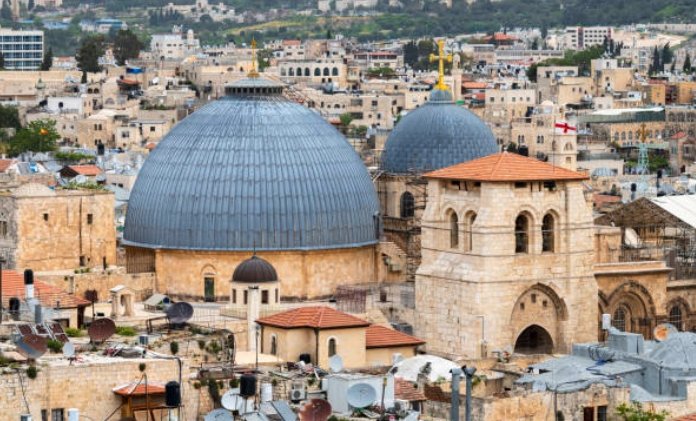
Peeling back the layers of time
What’s striking isn’t just what they found, but where they found it. This church — layered in centuries of history — has stood through empires, invasions, earthquakes, and religious transformations.
It was Emperor Constantine who, back in the 4th century, transformed a Roman temple into the church we see today. During the building process, workers stumbled upon an old tomb, believed by some to be Jesus’ resting place.
The site’s age and sanctity made excavation tricky. You can’t just bulldoze holy ground.
So scientists brought in advanced tools:
-
Ground-penetrating radar to map underground spaces
-
3D modeling to reconstruct the church layer by layer
-
Non-invasive scanning tech that shows what lies beneath without a single stone being moved
That blend of old-school archaeology and modern tech is how researchers pinpointed the plant material.
Sacred ground, sacred science
Here’s what makes this whole thing even more extraordinary. The plant material wasn’t random.
Olive trees and grapevines weren’t just typical flora in ancient Judea — they were symbolic. Olive oil was used in anointing rituals. Grapevines represented life, covenant, and sacrifice. Both are central to Christian theology.
And the timing? Pinpointing the samples to around 33 CE puts them squarely in the timeline of Jesus’ death.
“It’s not definitive proof,” a Jerusalem archaeologist unaffiliated with the dig told Haaretz. “But it adds weight to an already powerful tradition.”
One sentence again: It’s not just faith anymore — it’s beginning to look like evidence.
Layers of belief, bricks, and bones
The Church of the Holy Sepulchre is no stranger to mystery. Just stepping inside feels like walking into a time machine stuck in 10 different centuries at once.
You’ve got the tomb — enclosed by the ornate Edicule — which many believe to be Jesus’ final resting place. Then the Greek Orthodox chapel. The Armenian altar. The Roman Catholic spaces. Centuries of renovations stacked like a layer cake of devotion.
The excavations since 2022 have uncovered:
-
Pottery from the Iron Age
-
Crusader-era coins
-
Byzantine foundations
But it’s these plant fragments that are making the loudest whisper.
Jerusalem’s tangled archaeological politics
Not everyone’s thrilled about digging under holy sites, though.
In Jerusalem, archaeology and politics are tightly knotted. Every shovel-full of dirt brings history — and controversy. Church authorities, religious leaders, and state officials all have a say. The Church of the Holy Sepulchre is jointly managed by several denominations, and even a minor change can spark decades of debate.
So how’d this dig even happen?
A rare agreement between religious custodians allowed scholars limited access beneath the church starting in 2022. It wasn’t publicized widely — probably to avoid fuss. But once artifacts started coming out, it became hard to keep quiet.
And now, with something as potent as 2,000-year-old olive and grape remnants, silence is no longer an option.
What’s next for the dig and the data
The research team isn’t stopping. They’re processing samples, scanning more areas, and using digital modeling to recreate what the area might’ve looked like in the 1st century.
Here’s what we know so far:
| Item Found | Estimated Date | Description |
|---|---|---|
| Olive Tree Fragments | ~33 CE | Carbon-dated; potential garden link |
| Grape Vine Remains | ~33 CE | May indicate vineyard-style planting |
| Crusader Coins | 12th century | Suggests continued veneration |
| Iron Age Pottery | 8th century BCE | Earliest artifact found on site |
Scientists are hoping the combination of biological sampling and spatial data will give them a full picture of what existed here 2,000 years ago. “We’re assembling a mosaic,” Stasolla said. “One leaf, one coin, one stone at a time.”
One sentence: And sometimes, a leaf can say more than a scroll.













Walmart’s $50 Million Opioid Settlement Closes Case Without Admission

California Sues Over $120 Million Morro Bay Wind Lease Buyout

Gilead Bixlenvo FDA Nod Opens Single Pill Path for Complex HIV Cases

Meta’s $18B Kids Deal Forever Shields Data Used to Spot Under-13s

Lettuce Outbreak Drove Record Cyclospora Spike Across 20 States

Amazon Shaves $20 Off M6 Mac Mini Before It Even Ships

SpaceX Louisiana Port Tests Debt Markets on Orbital AI Scale

Microsoft High Lifts Indexes as Small Caps Crack Support

Apple Replays 2015 Saturday Midnight Preorder for iPhone 18 Pro

Updated COVID Shots Clear FDA but Access Friction Hits High-Risk Groups

Take-Two CEO Pushes Netflix Subs for GTA 6 Extended Look

Halo Campaign Evolved Skulls Meet Death Barriers That Kill the Hunt

Wildlands Free Update Hands Players the Tools They Already Invented

Destiny 2 Fans Unlock Vaulted Maps After Live Service Ends

Quake Gets 19 Free Maps From MachineGames Quake Club

Quordle Monday Delivers Gavel Crush Speed Ethos Cleanly

Stripe Bid Shows PayPal Moat Cracked After Years of Slide

Tyson’s Five-Year Utah Plant Falls to Cattle Shortage Reckoning

Silver Lake Workday Talks Signal Private Floor for Software

Kennedy Lewis Takes Majority Control of The Greenbrier in $500M Deal
-

 TECHNOLOGY3 years ago
How to Adjust a Bulova Watch Band – An Easy Guide
-

 News3 years ago
Fred Pentland: Athletic Bilbao’s English mentor who changed the essence of Spanish football
-

 FINANCE3 years ago
Tax Planning for Every Season: Guide to Maximizing Your Tax Benefits
-

 Education3 years ago
African Ministers New Education Plan
-

 BUSINESS3 years ago
What is Entrepreneurial Operating System? A Comprehensive Guide to EOS
-

 Education3 years ago
Innovate Your Learning Journey with Technology and Enhance Education
-

 News3 years ago
Russians formally out of World Athletics Championships
-

 BUSINESS3 years ago
Top 9 Most Expensive American Cities to Rent an Apartment