
News
Manitou’s Gen 2 Mezzer Cracks the Air-Fork Sensitivity Ceiling

For the better part of seven years, Manitou’s Mezzer fork has had a small but devoted following. It was light, deeply adjustable, and stiff enough to keep pace with enduro bikes that kept growing heavier and longer in travel. It also had one consistent criticism in nearly every review: getting the fork moving off the top of the stroke took a deliberate push.
The Gen 2 Mezzer, which Manitou is launching with a starting price of $1,199 USD, attacks that single weakness with a feature the brand calls the Active Spring Piston, a small coil tucked inside the air spring that handles the first few millimetres of travel before the air system ever gets involved.
What Manitou Changed and What It Costs
The Gen 2 launch is not a quiet refresh. The chassis, the air spring and the damper have all been reworked, and the lineup has been broadened with two cheaper trims to sit beneath the flagship.
Both flagship forks run 37mm stanchions, share the new MC2-Pro-X damper, and use the updated Dorado Air spring with an integrated coil-sprung breakaway. The Pro is aimed at trail and short-travel enduro bikes, the LT at long-travel enduro and eMTB chassis where stiffness matters more than grams. Two lower trims, the Expert and the LT Comp, drop in at lower prices with simpler dampers.
| Model | Travel | Weight | Damper | Price |
|---|---|---|---|---|
| Mezzer Pro | 140 to 170mm | 2,030g | MC2-Pro-X (full cartridge) | $1,199 |
| Mezzer LT Pro | 150 to 190mm | 2,220g | MC2-Pro-X (full cartridge) | $1,199 |
| Mezzer Expert | 140 to 170mm | Pro-equivalent | Half-cartridge (open bath compression) | Lower |
| Mezzer LT Comp | 150 to 190mm | +110g vs LT Pro | ABS+ cartridge | Lower |
Prices for the Expert and LT Comp had not been published by Manitou’s parent Hayes Bicycle Group’s Mezzer fork collection at the time of writing.
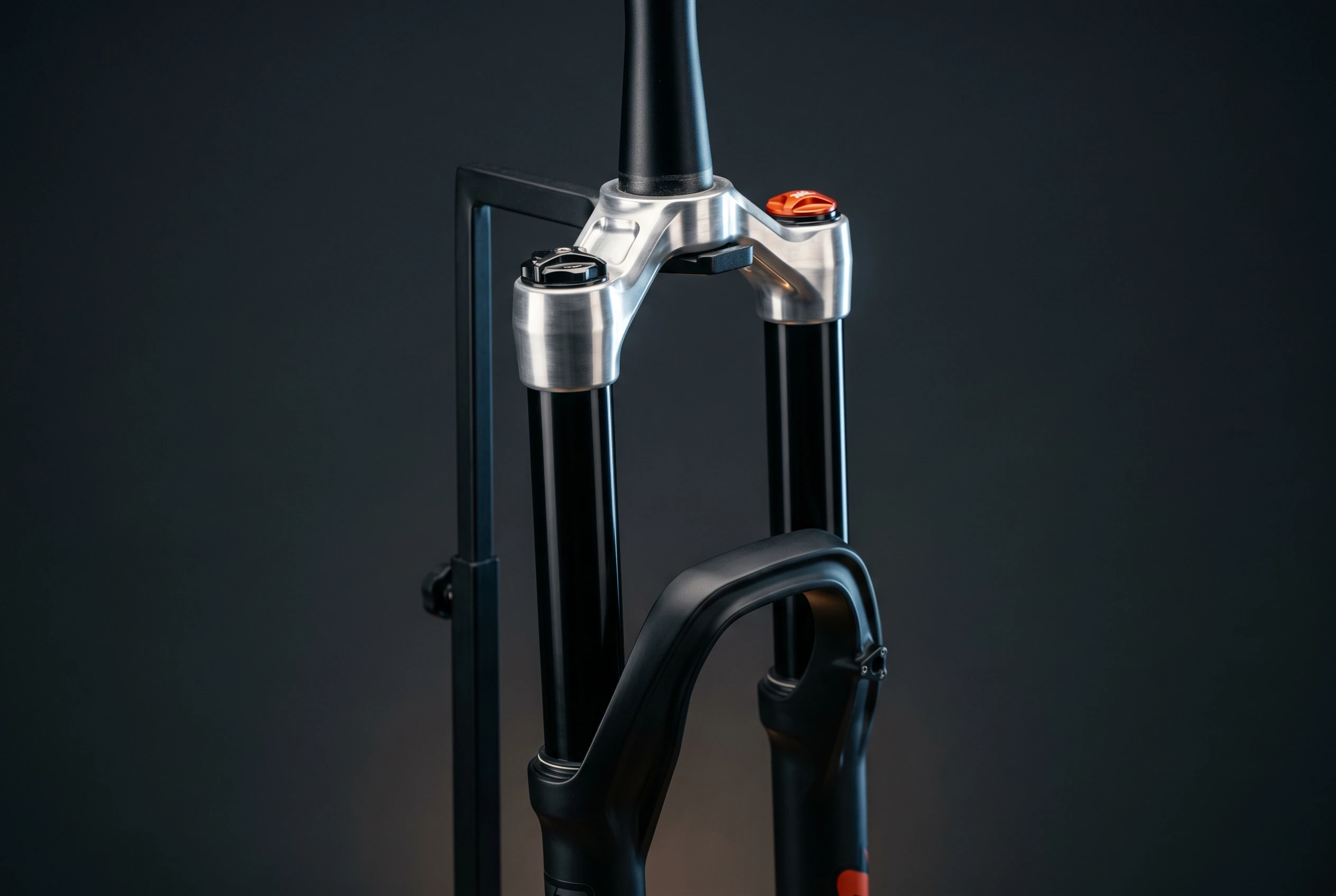
Two Chassis, Tuned for Different Bikes
Both flagships share that 37mm stanchion diameter, but Manitou now treats the Pro and LT as distinct platforms rather than two travel options on one fork.
The Pro’s crown gets post-cast machining for a slightly slimmer profile, and its stanchions are tapered with a more aggressive internal bore to shed grams. The result is a fork that is a claimed 2.1% less stiff torsionally than the outgoing Mezzer, which sounds bad on paper and is actually the point: short-travel bikes are happier with a forgiving front end, and oversprung stiffness can transmit chatter into the bars.
The LT goes the other way. Its crown is polished as forged, its stanchions are thicker-walled and parallel, and it lands 8.3% stiffer than the previous Mezzer. Manitou says the fore-aft stiffness delta between the two chassis is 9.7%, which is roughly the difference between a 36mm and a 38mm fork from a competitor.
The reverse arch is still there, and so are the 2.5mm bleed screws on the back of the lowers for topping up oil in the field. Less visible is a new piece called Micromanager Bushing Alignment, a machined aluminum spacer in the dropout that takes up any tolerance slack between the lower casting and the axle. Manitou’s argument: without it, clamping the front wheel can preload the bushings just enough to add stiction, and stiction is the enemy of the small-bump performance the Gen 2 is built around.
The Coil Inside the Air Spring
The headline mechanical change sits inside the spring leg. Air-sprung forks have always traded a slightly notchy top of stroke for the tunability and light weight that air gives you. Even premium seals add measurable breakaway force.
The Active Spring Piston is Manitou’s workaround. It is a short coil spring stacked under the air piston, so the first few millimetres of fork travel happen against the coil rather than against the air seals. The air system only engages once the coil is preloaded, which means the fork’s initial response is mechanically decoupled from the friction of an air spring’s main seal.
- Top-end suppleness comes from the coil handling the very start of the stroke without air-seal friction in the way.
- Mid-stroke support comes from the main air chamber, rebalanced to be naturally more linear than the previous Mezzer.
- Bottom-out control comes from a hydraulic bottom-out circuit that affects only the final 30mm of travel and has no external adjustment.
- Shape adjustability comes from the IRT (Infinite Rate Tuning) chamber, an independent secondary air volume that lets riders dial the ramp-up curve with a shock pump instead of internal volume spacers.
Travel is still adjustable in 10mm increments via plastic clip-on spacers, with one proprietary tool needed to unthread the air spring from the stanchion. That keeps the LT useful as a single fork across multiple bikes, which matters at a $1,199 price point.
A New Damper with High-Speed Rebound
The MC2-Pro-X damper went through nearly 70 internal iterations before Manitou settled on a production tune. The headline change for riders is the addition of high-speed rebound adjustment, a feature the previous Mezzer never had.
Adjustment ranges are:
- 8 clicks of high-speed compression
- 10 clicks of low-speed compression
- 8 clicks of high-speed rebound
- 10 clicks of low-speed rebound
The damper is still a bladder design rather than an internal floating piston, which is unusual at this travel bracket. Bladder dampers have lower breakaway force than IFP designs, which is why they show up in cross-country forks where small-bump sensitivity matters more than absolute high-speed control. They are also lighter. The drawback is cavitation at high shaft speeds, where the bladder cannot react fast enough to oil flow and the damping briefly drops out.
Manitou’s fix is a pressurized chamber wrapped around the bladder, charged through a Schrader-style valve adapter that ships with the fork. The pressure resists cavitation at the speeds where it would otherwise appear. Manitou positions the chamber as a service step rather than a daily-fiddle adjustment, which is the right call: most riders should not be touching it after the first setup. Oil flow has also been increased on both circuits, which lets the high- and low-speed adjusters work with less crossover between them.
Where It Sits Against the Fox 38 and RockShox Zeb
The Mezzer LT’s 2,220g claimed weight is competitive in a category where the measured weights of the Fox 38 and RockShox Zeb Ultimate have settled around 2,300g to 2,500g depending on configuration. The Pro at 2,030g is genuinely light for a 37mm-stanchion fork with this much adjustability.
The pitch against the incumbents is sharper than the weight. Fox and RockShox have spent the last three generations chasing chassis stiffness and stroke support; sensitivity at the top of travel has improved, but mostly through seal compounds and damper tuning. Manitou is taking a different route, treating the air spring’s breakaway friction as a problem the air system itself cannot fully solve, and putting a coil in front of it.
The competitive risk is twofold. Manitou is a smaller distribution operation than either of its rivals, which means dealer support and service-centre coverage are thinner in many regions. And the Gen 2’s bladder-plus-pressurized-chamber damper architecture, while clever, adds one more service touchpoint than a sealed IFP cartridge. Whether that matters in practice will depend on how the long-term service life shakes out.
On the Trail, Suppleness That Reads as Softness
Pinkbike’s first-ride testers ran the LT at 170mm on a Frameworks Enduro and the Pro at 160mm on a Santa Cruz Bronson. Both have been ridden in wet and dry conditions on familiar trails, which is the kind of testing that surfaces the difference between a chassis upgrade and a marketing slide.
The LT Initiates Travel With Almost No Force
The Gen 2 LT’s break-in feel is the line every Mezzer Gen 1 owner will want to read. The previous fork needed a deliberate push to start moving; the new one initiates travel as easily as anything the testers had ridden recently. The flagged risk is that riders who chased the outgoing Mezzer’s high-and-supportive feel may read the new fork as soft and immediately add pressure. Manitou’s advice, echoed by Pinkbike, is to ride with the suppleness for a few sessions before chasing perceived support, because the IRT chamber and hydraulic bottom-out together prevent the fork from giving up travel cheaply.
The Pro Tracks Roots and Wet Roundness
Mike Kazimer, riding the Pro on a Santa Cruz Bronson, noticed the small-bump traction first while climbing, where roots and rocks were disappearing under the fork in a way that initially made him check his tyre pressure. On wet descents over slick roots, the Pro had the kind of ground-hugging behaviour usually associated with coil-sprung forks. The lack of perceptible lag between tyre contact and fork compression is the on-trail signature of the Active Spring Piston, and it is the feature most likely to convert long-time Fox and RockShox riders.
Setup Pressures Are Lower Than the First Mezzer
Both testers settled on pressures below Manitou’s chart for their weights. The LT tester is running 68psi main and 106psi IRT with damper settings of LSC3, HSC3, LSR7 and HSR5 at the time of publication. Kazimer is at 55psi main and 83psi IRT on the Pro at 160 pounds, with LSC4, HSC4, HSR3 and LSR5. Both expect to creep pressures up as familiarity grows.
Quirks Worth Knowing Before You Order
The Gen 2 is not flawless, and a first ride is the right moment to flag the small annoyances before months of trail use blur them.
- Top-out clunk is audible and faintly tactile on both chassis when the fork extends fully, most noticeable on slow technical climbs and when the bike is unweighted off jumps.
- Climbing clicks from the rebound circuit are audible on both forks. Some riders will not hear them; others will find them grating on long fire-road climbs.
- Pro fork rebound skews fast across the full adjustment range. Even with both rebound dials fully closed, the Pro still extends quickly, which lighter or slower riders may find limiting.
- Service complexity sits one step above a sealed cartridge damper because of the pressurized chamber around the bladder. Home mechanics will need a shock pump and Manitou’s adapter to recharge it.
None of those are deal-breakers at the Gen 2’s price, and several may disappear with break-in or firmware-style production refinements. The top-out feel in particular is the kind of detail that brands often quietly revise within the first production run.
The Gen 2 Mezzer’s full test is still to come. Pinkbike has confirmed back-to-back rides against the current Fox 38 and RockShox Zeb generations. If the small-bump advantage holds up next to those forks on identical trails, Manitou will have done something the brand has not managed in years: pull a real performance lead, not just a value proposition, against the two companies that have owned this category since the 36 and Lyrik first showed up.


Bariatric Surgery Delivers 5x the Weight Loss of Ozempic in NYU Study

Olive Oil and Lemon Shot Every Morning: What Science Actually Shows

Wisconsin Confirms Five Mpox Cases as US Total Climbs to 535

Six Questions Sleep Researchers Use to Tell If You’re Getting Enough

ACS Adds Shield Blood Test to Colorectal Cancer Screening Guideline

New York, New Jersey Subpoena FIFA Over World Cup Ticket Pricing

Lamar Jackson Calls Ravens Coaching Change a ‘Breath of Fresh Air’

Hurricanes Shut Out Canadiens 4-0, One Win From Stanley Cup Final

Naomi Osaka’s Eiffel Tower Dress Hands Kevin Germanier a Roland Garros Runway

Donkey Kong 64 Joins Switch Online June 4 After 26-Year Wait

Mitchell Matches Kobe in Game 7 Rout, Cavaliers Reach East Finals

Shai Gilgeous-Alexander Wins Second Straight MVP With 83 of 100 First-Place Votes

Xperia 1 VIII Holds Price, Xiaomi 17 Max Loads Up: Week 20 Phone News

Colt Emerson Debuts, Mariners Get Swept by Padres in Vedder Cup

Brent at $111 Hides the Hormuz Damage Hitting Fed and Asia

Jaylen Brown Calls Stephen A. Smith the Face of Clickbait Media

Rousey Finishes Carano in 17 Seconds and Hands Netflix Its MMA Opening

LIRR Strike Hits Third Day as 250,000 Commuters Face a Tougher Manhattan Run

Nebraska Softball Tops GCU, Lands Program’s First Home Super Regional

Santa Marta’s Fossil Fuel Exit Plan Puts Scotland’s Drilling U-Turn on the Clock
-

 TECHNOLOGY3 years ago
How to Adjust a Bulova Watch Band – An Easy Guide
-

 FINANCE3 years ago
Tax Planning for Every Season: Guide to Maximizing Your Tax Benefits
-

 Education3 years ago
African Ministers New Education Plan
-

 News3 years ago
Fred Pentland: Athletic Bilbao’s English mentor who changed the essence of Spanish football
-

 BUSINESS3 years ago
What is Entrepreneurial Operating System? A Comprehensive Guide to EOS
-

 Education3 years ago
Innovate Your Learning Journey with Technology and Enhance Education
-

 News3 years ago
Russians formally out of World Athletics Championships
-

 BUSINESS3 years ago
Top 9 Most Expensive American Cities to Rent an Apartment