
BUSINESS
PJM’s Heat-Driven Demand Record Comes With a Bigger Bill
PJM’s grid hit a record 168 gigawatts in July’s heat, but capacity auctions already lock in billions in data center-driven charges through 2027.

PJM Interconnection carried a record 168.158 gigawatts of electricity on July 2, the highest load in its history and enough to break a mark that had stood since 2006. The grid operator serves 67 million people from Chicago to Washington, DC. Triple-digit heat pushed air conditioners into overdrive while Virginia’s data centers kept drawing power around the clock.
The grid held. Wind and solar covered part of the gap, and federal forecasters say PJM has enough generation for a typical summer. A bigger bill is already locked into contracts running through 2027: PJM’s capacity auctions have priced data center demand in so heavily that ratepayers across the grid’s 13-state footprint face billions of dollars in higher charges, no matter how this heat wave ends.
PJM Shatters a Record That Stood for Two Decades
The old mark, 165.6 gigawatts, dated to 2006, back before smartphones were common and years before anyone had heard of a large language model. PJM erased it by more than 2.5 gigawatts on a single July afternoon.
- 168.158 gigawatts – the new all-time peak load PJM recorded on July 2
- 165.6 gigawatts – the previous record, set in 2006 and untouched for 20 years
- 67 million – people across the PJM footprint drawing from the same grid
Wind and solar covered a meaningful share of the load that afternoon, and PJM avoided ordering rolling blackouts even as the old record fell. A second heat wave was already forming behind it, this time aimed at Texas and the central US.
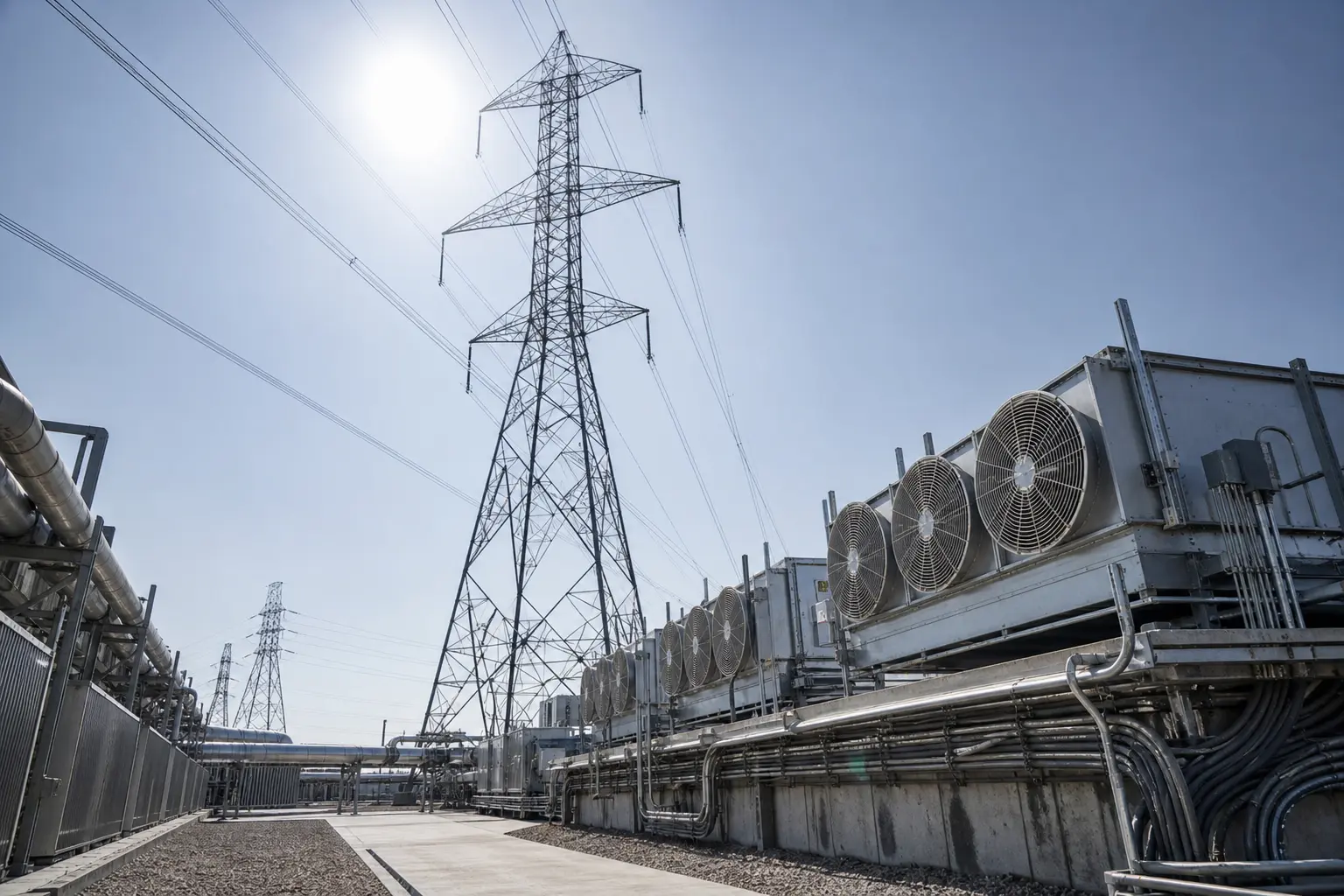
MISO and Southwest Power Pool Feel It Too
PJM was not alone. Emergency alerts cascaded across grids covering more than half the country’s 50 states in recent weeks, including the Midcontinent Independent System Operator (MISO) and the Southwest Power Pool, which run electricity systems stretching from the Midwest to the Rocky Mountains.
A fresh heat wave is now building across the western and central United States, with the Climate Prediction Center forecasting temperatures near 105F in Texas and neighboring states in the coming days.
There are expressed concerns from RTOs that we are reaching tipping points.
Timothy Fox, an analyst at ClearView Energy Partners LLC, made that assessment as regional transmission operators (RTOs), the nonprofit entities that coordinate power flows across state lines, contend with demand growth few of them planned for. The heat itself is not unprecedented. “It’s certainly not out of the ordinary to see these types of temperatures, especially in places like eastern PJM,” said Ed Vallee, a meteorologist at Atmospheric G2, who noted Washington typically tops 100F at least once every summer.
What has changed is the cushion. A grid built to absorb one bad heat day now has to do it while data centers hold their draw steady, whether or not the temperature breaks a record.
The Price Tag Already Written Into 2027
PJM does not just keep the lights on. It also runs an annual capacity auction, where power plant owners bid to guarantee supply years in advance under a price collar approved by the Federal Energy Regulatory Commission (FERC), and the clearing price gets passed to every utility customer in the footprint. That price has moved in one direction only.
| Delivery Year | Capacity Clearing Price | Change |
|---|---|---|
| 2024/2025 | $28.92 per MW-day | baseline |
| 2025/2026 | $269.92 per MW-day | up more than ninefold |
| 2026/2027 | $329.17 per MW-day | up about 22%, hit the FERC-approved cap |
PJM’s own newsroom described generators responding to the price signal by bidding more than 134,000 megawatts of resources into the most recent auction. Supply is showing up. It has not caught up yet.
How Data Centers Became PJM’s Biggest Line Item
PJM’s own market monitor traces most of that price climb to a single source. Data center demand, some of it from facilities that have not broken ground, is doing more to move the auction than any other factor.
- Data centers accounted for 63% of the price increase in the 2025/2026 auction, adding roughly $9.3 billion to what customers pay in that single year.
- In the most recent 2026/2027 auction, about $6.3 billion of the $16.4 billion total capacity bill traces back to data center load.
- Across PJM’s last four base capacity auctions combined, data centers accounted for $29.4 billion of $63.6 billion in total charges, 46% of the total.
Some of that cost is speculative. Roughly $6.2 billion is tied to data centers that have not been built yet, but could come online by the 2027/2028 delivery year starting June 1, 2027. That raises real questions about whether load forecasts are running ahead of actual construction.
Much of the physical growth is concentrated in Virginia. PJM’s own long-term forecast projects more than 20,000 megawatts of new data center load in the Dominion zone alone by 2037, and the nonprofit research group IEEFA (Institute for Energy Economics and Financial Analysis) found that projected growth could push capacity prices up by a factor of 10 over time.
Regional Grids Weren’t Designed for This Load
RTOs like PJM were built and refined during a stretch of nearly flat electricity demand that lasted roughly two decades. Efficiency gains in lighting, appliances and industry kept load growth close to zero across much of the country, and grid planners budgeted accordingly.
That era is over. Data centers built for cloud computing and artificial intelligence draw power continuously, without the seasonal dips that shaped how RTOs modeled risk. Add more frequent 100F days on top, and the models that generations of planners relied on stop describing the grid they are actually running.
The 2006 record fell to a heat wave and little else. The 2026 record fell to a heat wave stacked on a demand base that now climbs every month of the year.
What Happens When the Heat Wave Ends?
This particular summer looks manageable. The North American Electric Reliability Corporation (NERC), the industry body that oversees grid reliability across the US and Canada, said PJM, MISO and the Southwest Power Pool all have adequate resources for normal and above-normal conditions this summer. MISO actually improved from elevated to normal risk after nearly 59 gigawatts of new resources came online.
The years right after this one look tougher. NERC’s own trajectory shows PJM facing elevated resource adequacy risk from 2026 through 2028, then high risk starting in 2029. MISO moves from normal risk this year to elevated in 2027 and high risk by 2028, as new demand keeps arriving faster than new power plants can be permitted and built.
The capacity charges tied to those higher-risk years are already locked in at record prices. Utilities are already filing the rate cases that will carry those costs onto monthly bills, no blackout required.
Frequently Asked Questions
How Does a PJM Capacity Auction Affect My Electric Bill?
PJM’s capacity auction sets a price that power plant owners get paid to guarantee they will be available years ahead of time, and utilities recover that cost from customers through delivery charges on monthly bills. The 2026/2027 clearing price of $329.17 per MW-day works out to billions of dollars that utilities across the footprint will pass through over the coming delivery year.
Will Data Center Demand Keep Pushing Prices Higher After 2027?
Possibly, though not all of it is guaranteed. About $6.2 billion of the latest auction’s capacity costs are tied to data centers that have been proposed but not yet built, meaning some of that projected demand, and the prices tied to it, could shrink if projects are delayed, cancelled or scaled back before the 2027/2028 delivery year begins.
What Do PJM’s Emergency Alerts Mean for Households?
A maximum generation alert asks power plant owners and utilities to ready all available resources and calls on large customers to conserve voluntarily. It is a precaution, not a blackout warning, and PJM has issued several this summer without cutting power to homes.
How Does the 2026 Peak Compare With the 2006 Record?
The 2006 record was set on a grid running mostly on coal and gas, with negligible utility-scale solar. The 2026 peak of 168.158 gigawatts was met with meaningful help from wind and solar generation, even as the underlying demand came from a different source than before: always-on data centers rather than just afternoon air conditioning.


A Stalled Volkswagen EV Triggered a Deadly Loop 202 Pileup

ChatGPT, Gemini and Claude Traded Praise as Billions Ride on It

New Jersey Bans Surveillance Pricing After a Union Push

SpaceX Stock Sits Just $15 From a Zero Value AI Verdict

ChatGPT Health Data Skips HIPAA as Telehealth Stocks Slide

Apple Wagers Years of Delay on Smart Glasses Privacy

FDA Recall Pulls Nearly 19 Million Eggs Over Salmonella

Ubisoft’s New Far Cry Game Rides on Tencent’s Billions

PlayStation Blackout Protest Could Hit the Wrong Targets

Taylor Farms Gave Trump Allies $2 Million Before Its Recall Call

Pokémon GO Developer Niantic Rebrands as Scopely Explore

Persona 4 Revival Hands All Anime Cutscenes to Studio MAPPA

Jaylen Brown Traded to 76ers for Paul George and Four Draft Picks

Doom Studio id Software Cuts Half Its Staff in Xbox Layoffs

Nintendo Switch Online Adds Four Classics and One Japan-Only Title

Jordan Henderson Hospitalized After Wrist Injury at the Azteca

Mexico’s World Cup Run Ends at Azteca as England Hold On 3-2

Meta’s Muse Image Lets Anyone Use Your Instagram Photos in AI

Louis Vuitton Beats Molly Tea in China, Triggers Cultural Backlash

Pink Bearista Cup Returns July 13 as Starbucks Pink Vibes Drops
-

 TECHNOLOGY3 years ago
How to Adjust a Bulova Watch Band – An Easy Guide
-

 News3 years ago
Fred Pentland: Athletic Bilbao’s English mentor who changed the essence of Spanish football
-

 FINANCE3 years ago
Tax Planning for Every Season: Guide to Maximizing Your Tax Benefits
-

 Education3 years ago
African Ministers New Education Plan
-

 BUSINESS3 years ago
What is Entrepreneurial Operating System? A Comprehensive Guide to EOS
-

 Education3 years ago
Innovate Your Learning Journey with Technology and Enhance Education
-

 News3 years ago
Russians formally out of World Athletics Championships
-

 BUSINESS3 years ago
Top 9 Most Expensive American Cities to Rent an Apartment